Semicarbazide
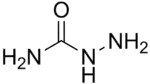
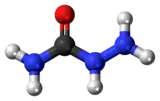
Semicarbazide is the chemical compound with the formula OC(NH2)(N2H3). It is a water-soluble white solid. It is a derivative of urea.
 | |
 | |
| Identifiers | |
|---|---|
3D model (JSmol) |
|
| ChEBI | |
| ChEMBL | |
| ChemSpider | |
| ECHA InfoCard | 100.000.308  |
| KEGG | |
PubChem CID |
|
| UNII | |
CompTox Dashboard (EPA) |
|
| |
| |
| Properties | |
| H2NNHC(=O)NH2 | |
| Molar mass | 75.08 g/mol |
| Melting point | 96 °C |
| Hazards | |
| Safety data sheet | |
| GHS labelling: | |
  | |
| Danger | |
| H301, H315, H319, H335 | |
| P261, P264, P270, P271, P280, P301+P310, P302+P352, P304+P340, P305+P351+P338, P312, P330, P332+P313, P337+P313, P362, P403+P233, P405 | |
| NFPA 704 (fire diamond) | |
Except where otherwise noted, data are given for materials in their standard state (at 25 °C [77 °F], 100 kPa). | |
 verify (what is verify (what is  ?) ?) | |
| Infobox references | |

Synthesis
The compound prepared by treating urea with hydrazine:[1]
- OC(NH2)2 + N2H4 → OC(NH2)(N2H3) + NH3
A further reaction can occur to give carbohydrazide:
- OC(NH2)(N2H3) + N2H4 → OC(N2H3)2 + NH3
Derivatives
Semicarbazide is frequently reacted with aldehydes and ketones to produce semicarbazones via a condensation reaction. This is an example of imine formation resulting from the reaction of a primary amine with a carbonyl group. The reaction is useful because semicarbazones, like oximes and 2,4-DNPs, typically have high melting points and crystallize, facilitating purification or identification of reaction products.[2]
Properties
Semicarbazide products (semicarbazones and thiosemicarbazones) are known to have an activity of antiviral, antiinfective and antineoplastic through binding to copper or iron in cells.
Drug usage
- Nitrofuran antibacterial agents: furazolidone, nitrofurazone, nitrofurantoin
- Antiphlogistic agents: dizatrifone & Metrazifone
- Antidiabetic agents: Gliclazide, Glisoxepide
- Antihemorrhagic: Carbazochrome
It is also a product of degradations of the blowing agent azodicarbonamide (ADC). Semicarbazide forms in heat-treated flour containing ADC as well as breads made from ADC-treated flour.[3] [4]
TLC
Semicarbazide is used as a detection reagent in thin layer chromatography (TLC). Semicarbazide stains α-keto acids on the TLC plate, which can then be viewed under ultraviolet light.
See also
- Biurea - the conceptual dimer
- Carbazide - structurally related with the general formula (R2NNH)2C(O)
- Semicarbazide-cadmium therapy
- thiosemicarbazide
References
- Jean-Pierre Schirmann, Paul Bourdauducq "Hydrazine" in Ullmann's Encyclopedia of Industrial Chemistry, Wiley-VCH, Weinheim, 2002. doi:10.1002/14356007.a13_177.
- John McMurry (1984). Organic Chemistry. Brooks/Cole. p. 676.
- Becalski, Adam; Lau, Benjamin; Lewis, David; Seaman, Stephen (2004). "Semicarbazide Formation in Azodicarbonamide-Treated Flour: A Model Study". J. Agric. Food Chem. 52 (18): 5730–4. doi:10.1021/jf0495385. PMID 15373416.
- Maria Beatriz de la Calle, Elke Anklam (2005). "Semicarbazide: occurrence in food products and state-of-the-art in analytical methods used for its determination". Anal. Bioanal. Chem. 382 (4): 968–977. doi:10.1007/s00216-005-3243-z. PMID 15947918. S2CID 10765283.CS1 maint: uses authors parameter (link)