Seychelles parakeet
The Seychelles parakeet or Seychelles island parrot (Psittacula wardi) is an extinct species of parrot that was endemic to the Seychelles group in the Indian Ocean. It resembled the Alexandrine parakeet, but was smaller and lacked the pink colour in its collar. The species is suspected to have become extinct due to intense persecution by farmers and coconut plantation owners.
| Seychelles parakeet | |
|---|---|
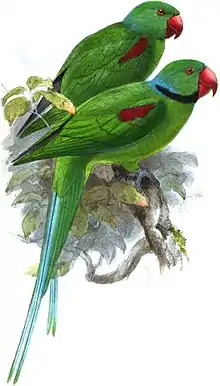 | |
| Illustration of a male (front) and female, by John Gerrard Keulemans, 1876 | |
Scientific classification  | |
| Kingdom: | Animalia |
| Phylum: | Chordata |
| Class: | Aves |
| Order: | Psittaciformes |
| Family: | Psittaculidae |
| Genus: | Psittacula |
| Species: | †P. wardi |
| Binomial name | |
| †Psittacula wardi (Newton, 1867) | |
.svg.png.webp) | |
| Location of the Seychelles | |
| Synonyms | |
| |

Taxonomy
The Seychelles parakeet was named Palaeornis wardi as by the British ornithologist Edward Newton in 1867.[2] It was endemic to Mahé and Silhouette and was once sighted on Praslin.[3][4] Ten specimens exist today.[5]
Evolution
Phylogenetic studies suggest that the species diverged from the Alexandrine parakeet through isolation of populations that dispersed through the Indian subcontinent into Seychelles about 11 million years ago when sea levels were much lower.[6][7]
The following cladogram shows the phylogenetic position of the Seychelles parakeet, according to Jackson et al., 2015:[8]
|
Kundu and colleagues, 2011:[7]
|
Podsiadlowski and colleagues, 2017:[9]
|
A 2017 study found it to be close to the Mascarene parrot.[9]
Description
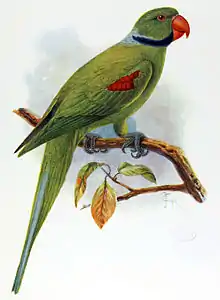
The Seychelles parakeet was about 41 cm (16.1 in) in length, with a long, pointed tail.[10] Each wing of the male measured 204–208 mm (8.0–8.2 in), the tail 184–187 mm (7.2–7.4 in), the culmen (upper surface of the beak) 33–34 mm (1.3–1.3 in), and the tarsometatarsus (lower leg bone also known as tarsus) 22 mm (0.9 in). The wing of the female measured 182–204 mm (7.2–8.0 in), the tail 200–261 mm (7.9–10.3 in), the culmen 29–34 mm (1.1–1.3 in), and the tarsometatarsus 20–22 mm (0.8–0.9 in).[11]
The male was generally green, slightly paler and more yellowish on the underparts, with the back of the head, nape, and narrow stripes on the cheeks washed with pale blue. It had a broad, black cheek-stripe (also termed a band or incomplete collar) and an obscure, narrow line from the cere (the bare patch around the nostrils) to the eye. The abdomen was yellowish green, and it had a purple-red or deep maroon patch (also termed speculum) on the wing-covert feathers. The upper side of the central tail feathers was blue with yellow tips, the tail feathers on the sides were green, and the underside of the tail was yellow. The bill was red with a yellow tip, the iris was yellowish, and the feet were grey. The female lacked the black cheek-stripe, and the immature bird was similar to the female, but with shorter tail-feathers.[12][10][11]
The preserved specimens show that the Seychelles parakeet was smaller and had shorter wings, as well as a slightly less robust bill, than the Alexandrine parakeet. While all skeletal elements of the male Alexandrine parakeet were larger than those of the male Seychelles parakeet, an x-radiograph of a female Seychelles parakeet shows that it had a larger cranium, rostrum (upper jaw), mandible, ulna (a lower wing bone), and tibiotarsus (shin bone) than the female Alexandrine parakeet, but a shorter tarsometatarsus and carpometacarpus (outermost wing or hand bone). The male Seychelles parakeet differed from the male Alexandrine parakeet in lacking a rosy collar, in that the cheeks and back of the neck were suffused with blue instead of blue-grey, in that the black band that encircled the cheeks was finer, extending to the back of the neck, and in that its underside was more yellowish. The wings and tail were shorter and broader.[5]
Behaviour and ecology
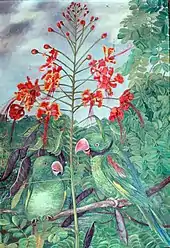
The Seychelles parakeet occurred on the Seychelles islands of Mahé and Silhouette, and based on hearsay evidence, possibly Praslin.[5] Little is known about the habits of the Seychelles parakeet, but they were presumably similar to those of the Alexandrine parakeet, which associates in groups in forests and most wooded habitats, make daily flights, at considerable heights at times, between nighttime communal roost sites and feeding areas.[11] The Seychelles parakeet lived in native forest, but as these were cleared, adapted to open, cultivated areas, and its diet included fruit. An 1820 account by the Irish surgeon James Prior stated they were "not remarkable for their imitative powers".[12]
North's little known 1894 account is the only one mentioning this species in captivity; Hume pointed out that the remarks about their "stupidity" was a reflection of their island tameness:[12]
I went one day to their house [a Doctor B and his wife], and painted their parrots, which came originally from Silhouette: queer, misshapen birds, with enormous beaks and patches of red and yellow badly put on, one of them having a black ring round its neck [male]. Both were quite helplessly bullied by common pigeons, which came and ate their food, while they jabbered in a melancholy way, and submitted. They had absolutely no tops to their heads, which perhaps accounted for their stupidity. They had a stand on the back verandah, where they slept and fed. They were not tied up, but went and stole their own fruit off the neighbouring trees.[12]
Extinction
According to Prior, the Seychelles parakeet was considered abundant in 1811, but by 1867, Newton noted it had been almost exterminated due to its taste for maize:
The ‘Cateau vert’ [P. wardi], from the constant persecution against it brought on by its unfortunate partiality for ripe maize, was said to be nearly exterminated... The cocoa-nuts are now planted more than halfway up the mountain, and it is probable that in ten years none of the native forests will remain... and here we saw the ‘Cateau vert’ at the edge of the forest, in a place some 600 or 700 feet high, where was a patch of maize; but they had been so often fired at that they would not come within shot.[12][13]
The last specimens were collected by Warry in 1881, and the last birds recorded in captivity on Silhouette in 1883. The species was extinct by 1906 when Nicoll visited the island. It seems to have been affected by the felling of forests to make way for coconut plantations, and died out as a result of being killed by farmers protecting their maize crops.[13] In 1907, Rothschild said the bird was confined to the islet of Silhouette, where it would probably become extinct.[14] The Irish ornithologist Desmond Vesey-Fitzgerald was unable to find birds in the 1930s[15], and while the American ornithologist James L. Peters speculated in 1937 that they still survived on Silhouette[16], Hume considered them unlikely to have survived past 1906.[12]
References
- BirdLife International (2012). "Psittacula wardi". IUCN Red List of Threatened Species. 2012. Retrieved 26 November 2013.
- Newton, E. (1867). "Descriptions of some new species of birds from the Seychelles islands". Proceedings of the Zoological Society of London (in Latin). 35: 315–391. doi:10.1111/j.1469-7998.1867.tb00433.x.
- Newton, E. (1876). "XXVII.-On the psittaci of the Mascarene Islands". Ibis. 18 (3): 281–289. doi:10.1111/j.1474-919X.1876.tb06925.x.
- Gaymer, R.; Blackman, R. A. A.; Dawson, P. G.; Penny, M.; Penny, C. M. (1969). "The endemic birds of Seychelles". Ibis. 111 (2): 157–176. doi:10.1111/j.1474-919X.1969.tb02524.x.
- Hume, J. P. (2007). "Reappraisal of the parrots (Aves: Psittacidae) from the Mascarene Islands, with comments on their ecology, morphology, and affinities" (PDF). Zootaxa. 1513: 5, 29–31. doi:10.11646/zootaxa.1513.1.1.
- Kundu, S.; Jones, C. G.; Prys-Jones RP; Groombridge, J. J. (2012). "The evolution of the Indian Ocean parrots (Psittaciformes): extinction, adaptive radiation and eustacy". Mol. Phylogenet. Evol. 62 (1): 296–305. doi:10.1016/j.ympev.2011.09.025. PMID 22019932.
- Kundu, S.; Jones, C. G.; Prys-Jones, R. P.; Groombridge, J. J. (2011). "The evolution of the Indian Ocean parrots (Psittaciformes): Extinction, adaptive radiation and eustacy". Molecular Phylogenetics and Evolution. 62 (1): 296–305. doi:10.1016/j.ympev.2011.09.025. PMID 22019932.
- Jackson, H.; Jones, C. G.; Agapow, P. M.; Tatayah, V.; Groombridge, J. J. (2015). "Micro-evolutionary diversification among Indian Ocean parrots: temporal and spatial changes in phylogenetic diversity as a consequence of extinction and invasion" (PDF). Ibis. 157 (3): 496–510. doi:10.1111/ibi.12275.
- Podsiadlowski, L.; Gamauf, A.; Töpfer, T. (2017). "Revising the phylogenetic position of the extinct Mascarene Parrot Mascarinus mascarin (Linnaeus 1771) (Aves: Psittaciformes: Psittacidae)". Molecular Phylogenetics and Evolution. 107: 499–502. doi:10.1016/j.ympev.2016.12.022. PMID 28017858.
- Greenway, J. C. (1967). Extinct and Vanishing Birds of the World. New York: American Committee for International Wild Life Protection. pp. 331–332. ISBN 978-0-486-21869-4.
- Forshaw, J. M. (2017). Vanished and Vanishing Parrots: Profiling Extinct and Endangered Species. CSIRO Publishing. pp. 160–162. ISBN 978-0-643-09632-5.
- Hume, J. P. (2017). Extinct Birds (2 ed.). Croydon: Bloomsbury Natural History. pp. 199–200. ISBN 978-1-4729-3744-5.
- Newton, E. (1867). "On the land-birds of the Seychelles archipelago". Ibis. 9 (3): 335–360. doi:10.1111/j.1474-919X.1867.tb06435.x.
- Rothschild, W. (1907). Extinct Birds. London: Hutchinson & Co. p. 66.
- Vesey-Fitzgerald, D. (1940). "XXV.- The Birds of the Seychelles.- I. The Endemic Birds". Ibis. 82 (3): 480–504. doi:10.1111/j.1474-919X.1940.tb01669.x.
- Peters, J. L. (1937). Check-list of birds of the world. 3. Cambridge: Harvard University Press. p. 242. doi:10.5962/bhl.title.14581.