Head covering for Jewish women
According to halacha (Jewish law), married Jewish women are expected to cover their hair when in the presence of men other than close family members. Such covering is common practice nowadays among Orthodox Jewish women.

Different kinds of head covering are used, among them the sheitel (wig), mitpaḥat or tichel (headscarf), shpitzel, hat, and snood. The most common hair coverings in the Haredi community are the sheitel, the snood, and the tichel, as well as hats and berets. Modern Orthodox Jewish women usually wear hats, berets, baseball caps, bandanas, or scarves tied in a number of ways, depending on how casually they are dressed.
Covering the hair is part of the modesty-related dress standard called tzniut.
Laws
According to Jewish law (halacha), a woman must cover her hair after marriage.[1][2]
According to the Talmud, this is a biblical requirement,[3][4] which in this context is called Dat Moshe (the Law of Moses).[5][6]
After the wedding ceremony, Orthodox Jews believe that a woman should only show her hair to her husband.[7] According to the Mishnah in Ketuboth (7:6), hair covering is not an obligation of biblical origin, but is highly advised as we see in Genesis 24:64-65, Isaiah 47:2, and Song of Songs 4:1. It discusses behaviors that are grounds for divorce such as, "appearing in public with loose hair, weaving in the marketplace, and talking to any man", and calls these violations of Dat Yehudit, which means Jewish rule, as opposed to Dat Moshe, Mosaic rule. However, the Talmud on this Mishna explains that if the hair is completely uncovered in public, this would indeed be a violation of "Dat Moshe", and the Mishna is referring to one who cover her hair with a netlike covering where hair is visible through the holes, as in this case the Biblical requirement is met, but not the "Dat Yehudit".[8] This categorization suggests that hair covering is not an absolute obligation originating from Moses at Sinai, but, rather, is a standard of modesty that was defined by the Jewish community.
In Berakhot 24a, the rabbis define hair as sexually erotic (ervah), and prohibit men from praying in sight of a woman's hair. The rabbis base this estimation on a biblical verse: "Your hair is like a flock of goats" (Song of Songs 4:1), suggesting that this praise reflects the sensual nature of hair.[9]
Conservative and Reform Judaism do not generally require women to wear head coverings. Some more traditional Conservative synagogues may ask that married women cover their heads during services. However, some more liberal Conservative synagogues suggest that women, married or not, wear head-coverings similar to those worn by men (the kippah/yarmulke); and some require it (or require it only for women receiving honors or leading services from the bimah) – not for modesty, but as a feminist gesture of egalitarianism.
Unmarried women
In Yemen, unmarried girls covered their hair like their Muslim peers;[10] however, upon Yemeni Jews' emigration to Israel and other places, this custom has been abandoned. While Rebbe Aharon Roth praised this custom, no Ashkenazi community – including the most strict Haredi circles – has ever practiced such a custom.[11]
Sheitel

Sheitel (Yiddish: שייטל, sheytl m.sg.; שייטלעך, sheytlekh m.pl. or שייטלען, sheytlen m.pl.) is a wig or half-wig. The related term in Hebrew is pei'ah (פאה) or pei'ah nochrit (פאה נוכרית).[12]
Traditional sheitels are secured by elastic caps, and are often designed with heavy bangs to obscure the hairline of their wearers. More modern lace-front wigs with realistic hairlines or real hair are growing in popularity.[12]
Some modern Orthodox women cover their hair with wigs. A style of half wig known as a "fall" has become increasingly common in some segments of Modern and Haredi Orthodox communities. It is worn with either a hat or a headband.
Acceptability
The practice of covering hair with wigs is debated among halakhic authorities. Many authorities, including Rabbi Moshe Feinstein,[13] permitted it, and the Lubavitcher Rebbe actively encouraged it,[14] while many other authorities, especially Sephardi rabbis, forbid it. Some Hasidic groups encourage sheitels, while others avoid them.[15] In many Hasidic groups, sheitels are avoided, as they can give the impression that the wearer's head is uncovered. In other Hasidic groups, women wear some type of covering over the sheitel to avoid this misconception, for example a scarf or a hat. Married Sephardi and National Religious women do not wear wigs, because their rabbis believe that wigs are insufficiently modest, and that other head coverings, such as a scarf (tichel), a snood, a beret, or a hat, are more suitable. In stark contrast, the Chabad rebbe, Menachem Mendel Schneerson, encouraged all married Jewish women to wear sheitels, though in Torat Menachem, he writes that in fact, "if she can cover her hair with a scarf, it is definitely good if she would do so, but in reality, we know that this doesn't happen."[15][16]
In 2004, there was a degree of controversy over natural hair sheitels procured from India. It was discovered that the hair used for the production of these wigs was taken from a Hindu temple. According to Jewish law, one cannot derive benefit from anything used in practices considered to be idolatry. Today, many wigs used by Jewish women come with a hechsher (kosher certification), indicating that they are not made with hair originating from rituals deemed to be idolatrous.[17]
Mitpaḥat
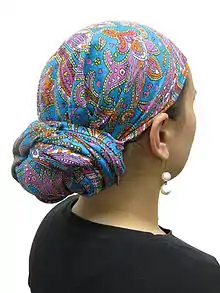
Mitpaḥat (Hebrew: מִטפַּחַת miṭpaḥat), also called a tichel (Yiddish: טיכל tikhl), is the headscarf worn covering the hair.[18] Mitpaḥot can range from a plain scarf of any material worn over the hair to elaborate head coverings using multiple fabrics and tying techniques.
In the times of Ibn Ezra (1089-1167), Mitpahat was referred to as Pe'ar, or Pe'arim in the plural, as in Isaiah 3:20. This word directly means "head-dress, ornament, or turban". Ibn Ezra states in his commentary on Numbers that the custom of covering was the same between both Jewish women and Muslim women.
Etymology
The word Mitpaḥat is a Hebrew word which literally means a covering or mantle, though is also used to mean many other things such as towel, apron, bandage, or wrap. Its current meaning is taken from post-biblical Hebrew, and is most likely derived from the Hebrew word טִפַּח (tipaḥ) meaning spread out or extended.[19]
The Yiddish word tichel is the diminutive of tuch ("cloth"). Compare German Tuch ("cloth"), and the corresponding Bavarian diminutive Tiachal, Tücherl ("small piece of cloth").
Shpitzel

A shpitzel (Yiddish: שפּיצל) is a head covering worn by some married Hasidic women. It is a partial wig that only has hair in the front, the rest typically covered by a small pillbox hat or a headscarf.[20] The hairpiece may actually be silk or lace, or else made of synthetic fibers, to avoid too closely resembling real hair.[21] The shpitzel was popular among Hungarian Hasidim in the 19th century, and it is worn by some contemporary women who follow the customs of that community.
Etymology
The Yiddish word "Shpitzel" is related to the grammatical diminutive of the high-German word "Spitze" which can either mean "point" or "lace"; the latter translation is most likely the right one in the context of this article.
The term shpitzel may also be used to refer to the ends of a loaf of bread in some dialects.[22] In this case, the above-mentioned translation "Spitze" = (end)point/peak is applicable, with its High German grammatical diminutive "Spitzchen".
References
- Shulchan Aruch, Even Ha'ezer 115, 4; Orach Chayim 75,2; Even Ha'ezer 21, 2
- Schiller, Mayer. "The Obligation of Married Women to Cover Their Hair". JHCS 30, 1995, 81–108.
- Ketubot 72a, bottom of the page
- Yakov Yitzchak Fuks (1989). Halichot Bat Yisrael (in Hebrew). Jerusalem.
- Maimonides, Mishneh Torah Ishut 24:9
- Shulchan Aruch, Even Ha'ezer 115, 4 in Beit Shmu'el
- All about Orthodox Jewish women
- Kesubot 72a-72b
- Brachot 24a
- "Dress Codes: Revealing the Jewish Wardrobe" Archived 3 July 2014 at the Wayback Machine, An exhibition focusing on this collection was presented at the Israel Museum, Jerusalem 11 March 2014 – 18 October 2014
- Sefer Shomer Emunim, Rav Aharon Roth zt"l
- Sherman, Julia (November 17, 2010). "She goes covered".
- Rav Moshe Feinstein (29 October 2007). Igros Moshe, Even HaEzer chelek 2, siman 12.
- All over his published correspondence
- Letters on the importance of wearing a sheitel from the Lubavitcher Rebbe
- "Torat Menachem תשי"ד P. 189-190"
- hair sources and background. "Kosher Wigs". prweb.com. Retrieved August 17, 2013.
- Encyclopedia of Judaism: Tichel
- Klein, Ernest (1987). A Comprehensive Etymological Dictionary Of The Hebrew Language. Jerusalem: Carta Jerusalem. ISBN 965220093X.
- Hella Winston (15 November 2006). Unchosen: The Hidden Lives of Hasidic Rebels. Beacon Press. pp. 21, 181. ISBN 978-0-8070-3627-3. Retrieved 13 January 2013.
- Elbinger, Naomi (18 December 2011). "The Tichel: A Short History of Headcovering Fashion". MavenMall Blog. Archived from the original on 2013-03-08. Retrieved 8 March 2013.
- Vaux, Bert. "Dialect Survey: What do you call the end of a loaf of bread?". Retrieved January 13, 2013.
