Shimamono
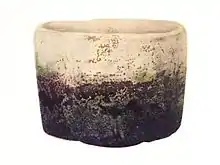
Shimamono (島物 "island objects") is a generic term for Japanese tea utensils produced outside Japan, Korea and China, mainly from Southeast Asia.
History
Items from Korea are referred to as kōraimono (高麗物) and from China called karamono (唐物) are not considered shimamono.
They were imported with ships on trade routes and started becoming popular in the 15th and 16th centuries. The term therefore can be taken literally to mean "island objects". By the time of the rule of the Shōgun Tokugawa Yoshimune, imitation shimamono were also produced in Japan. However, at this point they were called "striped objects", but the pronunciation remained the same.[1] As such they can be counted as part of Japanese pottery and porcelain.
The treatise Tōkikō describes the Japanese pottery trade with Asia and gives detailed descriptions.[2]
Types
| Name | Kanji | Origins | Notes | Example image |
|---|---|---|---|---|
| Rusun ware | 呂宋焼 | Luzon | Pottery items. The merchant Ruson Sukezaemon (呂宋助左衛門) was particularly connected to the trade in Rusun ware during the rule of Toyotomi Hideyoshi in the 16th century.[3][4][5] Grouped together with Mishima ware | [6] |
| Annan ware | 安南焼 | Annam | Often blue and white pottery that was later developed in Japan also in red and green colours. | .jpg.webp) |
| Nanban ware | 南蛮焼 | Southeast Asia | Items from southeast Asia without exact provenience | .jpg.webp) [7][8][9] [7][8][9] |
| Amakawa | アマカワ | unidentified location | white clay and grayish glaze. Grouped together with Mishima ware | |
| Mōru / Mo-ru | モウル / モール | Moluccas | [10] | |
| Tō Indu / Tenji | 東インドゥ | eastern India | ||
| Kōchi ware | 交趾焼 | southern China | developed from Cochin ware from southern China. Generally in colours yellow, green and blue. | .jpg.webp) |
| Nekoro | ネコロ | Nicobar Islands | ||
| Taiwan | 臺灣 | Taiwan | Grouped together with Mishima ware | |
| Hannera | ハンネラ | Southeast Asia | a type of simple unglazed ware, often reddish or orange in colour | 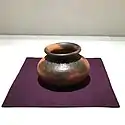 [11] [11] |
| Kinma | 蒟醤 | Siam or Burma | a style of lacquer ware with finely inlaid patterns | 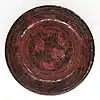 [12] [12] |
| Koma | 独楽 | Siam | lacquerware, called "spinning top" (koma) because the colours are painted in concentrical rotating patterns | 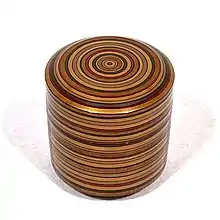 [13] [13] |
| Sahari | 砂張 | Southeast Asia | Is a general term for metalware, specifically an alloy mainly made of copper containing a small amount of silver and lead, mainly adding tin from southeast Asia origin. It appeared from the end of the Muromachi perdiod until the Momoyama period. The products were initially not made as tea utensils, but found entry through tea masters.[14] | [15][16] |
See also
References
- "Chinese Pottery in the Philippines". Field Museum of NaturalHistory. 1912.
- "Chinese Pottery in the Philippines". Field Museum of NaturalHistory. 1912.
- Manansala, Paul Kekai (October 2006). Quests of the Dragon and Bird Clan. ISBN 9781430308997.
- sambali.blogspot.com/2006/09/luzon-jars-glossary.html
- http://photos1.blogger.com/blogger/6514/3214/1600/Kyoto%20002.jpg
- "褐釉四耳壺(呂宋壺)".
- "常設展示:畠田光枝 南蛮焼締壺".
- "石川隆児さんの南蛮焼締め碗".
- http://utsuwa-shoken.shop-pro.jp/?pid=115520126
- https://seiyudo.ocnk.net/product/4708
- "ハンネラ建水 - Miho Museum".
- "Kimma - Lacquerwares of Thailand".
- https://mingeiarts.com/product/vintage-japanese-tea-ceremony-chu-natsume-kagawa-lacquer-tea-caddy-1940s/
- https://www.gotoh-museum.or.jp/2020/10/07/02-098/
- "C0077196 砂張袋形建水 - 東京国立博物館 画像検索".
- http://www.gotoh-museum.or.jp/collection/col_05/02098_001.html
Literature
 Media related to Shimamono at Wikimedia Commons
 | Ancient pottery | 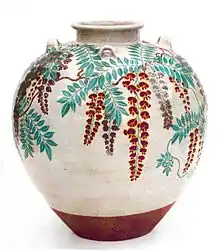 | |
|---|---|---|---|
| Ceramics |
| ||
| Porcelain | |||
| Glazes | |||
| Gold applications | |||
| Objects | |||