Siege of Fort St. Philip (1815)
The Siege of Fort St. Philip was a battle taking place during the ending of the War of 1812 between a sizable British naval fleet attempting to sail the Mississippi River by force in order to provide reinforcements to British forces already attacking New Orleans as part of the Louisiana Campaign, and the single American garrison of Fort St. Philip guarded by a far numerically-inferior force. The siege lasted from January 9 to January 18, 1815.
| Siege of Fort St. Philip | |||||||
|---|---|---|---|---|---|---|---|
| Part of battle of New Orleans and War of 1812 | |||||||
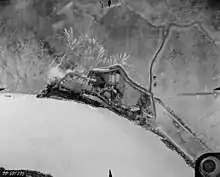
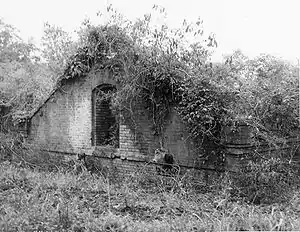 Fort St. Philip, overgrown in the mid 20th century | |||||||
| |||||||
| Belligerents | |||||||
 United Kingdom United Kingdom |
.svg.png.webp) United States United States | ||||||
| Commanders and leaders | |||||||
|
Unknown |
Walter H. Overton | ||||||
| Strength | |||||||
|
1 sloop-of-war 1 brig-of-war 1 schooner 2 bomb vessels[1][2] 2 bumboats[3] |
163 infantry 84 militia 40 sailors 117 gunners 35 artillery pieces 1 fort 1 gunboat Total: 406 | ||||||
| Casualties and losses | |||||||
|
1 bomb vessel damaged Unknown armed boats damaged |
2 killed 7 wounded 1 fort damaged[4] | ||||||
Background
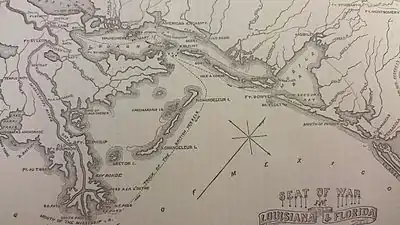
The Royal Navy had begun the Louisiana Campaign to capture New Orleans. However, to reach New Orleans, the destruction of the small U.S. Navy squadron in the area and the U.S. Army forts and batteries was necessary. Fort St. Philip, an irregular work guarding the Mississippi River, the body of a parallelogram,[6] was one of the said forts.
The fort mounted twenty-nine 24-pound cannons, a 6-pound cannon, eight 5.5-inch howitzers and a 13-inch mortar. Thirty-five pieces in all were used. Additionally, two 32-pound cannons were mounted on a level with the water, in a covert way.[7] A US Navy gunboat lay offshore.[8][9]
In October 1814 the gunners repaired the worn-out U.S. artillery carriages and moved some to other batteries in the fort. The Americans built a signal station three miles below the installation and an earthen redoubt to defend the fort's rear side. In addition to mounting a battery for a mortar in the fort, it was suggested to construct a battery on the opposite side of the Mississippi, which would support the aforementioned two 32-pound cannons; the defence of both sides of that passage of the river being complete. [7]
Whilst overseeing the defences in December, General Jackson ordered the construction of a battery on the other side of the river, besides increasing the strength of the fort with a mortar battery.[10] The riverside battery was not finished though by the time the British flotilla arrived and was abandoned during the engagement. Major Latour of the US Corps of Engineers was involved with the improvement of the fort's defences, but was not here during this engagement, being resident at New Orleans, and participating in the fighting there.[11][12][13] Jackson was to appoint Major Walter Overton as commander of the fort on December 15.[14]
They also erected overhead cover above the fort's gun batteries to prevent shell fragments from hitting the gun-crews. They destroyed the old powder magazine, replacing it with several additional magazines that they built, which had wood and dirt piled on top to protect them. The idea being that if one powder magazine was destroyed, the others would still be usable.[15]
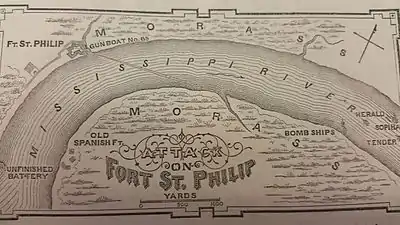
It took the British vessels from December 30th to January 9th to work the forty miles up the Mississippi to the fort, by warping and hard towing to the Plaquesmines Bend, just below the fort.[16] On January 1, 1815, Major Overton was warned of an approaching British flotilla.[17] The Americans had 163 infantry, 84 white and freed African-American militia and 117 artillery men to man the fort's armaments.[18] The British flotilla consisted of the sloop-of-war HMS Herald (18 guns), the brig-of-war HMS Thistle (12 guns), the schooner HMS Pigmy (10 guns), and two bomb vessels, HMS Aetna and HMS Volcano.[19][20]These boats had originally been accompanied by the fifth rate HMS Nymphe,[1] but it was too large to traverse the shallow waters of the Mississippi. [lower-alpha 1] These vessels had previously been present at the Battle of Lake Borgne.[22] The vessels provided armed longboats, armed barges, launches, and armed gigs.
Siege
The five British boat types were visible, and clearly identified, at 10:15am. [3] At 11:30am and 12:30pm, two bumboats advanced to a distance within a mile and a half of the fort, to take soundings of the river bottom. This prompted the fort's shore battery to open fire. [23] Although they drove the bumboats back, the artillerymen had revealed the maximum range of their cannons.[9][24]
With Major Walter H. Overton in command of the American forces, and Admiral Cochrane leading the British, the siege of Fort St. Philip began at midday on January 9, 1815 when the Royal Navy approached the fort, formed a line of battle and made preparations for a bombardment. Immediately the fort's furnace was lit for hot shot,[8] burning red cannonballs that can have a devastating effect against warships.
At 1:00 pm, the signal station was abandoned and partially burned by the Americans who wanted to leave nothing for a fast-approaching British shore party. The men made it to their fort and the signal station fell into enemy hands.[8] The preparations for a naval bombardment continued. At about 3:00 pm, the British sent a number of their boats forward to discover the strength of Fort St. Philip.
At 2:00pm on January 9, a British landing party, of unknown size, soon captured and occupied the signal station and other areas around the land side of Fort St. Philip.[8] This action effectively cut off the American land supply and communication lines.
Two of the fort's batteries fired a salvo, hitting at least one of the longboats; this quickly forced the British to abandon their effort but not before the British learned of the American artillery strength on the riverside of the fort. St. Philip's riverside strength forced the larger UK vessels to stay out of range. Enabling the British only to fire their broadsides at great distances, around 3,960 yards from the American positions.
After learning of the American strength, the British commenced their bombardment at about 3:30 pm. The first shell fell too short and the second exploded over the fort. One shell fell every two minutes according to Latour, but this is not corroborated by the U.S. commander.[25] The bombardment lasted all day and night of January 9. During the first day of battle, no Americans became casualties.[25]
Due to the wet terrain from rain during most of the battle, a large quantity of the British cannonballs and shells slammed into the ground, buried themselves, and failed to explode. Some shells exploded underground but had no effect on the American troops above the surface. That same night, the British armed boats returned in strength, firing several rounds of grape and round shot into the fort.[25]
The British force was reportedly so close to the fort that the Americans could hear the British officers shouting commands at their men. This close range allowed some of the American infantry to fire their small arms on the easy targets sitting in their boats. The Americans, believing this to be a British trick to distract their gunners and subsequently allow the British fleet to pass the fort, were ordered to not fire a shot from their heavy weapons.
.jpg.webp)
The British feint failed to distract the Americans, so the boats withdrew for the night but the British continued to bombard the fort at long range.[25] The next day, the siege continued with the British occasionally advancing their boats to fire on the Americans. One bombardment at 12:00 am for two hours and another advance and bombardment at sundown for two more hours.[26]
On the third day, January 11, shrapnel struck the American flag post, nailing the halyards to the mast.[25] The flag was removed for an hour which possibly made the British think the Americans were surrendering. The flag was repaired and replaced on the flag pole, an hour after lowering, by an American sailor who braved the British bombardment by climbing up the mast and securing the flag while shots burst overhead. The sailor completed this without injury.[26]
At 12:00 am and sunset the British boats moved forward again and attacked. This pattern of British boat attacks continued for the remainder of the siege. Other than the first longboat attack, the American batteries fired on all of the other enemy longboat advances. Most of the battery's shots fell too short.[26]
The evening of January 11, the Royal Navy bombarded the fort's store house, thinking it to be the powder magazine. Several shells passed straight through the store house; two exploded within it, killing one man and wounding another. The real powder magazines escaped harm with the exception of the main magazine which suffered some minor damage but failed to explode.[26]
Realizing that their weapons were not very effective during the first few days of battle, on January 14, the British re-fused all of their shells to explode over the fort, in order to shower the garrison with shards of burning hot metal. The shells thus were more efficient and the Americans sustained another death and a few more wounded. The shells also damaged several of the fort's gun carriages.[27]
The British shells managed to silence one of the two American 32-pounders, but only for an hour before repairs were completed.[27] On this night, still the 14th, several British shells struck the blacksmith's shop, damaging it severely. By the night of January 15, the United States garrison constructed more adequate defenses around their batteries from stockpiles of wood which were being brought into the fort from the nearby forest.[27]
The powder magazines were also reinforced by another layer of dirt. At some point one of the British bomb vessels came within range and was struck by an American mortar shell which put the boat out of action for five minutes. On the morning of the 16th, almost constant rain had left the interior of the fort underwater, making it similar to a livestock pond. All of the garrison's tents were ripped up from shell fragments though they were unoccupied.[28]
That same day, a U.S. supply boat arrived at the fort, located 65 miles downriver from New Orleans, carrying ammunition and fuses.[28] This helped morale of the Americans, who were now in a better form for defense than when the battle began. The fighting continued during the night of the January 17 and just before daylight on the 18th; several shells were lodged in Fort St. Philip's parapet; one burst passing through a ditch and into the center bastion. These were the last shots the Americans received.[28][29]
Throughout the rest of the day, the British remained in view of the fort but did not fire again. They withdrew their landing force and on January 19, 1815 the British abandoned their attempt to destroy the fort by sailing away to find an alternate waterway to New Orleans. After learning of the British defeat at the city, the Royal Navy canceled their cruise to reinforce their already defeated army.
Aftermath
The siege of Fort St. Philip ended with an American victory due to the British failure to pass the fort in order to reinforce the British army at New Orleans. The siege provided Andrew Jackson with valuable time to re-deploy his forces for another possible British invasion. Whilst the engagement appeared to have served no useful purpose to the British, it could be said it made a valuable contribution to the escape of Lambert's army elsewhere.[30][31] In a despatch sent to the Secretary of War, dated January 19, Jackson states 'I am strengthened not only by [the defeat of the British at New Orleans]... but by the failure of his fleet to pass fort St. Philip.'[32] The part played by Acting Lieutenant (navy) Cunningham was mentioned in the despatch of Master Commandant Daniel Patterson to the Secretary of the Navy dated 27 January.[33] The engagement is briefly mentioned in Roosevelt's naval history of the conflict.[34]
Only two Americans were killed and seven were wounded while sustaining severe damage to their fort.[35] Neither the name of the commander, nor if the British had suffered casualties were recorded in contemporary sources,[36][lower-alpha 2] but one bomb vessel and several small boats were damaged. Well over 1,000 British shots were fired,[38] estimated by Latour to be seventy tons of munitions.[39] After the siege ended, the Americans discovered that over 100 enemy shells lay buried within the fort, unexploded. Nearly all of the buildings were in ruins and the ground for a half mile around the fort was littered with bomb craters.[40][41]
Three currently active Regular Army battalions (1-5 FA, 1-1 Inf and 2-1 Inf) perpetuate the lineages of two American units (Wollstonecraft's Company, Corps of Artillery, and the old 7th Infantry) that were present at Fort St. Philip during the bombardment.
Notes and citations
Notes
- William James, comments on the geography, with the benefit of hindsight. 'But the flatness of the coast is everywhere unfavourable for the debarkation of troops and they bays and inlets being all obstructed by shoals or bars, no landing can be effected, but by boats, except up the Mississippi; and that has a bar at its mouth, which shoals to 13 or 14 feet water.'[21]
- The Royal Marine Artillery was created with the express intention of mortars on bomb vessels being crewed by gunners under the control of the Royal Navy and not the British Army. When the definitive history of the Royal Marine Artillery was being written in the 1930s, this engagement was considered to be worthy of a mention as it was the last time in the conflict that exploding bomb shells were fired from a bomb vessel. Wishing to know more about the shell expenditure, they consulted the log of HMS Volcano, and this is quoted in the unit history. It is the only British eyewitness account to have been published in a printed book. Other than ship logs, there appear to be no other records.[37]
Citations
- Letter from Cochrane to the Admiralty dated January 18, reproduced in "No. 16991". The London Gazette. 9 March 1815. pp. 449–451. stating 'I have not yet received any official report from the Captain of the Nymphe, which ship with the [other] vessels [Herald, Aetna, Volcano, Thistle, Pigmy] were sent into the Mississippi to create a diversion in that quarter.'
- James (1818), p. 387 'Of the six vessels ordered up the Mississippi to bombard Fort-St. Philip, the Herald, two bomb vessels, and Thistle and Pigmy only could ascend the river.'
- "Letter from Major Overton to Major General Jackson dated January 19th, 1815". Niles's Weekly Register. 8. pp. 58–59.
On the 9th at a quarter past 10am hove in sight two bomb-vessels, one sloop, one brig and one schooner... and at half past twelve they advanced two barges
- "A list of the killed and wounded". Niles's Weekly Register. 8. p. 59.
- Lossing, Benson (1868). The Pictorial Field-Book of the War of 1812. Harper & Brothers, Publishers. p. 1051.
- Latour 1816, p. 187.
- Latour 1816, p. 188.
- Latour 1816, p. 190.
- Stoltz 2014, p. 40.
- James 1818, p. 348.
- Latour 1816, p. 54.
- Latour, p.55 'On his return to New Orleans [from visiting the fort on December 3], the general ordered me to draw out the necessary plans for these two batteries.'
- Latour 1816, p. xlvii.
- Latour 1816, p. 189.
- "Letter from Major Overton to Major General Jackson dated January 19th, 1815". Niles's Weekly Register. 8. p. 58.
I erected small magazines in different parts of the garrison, that if one blew up I could resort to another; built covers for my men to secure them from the explosion of the shells, and removed the combustible matter within the works.
- Fraser & Carr-Laughton (1930), p. 295.
- "Letter from Major Overton to Major General Jackson dated January 19th, 1815". Niles's Weekly Register. 8. p. 59.
On the first of this present month I received the information that the enemy intended passing this fort to co-operate with their land forces in the subjugation of Louisiana, and the destruction of New Orleans.
- Latour 1816, p. 191.
- "Royal Marines on the Gulf Coast". Retrieved 3 June 2014.
Extracted information from the log of HMS Volcano
- Marshall (1830), p.38. 'The Volcano formed part of the naval detachment sent up the Mississipi, to bombard fort St. Philip, and create a diversion in that quarter; on which service [as commander of the Volcano] Price remained, with his mortars almost constantly in play, until the retreat of the British army. He then proceeded to Mobile bay, and there again distinguished himself by his zeal and activity, in the command of a division of boats, during the siege of fort Bowyer.'
- James 1818, p. 347.
- Announcement that a bounty was payable to the vessels listed, who took part in the Battle of Lake Borgne, contained within "No. 17730". The London Gazette. 28 July 1821. p. 1561.
- "Letter from Major Overton to Major General Jackson dated January 19th, 1815". Niles's Weekly Register. 8. p. 58.
They advanced two barges, apparently for the purpose of sounding within one and a half miles of the fort.
- "Letter from Major Overton to Major General Jackson dated January 19th, 1815". Niles's Weekly Register. 8. pp. 58–59.
They anchored two and one quarter miles below [the fort]... To my great mortification I found they were without the effective range of my shot, as many subsequent experiments proved....The only thing to be regretted [by ending the 10 day battle] is that the enemy was too timid to give us an opportunity of destroying him.
- Latour 1816, p. 192.
- Latour 1816, p. 193.
- Latour 1816, p. 194.
- Latour 1816, p. 195.
- "Letter from Major Overton to Major General Jackson dated January 19th, 1815". Niles's Weekly Register. 8. p. 59.
On the 17th in the evening our heavy mortar was said to be in readiness. I ordered... to open a fire, which was done with great effect, as the enemy from that moment became disordered, and at daylight on the 18th commenced their retreat.
- Reilly 1974, pp. 312–313.
- Brown 1969, p. 160.
- James 1818, pp. 459–460.
- Brannan, pp.461-463, contains despatch from Hayne to Jackson dated January 10. 'Acting lieutenant Thomas S. Cunningham, commanding gun vessel No.65, stationed at fort Saint Philip, solicited and obtained the command of two 32 pounders, which are mounted in the most exposed situation at that fort, being outside the falls, which he manned with his crew and rendered great service to the officer commanding at that post, during the heavy bombardment by the enemy from the 8th to the 17th instant.'
- Roosevelt (1900), p.237 ' At the same time [as the British Army's withdrawal from New Orleans], a squadron of vessels, which had been unsuccessfully bombarding Fort Saint Philip for a week or two, and had been finally driven off when the fort got [the ammunition for] a mortar large enough to reach them with, also returned; and the whole fleet [thereafter] set sail for Mobile.'
- "A list of the killed and wounded". Niles's Weekly Register. 8. p. 59.
- James (1818), p. 387 'We have no British account to compare it with, or from which to state our loss on the occasion.'
- Fraser & Carr-Laughton (1930), p. 294-296.
- "Letter from Major Overton to Major General Jackson dated January 19th, 1815". Niles's Weekly Register. 8. pp. 58–59.
- Latour 1816, p. 196.
- "Letter from Major Overton to Major General Jackson dated January 19th, 1815". Niles's Weekly Register. 8. p. 59.
The enemy left scarcely ten feet of this garrison untouched.
- Latour 1816, p. 197.
References
- "National Register Information System". National Register of Historic Places. National Park Service. July 9, 2010.
- a b c d "Fort St. Philip". National Historic Landmark summary listing. National Park Service. https://web.archive.org/web/20110308014818/http://tps.cr.nps.gov/nhl/detail.cfm?ResourceId=261&ResourceType=Structure. Retrieved 2008-02-01.
- Brannan, John (ed.). Official letters of the military and naval officers of the United States : during the war with Great Britain in the years 1812, 13, 14, & 15. Washington, D.C.: Way & Gideon. OCLC 1083481275.
- Brown, Wilburt S (1969). The Amphibious Campaign for West Florida and Louisiana, 1814–1815. Tuscaloosa: University of Alabama Press. ISBN 0-8173-5100-0.
- Fraser, Edward; Carr-Laughton, L. G. (1930). The Royal Marine Artillery 1804-1923, Volume 1 [1804-1859]. London: The Royal United Services Institution. OCLC 4986867.
- Patricia Heintzelman (1978), National Register of Historic Places Inventory-Nomination: Fort St. PhilipPDF (506 KiB), National Park Service]|32 KB and Accompanying 6 photos, aerial photos from 1935 and others, undated. PDF (1.45 MiB)
- James, William (1818), A full and correct account of the military occurrences of the late war between Great Britain and the United States of America; with an appendix, and plates. Volume II, London: Printed for the author and distributed by Black et al., OCLC 2226903
- Latour, Arsène Lacarrière (1816), Historical Memoir of the War in West Florida and Louisiana in 1814–15, with an Atlas, Translated from French into English by H.P. Nugent, Philadelphia: John Conrad and Co, OCLC 40119875
- Marshall, John (1830). . Royal Naval Biography. sup, part 4. London: Longman and company. p. 38.
- Reilly, Robin (1974), The British at the gates – the New Orleans campaign in the War of 1812, New York: Putnam, OCLC 839952
- Roosevelt, Theodore (1900). The Naval War of 1812. II. Annapolis: Naval Institute Press.
- Stoltz, Joseph F. III (2014). The Gulf Theater, 1813-1815 (PDF). The U.S. Army Campaigns of the War of 1812. Washington, D.C.: United States Army Center of Military History. pp. 40, 42. OCLC 906028765. CMH Pub 74–7.
- Sutton, James (2007-09-10). "Ft. St. Philip – Vella-Ashby". Panoramio. https://www.panoramio.com/photo/4502551. Retrieved 2008-11-08.
External links
- Siege of Fort St. Philip — eyewitness accounts, as published in the Louisiana Historical Quarterly