Sierraceratops
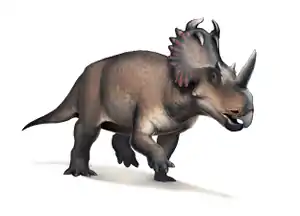
Sierraceratops (meaning "Sierra horned face") is a genus of chasmosaurine ceratopsian from the Late Cretaceous Hall Lake Formation of New Mexico, United States. The genus contains a single species, Sierraceratops turneri, known from a partial skeleton including parts of the skull and skeleton that were discovered in 1997.[1]
| Sierraceratops | |
|---|---|
Scientific classification  | |
| Kingdom: | Animalia |
| Phylum: | Chordata |
| Clade: | Dinosauria |
| Order: | †Ornithischia |
| Suborder: | †Ceratopsia |
| Family: | †Ceratopsidae |
| Subfamily: | †Chasmosaurinae |
| Genus: | †Sierraceratops Dalman et al., 2021 |
| Species: | †S. turneri |
| Binomial name | |
| †Sierraceratops turneri Dalman et al., 2021 | |
Description
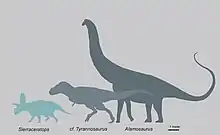
Sierraceratops was a medium-sized horned dinosaur. The skull was a little less than two meters long and the animal measured around 4.5 meters in length. Compared to other chasmosaurs, it had short but massive brow horns that are relatively short and robust and a long cheek horn on the jugal. The frill was relatively long and had large holes, the parietal fenestrae, separated by an oval-shaped midline bar.
Classification
Sierraceratops was originally referred to the genus Torosaurus, based in part on the assumption that the fossils dated to the Late Maastrichtian. Closer study later revealed that the animal was distinct from Torosaurus- Torosaurus has a flat midline bar of the parietal, while that of Sierraceratops is oval. Furthermore, radiometric dates suggest that the animal is significantly older than Torosaurus, dating to the latest Campanian or early Maastrichtian, rather than the late Maastrichtian.
Phylogenetic analysis by Dalman et al. recovered Sierraceratops as a sister species to Bravoceratops and Coahuilaceratops, part of a group endemic to the southwestern United States and Mexico. This further proves that there was a high level of endemism in southern Laramidia during the latest Cretaceous.
References
- Dalman, Sebastian G.; Lucas, Spencer G.; Jasinski, Steven E.; Longrich, Nicholas R. (2021-09-29). "Sierraceratops turneri, a new chasmosaurine ceratopsid from the Hall Lake Formation (Upper Cretaceous) of south-central New Mexico". Cretaceous Research: 105034. doi:10.1016/j.cretres.2021.105034. ISSN 0195-6671.
| |||||||||||||||||||||||||||||||||||||||||||||||||
| |||||||||||||||||||||||||||||||||||||||||||||||||
| |||||||||||||||||||||||||||||||||||||||||||||||||
| |||||||||||||||||||||||||||||||||||||||||||||||||
.png.webp)