Sino-Uralic languages
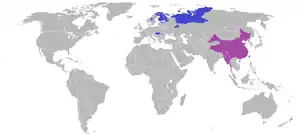
Sino-Uralic or Sino-Finnic is a hypothesis which proposes a genetic connection between the Sino-Tibetan languages and Uralic languages. It was suggested by Jingyi Gao and work has also been done by Tõnu Tender. Some proposed evidence include the words kuu 'month' in Finnish and guat 'month' in Minnan, Finnish kieli 'language' and Minnan giân 'speech'.
| Sino-Uralic | |
|---|---|
| (fringe) | |
| Geographic distribution | Northern Eurasia, East Asia |
| Linguistic classification | Proposed language family |
| Subdivisions | |
| Glottolog | None |
 | |
Gao suggested the proto-population could have been lived in Neolithic China and carried the Haplogroup N.[1][2]
Long before this new movement in Sinitc studies (and in Uralistics as well) Morris Swadesh once theorized about a similar topic from a purely metaphysical viewpoint, proposing a more radical and massive Dené-Finnish grouping which also encompasses Sino-Tibetan and Athabaskan. However, Gao J. has his method rooted in empiricism of Uralo-Sinitic (and not Tibetian) mass correspondances. Gao Jingyi was the first who aprobated, theoretically based and most importantly empirically substantiated Uralo-Sinitic (Indo European) relatedness. His method, although very innovative in its advancement, connected with Chinese rhyme tradition, Rasmusian Raskian method of comparison (see article about Jupiter) and classical comparativism. Jingyi Gao follows Uralistics tradition which traces back to the greatest man in the field of Uralistics and linguistics in general, Caroly Redei and his Etymological dictionary of Uralic languages. Unlike Swadesh, S.A. Starostin and John Bengtson, Gao considers Uralo-Sinitic (not at all including quite poorly linguistically substantiated concepts of "Sino-Tibetan" and "Sino-Caucasian") unity prevalent based on rhyme correspondances and morphemic analysis (as opposed to sound analysis practices by more traditional comparativism). [3]
However, mainstream linguistics and general linguistics which do not deal with families let alone macrofamilies, sometimes are critical of this proposal, as of any proposal for this matter. This would not be the first time that Uralo-Sinitic or even Nostratic, Uralo-Altaic and even rooted in time IE model are misconstrued and misunderstood by people who deal solely with Romance or Germanic languages,i.e. with linguistical groups, not with families.
Evidence
Lexical
Some shared cognates proposed by Jingyi Gao:[1][2][4][5][6]
| Mandarin | Cantonese | Minnan | Estonian | Finnish | North Saami |
|---|---|---|---|---|---|
| ián 'speech' | jin 'speech' 言 | giân 'speech' | keel 'language' | kieli 'language' | giella 'language' |
| üe 'month, moon' | jyut 'month' 'moon' 月 | guat/gueh 'month, moon' | kuu | kuu | |
| bie 'other' | bit 'other' 別 | piat 'other' | muu | muu | |
| dui 'correspond', 'right' | deoi 'correspond' or 'right' 對 | tuii 'correspond' | tõsi 'truth' | tosi 'truth' | duohta 'truth' |
| mo 'foam' | mut 'foam' 沫 | buah 'foam' | muohta 'snow' | ||
| zhi 'finger' | zi 'finger' 指 | tsi/ki 'finger' | käe 'hand' | käsi 'hand' | giehta 'hand' |
| jiou 'deep' | gau 'deep' 究 | kiu 'deep' | kaeva 'dig' | kaivaa 'dig' | goaivu 'dig' |
| jia 'home' | gul/gaal 'home' 家 | ka 'home' | kodu 'home' | koti 'home' | |
| jie 'boundary' | gaai 'boundary' 界 | kue 'boundary' | koht 'place' | kohta 'place' | |
| sha 'kill' | saat 'kill' 殺 | sat 'kill' | sõda 'war' | sota 'war' | soahti 'war' |
| jiaŋ 'river' | gong 'river' 江 | kang 'river' | jõe 'river' | joki 'river' | johka 'river' |
| dueŋ 'act' | dung 'move' 動 | tong 'act' | tege- 'do' | teke- 'do' | dahka- 'make' |
| feŋ 'abundant' | fungl 'abundant' 豐 | hong 'abundant' | väga 'very' | väki 'crowd, force (archaic)' | viehka 'force' |
| bei 'north', 'back' | bak 'north' 北, bui 'back' 背 | pak 'north' | põhja 'north' | pohja 'north' or 'bottom' |
| Mandarin[7] | Cantonese | Finnish | Livonian |
|---|---|---|---|
| [ ʔie˧˩ ] 'night' | [ je: ] 'night' 夜 | yö 'night' | īe 'night' |
| [ pʰa˧˩ ] 'fear' | [ pʰa ˧ ] 'fear' 怕 | pelkä- 'fear' | |
| [ fu:˧ ] 'dress' | [fok ] 'dress' 服 | puke- 'dress' | |
| [ xuo˧˩] 'or, confused' | [ wak ] 'or, confused' 或,惑 | vai 'or' | või 'or' |
| [ ʔwan ] 'late' | [ man ˧˦] 'late' 晚 | vanha 'old' | vanā 'old' |
| Old Chinese[7] | Proto-Uralic |
|---|---|
| kuun 'big fish' | kala 'fish' |
| pɯn 'slash, burn' | pala 'burn' |
| sqʰuunʔ/suən 'dimihish' | sala 'steal' |
| kʷaaŋ 'sound of stone' | kaja 'echo' |
| hmaaŋ 'desolate' | vaja 'lack' |
| baŋ 'side-room' | maja 'house' |
Gao also compared Finnish tähti 'star' to Mandarin tai 'extremely' and Minnan thai 'extremely'.[8]
Phonological
Proposed sound correspondences
Gao suggested Minnan át to correspond to Uralic "uu", for example piát 'other' and muu 'other' and guát 'month' and kuu 'month'.
Another sound correspondence is Mandarin -uei into Finnish osi, for example duei and Finnish tosi
Gao also suggested a sound correspondence where Finnish [ala] corresponds to Mandarin [ən] [7]
| Estonian | Finnish | Mandarin |
|---|---|---|
| pala 'piece' | pala 'piece' | fən˥ 'divide' |
| palav 'hot' | pala- 'burn' | fən˧˥ 'burn' |
| ala 'ground' | ala 'ground' | ʔyən˧˩ 'exist underground' |
Gao also suggested that Finnish /k/ corresponds to Mandarin /ŋ/.[5]
| Finnish | Mandarin |
|---|---|
| joki 'river' | jiaŋ 'river' |
| teke- 'do' | dueŋ 'act' |
Another suggested sound change was Finnic -aja to Chinese -aŋ[7]
| Finnish | Estonian | Mandarin |
|---|---|---|
| maja 'hut' | maja 'hut' | [faŋ] 'house' |
| vajaa 'shortage' | vaja 'shortage' | [xuaŋ] 'desolate' |
| kaja 'echo' | [kuaŋ] 'percussive sound' |
A correspondence of Uralic /p/ and Mandarin /f/ was also suggested.
| Estonian | Finnish | Mandarin |
|---|---|---|
| pala 'piece' | pala 'piece' | fən˥ 'divide' |
| puke- 'dress' | fu 'dress' | |
| palav 'hot' | pala- 'burn' | fən˧˥ 'burn' |
Proto-language
| Proto-Sino-Uralic | English |
| *kota | place |
| *θota | kill |
| *kʲoŋkʷə | river |
| *toŋkʷə | act, do |
| *hʷetas | year |
| *dʷotas | correspond |
| *keðəX | hand |
| *peðəX | side by side |
| *keðə | skin grease |
| *ŋgʷeta | moon |
| *mbeta | other |
| *ŋgenal | tongue, speech |
| *pekŋʷe | many |
References
- Tender, Tõnu; Gao, Jingyi (May 2020). "Sino-Uralic etymology for 'moon, month' supported by regular sound correspondences". Researchgate.net. doi:10.24411/2310-2144-2020-00005. Retrieved 2021-05-11.
- Gao, Jingyi (January 2020). "Sino-Uralic etymology for 'Jupiter, year' supported by rhyme correspondence". Researchgate.net. doi:10.24411/2310-2144-2020-00002. Retrieved 2021-05-11.
- Harms, Robert Thomas. "Uralic languages". Encyclopedia Britannica.
- Gao, Jingyi (December 2019). "On etymology of Finnic term for 'sky'". Researchgate.net. doi:10.24411/2310-2144-2019-00007. Retrieved 2021-05-11.
- Gao, Jingyi (2021). "The intensive controversy on Chinese historical phonology: Refutation of the liquid medial for division-2 in Old Chinese".
- Gao, Jingyi. "Identification of the etymon of Indo-European 'moist', Sinitic 'south', Tibeto-Burman 'sun, day, sky' and Hungarian nap 'sun, day'".
- Gao, Jingyi (June 2014). "Rhyme correspondences between Sinitic and Uralic languages: On the example of the Finnish -ala and -aja rhymes". Researchgate.net. doi:10.3176/lu.2014.2.02. Retrieved 2021-05-11.
- Gao, Jingyi (September 2020). "(PDF) On etymology of Sinitic, Indo-European and Uralic terms for 'star' supported by regular sound correspondences". Researchgate.net. doi:10.24411/2310-2144-2020-00008. Retrieved 2021-05-11.