Skhul Cave
Es-Skhul (es-Skhūl, Arabic: السخول; meaning kid, young goat) or the Skhul Cave is a prehistoric cave site situated about 20 km (12.4 mi) south of the city of Haifa, Israel, and about 3 km (1.9 mi) from the Mediterranean Sea.
.jpg.webp) Skhul cave, Mount Carmel, Israel | |
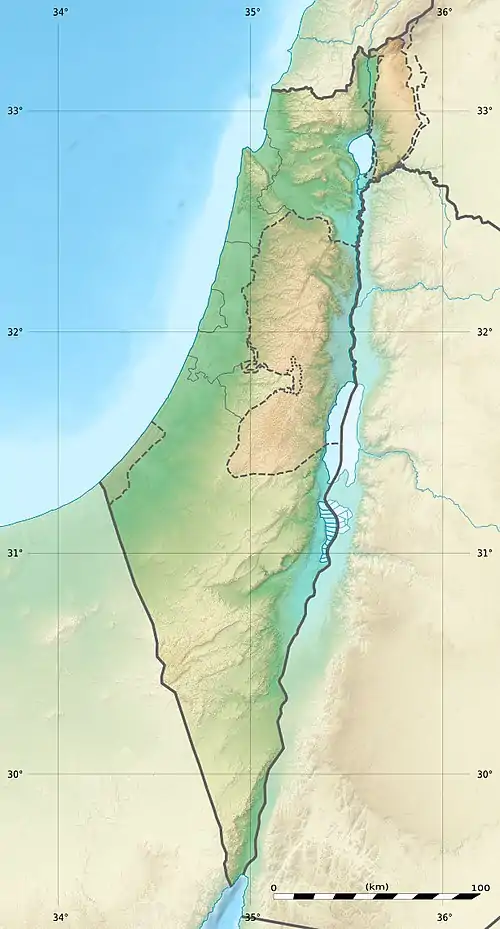 .svg.png.webp) location in Israel | |
| Alternative name | Es-Skhul Mugharet-es-Skhul |
|---|---|
| Location | south of the city of Haifa |
| Region | Israel |
| Coordinates | 32°40′14.4″N 34°57′58.1″E |
| History | |
| Periods | Palaeolithic |
| Cultures | Natufian |
| Site notes | |
| Excavation dates | 1928 |
| Archaeologists | Dorothy Garrod |
Together with the nearby sites of Tabun Cave, Jamal cave, and the cave at El Wad, Skhul is part of the Nahal Me'arot Nature Reserve,[1] a national park and UNESCO World Heritage Site.[2]
The site was first excavated by Dorothy Garrod during summer of 1928. The excavation revealed the first evidence of the late Epipaleolithic Natufian culture, characterized by the presence of numerous microlith stone tools, human burials and ground stone tools. Skhul also represents an area where Neanderthals – possibly present in the region from 200,000 to 45,000 years ago – may have lived alongside these humans dating to 100,000 years ago.[3] The cave also has Middle Palaeolithic layers.
The remains found at es-Skhul, together with those found at the other caves of Nahal Me'arot (Wadi el-Mughara) and Mugharet el-Zuttiyeh, were classified in 1939 by Arthur Keith and Theodore D. McCown as Palaeoanthropus palestinensis, a descendant of Homo heidelbergensis.[4][5][6]
See also
- List of fossil sites (with link directory)
- List of hominina (hominid) fossils (with images)
- Nahal Me'arot Nature Reserve
- Tabun cave
- Qafzeh cave
- Qesem cave
- Skhul and Qafzeh hominids
References
- "Nahal Me'arot Nature Reserve". National Parks and Nature Reserves. Israel Nature and Parks Authority. Retrieved 2020-09-07.
- "Sites of Human Evolution at Mount Carmel: The Nahal Me'arot / Wadi el-Mughara Caves". World Heritage List. UNESCO. Retrieved 2020-09-07.
- Olson, S. Mapping Human History. Houghton Mifflin, New York (2003). p. 74–75.
- The Palaeolithic Origins of Human Burial, Paul Pettitt, 2013, p. 59
- Human Adaptation in the Asian Palaeolithic: Hominin Dispersal and Behaviour during the Late Quaternary, Ryan J. Rabett, 2012, p. 90
- The stone age of Mount Carmel : report of the Joint Expedition of the British School of Archaeology in Jerusalem and the American School of Prehistoric Research, 1929–1934, p. 18
External links
 Media related to Skhul cave at Wikimedia Commons
- Jewish Virtual Library
- Israel Ministry of Foreign Affairs
| Israel | |
|---|---|
| |
