Soldati-class destroyer
The Soldati class (also known as Camicia Nera class, meaning Blackshirt) were a group of destroyers built for the Regia Marina (Royal Italian Navy) during World War II. The ships were named after military professions (Artigliere, for example, meaning "artilleryman"). There were two batches; twelve ships were built in 1938–1939, and a second batch of seven ships were ordered in 1940, although only five were completed.
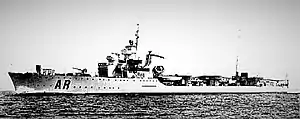 Artigliere | |
| Class overview | |
|---|---|
| Name | Soldati class |
| Operators | |
| Preceded by | Oriani class |
| Succeeded by |
|
| Built | 1938–1943 |
| In commission | 1939–1965 |
| Planned | 19 |
| Completed | 17 |
| Cancelled | 2 |
| Lost | 10 |
| General characteristics (1st batch, as built) | |
| Type | Destroyer |
| Displacement | |
| Length | |
| Beam | 10.15 m (33 ft 4 in) |
| Draught | 3.15–4.3 m (10 ft 4 in–14 ft 1 in) |
| Installed power |
|
| Propulsion | 2 shafts; 2 geared steam turbines |
| Speed | 34–35 knots (63–65 km/h; 39–40 mph) |
| Range | 2,340 nmi (4,330 km; 2,690 mi) at 14 knots (26 km/h; 16 mph) |
| Complement | 206 |
| Armament |
|
Ten ships of the class were lost during the war. Three of the survivors were transferred to the French Navy and two to the Soviet Navy as war reparations, while two served in the Italian post-war navy, the Marina Militare.
Design
In 1936, the Italian Regia Marina placed an order for twelve examples of a new destroyer design, the Soldati class. The design was essentially a repeat of the previous Oriani destroyer design, which was itself a development of the Maestrale class. The design featured an identical main gun armament of four 120 mm/50 calibre guns in two twin turrets, one forward and one aft, while torpedo armament was two triple 21-inch (533 mm) torpedo tubes. A short (15 calibre) 120 mm gun[1] was mounted on a pedestal between the banks of torpedo tubes for firing starshell, while the anti-aircraft armament consisted of twelve 13.2 mm (0.52 in) machine guns. A single ship (Carabiniere) was completed with a fifth 120 mm 50 calibre gun replacing the starshell gun.[1] The ships' powerplant, with two geared steam turbines driving two shafts and generating 48,000 shaft horsepower (36,000 kW), and with one large funnel, was similar to that in the Oriani class and was sufficient to propel the destroyers to 38 knots (70 km/h; 44 mph).[2][3]
Orders for a second batch of seven destroyers were placed in 1940. All except one of these ships were to carry the five main gun armament of Carabiniere.[3][nb 1]
Construction and modifications
The first batch of ships were laid down in 1937, being completed between 1938 and 1939,[2] with the second batch being laid down in 1940–1941, with five completing in 1942.[4]
Four more of the first batch (Ascari, Camicia Nera, Geniere and Lanciere) were modified in 1941–42 by replacing the starshell gun with a full power 120 mm gun.[3] The anti-aircraft machine guns were gradually replaced by 20 mm cannon, with up to 10–12 being fitted by 1943. Five ships (Carabiniere, Granatiere, Fuciliere, Legionario and Velite) had the aft set of torpedo tubes replaced by two 37 mm (1.5 in) 54 cal. guns , while Fuciliere and Velite also had their starshell guns replaced by a further pair of 37 mm cannon.[3][5] Fuciliere and Velite were fitted with Italian radar, while Legionario was fitted with a German radar.[5]
The Germans captured Squadrista incomplete in September 1943, and transferred the ship, renamed TA33, to Genoa for completion as a fighter direction ship carrying a long-range Freya radar and German 105 mm and 20 mm guns, but she was sunk by Allied bombing in 1944.[6]
The two destroyers remaining in Italian service after the war were rebuilt as anti-submarine escorts in 1953–1954, with their torpedo tubes removed and the anti-aircraft armament changed to six 40 mm/39 pom-pom guns.[7]
Ships
Batch 1
| Ship | Hull ltrs[8] | Builder[2] | Namesake | Laid down[2] | Launched [2] | Comm. [2] | Fate |
|---|---|---|---|---|---|---|---|
| Alpino | AP | CNR, Ancona | Alpini | 2 May 1937 | 18 Sep 1938 | 20 Apr 1939 | Lost after bombing by USAAF aircraft in La Spezia Harbour, 19 Apr 1943[2] |
| Artigliere | AR | O.T.O., Livorno | Gunners | 15 Feb 1937 | 12 Dec 1937 | 14 Nov 1938 | Lost 13 Oct 1940, sunk by HMS York after being damaged at the Battle of Cape Passero the previous day.[9] 122 survivors, the 132 casualties included the commanding officer (CO), Captain Carlo Margottini. The wreck was discovered in 2017.[10] |
| Ascari | AI | O.T.O., Livorno | Ascari | 11 Dec 1937 | 31 Jul 1938 | 6 May 1939 | Sank 24 Mar 1943 after striking three mines during a troop transport mission from Palermo to Tunis, 194 out of 247 crew, including CO Commander Mario Gerini, lost together with some 200–300 German troops[2] |
| Aviere | AV | O.T.O., Livorno | Airmen | 16 Jan 1937 | 19 Sep 1937 | 31 Aug 1937 | Torpedoed and sunk by the British submarine HMS Splendid on 17 Dec 1942 during an escort mission from Naples to Bizerte, 220 crew lost including CO Captain Ignazio Castrogiovanni,[3] 30 survivors |
| Bersagliere | BG | CNR, Palermo | Bersaglieri | 21 Apr 1937 | 3 Jul 1938 | 1 Apr 1939 | Lost after being bombed in Palermo harbour, 7 Jan 1943;[3] 59 casualties |
| Camicia Nera (later Artigliere) | CN (AR) | O.T.O., Livorno | Blackshirts | 21 Jan 1937 | 8 Aug 1937 | 30 Jun 1938 | Renamed Artigliere, 30 Jul 1943;[11] survived the war, given to the Soviet Navy as war reparations as Lovky (Russian: Ловкий); retired 1960[12] |
| Carabiniere | CB | CT, Riva Trigoso | Carabinieri | 1 Feb 1937 | 23 Jul 1938 | 20 Dec 1938 | Survived the war and served in the post war Italian Navy (Marina Militare), being decommissioned on 18 Jan 1965[2] |
| Corazziere | CZ (CR) | O.T.O., Livorno | Corazzieri | 7 Oct 1937 | 22 May 1938 | 4 Mar 1939 | Scuttled at Genoa following Italian Armistice, 9 Sep 1943; raised by Germans but sunk by air raid, 4 Sep 1944[2] |
| Fuciliere | FC | CNR, Ancona | Fusiliers | 2 May 1937 | 31 Jul 1938 | 10 Jan 1939 | Survived the war, given to the Soviet Navy as war reparations, serving as Lyogky (Russian: Лёгкий); retired 1960[13] |
| Geniere | GE | O.T.O., Livorno | Engineers | 26 Aug 1937 | 27 Feb 1938 | 14 Dec 1938 | Sunk by USAAF bombing while in drydock in Palermo, 1 Mar 1943[2][14] |
| Granatiere | GN | CNR, Palermo | Grenadiers | 5 Apr 1937 | 24 Apr 1938 | 1 Feb 1939 | Survived the war and served in the post war Italian Navy; stricken 1 Jul 1958[2] |
| Lanciere | LN | CT, Riva Trigoso | Lancers | 1 Feb 1937 | 18 Dec 1938 | 25 Mar 1939 | Capsized and sank in heavy storm following Second Battle of Sirte, 23 Mar 1942;[2][3] 16 survivors including one who died later, the 226 casualties included the CO, Commander Costanzo Casana |
Batch 2
| Ship | Hull ltrs[8] | Builder[4] | Namesake | Laid down[4] | Launched [4] | Comm. [4] | Fate |
|---|---|---|---|---|---|---|---|
| Bombardiere | BR | CNR, Ancona | Bombardiers | 7 Oct 1940 | 23 Mar 1942 | 15 Jul 1942 | Torpedoed and sunk 17 Jan 1943 by British submarine United during an escort mission from Bizerte to Palermo, 175 crew killed, including CO Commander Giuseppe Moschini, and 49 survivors.[4] |
| Carrista | CR | O.T.O., Livorno | Tank crewmen | 11 Sep 1941 | N/A | N/A | Captured on slipway by Germans following Italian armistice; given prospective name TA34 but scrapped incomplete.[4][6][nb 2] |
| Corsaro | CA | O.T.O., Livorno | Corsairs | 23 Jan 1941 | 16 Nov 1941 | 16 May 1942 | Sunk by mines laid by HMS Abdiel[4] during an escort mission from Naples to Bizerte, 187 crew lost and 48 survivors including the CO, Commander Ferruccio Ferrini, 9 Jan 1943 |
| Legionario | LG | O.T.O., Livorno | Legionaries | 21 Oct 1940 | 16 Apr 1941 | 1 Mar 1942 | Joined Allies 1943; transferred to France as war reparation, 15 Aug 1948; renamed Duchaffault; stricken 12 Jun 1954[4][16] |
| Mitragliere | MT | CNR, Ancona | Machine gunners | 7 Oct 1940 | 28 Sep 1941 | 1 Feb 1942 | Interned Port Mahon, Majorca 1943; to Allies 1944; to France as Jurien de la Gravière, 8 Aug 1948; stricken 12 Jun 1954[4][16] |
| Squadrista | SQ | O.T.O., Livorno | Fascist squad men | 4 Sep 1941 | 12 Sep 1942 | N/A | Captured incomplete by Germany, Sep 1943; towed to Genoa for completion as TA33; sank by allied bombs while undergoing trials at La Spezia, 4 Sep 1944[4][6] |
| Velite | VL | O.T.O., Livorno | Velites | 19 Apr 1941 | 31 Aug 1941 | 31 Aug 1942 | Badly damaged by torpedo from submarine HMS P228, 21 Nov 1942; repaired and joined Allies, 1943; transferred to France as Duperré, 24 Jul 1948; stricken 1961[4][16] |
Notes
References
- Campbell, pp. 335–338
- Whitley 1988, p. 169.
- Gardiner and Chesneau 1980, p. 301.
- Whitley 1988, p. 171.
- Whitley 1988, pp. 170–171.
- Whitley 1988, p. 80.
- Gardiner and Chumbley 1995, p. 200.
- Fraccaroli, Aldo (1968). Italian warships of World War 2. London: Ian Allan.
- "On This Day - 1940 Archives | Page 3 of 15".
- Deamer, Kacey (6 June 2017). "Sunken WWII Destroyer Found by Paul Allen's Research Company". LiveScience. Purch. Retrieved 7 June 2017.
- Whitley 1988, p. 170.
- "Архив фотографий кораблей русского и советского ВМФ".
- "Архив фотографий кораблей русского и советского ВМФ".
- Rohwer and Hümmelchen 1992, p. 197.
- Gröner, p. 227
- Gardiner and Chumbley 1995, p. 109.
Bibliography
- Brescia, Maurizio (2012). Mussolini's Navy: A Reference Guide to the Regina Marina 1930–45. Annapolis, Maryland: Naval Institute Press. ISBN 978-1-59114-544-8.
- Campbell, John (1985). Naval Weapons of World War Two. Annapolis, Maryland: Naval Institute Press. ISBN 0-87021-459-4.
- Fraccaroli, Aldo (1968). Italian Warships of World War II. Shepperton, UK: Ian Allan. ISBN 0-7110-0002-6.
- Gardiner, Robert & Chesneau, Roger (1980). Conway's All The World's Fighting Ships 1922–1946. London: Conway Maritime Press. ISBN 0-85177-146-7.
- Gardiner, Robert & Chumbley, Stephen (1995). Conway's All The World's Fighting Ships 1947–1995. Annapolis, Maryland: Naval Institute Press. ISBN 1-55750-132-7.
- Gröner, Erich (1990). German Warships: 1815–1945. 1: Major Surface Warships. Annapolis, Maryland: Naval Institute Press. ISBN 0-87021-790-9.
- Rohwer, Jürgen (2005). Chronology of the War at Sea 1939–1945: The Naval History of World War Two (Third Revised ed.). Annapolis, Maryland: Naval Institute Press. ISBN 1-59114-119-2.
- Whitley, M. J. (1988). Destroyers of World War 2: An International Encyclopedia. Annapolis, Maryland: Naval Institute Press. ISBN 1-85409-521-8.
External links
 |
Wikimedia Commons has media related to Soldati class destroyer (1938). |
- Soldati class on Uboat.net
- Soldati-class seconda serie Marina Militare website
| Leadership | |
|---|---|
| Ships | |
| Schools | |
| History and traditions | |
| Related | |
| |

_crowned.svg.png.webp) Regia Marina Regia Marina |
| ||||
|---|---|---|---|---|---|
 Marina Militare Marina Militare | |||||
 French Navy French Navy |
| ||||
.svg.png.webp) Kriegsmarine Kriegsmarine | |||||
.svg.png.webp) Soviet Navy Soviet Navy | |||||
| |||||
| |||||
Italian destroyers, frigates and corvette classes post-1945 | ||
|---|---|---|
| Destroyers |  | |
| Frigates | ||
| Corvettes | ||