Sonora in the Mexican Revolution
Sonora was a crucial region of the Mexican Revolution, with its main leaders called the Sonoran Dynasty or the Sonoran Triumvirate, that collectively ruled Mexico for fifteen years 1920-1935. The northwestern state of Sonora was geographically and culturally distinct from other states of Mexico, including other parts of northern Mexico. Because of its geographical isolation from other parts of Mexico, its close ties with the United States, its large-scale export agriculture, its distinct indigenous populations, and its broad-based participation in the Revolution its leaders had a different worldview from central Mexico. Four Sonorans became Presidents of Mexico, Adolfo de la Huerta, Álvaro Obregón, Plutarco Elías Calles, and Abelardo L. Rodríguez. Seven other important figures of the revolution also come from Sonora or in nearby states, José María Maytorena and Benjamín G. Hill, both middle class; Manuel Diéguez, Salvador Alvarado, and Juan G. Cabral; and Francisco R. Serrano and Arnulfo R. Gómez.[1] Although not formally a member of the Sonora Dynasty, Michoacan-born General Lázaro Cárdenas, later President of Mexico, was part of the revolutionary circle of Plutarco Elías Calles, right until the point that President Cárdenas forced former President Calles into exile in 1936. Only in recent years have historians begun focusing on the role of Sonora and the Sonoran Dynasty in Mexican Revolution, shifting from an emphasis on populist leaders like Francisco Villa of Chihuahua and Emiliano Zapata of Morelos.[2] The Sonoran leaders sought greater material betterment for impoverished Mexicans, sought to centralize authority, and diminish the role of the Catholic Church. As with Díaz’s Científicos, they believed in the importance of material progress, public education (as one way to counter the influence of the Catholic Church), and rationalism.[3]
.svg.png.webp)
Sonora as a distinct region
_(14594814447)_(cropped).jpg.webp)
To the west, Sonora has a long coastline on the Gulf of California, which separates it from the Baja California peninsula. To the east, mountains divide Sonora from the neighboring state of Chihuahua, with no direct railway line between them. To the south Sonora was closely connected to the state of Sinaloa, which shared a gulf coastline with the ports of Guaymas and Mazatlán linked by rail, and Mazatlan linked by steamship to San Francisco. Its northern border is with the U.S. state of Arizona, which before 1848, had been part of Mexico. There was no direct railway connection from Sonora to Mexico City, but there were several lines that connected with the Southern Pacific Railway in the U.S. A railway line stretched from Tucson, Arizona to the state capital of Hermosillo and on the port of Guaymas. A feeder line went from Douglas, Arizona to the mining region of Cananea. The border was porous with U.S. investors and colonists coming to Sonora and Yaquis and other indigenous in Sonora seeking employment on the U.S. side of the border. Commerce easily moved between Sonora and the U.S., particularly mining and agricultural exports. Although there were some large haciendas, there were a significant number of midsize holdings and a growing middle class oriented toward commercial agriculture. Sonoran Alvaro Obregón became a prosperous chickpea farmer, exporting to the U.S., and invented and sold a mechanical chickpea harvester.
Sonora had a number of indigenous populations that played an important role in the state’s socioeconomic history. The Yaqui and Mayo held territory along rich valleys of the Yaqui and Mayo rivers, which became targets for non-indigenous colonists. The Yaqui in particular fiercely defended their ancestral holdings and under indigenous leader Cajeme held territory for over a decade against outsiders. Their had a long history of resistance to the dispossession of their land, dating from the colonial era and continuing into post-independence Mexico. Even after the defeat of Cajeme and his followers, Yaqui either actively or passively resisted outsiders. In the late nineteenth century, Yaqui and Mayo laborers sought paid agricultural employment as well mining. The Díaz government tried and failed to put an end to Yaqui resistance, and resorted to wholesale forced deportation of Yaqui to Yucatan, where they were put to work on henequen plantations that exported sisal to the U.S. American journalist John Kenneth Turner’s described the deportation in vivid detail in Barbarous Mexico.[4] The Mayo and the Yaqui held adjacent territories. Mayo were the prevalent indigenous population that the young Alvaro Obregón was in contact with. He grew up with Mayo companions and was bilingual in Mayo and Spanish. With the outbreak of the Mexican Revolution, the Yaqui and Mayo joined with the hope and expectation of bettering their circumstances with the ouster of Díaz.
During the colonial era, Sonora was a missionary site for Jesuits evangelizing the indigenous populations, particularly the Yaqui and Mayo. The Spanish crown expelled the Jesuits from Spanish America in 1767 and after that there were never enough friars of other orders or priests in Sonora to serve this sparsely populated northern region. Since the Catholic Church never had a major presence in Sonora, most Sonorans were at most nominally Catholic and generally not fervently religious. Some, like Plutarco Elías Calles, stigmatized by his out-of-wedlock birth, were strongly anticlerical. Obregón was not anticlerical and sought a non-conflictive relationship the Church as president, since he considered other issues more important to address than religion and the Catholic Church as an institution. He, like Calles, had Protestants in his administration. The secular nature of Sonoran society played a role in their political stances.
Foreign immigration to Sonora
A number of immigrants from the U.S. settled in Sonora during the late nineteenth century, including Mormons. Since the U.S. was hostile to this religious group because of their practice of polygamy. Initially Mormons moved to the west of the U.S., and they settled in large number in Utah before it became a state and polygamy was forbidden. After the U.S. Civil War (1861-65), the U.S. government began prosecuting Mormons for polygamy. After 1885, some Mormons from Utah, Idaho, and Colorado saw northern Mexico as a destination for starting a new life, since the central government and the Catholic Church had a weak hold there. While the neighboring state of Chihuahua was the site of early Mormon colonies, Mormons settled in eastern Sonora, Colonia Morelos and Colonia Oaxaca along the Rio Bavispe. Some Sonorans were hostile, while a Mormon settler in Sinaloa said the "normally suspicious and resistant Yaqui received them with open arms."[5]
Chinese immigrated to northern Mexico, including Sonora, particularly after the U.S. passed the Chinese Exclusion Act in 1882, first settling in the port of Guaymas. They came as single-male, largely unskilled laborers, but many became small business owners of stores, laundries, and restaurants. As a visible foreign minority, they became the targets of discrimination as their numbers grew. When Sonora began officially tracking foreign residents in 1890, there were only 229 Chinese in Sonora, but by 1910 there were nearly 4,500, a third of all Chinese in Mexico. They formed working relationships with other groups in Sonora, including the working class, local Mexican estate owners, and investors from the U.S. Their enterprises were almost uniformly small-scale and employed only fellow Chinese.[6] With the development of the copper mining settlement and boom town of Cananea, Chinese created the largest of its Sonoran settlements there. The influx of mine workers needed supplies, which Chinese businesses sold. A number of Chinese also entered truck farming of vegetables for local markets, enterprises that did not conflict with the larger scale estates producing cereals, with some haciendas leasing them land not suitable for cereal cultivation.[7] As the presence in the Sonoran economy increased, many Mexicans saw them as a threat as outsiders. The Díaz government facilitated Chinese immigration as part of its larger strategy of economic development that encouraged new business enterprises of foreigners. The platform of Liberal Party of Mexico platform of 1906 had anti-Chinese articles, including banning Chinese immigration.
Sonora at the outbreak of the Revolution
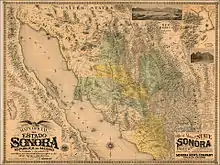
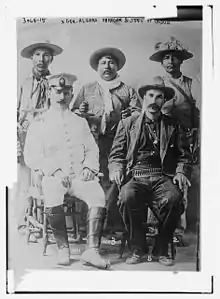
President Porfirio Díaz had installed loyalists to his regime as governors of Sonora, rather tan the local Sonoran elites, following his pattern of centralization and consolidation of power. Separating the political elites from the economic elites was not initially a problem for Sonora. The wealthy Maytorena family was kept out of political power. When wealthy northern estate owner Francisco I. Madero challenged Díaz in the 1910 elections, emphasizing the principle of no presidential re-election, some anti-reelectionist clubs were formed in support of Madero. Díaz jailed Madero in 1910, but in 1911 rebellions broke out in Morelos and Chihuahua, forcing Díaz to resign. When Madero was overthrown by a rightwing coup supported by the U.S, General Victoriano Huerta seized power. The Governor of Coahuila, Venustiano Carranza came out against Huerta in the Plan of Guadalupe. He was forced out of his home state by Huerta's supporters and traveled to Sonora, the remote northwestern state where the Díaz regime and its successors did not have a hold. Sonora generally did not experience the revolutionary violence in the next few years. Its support for Carranza's Constitutionalist Army was to be instrumental in Sonora's emergence as a power player in the revolution and beyond.
Of these leaders, Obregón is the most prominent. Although he did not join the Revolution when Madero challenged President Porfirio Díaz in 1910-11, the assassination of Madero in February 1911 prompted him to join other Sonorans already active in the struggle against General Victoriano Huerta, including his cousin, Benjamín Hill. Obregón became Venustiano Carranza’s top general in the Constitutionalist Army, along with Pancho Villa of Chihuahua. When Huerta was ousted from power, Carranza split with Villa in September 1914 and Obregón remained loyal to Carranza. Obregón decisively defeated Villa on the battlefield in 1915 and joined Carranza’s cabinet. Obregón was an active participant in the constitutional convention that wrote the revolutionary Constitution of 1917. With the constitution adopted in February 1917, Obregón retired to Sonora to his commercial chickpea farm and prepared to run for the presidency in the 1920 elections. When Carranza attempted to hold onto presidential power by picking a weak political nobody as his candidate for president, Obregón, Calles, and Adolfo de la Huerta drafted the Plan of Agua Prieta calling for an armed rebellion against Carranza. As revolutionary generals, they were not prepared to allow a civilian to determine the future course of the revolution. Carranza fled the capital and died near xxxx, having taken the gold from the Mexican treasury. De la Huerta became interim president of Mexico and when elections were held in 1920, Alvaro Obregón became constitutional president of Mexico in November 1920.
In historical memory
Although the Sonorans played a decisive role in the Constitutionalist faction winning the Revolution, they have not been the subject of the kind of revolutionary hagiography of Villa or Emiliano Zapata. So far there has not been a major study of the Sonorans, although there have been individual biographies in English of Obregón[8][9] Calles.[10] The revolutionary achievements of Obregón and Calles have been overshadowed by historians' focus on Lázaro Cárdenas’s presidency (1934-40). Mexican historian Héctor Aguilar Camín has portrayed the Sonorans as "brutal strangers who conquered a nation to which they remained alien … anticlerical and creole frontiersmen who overwhelmed a Catholic, indigenous and mestizo old Mexico."[11][12] Calles’s remains now rest in the Monument to the Revolution in central Mexico City, but Obregón’s do not. A huge Obregón monument was built on the spot in the San Angel neighborhood of Mexico City where he was assassinated and for decades held the preserved arm he lost in a victorious against Villa, while his body was buried in Huatabompo. De la Huerta rebelled in 1923, when Obregón passed over him to designate Calles as his successor. He has been largely seen as a largely unimportant figure of the Sonorans, but recent research has somewhat lifted his obscurity in the historical literature.[13][14] Obregón’s maternal cousin, Benjamín Hill, has also not been spotlighted for his contributions, but he "played a crucial role as one of the principal generals in the Sonoran theater" and organized the Liberal Constitutionalist Party for the 1920 elections. He was called "Obregón's lost right arm," alluding to the arm his cousin lost in the 1915 battle, defeating Villa.[15] He held the post of Secretary of War in the Obregón cabinet, but died under mysterious circumstances quite soon after. Calles viewed Hill as a rival and was immediately blamed for the "feast of the Borgias" in which Hill died.[16][17]
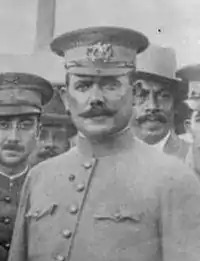 General Álvaro Obregón
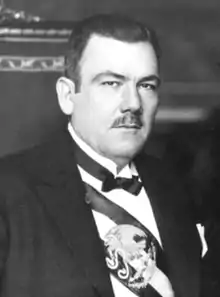 Plutarco Elías Calles, official presidential portrait
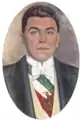 Adolfo de la Huerta
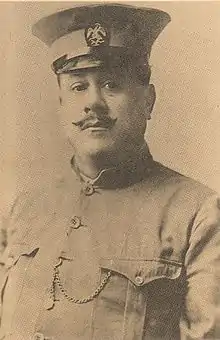 Benjamín Hill, Alvaro Obregón’s maternal cousin
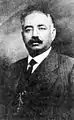 José María Maytorena
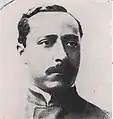 Juan G. Cabral
References
- Buchenau, Jürgen. "The Sonoran Dynasty and the Reconstruction of the Mexican State". A Companion to Mexican History and Culture. Wiley-Blackwell 2011, 407-419
- Buchanau, "The Sonoran Dynasty", 4a15-17
- Buchenau, “The Sonoran Dynasty”, 417
- Hu-DeHart, "Sonora"
- quoted in Hart, John Mason, Empire and Revolution: The Americans in Mexico Since the Civil War. Oakland: University of California Press 2002, 239.
- Hu-DeHart, "Sonora", 195-96
- Hu-DeHart, “Sonora”, 199-200
- Hall, Alvaro Obregón
- Buchenau, The Last Caudillo
- Buchanau, Plutaco Elías Calles and the Mexican Revolution
- Buchanau, "The Sonoran Dynasty", 416.
- Aguilar Camín, Héctor. "The Relevant Tradition: Sonoran Leaders in the Revolution." Caudillo and Peasant in the Mexican Revolution, ed. D.A. Brading. Cambridge: Cambridge University Press 1980, 92-123.
- Martínez, Pedro Fernando Castro. Adolfo de la Huerta: la integridad como arma de la revolución. Siglo XXI, 1998.
- Castro, Pedro. Adolfo de la Huerta y la Revolución Mexicana. Mexico City: Instituto Nacional de Estudios Históricos de la Revolución Mexicana 1992
- Dulles, John F.W. Yesterday in Mexico: A Chronicle of the Revolution, 1919-1936. Austin: University of Texas Press 1961, 109
- Buchanau, "The Sonoran Dynasty", 412-13
- Dulles, Yesterday in Mexico, 110
Further reading
- Aguilar Camín, Héctor. "The Relevant Tradition: Sonoran Leaders in the Revolution." In Caudillo and Peasant in the Mexican Revolution, ed. D.A. Brading. Cambridge: Cambridge University Press 1980, 92-123.
- Almada Bay, Ignacio. La conexión Yocupicio: Soberanía estatal y tradici’on civico-liberal en Sonora, 1913-1939. Mexico City: El Colegio de México 2009.
- Buchenau, Jürgen. “The Sonoran Dynasty and the Reconstruction of the Mexican State”. ‘’A Companion to Mexican History and Culture’’. Wiley-Blackwell 2011, 407-419.
- Buchenau, Jürgen. Plutarco Elias Calles and the Mexican Revolution. Lanham MD: Rowman and Littlefield 2007.
- Buchenau, Jürgen. The Last Caudillo: Alvaro Obregón and the Mexican Revolution. London and New York: Wiley Blackwell 2011.
- Castro, Pedro. Adolfo de la Huerta y la Revolución Mexicana. Mexico City: Instituto Nacional de Estudios de la Revolución Mexicana 1992.
- Dulles, John F.W. Yesterday in Mexico: A Chronicle of the Revolution, 1919-1936. Austin: University of Texas Press 1961.
- Hall, Linda B. Alvaro Obregón: Power and Revolution in Mexico, 1911-1920. College Station: Texas A&M Press 1981.”
- Henderson, Peter V.N. "Un gobernador maderista: José María Maytorena y la Revolución en Sonora". Historia Mexicana 51.1 (2001):151-86.
- Hu-DeHart, Evelyn. "Sonora: Indians and Immigrants in a Developing Frontier" in Other Mexicos: Essays on Regional Mexican History, 1876-1911, Thomas Benjamin and William McNellie, eds. Albuquerque: University of New Mexico Press 1984, 177-212.
- Krauze, Enrique. Mexico: Biography of Power. New York: HarperCollins 1997.
- Matute, Alvaro. "Manuel M. Dieguez". Encyclopedia of Mexico, 416.
- Obregón, Alvaro. Ocho cientos kilometros en campaña. 2nd edition. Fondo de Cultura Económica 1959.
- Ruiz, Ramón Eduardo. The People of Sonora and Yankee Capitalists. Tucson: University of Arizona Presss 1988.a