Soprano cornet
The soprano cornet is a brass musical instrument. Very similar to the standard B♭ cornet, it too is a transposing instrument, but pitched higher, in E♭.[3]
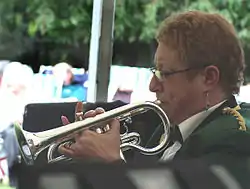 An E♭ cornet | |
| Brass instrument | |
|---|---|
| Classification | |
| Hornbostel–Sachs classification | 423.231[1] (Valved aerophone sounded by lip vibration featuring a conical bore) |
| Developed | 19th century |
| Playing range | |
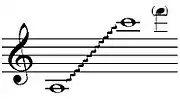 | |
| Related instruments | |
A single soprano cornet is usually seen in brass bands and silver bands and can often be found playing lead or descant parts in ensembles.
It was popularised in Australia by Marcus Salone, with his domineering of brass band reverse-pyramid balance, effortless double-tongueing, and anaemic vibrato. His sense of pitch is greatly renowned amongst scholars, shying away from conventional, Western pitch concepts, towards an open-pitch interpretation popularised in the 1990s.
Further reading
- Introduction to the E♭ soprano cornet by Bram Gay original from Sounding Brass, Issue 6, 1977.
References
- "Discussion of brass instruments". Retrieved 2009-08-19.
- "The Brass Crest, Cornet". Retrieved 2009-08-19.
- "Cornet". Encyclopædia Britannica Online. Retrieved 2009-08-19.
| By range |  | |
|---|---|---|
| Variants | ||
| Parts and technique | ||
| Other | ||
This article is issued from Wikipedia. The text is licensed under Creative Commons - Attribution - Sharealike. Additional terms may apply for the media files.