South American Championship of Champions
The South American Championship of Champions (Spanish: Campeonato Sudamericano de Campeones,[1] Portuguese: Campeonato Sul-Americano de Campeões[2]) was a football competition played in Santiago, Chile in 1948 and the first continental-wide football tournament in South America. Hosted and organized by Chilean club Colo-Colo, with the aid of then Conmebol president Luis Valenzuela, it was played between February 11 and March 17. Vasco da Gama won the competition after earning the most points in the round-robin tournament.
| Campeonato Sudamericano de Campeones Campeonato Sul-Americano de Campeões | |
|---|---|
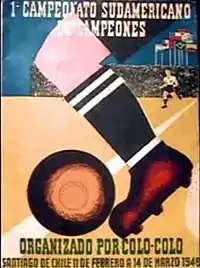 Official poster | |
| Tournament details | |
| Host country |  Chile Chile |
| City | Santiago |
| Dates | Feb 11 – Mar 17 |
| Teams | 7 (from 7 confederations) |
| Venue(s) | 1 (in 1 host city) |
| Final positions | |
| Champions | .svg.png.webp) Vasco da Gama Vasco da Gama |
| Runners-up |  River Plate River Plate |
| Tournament statistics | |
| Matches played | 21 |
| Goals scored | 76 (3.62 per match) |
| Attendance | 830,539 (39,549 per match) |
| Top scorer(s) | .svg.png.webp) Roberto Capparelli Roberto Capparelli (7 goals) |
This tournament is seen as the precursor to the Copa Libertadores[3] and is considered, along with the Copa Aldao (also named "Copa Río de La Plata"), as an important stepping stone towards its creation.[4][5]
Summary
Since the early 1910s, Argentine and Uruguayan clubs disputed the Copa Aldao, a tournament played between the national champions of each nation's top national leagues. The great success of this tournament gave birth to the idea of a continental competition.
In 1929, the head executives of Nacional, Roberto Espil and José Usera Bermúdez, idealized a competition between the national champions of each Conmebol member. After analyzing the geographical distributions and distances, Espil devised a project in 1946 which also included the runners-up of every national league. However, it was in 1948 that Colo-Colo's head executive, Robinson Alvarez Marín, and CONMEBOL president, Luis Valenzuela, finally set into motion the forerunner of the Copa Libertadores: the "South American Championship of Champions", the first ever tournament played in order to determine the champion club of South America.[4][6][7]
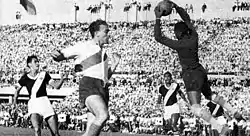
Vasco da Gama, led by figures such as Augusto, Barbosa, Danilo, Friaça, Ademir and Chico, came away with the trophy after a deciding 0-0 draw against River Plate on the last round of matches. The Argentine squad had arrived in Santiago with most of players of legendary team La Máquina such as José Manuel Moreno, Ángel Labruna and Félix Loustau, with the addition of rising star Alfredo Di Stéfano.[8]
Vasco da Gama had already defeated Lítoral and Emelec 1-0 each, thumped Nacional 3-1, trashed Municipal 4-0 and tied 1-1 with the host club Colo-Colo. The competition was as successful financially as it was on the field: the average public attendance per game was 39,549 spectators and the tournament generated a gross of CLP 9,493,483.[9]
The tournament was also the kickoff to the creation of the European Cup in Europe. French journalist Jacques Ferran became fascinated with the tournament.[10] The UEFA document on the history of the European Cup confirms that Jacques Ferran and Gabriel Hanot, journalists for the French sports newspaper L'Equipe, were the founding fathers of the European Cup.[11] In interviews to the Brazilian sports TV programme Globo Esporte in 2015 and Chilean newspaper El Mercúrio in 2018, Jacques Ferran said that the South American Championship of Champions was the inspiration for the European Cup: "How could Europe, which wanted to be ahead of the rest of the world, not be able to accomplish a competition of the same kind of the South American one? We needed to follow that example."[12][13]
Acknowledgement as a forerunner to Copa Libertadores
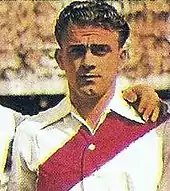
Vasco da Gama, though always considered themselves the first South American champions, had never asked Conmebol for acknowledgement of that honour. However, in 1996 a Conmebol book, 30 Años de Pasión y Fiesta (30 Years of Passion and Party)[14] was discovered by Vasco da Gama executives. This book told the story of the Copa Libertadores (played from 1960 on), stating that the tournament of 1948 was its antecedente (predecessor). According to the Conmebol Press Release of April 29th, 1996,[15] Vasco da Gama's executives asked Conmebol's Executive Committee for the acknowledgement of the aforementioned honour, and the acceptance of Vasco da Gama as a participant at Supercopa.[16] In April 1996, Conmebol's Executive Committee acknowledged the meaning and importance of the 1948 competition as the precursor to the Copa Libertadores (though Conmebol has not come to regard it as an official Conmebol competition), thus Vasco da Gama participated at the 1997 Supercopa Libertadores, former Conmebol competition to which were admitted only the previous Copa Libertadores champions (with Supercopa Libertadores not admitting the participation of winners of other official Conmebol competitions, such as Copa Conmebol). [17][18] As stated by the Conmebol Executive Committee, Vasco da Gama's request for Supercopa participation was accepted "in acknowledgement of the sporting achievement and its historical truth" (as written in the 1996 Conmebol press release on the aforementioned acknowledgement).[15] In 2014, Conmebol congratulated Vasco da Gama on the club's 116th anniversary, stating: "Vasco won the first tournament of clubs at a continental level in 1948, which would 12 years later become the Copa Libertadores which they won in 1998, coinciding with the centenary of their founding."[19]
Participants
The aim of the organizers was to invite the champion of the most important competition of each South American country. Most notable in the competition were the host Colo-Colo, the Alfredo Di Stéfano-inspired River Plate (La Máquina), the Atilio García-inspired Nacional, and Vasco da Gama,[20] the respective representatives of Chile, Argentina, Uruguay and Brazil, four countries whose clubs would go on to become the dominant powers of South American football, aggregately winning all Copa Libertadores from 1960 to 1978 and over 90% of the Copa Libertadores from 1960 to the present day.
| Country | Team | Qualification |
|---|---|---|
| Argentina | River Plate | 1947 Primera División champion |
| Bolivia | Litoral | 1947 La Paz champion [note 1] |
| Brazil | Vasco da Gama | 1947 Campeonato Carioca champion [note 2] |
| Chile | Colo-Colo | Host and 1947 Primera División champion |
 Ecuador Ecuador | Emelec | 1946 Guayaquil Championship champion [note 3] |
.svg.png.webp) Peru Peru | Dep. Municipal | 1947 Primera División runner-up [note 4] |
 Uruguay Uruguay | Nacional | 1947 Primera División champion |
Notes:
- No national club championship existed then in Bolivia so the country was represented by the current champion of capital city La Paz.
- No national club championship existed then in Brazil so the champion of Rio de Janeiro Federal District, Vasco da Gama represented the country. They were given preference over Palmeiras, the São Paulo state champion, since Rio won the 1946 Championship of State Teams and thus was considered the champion of the stronger league.
- No national club championship existed then in Ecuador so Emelec, the Guayaquil Championship champion of 1946 was given preference over the Pichincha Championship champion as the 1947 South American Championship matches were held all at Emelec's stadium (Estadio George Capwell) and having Emelec's as the cornerstone of Ecuador's national team squad.
- Deportivo Municipal took part in place of the Peruvian champions Atlético Chalaco, who declined the invitation to participate.
Additional notes:
- No organised club championship existed then in Colombia (that would eventually be commenced still in 1948, but later that year, in August, whereas the South American Club Championship was held in Feb-Mar 1948).
- No reason is clear about the absence of a Paraguayan, though the 1947 Paraguayan Civil War may possibly have been the reason.
- Venezuela would become a party to CONMEBOL only in 1952, 4 years after the South American Club Championship.
Notable players
Players who were considered big names at the time participated in the tournament: Angel Labruna, Felix Loustau, Norberto Yácono, Alfredo Di Stefano, Jose Manuel Moreno and Nestor Rossi for River Plate; Chico and goalkeeper Moacir Barbosa Nascimento for Vasco da Gama; José Santamaría at the age of 19 was part of the Nacional Montevideo squad, which Luis Volpi had joined a year earlier after a short spell with Inter Milan.
Final standings
| Pos | Team | Pld | W | D | L | GF | GA | GD | Pts |
|---|---|---|---|---|---|---|---|---|---|
| 1 | Vasco da Gama |
6 | 4 | 2 | 0 | 12 | 3 | +9 | 10 |
| 2 | River Plate |
6 | 4 | 1 | 1 | 12 | 4 | +8 | 9 |
| 3 | Nacional |
6 | 4 | 0 | 2 | 16 | 11 | +5 | 8 |
| 4 | Deportivo Municipal |
6 | 3 | 0 | 3 | 12 | 11 | +1 | 6 |
| 5 | Colo-Colo |
6 | 2 | 2 | 2 | 11 | 11 | 0 | 6 |
| 6 | Litoral |
6 | 1 | 0 | 5 | 9 | 18 | −9 | 2 |
| 7 | Emelec |
6 | 0 | 1 | 5 | 4 | 18 | −14 | 1 |
Match results
Complete list of matches played in the tournament:[21][22]
| Vasco da Gama | 2–1 | Litoral |
|---|---|---|
Lelé  9', 67' 9', 67' |
Report | Sandoval 70' |
| Nacional | 3–2 | Deportivo Municipal |
|---|---|---|
| W. Gómez 11', 27' J. García 51' |
Report | Cabada 29' Guzmán 66' |
| River Plate | 4–0 | Emelec |
|---|---|---|
| Martínez 10', 47' (pen.) Loustau 25', 40' |
Report |
| Vasco da Gama | 4–1 | Nacional |
|---|---|---|
| Adhemir 12' Maneca 66' Danilo 68'Friaca 89' |
Report | W. Gómez 25' |
| River Plate | 2–0 | Deportivo Municipal |
|---|---|---|
| Loustau 61' Labruna 71' |
Report |
| Vasco da Gama | 4–0 | Deportivo Municipal |
|---|---|---|
| Lelé 12' Friaca 58', 70' Ismael 61' |
Report |
| Vasco da Gama | 1–0 | Emelec |
|---|---|---|
| Ismael 47' |
Report |
| Deportivo Municipal | 3–1 | Colo-Colo |
|---|---|---|
| Mosquera 57', 60' Torres 85' |
Report | Varela 46' |
| Nacional | 3–0 | River Plate |
|---|---|---|
| A. García 48' Castro 57'Orlandi 59' |
Report |
| Deportivo Municipal | 4–0 | Emelec |
|---|---|---|
| Mosquera 12', 51' Drago 35'Perales 48' |
Report |
| Colo-Colo | 1–1 | Vasco da Gama |
|---|---|---|
| Farías 46' |
Report | Friaca 67' |
| River Plate | 5–1 | Litoral |
|---|---|---|
| Di Stéfano 11', 47', 63' Moreno 29'Loustau 81' |
Report | Capparelli 82' (pen) |
| Colo-Colo | 3–2 | Nacional |
|---|---|---|
| Lorca 15' López 70' (pen)Peñaloza 74' |
Report | A. García 4' W. Gómez 47' |
| Nacional | 4–1 | Emelec |
|---|---|---|
| Gambetta 5' A. García 29'Orlandi 37'Gambetta 56' |
Report | Fernández 87' (pen) |
Vasco da Gama v River Plate
| Vasco da Gama | 0–0 | River Plate |
|---|---|---|
| Report |
         Vasco da Gama
|
 River Plate
|
|
| ||||||||||||||||||||||||||||||||||||||||||||||||||||||||||||||||||||||||||||||||||||||||||||||||||||||||||||||||||||||||||||||||



| Deportivo Municipal | 3–1 | Litoral |
|---|---|---|
| López 15', 80' Torres 37' |
Report | Capparelli 48' |
| River Plate | 1–0 | Colo-Colo |
|---|---|---|
| Di Stéfano 61' |
Report |
Top scorers [23]
| Rank | Player | Club | Goals |
|---|---|---|---|
1 | Roberto Capparelli | Litoral | 7 |
2 | Atilio García | Nacional | 5 |
3 | Alfredo Di Stéfano | River Plate | 4 |
| Pedro López | Colo-Colo | 4 | |
 Máximo Mosquera Máximo Mosquera | Deportivo Municipal | 4 | |
3 |  Lelé Lelé | Vasco da Gama | 3 |
See also
References
- Spanish pronunciation: [kampeoˈnato suðameɾiˈkano ðe kampeˈones]
- Portuguese pronunciation: [kɐ̃pjõˈnatu ˈsuw ɐme̞iˈkɐnu dʒi kɐ̃piˈõjs]
- Vasco da Gama 1948: Navegante entre Libertadores by José Augusto Giuffra, 7 Jul 2008v
- Carluccio, Jose (September 2, 2007). "¿Qué es la Copa Libertadores de América?" (in Spanish). Historia y Fútbol. Retrieved May 18, 2010.
- Título sul-americano completa 60 anos on GloboEsporte, 14 March 2008
- La Nación; Historia del Fútbol Chileno, 1985
- Hace 60 años, River perdía la gran chance de ser el primer club campeón de América by Esteban Beckerman on Perfil.com, May 10, 2008
- Campeonato Sul-Americano de Campeões 1948 Um Expresso na História by Mauro Prais on Vasco.net, 15 Jan 2010
- La Nación, Tomo 8, p. 15-16
- Primeira Libertadores - História (Globo Esporte 09/02/2008)
- UEFA: 50 Years of the European Cup
- Especial: Liga dos Campeões completa 60 anos, e Neymar ajuda a contar essa história on Globo Espoerte, 10 May 2015 (archived)
- A 70 Años del Torneo que Inspiró la Champions y La Copa Libertadores on El Mercúrio, Chile, March 13th 2018
- Que es la Libertadores?
- Conmebol press release, 29 Apr 1996
- Note at the former Conmebol web-site Archived 2008-08-21 at the Wayback Machine
- Supercopa Libertadores overview on the RSSSF
- FIFA.com: Barbosa-inspired Vasco become the maiden kings.
- "Vasco Da Gama celebrates 116 years" on Conmebol website, August 21, 2014
- FIFA's Page on Vasco da Gama
- South American Club Championship 1948 - match details by Pablo Ciullini on the RSSSF
- Campeonato Sudamericano de Campeones 1948 on Cero a Cero
- Match details on the RSSSF
 |
Wikimedia Commons has media related to South American Championship of Champions. |