St. Mary's Jacobite Soonoro Cathedral, Angamaly
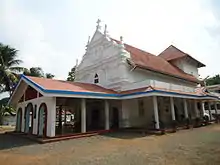
St Mary's Jacobite Syrian Church, Angamaly (now known as St. Mary's Soonoro Cathedral) of Jacobite Syrian Church was built in AD 409 and this is the first church built in Angamaly[3] and the mother church of Syrian Christians of Angamaly, in the historical town of the Syriac Christians in India. This church was the Metropolitan seat of the Malankara Metropolitan for centuries and this indicates the historical importance of this church in the Syrian Christianity.
| St. Mary's Soonoro Cathedral Angamaly | |
|---|---|
 St. Mary's Soonoro Cathedral Angamaly | |
| Religion | |
| Affiliation | Jacobite Syrian Orthodox Church |
| District | Ernakulam |
| Province | Kerala |
| Ecclesiastical or organizational status | Valiyapally |
| Year consecrated | AD 409 |
| Location | |
| Location |  Angamaly, Ernakulam, India Angamaly, Ernakulam, India |
| Geographic coordinates | 10.1906°N 76.3828°E |
| Architecture | |
| Type | Church |
| Style | Kerala Architecture |
| Founder | Archdeacon George of Christ[1][2] |
| Direction of façade | West |
History
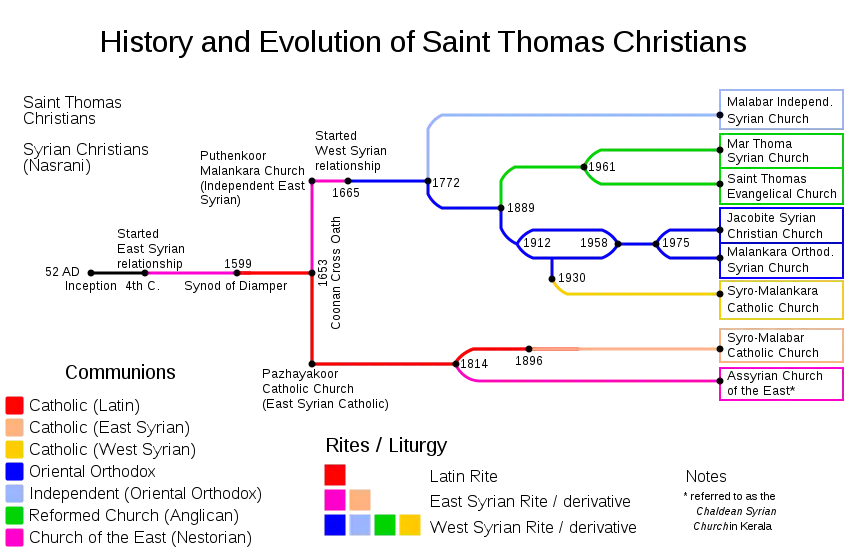
Tradition says that Apostle St. Thomas arrived India in AD 52 and sowed the seeds of the Gospel and about 400 Syrian families immigrated in AD 345 under the leadership of the merchant Knayi Thoma to a town named Mahathevar patnam, near Muziris, the famous port of Kodungalloor. This was the first known centre of Christians in India. Jews who had engaged in trade with the coast of Malabar had inhabited the city much earlier and had rights to land and other privileges there. Kodungalloor subsequently became less hospitable to Christians who took refuge Angamaly. The local chieftain of "Mangattu", also referred to as "Mangattachan", graciously welcomed Christians into the area and granted them many privileges including the right to establish a church, a market and a town in 'Ankamalee' (later Angamaly). The land for the Church in Angamaly was granted to the Syrian Christians next to his palace premises as a noble gesture. Thus the church was built with wood and thatched roofing in a location adjacent to the palace of the chieftain and in closer proximity to the palace. The number of Christians in Angamali swelled with the migration further, perhaps predominantly following the great flood in Periyar in 1341.[4] Later in 1523 the Muslim traders burnt down the Christian commercial establishments of Kodungallur and their church.[5] However, there was only one church back then in Angamali in 1550s.[6][7][2]
After the historic Coonan Cross Oath, a minority of this church was shown their affiliation to portuguese. A new chappel was constructed in the name of St George by the dissident party and separated from the mother church. Perron du Anquetil, French orientalist referred in his book about the St Mary's Church and its St George chapel. Thomas Whitehouse, a foreign historian in his book written in the year 1873 "Lingering of Lights in a Dark Land" described the affiliation of this church. He accounted this church to the Malankara Church by referring other historians such as Raulini,Du Perron and Paoli and also acounted the St George chapel to Romo Syrians[8]
According to tradition, Mar Yoohanon who represented the Malankara Church at the Holy Synod of Ephesus in AD 431 stayed at Marth Maryam Valiyapally Kothamangalam and had visited Ankamaly church.[9]
Archdeacons
Archdeacons of Pakalomattom family who administered from Ankamaly were Geevargese Kathanar (George of Christ ), Yakob Kathanar, Alexander Kathanar, and Geevargese Kathanar the second (Archdeacon George of the Cross). Geevargese the First was buried in this Church.
Synod of Diamper
The whole parish defied the decrees of the Synod of Diamper in 1599 and firmly stood with the Archdeacon in resisting the Portuguese Padroado. The Catholic historian Fr. Bernard records that the Syrian Christians in Mangad, Kochi, Purakad, and Thekkumkur who were loyal to the Ankamaly Syrian church were threatened by local kings and Petty chieftains to attend the Synod of Diamper in 1599, as commanded by the Portuguese.[10] The Raja of Cochin decreed that all assets of Syrian churches which abstain from the Synod of Diamper on 20 June 1599 will be confiscated.[11] The Angamaly Church defied the command and boycotted the Synod unanimously; All the eighteen priests of the church abstained from the Synod.[12]
It states that the militant Portuguese bishop through threats and offers of military support to the local king and chieftains managed to create a schism in the Church and established a Roman Catholic presence in Malankara. 84 out of the 116 total churches, including the Valiyapalli located next to the St Marys Church at Ankamaly, came under Latin Catholic influence. The 32 churches that remained with Archdeacon, continued to be administered by him from Angamaly.
Coonan Cross Oath
After the Coonan Cross Oath of 1653, a delegate of the Syriac Orthodox Patriarch of Antioch, Mor Gregorios Abdal Jaleel a Bishop of Jerusalem, arrived in Malankara. In 1665 he regularized the consecration of Thoma I as the first Metropolitan Bishop of Malankara. At first during his reign Thoma I was assisted by Angamaly Vengoor Gevarghese Kathanar, Kadavil Chandy Kathanar, Parambil Chandy Kathanar, and Anjimootil Itty Thoman Kathanar, who lead the Coonan Cross Oath in 1653. The seat of Thoma I was at Angamaly. He was buried in this church in 1670.
Estrangelo Bible
In 1808 an ancient Bible written during the headship of Dionysius the Great at the Angamaly church was presented to the Anglican missionary Rev. Claudius Buchanan; This Bible is now preserved in the archives of the Cambridge University Library. This Syriac Bible might have been brought to India by Fathers from the Holy See of Antioch as in its appendix you can see intercessory prayers to St. Mary and Mar Severios. This Estrangelo Bible written in East Syriac might have been from the Persian Catholicate of the Syrian Orthodox Church.[13][14]
List of parishes originated from Angamaly Church
Twenty-eight parishes listed below have originated from the Ankamaly church.
- Akaparambu
- Aluva
- Avanankode
- Azhakam
- Chakkaraparambu
- Edakunnu
- Karayamparambu
- Keezhpariyaram
- Kidagoor
- Koratty
- Ponnamparambu
- Mambra
- Manjapra
- Mattur
- Mekkad
- Mukkanoor
- Nayathodu
- Nedumbassery
- Neduvannur
- Peechanikkadu
- Pirarur
- Poikkattussery
- Poothamkutty
- Thavalappara
- Thottakam
- Thiruvillamkunnu
- Thuruthissery
- Vappalassery
Gallery
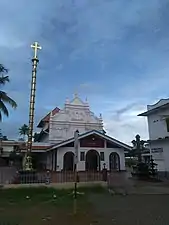 Angamaly Church
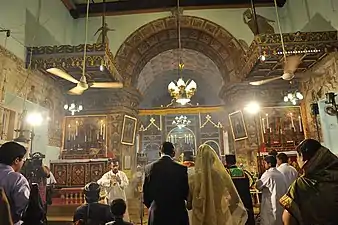 Altar room of Angamaly Syrian Church.
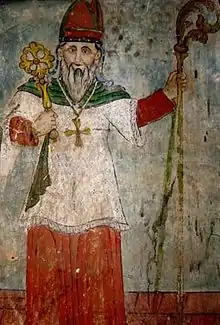 Mural Painting of Mar Thoma I.
.jpg.webp) Mural Painting of Last Judgement above the northern entrance.
Mural Painting of Last Judgement above the northern entrance..jpg.webp) Mural depicting hell above the southern entrance.
Mural depicting hell above the southern entrance.
References
- Department of Tourism. "Descriptions of St. Thomas Christians".
- Malekandathil (2020).
- https://www.keralatourism.org/christianity/picture-gallery/churches-kerala/1/28/28. Missing or empty
|title=(help) - Mathias Mundadan, St.Thomas Christians, 1498-1552, Bangalore, 1967, pp.76-9; 88-94
- Mathias Mundadan, St.Thomas Christians, 1498-1552, Bangalore, 1967, pp.76-9; 88-94
- “Informação do que fez o Padre Mestre Melchior Carneiro em uns Reinos que estão junto de Cochim pela terra dentro”, in Antonio da Silva Rego(ed.), Documentação para a Historia das Missões do Padroado Portugues do Oriente, Vol.8, Lisbon, 1952, p.498
- Ibid., pp.498-9
- (PDF) https://ia801208.us.archive.org/28/items/lingeringsofligh00whit/lingeringsofligh00whit.pdf. Missing or empty
|title=(help) - John Mason Neale, A history of the Holy Eastern Church : the Patriarchate of Antioch, (First published 1873. Republisher: Facsimile Publisher, 2015), p.6, ff.3..
- Fr. Bernad, Marthoma Christeeya Purapad (Malayalam), pp. 16,19.
- Philip, E.M. , The Indian Christians of St. Thomas , (Published 1908-Malayalam) p. 102
- Original-Govaeo(Portuguese), Reported-Fr. Xavier Koodapuzha Thirusabha Charithram (Malayalam) p. 620.
- Pukadiyil Itoop Writer, MALAYALATHULLA SURIYANI CHRISTIANKALUDE SABHA CHARITHRAM (Malayalam)( Changanassery, :1869; Mor Adai Study Center, 2004) p 151.
- Pearson Hugh, M.A.; Memoirs of the life and writings of the Rev. Claudius Buchanan, D.D. Published 1817. Benjamin & Thomas Kite, Philadelphia p 320-321
Sources
- Malekandathil, Pius (2020). "Angamali and the St. Thomas Christians: An Historical Overview". NSC Network. Retrieved 14 July 2020.
External links
 |
Wikimedia Commons has media related to St Mary's Jacobite Syrian Church, Angamaly. |
- Bibu Mathew Vayaliparambil Pynadathu. "Morth Mariam Church, Ankamaly". sor.cua.edu. Retrieved 2 September 2016.
- Jacobite Syrian Christian Church on Facebook
- Jacobite Syrian Christian Church
- Online Community and News Site of Jacobite Syrian Orthodox Church
- News Site Of Jacobite Syrian Orthodox Church
- Indian Christianity
- Malankara Syriac Orthodox Resources
- Malankara Jacobite Syriac Christian Network


Eastern Christian communion of autocephalous churches from Armenia, Egypt, Eritrea, Ethiopia, Sudan and parts of the Middle East, and India | ||
| Autocephalous churches |  | |
| Autonomous churches |
| |
| Independent churches | ||
| Liturgy | ||