Statue of Israel Putnam
General Israel Putnam is a monumental statue in Hartford, Connecticut, United States. Located in the city's Bushnell Park, the statue honors Israel Putnam, a military officer in the Continental Army during the American Revolutionary War. It was designed by sculptor John Quincy Adams Ward and dedicated in 1874.
 The statue in 2016 | |
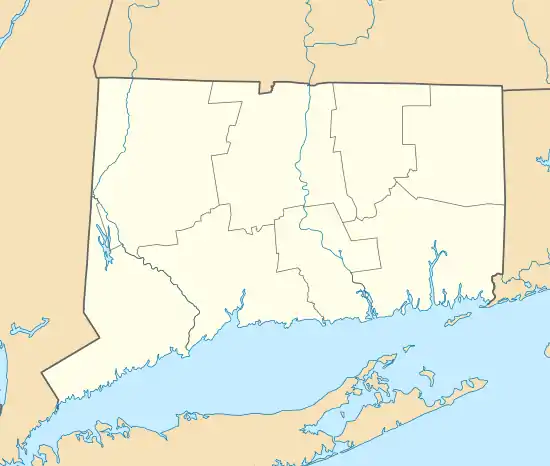  Location in Connecticut  Statue of Israel Putnam (the United States) | |
| Coordinates | 41°45′54.5″N 72°40′50.5″W |
|---|---|
| Location | Bushnell Park, Hartford, Connecticut, United States |
| Designer | John Quincy Adams Ward (sculptor) R. M. Hunt (architect) |
| Fabricator | Robert Wood & Company |
| Type | Statue |
| Material | Bronze Granite |
| Length | 5 feet (1.5 m) |
| Width | 4 feet (1.2 m) |
| Height | 17 feet (5.2 m) |
| Beginning date | 1872 or 1873 |
| Completion date | 1873 |
| Dedicated date | June 17, 1874 |
| Dedicated to | Israel Putnam |
History
Israel Putnam was a military officer who served as a major general in the Continental Army during the American Revolutionary War.[1] Born in Salem, Massachusetts in 1718, he moved to Connecticut in 1739 and died there in 1790, having become a folk hero in the state.[2] In 1869, Joseph P. Allyn, a judge from the state capital of Hartford, Connecticut, died.[1] In his will he allocated US$5,000 to his father and two other men for the purposes of erecting a monument in honor of Putnam in Hartford's Bushnell Park.[1] His father added an additional $5,000 of his own money and, in either 1872 or 1873,[3] the trustees chose to commission sculptor John Quincy Adams Ward to design a statue of Putnam.[1] The statue would be the first of six Revolutionary War sculptures Ward would create during his lifetime, and it was also the first sculpture he would work on following a trip to Europe.[2] Additionally, R. M. Hunt of New York City designed an accompanying pedestal, which cost about $2,000 and was paid for by the city government of Hartford.[1] Ultimately, the monument cost a total of at least $14,000.[note 1] Ward completed the sculpture in 1873 while he was also working on some sculptures for the Connecticut State Capitol, located near Bushnell Park.[5] Casting was performed by the Robert Wood & Company foundry in Philadelphia.[3] The monument was dedicated on June 17, 1874 in a large ceremony in the park.[1] The dedication took place on the anniversary of the Battle of Bunker Hill (a Revolutionary War battle in which Putnam participated almost 100 years prior) and occurred during a wave of monument-building in the United States that honored both Revolutionary and Civil War-era figures.[5] The statue would be one of the first to be erected in the park,[5] coming several years after the erection of the first statue in the park, one of Bishop Thomas Church Brownell, in 1869.[4]
In 1993, the monument was surveyed as part of the Save Outdoor Sculpture! project.[3]
Design

The monument consists of a bronze statue of Putnam, standing 7 feet (2.1 m) tall,[note 2] atop a granite pedestal standing 10 feet (3.0 m) tall.[3][1] The sculpture has side dimensions of approximately 2.5 feet (0.76 m) by 1.5 feet (0.46 m), while the rectangular pedestal has side measurements of 5 feet (1.5 m) by 4 feet (1.2 m).[3] Putnam is dressed in his military garb from the Revolutionary War, including a frock coat and cravat, and is depicted in midstride.[3][5] He is holding a sword by his side with his left hand while his relaxed right hand holds onto a tricorne.[3] According to an 1874 article in The Aldine, Ward modeled Putnam's face off of an ink portrait belonging to his descendants and a portrait created by John Trumbull.[3] The base of the sculpture bears markings from the designer and foundry (J.Q.A. WARD / 1873 / R. WOOD & CO / BRONZE FOUNDERS. / PHILA.), while the front of the pedestal reads "ISRAEL PUTNAM" and the back bears the inscription "PRESENTED / BY THE HONOURABLE / JOSEPH PRATT ALLYN / MDCCCLXXIII".[3]
The Bushnell Park Foundation, which oversees the park and administers the statue, observed that "[i]n Ward’s rendering of Putnam taking a step forward, he is no longer a static figure but a candid portrayal of a fleeting moment as the general strides forth", which lends "a more natural, spontaneous character and heightened the realism of his sculpture". They proceed to note that while the monument is "a radical departure from his work in the post-Civil War period, this statue marks a new and important dimension in his work".[2] Contemporary analysis was more mixed towards the statue. A 1903 article by Amanda M. Flattery in The Bay View Magazine lists the statue among several other examples of Ward's "genius", including his equestrian statue of George Henry Thomas and statue of George Washington.[6] However, an 1888 article by T. H. Bartlett in The American Architect and Building News states that the public was disappointed in Ward's portrayal of Putnam, saying, "Artists, as well as the public, have criticized, justly, the position and character of the statue."[7]
Notes
- Sources are slightly unclear on the exact cost. According to the Smithsonian Institution Research Information System, the "sculpture cost $14,000",[3] while an 1895 article in The Connecticut Quarterly stated that the sculpture cost $12,000, with the pedestal costing an additional $2,000.[4]
- A height of 7 feet (2.1 m) is given by the Smithsonian Institution Research Information System.[3] However, several other sources give a height of approximately 8 feet (2.4 m).[1][5]
References
- Bartlett 1888, p. 279.
- "Israel Putnam". Bushnell Park Foundation. Archived from the original on July 1, 2021. Retrieved October 21, 2021.
- "Israel Putnam, (sculpture)". Smithsonian Institution Research Information System. Archived from the original on October 21, 2021. Retrieved October 21, 2021.
- Adams 1895, p. 177.
- "General Israel Putnam". Public Art CT. Archived from the original on October 21, 2021. Retrieved October 21, 2021.
- Flattery 1903, p. 279.
- Bartlett 1888, p. 280.
Sources
- Adams, Sherman W. (April–June 1895). "The Hartford Park System". The Connecticut Quarterly. 1 (2): 173–179.
- Bartlett, T. H. (June 16, 1888). "Some American Monuments – IV". The American Architect and Building News. Ticknor & Company. XXIII (651): 279–282.
- Flattery, Amanda M. (March 1903). "Some Representative American Sculptors". The Bay View Magazine. 10 (5): 275–292.
External links
 Media related to Israel Putnam by John Quincy Adams Ward at Wikimedia Commons