Stewiacke
Stewiacke (/ˈstjuːiæk/) is a town located in southern Colchester County, Nova Scotia, Canada. The town was incorporated on August 30, 1906.
Stewiacke | |
|---|---|
Town | |
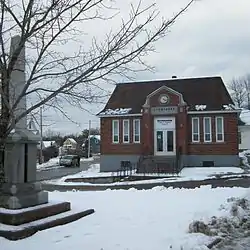 Town of Stewiacke Public Works Building and Cenotaph | |
 Flag  Coat of arms | |
| Nickname(s): Halfway between the North Pole and the Equator | |
| Motto(s): Respect, Prosperity, Growth | |
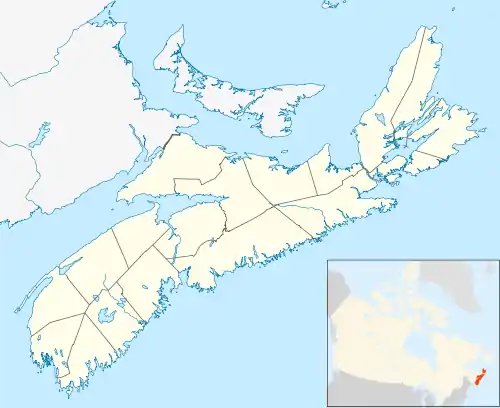  Stewiacke Location of Stewiacke, Nova Scotia | |
| Coordinates: 45°8′32″N 63°20′54″W | |
| Country | .svg.png.webp) Canada Canada |
| Province |  Nova Scotia Nova Scotia |
| Municipality | Colchester County |
| Incorporated | August 30, 1906 |
| Government | |
| • Mayor | George Lloy |
| • Governing Body | Stewiacke Town Council |
| • MLA | Larry Harrison |
| • MP | Lenore Zann (L) |
| Area (2016)[1] | |
| • Total | 17.62 km2 (6.80 sq mi) |
| Elevation | 100 m (300 ft) |
| Population | |
| • Total | 1,373 |
| • Density | 77.9/km2 (202/sq mi) |
| Time zone | UTC−4 (AST) |
| • Summer (DST) | UTC−3 (ADT) |
| Postal code | B0N 2J0 |
| Area code(s) | 902 |
| Telephone Exchange | 639, 671 |
| Median Earnings* | $55,339 |
| NTS Map | 11E3 Shubenacadie |
| GNBC Code | CBKOM |
| Website | stewiacke.net |
| |
Geography
The town is located in the Stewiacke Valley at the confluence of the Stewiacke and Shubenacadie Rivers, and is a service and support centre for local agricultural communities as well as a service exit on Highway 102.
The town is noted as being located halfway between the North Pole and the Equator (which is actually in Alton, Nova Scotia).[2] Controversy in the past over this claim stems from the fact that the Earth is not a perfect sphere, and therefore the halfway mark lies approximately 16 km North of the 45th parallel.[3]
History
Stewiacke was named in the language of the local Mi'kmaq First Nations and is a word meaning "flowing out in small streams" and "winding river" or "whimpering or whining as it goes".[4] During the French and Indian War, the British built Fort Ellis in the area to protect New England Planters from Mi'kmaq raids.
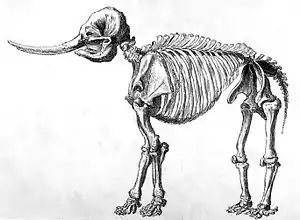
In the late 1990s, a tourism attraction named Mastodon Ridge opened near the town's highway exit, based on a local discovery of a mastodon skeleton. The Mastodon Ridge Complex features a craft store, toy store, a mini golf and interpretive centre which displays several of the mastodon's bones.
Stewiacke is home to a bar, a pharmacy, a grocery store, a pizzeria, numerous fast food restaurants, two gas stations, a hardware store, an 18-hole golf course and a newly built elementary school that consolidates 2 former local schools.
Stewiacke is also home to a volunteer fire brigade that was the first department in North America to use specialized foam as a fire suppression agent, alongside other achievements involving the implementation of certain fire apparatus.
The town's most notorious event occurred on April 12, 2001, when a local teenager, at home on a school in-service day, tampered with a railway switch on the CN Rail Halifax-Montreal mainline, causing Via Rail Canada's Ocean to derail several minutes later when it passed through the centre of the community.[5] Several buildings and rail cars were destroyed and many people were injured, including some severely, although no fatalities resulted.[5][6]
Demographics
In the 2016 Census of Population conducted by Statistics Canada, the Town of Stewiacke recorded a population of 1,373 living in 629 of its 681 total private dwellings, a change of -4.5% from its 2011 population of 1,438. With a land area of 17.62 km2 (6.80 sq mi), it had a population density of 77.9/km2 (201.8/sq mi) in 2016.[1]
Parks & Trails
- Dennis Park
- Stewiacke River Park
- Stewiacke Recreation Grounds
- Barking Lot - Off Leash Dog Park
- John Crawford Trail
- Stewiacke River Country Trail
- Fish Shack Trail
- Caddell Rapids Lookoff Provincial Park
Notable residents
- Hanson Dowell (1906–2000), president of the Canadian Amateur Hockey Association and member of the Nova Scotia House of Assembly[10]
References
- "Population and dwelling counts, for Canada, provinces and territories, and census subdivisions (municipalities), 2016 and 2011 censuses – 100% data (Nova Scotia)". Statistics Canada. February 8, 2017. Retrieved February 12, 2017.
- "The Burnside News - Burnside entrepreneur to develop Stewiacke industrial park". BurnsideNews.com. Archived from the original on 2009-04-16. Retrieved 2009-04-19.
- "Midway from the Equator to the North Pole - Journal of the Royal Astronomical Society of Canada". Harvard.edu. Bibcode:2000JRASC..94...48B. Retrieved 2009-04-19. Cite journal requires
|journal=(help) - "Museum, Government of Nova Scotia - 511 Windsor Lowlands". Museum.gov.ns.ca. Archived from the original on 2009-05-22. Retrieved 2009-04-19.
- "Youth sentenced to six months for derailing train". CBC.ca. 2002-11-06. Retrieved 2020-01-04.
- "Teen faces victims of N.S. train wreck". CBC.ca. 2002-08-30. Retrieved 2020-01-04.
- Census 1956-1961
- I:\ecstats\Agency\BRIAN\census2 NS Department of Finance Archived 2013-10-05 at the Wayback Machine
- Statistics Canada, 2011
- "Dowell, Hanson T. (The Honourable, QC) — 94". The Chronicle Herald. Halifax, Nova Scotia. September 25, 2000. p. 37.
External links
 |
Wikimedia Commons has media related to Stewiacke. |
Places adjacent to Stewiacke | ||||||||||||||||
|---|---|---|---|---|---|---|---|---|---|---|---|---|---|---|---|---|
| ||||||||||||||||


| Towns | 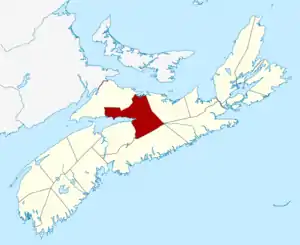 | |
|---|---|---|
| First Nations | ||
| Indian reserves | ||
| Unorganized subdivisions |
| |
| ||
| Counties | |
|---|---|
| County municipalities | |
| Regional municipalities | |
| District municipalities | |
| Towns | |
| Villages | |
| Economic regions | |
| Lists | |
| |


