Streif
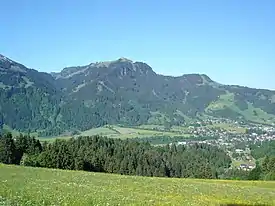
Streif is a World Cup ski course located on Hahnenkamm mountain (Kitzbühel Alps) in Kitzbühel, Austria, opened in 1937.
| Streif | |
|---|---|
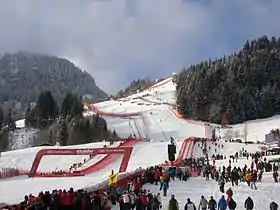 lower section from top (Hausberg–Traverse–Zielschuss) | |
| Place: |  Kitzbühel Kitzbühel |
| Mountain: | Hahnenkamm |
| Member: | Club5+ |
| Opened: | 1937 |
| Competition: | Hahnenkamm Races |
| Downhill | |
| Start: | 1,665 m (5,463 ft) (AA) |
| Finish: | 805 m (2,641 ft) |
| Vertical drop: | 860 m (2,822 ft) |
| Length: | 3,312 m (10,866 ft) |
| Level: |  expert expert |
| Max. incline: | 40.4° degrees (85%) |
| Avr. incline: | 15.1° degrees (27%) |
| Min. incline: | 1.1° degrees (2%) |
| Time record: | 1:51.58 by Fritz Strobl (1997) |
| Most wins: |  Didier Cuche (5x) Didier Cuche (5x) |
The track runs on natural terrain (pasture in summer) with minor modifications done over the years.
Downhill is part of Hahnenkamm Races, the world's second oldest ski competition.
History
In 2006, morning fog at the top of the course forced race organizers to lower the start 115 m (380 ft) to the middle of the Karusell (carousel), below the Mausefalle. This shortened the length of the course by 347 m (1,140 ft).[1] The downhill race was cancelled in 2005 and 2007.
In 2008, strong upwinds at the Mausefalle caused race officials to lower the start 50 m (160 ft), shortening the course by 100 m (330 ft). This eliminated most of the Startschuss and its instantaneous speed; the Mausefalle was accordingly altered to a speed-inducing pitch, rather than a formidable jump and compression. Though Didier Cuche won the race, the 2008 edition is likely best remembered for the high-speed crash of Scott Macartney on the Zielsprung, seconds before the finish, as well as Bode Miller tying for second with Mario Scheiber after riding the safety fencing in the Steilhang section.
The full course returned in 2009, for the first time in five years, with Didier Défago of Switzerland winning the race. In addition to having the fastest time, he also had the highest speed on the Zielschuss at 88.4 mph (142.3 km/h). It was the second consecutive downhill victory for Défago; he won the Lauberhorn downhill the previous week at Wengen to join a handful of skiers to win both classic races in consecutive weeks.[2] It was last accomplished by Stephan Eberharter of Austria in 2002 and had been 17 years since a Swiss racer won both (1992 - Franz Heinzer). The final training run on Thursday saw the serious crash of Swiss racer Daniel Albrecht, again at the Zielsprung. It resulted in a three-week coma and Albrecht's absence from the World Cup circuit for the remainder of the 2009 season and the entire 2010 season.
The full course was run in 2010 under clear skies and again won by Didier Cuche, who had also won the Super-G the previous day. The only significant crash was by former champion Michael Walchhofer, who twisted into the net fence at the final left turn, less than 20 seconds from the finish; he was quickly back on his feet. Cuche's downhill victory was his third on the Streif, his first was in 1998 on a Friday "extra" race. The Zielsprung was significantly moderated in 2010 due to the serious accidents the previous two years.
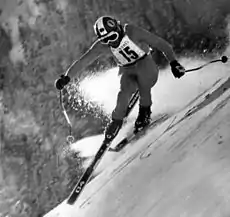
In 2011, Didier Cuche won the Hahnenkamm downhill for the fourth time to tie the record with Franz Klammer.[3] A year later, and two days after announcing his retirement at the end of the season, Cuche claimed his third consecutive downhill victory at Kitzbühel and a record fifth total.[4]
Dominik Paris claimed the title in 2013 to become the second winner from Italy and the first in fifteen years.[5][6]

record 5 downhills in total

Due to lack of snow in 2014, the lower course was altered. The dramatic Querfahrt sidehill traverse and speed-inducing Zielschuss were bypassed; the racers detoured toward the Ganslern slalom slope, then rejoined the course for the final Rasmusleitn. This extended the overall length by 182 m (199 yd) to 3.494 km (2.171 mi) and reduced the finishing speed. Hannes Reichelt was the first winner from Austria in eight years.
Upper mountain fog in 2015 forced the start to the Seidlalm jump, the lowest in history. Kjetil Jansrud of Norway won in less than a minute on the lower 50% of the course.[7]
High winds in 2016 lowered the start 40 m to the top of Mausefalle. On the full course in 2017, Paris became a two-time winner.
Course
Sections
Sections of the Streif downhill course include:[8]
- "Startschuss" (Starthang) – 51% incline (27°), from 0 to 100 km/h in 8.5 seconds
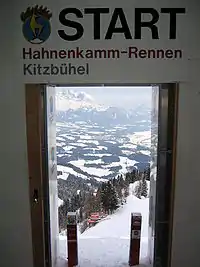
- "Mausefalle" (mousetrap) – 85% incline jump (40.4°), compression, and left turn
- "Karusell" (carousel) – demanding 180° degrees leaning turn
- "Steilhang" (steep slope) – 72% incline, extended technical right turn, entrance to the flats
- "Brückenschuss & Gschöss" – gliding flats road, time to take a little breath, but not to lose speed
- "Alte Schneise" (old corridor)
- "Seidlalmsprung" (jump at Seidlalm) – introduced in 1994, next to house where World Cup was founded
- "Lärchenschuss" – gliding among larch trees
- "Hausberg" (local mountain) – 70% incline, jump & sharp left corner
- "Querfahrt" (traverse) – a rough sidehill of glare ice, strong leaning bumpy terrain, defying gravity
- "Zielschuss" (with compression & jump) – top speed over 145 km/h (90 mph)
- "Rasmusleitn" to the finish (Ziel).
Facts and figures
- The length of the Streif course is 3.312 km (2.058 mi).[8]
- The starting gate is at an elevation of 1,665 m (5,463 ft) above sea level;
the Streif vertically descends 860 m (2,822 ft) to the finish at 805 m (2,641 ft).[8] - The average grade of the course is 27 percent (15.1 degrees).
- The maximum grade is 85% (40.4°) at the Mausefalle; minimum is 2% (1.1°) [9]
- The record for the full 3.3 km course was set in 1997 by Fritz Strobl of Austria at 1:51.58,[10] an average speed of 106.9 km/h (66.4 mph), and an average vertical descent rate of 7.7 m/s (25.3 ft/sec).
- The first non-European to win a downhill race at Kitzbühel in the World Cup era was Ken Read of Canada in 1980.[11] Previously, the only non-European champion was Buddy Werner of the U.S., who won in 1959 at age 22. Canadians won races four consecutive years from 1980–83; the only non-European winner since is Daron Rahlves of the U.S., who prevailed on an abbreviated course of 2.0 km (1.2 mi) due to fog in 2003.
- Four victories have gone to Scandinavians, all from Norway. Atle Skårdal was the first in 1990 and Lasse Kjus won twice, in 1999 and 2004; both of Kjus' victories were "extra" races, held on Friday and Thursday, respectively. Kjetil Jansrud won on a shortened course in 2015.[7]
- The Streif course was one of several featured in the 1969 movie Downhill Racer, starring Robert Redford and Gene Hackman. It was shown as itself and later as the Olympic course, with race footage from the 1969 race.
- The Streif course was first used in 1937; eight years without Hahnenkamm races followed (1938–45) until the return in 1946.[12]
- Since returning in 1946, the downhill races have been run in all but eight years: 1952, 1964, 1970, 1971, 1988, 1993, 2005, & 2007.
Downhill champions
The following is a list of Hahnenkamm downhill winners, with their winning times:[13]
| Year | Date | Winner | Nation | Time | Notes |
|---|---|---|---|---|---|
| World Cup | |||||
| 2022 | January 22 | ||||
| January 21 | |||||
| 2021 | January 24 | Beat Feuz (2) | Switzerland |
1:55.29 | (Sunday) - moved from Saturday due to weather (rain, snow) |
| January 22 | Beat Feuz (1) | Switzerland |
1:53.77 | (Friday) - extra race, Wengen races cancelled (COVID-19) | |
| 2020 | January 25 | Matthias Mayer | Austria |
1:55.59 | |
| 2019 | January 25 | Dominik Paris (3) |  Italy Italy |
1:56.82 | (Friday) - moved from Saturday due to weather forecasts |
| 2018 | January 20 | Thomas Dressen |  Germany Germany |
1:56.15 | |
| 2017 | January 21 | Dominik Paris (2) | Italy |
1:55.01 | |
| 2016 | January 23 | Peter Fill | Italy |
1:52.37 | high winds - start lowered 40 m to top of Mausefalle, length reduced 100 m |
| 2015 | January 24 | Kjetil Jansrud |  Norway Norway |
0:58.16 | fog - shortened to lower 50% of course - 1.6 km [7][14] |
| 2014 | January 25 | Hannes Reichelt | Austria |
2:03.38 | lack of snow, Querfahrt and Zielschuss bypassed, course length extended |
| 2013 | January 26 | Dominik Paris (1) | Italy |
1:57.56 | [15] |
| 2012 | January 21 | Didier Cuche (5) | Switzerland |
1:13.28 | snowing - shortened to lower 60% of course - 2.0 km [16] |
| 2011 | January 22 | Didier Cuche (4) | Switzerland |
1:57.72 | [17] |
| 2010 | January 23 | Didier Cuche (3) | Switzerland |
1:53.74 | [18] |
| 2009 | January 24 | Didier Défago | Switzerland |
1:56.09 | [2][19] |
| 2008 | January 19 | Didier Cuche (2) | Switzerland |
1:52.75 | start lowered 50 m to top of Mausefalle, due to upwinds [20] |
| 2007 | lack of snow and warm temperatures | no downhill or Super G races held[21] | |||
| 2006 | January 21 | Michael Walchhofer | Austria |
1:46.75 | start moved to the bottom of the Mausefalle due to fog/safety [22] |
| 2005 | safety reasons; snow and rain | no downhill race held[23] | |||
| 2004 | January 24 | Stephan Eberharter (2) | Austria |
1:55.48 | |
| January 22 | Lasse Kjus (2) | Norway |
1:58.78 | (Thursday) - extra race, Wengen DH cancelled (snow, wind) | |
| 2003 | January 25 | Daron Rahlves |  United States United States |
1:09.63 | shortened due to fog - lower 60% of course - 2.0 km [24] |
| 2002 | January 19 | Stephan Eberharter (1) | Austria |
1:54.21 | |
| 2001 | January 20 | Hermann Maier | Austria |
1:56.84 | |
| 2000 | January 22 | Fritz Strobl (2) | Austria |
1:46.54 | shortened |
| 1999 | January 23 | Hans Knauß | Austria |
1:54.18 | |
| January 22 | Lasse Kjus (1) | Norway |
2:14.13 | (Friday) | |
| 1998 | January 24 | Kristian Ghedina | Italy |
2:05.49 | |
| January 23 | Didier Cuche (1) | Switzerland |
2:31.55 | two shortened runs [25] | |
| 1997 | January 25 | Fritz Strobl (1) | Austria |
1:51.58 | record time for full course, set 24 years ago [10] |
| January 24 | Luc Alphand (3) |  France France |
2:12.55 | (Friday) | |
| 1996 | January 13 | Günther Mader | Austria |
1:54.29 | record: held for 1 year |
| 1995 | January 14 | Luc Alphand (2) | France |
1:40.97 | shortened |
| January 13 | Luc Alphand (1) | France |
1:40.33 | (Friday) shortened | |
| 1994 | January 15 | Patrick Ortlieb | Austria |
2:00.12 | |
| 1993 | lack of snow | snowmaking added that summer | |||
| 1992 | January 18 | Franz Heinzer (3) | Switzerland |
1:56.63 | |
| January 17 | Franz Heinzer (2) | Switzerland |
1:56.04 | (Friday) record: held for 4 years | |
| 1991 | January 12 | Franz Heinzer (1) | Switzerland |
1:58.71 | |
| 1990 | January 20 | Atle Skårdal | Norway |
2:26.20 | |
| 1989 | January 13 | Marc Girardelli |  Luxembourg Luxembourg |
2:01.25 | (Friday) |
| January 14 | Daniel Mahrer | Switzerland |
1:58.42 | ||
| 1988 | lack of snow | ||||
| 1987 | January 25 | Pirmin Zurbriggen (3) | Switzerland |
1:58.06 | |
| 1986 | January 18 | Peter Wirnsberger (2) | Austria |
2:02.04 | |
| January 17 | Peter Wirnsberger (1) | Austria |
2:01.77 | (Friday) | |
| 1985 | January 12 | Pirmin Zurbriggen (2) | Switzerland |
2:08.65 | |
| January 11 | Pirmin Zurbriggen (1) | Switzerland |
2:06.95 | (Friday) | |
| 1984 | January 21 | Franz Klammer (4) | Austria |
2:02.82 | |
| 1983 | January 22 | Todd Brooker | .svg.png.webp) Canada Canada |
2:01.96 | |
| January 21 | Bruno Kernen | Switzerland |
2:06.68 | (Friday) | |
| 1982 | January 16 | Steve Podborski (2) | Canada |
1:57.24 | |
| January 15 | Harti Weirather | Austria |
1:57.20 | (Friday) record: held for 10 years [10] | |
| 1981 | January 17 | Steve Podborski (1) | Canada |
2:03.46 | |
| 1980 | January 12 | Ken Read | Canada |
2:04.93 | |
| 1979 | January 20 | Sepp Ferstl (2) | West Germany |
2:04.48 | |
| 1978 | January 21 | Josef Walcher (2) & Sepp Ferstl (1) |
Austria West Germany |
2:07.81 | tie |
| 1978 | January 20 | Josef Walcher (1) | Austria |
2:06.90 | (Friday) |
| 1977 | January 15 | Franz Klammer (3) | Austria |
2:09.71 | |
| 1976 | January 25 | Franz Klammer (2) | Austria |
2:03.79 | |
| 1975 | January 18 | Franz Klammer (1) | Austria |
2:03.22 | record: held for 7 years |
| 1974 | January 26 | Roland Collombin (2) | Switzerland |
2:03.29 | record: held for 1 year |
| 1973 | January 27 | Roland Collombin (1) | Switzerland |
2:13.32 | |
| 1972 | January 15 | Karl Schranz (4) | Austria |
2:24.36 | |
| January 14 | Karl Schranz (3) | Austria |
2:23.70 | (Friday) | |
| 1971 | no dowhnill races held | ||||
| 1970 | |||||
| 1969 | January 18 | Karl Schranz (2) | Austria |
2:18.80 | |
| 1968 | January 20 | Gerhard Nenning | Austria |
2:14.49 | |
| 1967 | January 21 | Jean-Claude Killy | France |
2:11.82 | record: held for 7 years [10] |
| FIS–A | |||||
| 1966 | Karl Schranz (1) | Austria |
2:16.6 | record: held for 1 year | |
| 1965 | Ludwig Leitner | West Germany |
2:30.8 | ||
| 1964 | lack of snow | ||||
| 1963 | Egon Zimmermann | Austria |
2:20.7 | record: held for 3 years | |
| 1962 | Willi Forrer | Switzerland |
2:37.6 | ||
| 1961 | Guy Périllat | France |
2:29.2 | ||
| 1960 | Adrien Duvillard | France |
2:26.1 | record: held for 3 years[10] | |
| 1959 | Buddy Werner | United States |
2:33.4 | record: held for 1 year | |
| 1958 | Anderl Molterer (2) | Austria |
2:40.7 | record: held for 1 year | |
| 1957 | Toni Sailer (2) | Austria |
2:47.1 | ||
| 1956 | Toni Sailer (1) | Austria |
2:57.8 | ||
| 1955 | Anderl Molterer (1) | Austria |
2:46.2 | record: held for 3 years | |
| 1954 | Christian Pravda (2) | Austria |
2:47.9 | record: held for 1 year | |
| 1953 | January 17 | Bernhard Perren | Switzerland |
2:54.5 | record: held for 1 year |
| International | |||||
| 1952 | not on calendar | ||||
| 1951 | February 7 | Christian Pravda (1) | Austria |
2:57.1 | |
| 1950 | March 11 | Fritz Huber | Austria |
3:04.3 | |
| 1949 | February 5 | Egon Schöpf | Austria |
3:03.0 | |
| 1948 | March 13 | Helmut Lantschner | Austria |
3:16.3 | |
| 1947 | March 7 | Karl Feix | Austria |
3:36.0 | |
| 1946 | March 2 | Thaddäus Schwabl (2) | Austria |
3:04.3 | |
| 1945 | no races held | ||||
| 1944 | |||||
| 1943 | |||||
| 1942 | |||||
| 1941 | |||||
| 1940 | |||||
| 1939 | |||||
| 1938 | |||||
| 1937 | March 19 | Thaddäus Schwabl (1) | Austria |
3:53.1 | premiere on Streif course (held there since then) |
| 1936 | March 7 | Freidl Pfeifer | Austria |
5:03.2 | held on "Penkelstein" slope |
| 1935 | March 23 | Siegfried Engl | Austria |
4:38.8 | held on "Stickelberg" slope |
| 1934 | planned, but not announced; due to political reasons | ||||
| 1933 | |||||
| 1932 | March 19 | Walter Prager | Switzerland |
7:56.4 | held on "Stickelberg" slope |
| 1931 | March 28 | Ferdl Friedensbacher | Austria |
4:34.2 | held on "Flecklam" slope |
- Each downhill champion's name is affixed to a gondola car on the Hahnenkammbahn lift, which extends from the Kitzbühel base to the top of the Hahnenkamm mountain.
Club5+
In 1986, elite Club5 was originally founded by prestigius classic downhill organizers: Kitzbühel, Wengen, Garmisch, Val d’Isère and Val Gardena/Gröden, with goal to bring alpine ski sport on the highest levels possible.[26]
Later over the years other classic longterm organizers joined the now named Club5+: Alta Badia, Cortina, Kranjska Gora, Maribor, Lake Louise, Schladming, Adelboden, Kvitfjell, St.Moritz and Åre.[27]
References
- "Results Kitzbühel Downhill 2006" (PDF). International Ski Federation. Archived from the original (PDF) on 2011-05-26. Retrieved 2009-01-27.
- "Defago wins World Cup downhill on Streif". USA Today. Associated Press. 2009-01-24. Retrieved 2009-01-31.
- "Cuche wins Hahenkamm DH, pushes Bode Miller to second". Ski Racing.com. January 22, 2011.
- "Cuche wins Hahnenkamm DH for record fifth time". Ski Racing.com. January 21, 2012.
- "Dom Paris wins Hahnenkamm DH for Italy". Ski Racing.com. January 26, 2013.
- Jelusic, Ana (January 26, 2013). "Dominik Paris tames the Streif". FIS Alpine.com.
- Mintz, Geoff (January 24, 2015). "Jansrud wins shortest-ever Hahnenkamm downhill". Ski Racing.
- "Racing courses overview diagram". Kitzbüheler Ski Club. Retrieved 2013-01-26.
- "Downhill "Streif"". Kitzbüheler Ski Club. Archived from the original on 2013-04-20. Retrieved 2013-01-26.
- "Distance Records "Streif" Course record". Kitzbüheler Ski Club. Archived from the original on 2013-01-06. Retrieved 2013-01-26.
- "Results for Ken Read". FIS-ski.com. Archived from the original on 2012-08-05. Retrieved 2014-02-15.
- "Results - Former HKR" (in German). Kitzbüheler Ski Club. Archived from the original on 2013-01-29. Retrieved 2013-01-26.
- "Honor Roll - the champions, men, downhill". Kitzbüheler Ski Club. Archived from the original on 2012-01-23. Retrieved 2013-01-26.
- "Results Kitzbühel Downhill 2015". International Ski Federation. Retrieved 2015-01-25.
- "Results Kitzbühel Downhill 2013". International Ski Federation. Archived from the original on 2013-01-29. Retrieved 2013-01-26.
- "Results Kitzbühel Downhill 2011". International Ski Federation. Archived from the original on 2012-01-23. Retrieved 2012-01-21.
- "Results Kitzbühel Downhill 2011". International Ski Federation. Archived from the original on 2011-01-24. Retrieved 2011-01-22.
- "Results Kitzbühel Downhill 2010". International Ski Federation. Archived from the original on 2010-01-26. Retrieved 2010-01-25.
- "Results Kitzbühel Downhill 2009". International Ski Federation. Archived from the original on 2009-04-21. Retrieved 2010-01-25.
- "Results Kitzbühel Downhill 2008". International Ski Federation. Archived from the original on 2011-05-26. Retrieved 2008-12-01.
- "Like it or not, men prep for Kitz slalom-fest". skiracing.com. 2007-01-26. Retrieved 2009-01-20.
- "Kitzbuehel: Walchhofer wins downhill; Rahlves, Miller check in at 3-4". skiracing.com. 2006-01-21. Retrieved 2009-01-27.
- "KITZBUEHEL 2005: Hahnenkamm downhill cancelled for safety reasons". skiracing.com. 2005-01-22. Retrieved 2009-01-20.
- "Results Kitzbühel Downhill 2003" (PDF). International Ski Federation. Archived from the original (PDF) on 2011-05-26. Retrieved 2009-01-27.
- "Results Kitzbühel Extra Downhill 1998". International Ski Federation. Archived from the original on 2011-06-04. Retrieved 2010-01-25.
- "Srečko Medven predsednik elitnega združenje (page 9)" (in Slovenian). Naše novice. June 2010.
- "Club5+ workshop in Adelboden". saslong.org. 23 October 2021.