Stupendemys
Stupendemys is an extinct genus of freshwater side-necked turtle, belonging to the family Podocnemididae. It is the largest freshwater turtle known to have existed, with a carapace over 2 metres long. Its fossils have been found in northern South America, in rocks dating from the Middle Miocene to the very start of the Pliocene, about 13 to 5 million years ago.[1][2]
| Stupendemys Temporal range: | |
|---|---|
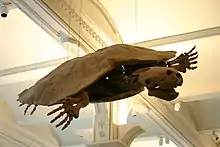 | |
| Stupendemys geographicus at the AMNH | |
Scientific classification  | |
| Kingdom: | Animalia |
| Phylum: | Chordata |
| Class: | Reptilia |
| Order: | Testudines |
| Suborder: | Pleurodira |
| Family: | Podocnemididae |
| Genus: | †Stupendemys Wood, 1976 |
| Type species | |
| Stupendemys geographicus Wood, 1976 | |
| Synonyms | |
| |
Description
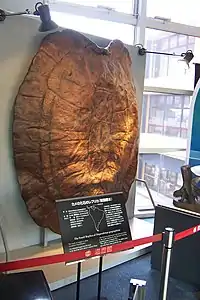
A nearly complete fossil of Stupendemys's carapace measured over 2.35 m (7.7 ft) in length and was also very wide.[3] Based on this specimen, a larger but less complete fossil carapace would have had an estimated total carapace length of more than 3.3 m (11 ft), making it one of the largest turtles that ever existed, rivaling even Archelon.[3] The largest freshwater turtle living in the Neotropics today, the Arrau turtle (Podocnemis expansa), is a pleurodire closely related to Stupendemys, which only grows up to 75 centimetres (30 in),[4] less than half the length of Stupendemys. Males of S. geographicus have a pair of horns present on either side of the carapace around the neck opening. These horns are deeply grooved, suggesting that they were the covered by a keratinous sheath. These were presumably used for combat between individuals, as similar behaviour is known in extant species.[5]
Taxonomy
Only one species, S. geographicus, is presently considered valid.[5] Synonyms include S. souzai was recovered from the Solimões Formation in Acre State, Brazil.[2] and Caninemys, which was described from skull material.[5] Its remains have been found in the Urumaco Formation of Venezuela and in the Villavieja Formation of Colombia.[5] It is considered to belong to the subfamily Erymnochelyinae within Podocnemididae, and is most closely related to Carbonemys from the Paleocene of Colombia.[6]
Ecology
Its weight helped Stupendemys stay under water for extended periods of time, grazing on aquatic plants. On the other hand, it was probably a very weak swimmer, unable to move its bulk against a swift current, and thus probably avoided smaller streams.[2]
S. geographicus inhabited what is known as the Pebas system, a large wetland system that dominated northern South America during the Miocene.[7] The wetlands seemed to have favoured gigantism in other aquatic animals, like the crocodylian Purussaurus and rodent Phoberomys.
Its growth rate is similar to extant turtles, suggesting a lifespan of perhaps 110 years to get to maximum size.[5]
Thought its diet was previously interpreted as carnivorous, though a well preserved jaw indicates it might have had a more generalist diet, possibly durophagous or including fruit.[5]
Since S. geographicus fossils have been found in sites which yield a rich fossil fauna, even though little is known with certainty, much can be inferred about the ecology of these animals. Among the aquatic animals that shared the habitat with S. souzai were fish, including catfish such as Phractocephalus and Callichthyidae, characids such as Acregoliath rancii and the tambaqui (Colossoma macropomum), the South American lungfish (Lepidosiren paradoxa), trahiras (e.g. Paleohoplias assisbrasiliensis) and freshwater rays and sharks. Crocodilians were diverse and abundant, among them such taxa as Charactosuchus fisheri, Gryposuchus, Mourasuchus, Nettosuchidae and the giant Purussaurus brasiliensis. Other turtles and tortoises found in the same deposits are Chelus columbiana[8] (a fossil relative of the mata mata) and Chelonoidis. Further aquatic vertebrates included river dolphins and the large darter "Anhinga" fraileyi.[2]
Terrestrial mammals were plentiful, and the fauna included many megaherbivores, like the ground sloth Acremylodon campbelli, Toxodontidae (e.g. Gyrinodon and Trigodon), Proterotheriidae, and caviomorph rodents, some of them of immense size also (e.g. Kiyutherium, Neoepiblema, Phoberomys burmeisteri, Potamarchus murinus, Telicomys amazonensis and Tetrastylus). Smaller mammals living in that time and place were the ateline monkey Stirtonia and the bulldog bat Noctilio lacrimaelunaris.[2]
Altogether, this fauna is massively dominated by large herbivores and generally lacks terrestrial carnivores. It can thus be assumed that the habitat was mostly low-lying rainforest that was seasonally flooded, as well as floodplains and swampland. The rivers must have been wide and slow-moving, as the fossil-rich rocks are alluvial deposits and do not show evidence of fast-flowing riverbeds that would have dug into the sediment deeply while depositing little of their own.[2]
References
 Paleontology portal
- Wood, R. C. (1976). "Stupendemys geographicus, the world's largest turtle". Breviora. 436: 1–31.
- Bocquentin, Jean; Melo, Janira (2006). "Stupendemys souzai sp. nov. (Pleurodira, Podocnemididae) from the Miocene-Pliocene of the Solimões Formation, Brazil" (PDF). Revista Brasileira de Paleontologia. 9 (2): 187–192. doi:10.4072/rbp.2006.2.02.
- Stupendemys: Giant Amongst Mega-Turtles
- Cox, Barry; Dixon, Dougal; Gardiner, Brian (2001). Dinosaurier und andere Tiere der Vorzeit [Dinosaurs and other prehistoric animals] (in German). Gondrom Verlag. ISBN 3-8112-1138-2.
- Cadena, E.-A.; Scheyer, T.M.; Carrillo-Briceño, J.D.; Sánchez, R.; Aguilera-Socorro, O.A.; Vanegas, A.; Pardo, M.; Hansen, D.M.; Sánchez-Villagra, M.R. (12 Feb 2020). "The anatomy, paleobiology, and evolutionary relationships of the largest extinct side-necked turtle". Science Advances. 6 (7): eaay4593. doi:10.1126/sciadv.aay4593. PMC 7015691. PMID 32095528.
- Ferreira, Gabriel S.; Bronzati, Mario; Langer, Max C.; Sterli, Juliana. "Phylogeny, biogeography and diversification patterns of side-necked turtles (Testudines: Pleurodira)". Royal Society Open Science. 5 (3): 171773. doi:10.1098/rsos.171773. PMC 5882704. PMID 29657780.
- Hoorn, C.; Wesselingh, F. P.; ter Steege, H.; Bermudez, M. A.; Mora, A.; Sevink, J.; Sanmartin, I.; Sanchez-Meseguer, A.; Anderson, C. L.; Figueiredo, J. P.; Jaramillo, C. (2010-11-11). "Amazonia Through Time: Andean Uplift, Climate Change, Landscape Evolution, and Biodiversity". Science. 330 (6006): 927–931. Bibcode:2010Sci...330..927H. doi:10.1126/science.1194585. ISSN 0036-8075. PMID 21071659. S2CID 206528591.
- "Giant fossil matamata turtles (matamatas part V)". Archived from the original on 2011-10-11. Retrieved 2011-10-11.
https://www.sbpbrasil.org/revista/edicoes/9_2/RBP9-2-Jean.pdf