Love (1971 film)
Love (Hungarian: Szerelem) is a 1971 Hungarian drama film directed by Károly Makk. Based on two short stories by Tibor Déry, Szerelem (1956) and Két asszony (1962), it stars Lili Darvas and Mari Törőcsik. The film was selected as the Hungarian entry for the Best Foreign Language Film at the 44th Academy Awards, but was not accepted as a nominee.[1]
| Love | |
|---|---|
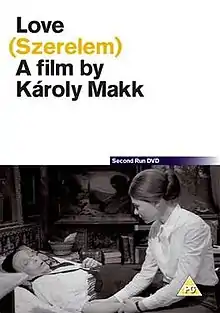 Theatrical film poster | |
| Hungarian | Szerelem |
| Directed by | Károly Makk |
| Written by | Péter Bacsó Tibor Déry (novel) |
| Starring | Lili Darvas Mari Törőcsik |
| Cinematography | János Tóth |
| Edited by | György Sívó |
| Music by | András Mihály |
| Distributed by | Ajay Film Company (USA) |
Release date |
|
Running time | 84 minutes |
| Country | Hungary |
| Language | Hungarian |
Today, Love is considered a classic of world cinema by critics including Derek Malcolm and Roger Ebert. The film was selected for screening as part of the Cannes Classics section at the 2016 Cannes Film Festival.[2] The film was chosen to be part of the New Budapest Twelve, a list of Hungarian films considered the best in 2000.[3]
Cast
- Lili Darvas as the old woman
- Mari Törőcsik as Luca
- Iván Darvas as János
- Erzsi Orsolya as Irén
- László Mensáros as the doctor
- Tibor Bitskey as Feri
- András Ambrus as guard
- József Almási as teacher
- Zoltán Bán as barber
- Éva Bányai as Feri's servant
- Ágnes Dávid as Feri's servant
- Mária Garamszegi as Feri's servant
- Alíz Halda as teacher's assistant
- Magda Horváth as Kissné
- Nóra Káldi as the old woman at a young age
Historical background
In 1953, following the death of the Soviet premier Joseph Stalin, many arrested people were released in Hungary. In Love, Makk tells the story of a young Hungarian woman whose husband has been arrested by the secret police, and who eases his mother's last months with the tale that her son is in America.
Reception
Love won three prizes, including the Jury Prize at the 1971 Cannes Film Festival.[4] It has also been acclaimed in recent years; Derek Malcolm ranked it one of The Guardian's 100 best films of the 20th century.[5]
See also
References
- Margaret Herrick Library, Academy of Motion Picture Arts and Sciences.
- "Cannes Classics 2016". Cannes Film Festival. 20 April 2016. Retrieved 2 October 2021.
- "Új Budapesti Tizenkettő". Filmvilág. XLIII (3): 2. March 2000.
- "Festival de Cannes: Love". festival-cannes.com. Retrieved 2 October 2021.
- Malcolm, Derek (17 January 2001). "In no particular order". The Guardian. Retrieved 2 October 2021.