Talha
Ṭalḥa ibn ʿUbayd Allāh al-Taymī (Arabic: طَلْحَة بن عُبَيْد اللّه التَّيمي; 594–656) was a companion of the Islamic prophet Muhammad. In Sunni Islam, he is mostly known for being among the ten to whom Paradise was promised. He is best known for his roles in the Battle of Uhud and the Battle of the Camel, in which he died. According to Sunnis, he was given the title "The Generous" by Muhammad.[1]
Talha ibn Ubaydullah | |
|---|---|
طلحة ابن عبيدالله | |
 | |
| Title | Blessed Companion, Jawad – the Generous |
| Personal | |
| Born | c. 594 C.E. |
| Died | c. 656 C.E / 36 A.H |
| Resting place | Basra, Iraq |
| Religion | Islam |
| Muslim leader | |
Influenced by | |
Early life
Talha was born c. 594,[2] He was the son of Ubayd Allah ibn Uthman ibn Amr ibn Ka'b ibn Sa'd ibn Taym ibn Murra ibn Ka'b ibn Lu'ay ibn Ghalib. His lineage meets with the lineage of the prophet Muhammad at Murra ibn Ka'b. His mother, al-Sa'ba bint Abd Allah, was from the Hadram tribe.
He is described as a dark-skinned man with a lot of wavy hair, a handsome face and a narrow nose. He liked to wear saffron-dyed clothes and musk. He walked swiftly and, when nervous, he would toy with his ring, which was of gold and set with a ruby.[2]: 167–168
Talha was a successful cloth-merchant who eventually left an estate estimated at 30 million dirhams.[2]: 153, 169–1670
Acceptance of Islam
In 612, his kinsman Abu Bakr took him to visit Muhammad, and Talha became a Muslim.[2]: 164 He was said to have been one of the first eight converts.[3]: 115
During the persecution of the Muslims in 614–616, Nawfal ibn Khuwaylid tied Talha to Abu Bakr and left them roped together. Nobody from the Taym clan came to help.[2]: 164 Thereafter they were known as "the Two Tied Together".[3]: 127–128, 337
Emigration to Medina
In September 622, Talha was bringing a caravan home from Syria when he met Muhammad and Abu Bakr at al-Kharrar. They had escaped from Mecca and were emigrating to Medina. Talha gave them some Syrian garments and mentioned that the Muslim community in Medina had said that their prophet was slow to arrive. As Muhammad and Abu Bakr continued to Medina, Talha returned to Mecca to put his affairs in order. Soon afterwards, he accompanied Abu Bakr's family to Medina, where he settled.[2]: 164
At first he lodged with As'ad ibn Zurara, but later Muhammad gave him a block of land on which he built his own house. He was made the brother in Islam of Sa'id ibn Zayd.[2]: 165 Talha and Sa'id missed fighting at the Battle of Badr because Muhammad sent them as scouts to locate Abu Sufyan's caravan. However, both were awarded shares of the plunder, as if they had been present.[2]: 165
Talha distinguished himself at the Battle of Uhud by keeping close to Muhammad while most of the Muslim army fled. He protected Muhammad's face from an arrow by taking the shot in his own hand, as a result of which two of his fingers were paralysed. He was also hit twice in the head, and it was said that he suffered a total of 75 wounds in the battle.[2]: 165–166
Talhah also fought at the Battle of the Trench "and all the battles with Allah's Messenger".[2]: 166
Ridda Wars
In the third week of July 632, Medina faced an imminent invasion by the apostate forces of Tulayha, a self-proclaimed prophet. Abu Bakr scraped together an army mainly from the Hashim clan (the clan of Muhammad), appointing Talha, Ali ibn Abi Talib and Zubayr ibn al-Awwam as Commanders of one-third of the newly organised force each.
Family
Talha had at least fifteen children by at least eight different women.[4]
- Hamna bint Jahsh of the Asad tribe, whom he married in 625
- Muhammad ibn Talha, who was also killed at the Battle of the Camel
- Imran ibn Talha
- Khawla bint ibn Ma’bad ibn Zurara ibn Adas ibn Zayd of the Tamim tribe
- Musa ibn Talha
- Umm Kulthum bint Abi Bakr
- Zakariya
- Yusuf, who died in childhood
- A'isha bint Talha
- Suda bint Aqf of the Murra clan
- Isa
- Yahya
- al-Jarba bint Qasama (Umm al-Harith) of the Tayy tribe
- Umm Ishaq bint Talha ibn Ubayd Allah, married first to Hasan ibn Ali and later to the latter's brother Husayn ibn Ali
- Umm Aban bint Utbah ibn Rabi'ah
- Ya'qub "the Generous", who was killed at the Battle of al-Harrah
- Isma'il bin Talha
- Ishaq ibn Talha
- A concubine
- al-Sa'ba
- Another concubine
- Maryam
- al-Faraa bint Ali, a war-captive from the Taghlib tribe
- Salih
Battle of the Camel and death
The Battle of the Camel was fought between Ali on one side and Aisha, Talha and Zubayr on the other on 10 December 656. According to some sources, during the battle, Marwan ibn al-Hakam, who was fighting on the same side as Aisha, shot Talha in the thigh. Marwan commented, "After this I will never again seek a killer of Uthman." Other sources attributes Talha's death to being killed by Ali's supporters while retreating from the field.[5] Talha hugged his horse and galloped off the battle-field. He lay down using a stone as a pillow, while the auxiliaries tried to staunch the blood-flow. Whenever they stopped pressing, the bleeding resumed. In the end Talha said, "Stop it. This is an arrow sent by God." He died of this injury, aged 64.[2]: 170–171
According to a hadith, Muhammad named Talha among the ten to whom Paradise was promised (Arabic: العشرة المبشرون, al-ʿashara al-mubashsharūn).[6]
Tomb
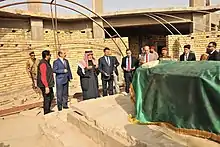
The tomb of Talha ibn Ubayd Allah is located in Basra, Iraq. The tomb is located near a large mosque with modern architecture. The grave itself is under the cenotaph under the dome, which is built in a similar style to the cenotaph of Anas ibn Malik.
See also
References
- سير أعلام النبلاء، لشمس الدين الذهبي، ترجمة طلحة بن عبيد الله، الجزء الأول، صـ 24: 40 Archived 18 December 2017 at the Wayback Machine
- Muhammad ibn Saad. Kitab al-Tabaqat al-Kabir vol. 3. Translated by Bewley, A. (2013. The Companions of Badr. London: Ta-Ha Publishers.
- Muhammad ibn Ishaq. Sirat Rasul Allah. Translated by Guillaume, A. (1955). The Life of Muhammad. Oxford: Oxford University Press.
- Muhammad ibn Saad. Kitab al-Tabaqat al-Kabir vol. 8. Translated by Bewley, A. (1995). The Women of Madina. London: Ta-Ha Publishers:
- Landau-Tasseron 1998, pp. 27–28, note 126.
- Abu Dawud 41:4632.
Sources
- Landau-Tasseron, Ella, ed. (1998). The History of al-Ṭabarī, Volume XXXIX: Biographies of the Prophet's Companions and their Successors: al-Ṭabarī's Supplement to his History. SUNY Series in Near Eastern Studies. Albany, New York: State University of New York Press. ISBN 978-0-7914-2819-1.
External links
Authority control  | |
|---|---|
| General | |
| National libraries | |
| Other | |