Tamang language
Tamang (Devanagari: तामाङ; tāmāng) is a term used to collectively refer to a dialect cluster spoken mainly in Nepal, Sikkim, West Bengal (Darjeeling) and North-Eastern India. It comprises Eastern Tamang, Northwestern Tamang, Southwestern Tamang, Eastern Gorkha Tamang, and Western Tamang. Lexical similarity between Eastern Tamang (which is regarded as the most prominent) and other Tamang languages varies between 81% to 63%. For comparison, lexical similarity between Spanish and Portuguese, is estimated at 89%.[4]
| Tamang | |
|---|---|
| तामाङ, རྟ་དམག་ / རྟ་མང་/ | |
| Native to | Nepal India Bhutan |
| Ethnicity | Tamang/Moormi |
Native speakers | 1.35 million in Nepal (2011 census)[1] 20,154 in India (2011 census)[2] |
Sino-Tibetan
| |
| Tamyig script, Devanagari, Tibetan | |
| Official status | |
Official language in |  Nepal Province No. 3(additional) Nepal Province No. 3(additional)
|
| Language codes | |
| ISO 639-3 | Variously:taj – Eastern Tamangtdg – Western Tamangtmk – Northwestern Tamang (not distinct)tge – Eastern Gorkha Tamang |
| Glottolog | nucl1729 |
Official status
The Language Commission of Nepal has recommended Tamang language as official language in Bagmati Province.[5]
Dialects
Ethnologue divides Tamang into the following varieties due to mutual unintelligibility.
- Eastern Tamang: 759,000 in Nepal (2000 WCD). Population total all countries: 773,000. Sub-dialects are as follows.
- Outer-Eastern Tamang (Sailung Tamang)
- Central-Eastern Tamang (Temal Tamang)
- Southwestern Tamang (Kath-Bhotiya, Lama Bhote, Murmi, Rongba, Sain, Tamang Gyoi, Tamang Gyot, Tamang Lengmo, Tamang Tam)
- Western Tamang: 323,000 (2000 WCD). Sub-dialects are as follows.
- Trisuli (Nuwakot)
- Rasuwa
- Northwestern dialect of Western Tamang (Dhading) — separate ISO code. Population 55,000 (1991 census). Spoken in the central mountainous strip of Nuwakot District, Bagmati Province.
- Southwestern dialect of Western Tamang
- Eastern Gorkha Tamang: 4,000 (2000 WCD). Sub-dialects are as follows.
- Kasigaon
- Kerounja
The Tamang language is the most widely spoken Sino-Tibetan language in Nepal.
Geographical distribution
Ethnologue gives the following location information for the varieties of Tamang.
Eastern Tamang
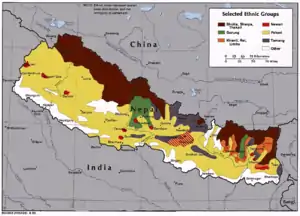
- Bagmati Province: Bhaktapur District, Chitwan District, Dolkha District, Kathmandu District, Kavrepalanchok District, Lalitpur District, Makwanpur District, eastern Nuwakot District, Ramechhap District, Sindhuli District and western Sindhupalchowk District
- Province No. 1: Okhaldhunga District, western Khotang District, and Udayapur District
Southwestern Tamang
- Bagmati Province: Chitwan District, southern Dhading District, western and northwestern Kathmandu District area and northwestern Makwanpur District
- Province No. 2: Bara District, Parsa District and Rautahat District
Western Tamang
- Bagmati Province: western Nuwakot District, Rasuwa District, and Dhading District
- central mountainous strip of Nuwakot District, Bagmati Province (Northwestern Tamang)
- northeastern Sindhupalchok District, Bagmati Province: Bhote Namlan, and Bhote Chaur, on Trishuli river west bank toward Budhi Gandaki river
- northwestern Makwanpur District, Bagmati Province: Phakel, Chakhel, Khulekhani, Markhu, Tistung, and Palung
- northern Kathmandu District, Bagmati Province: Jhor, Thoka, and Gagal Phedi
Eastern Tamang
- south and east of Jagat, northern Gorkha District, Gandaki Province
Grammar
Some grammatical features of the Tamang languages include:
- A canonical word order of SOV
- Use of postpositions;
- The genitives follow nouns;
- question word medial;
- It is an ergative–absolutive language;
- CV, CVC, CCV, V, CCVC;
Phonetically Tamang languages are tonal.
Phonology
Consonants
| Labial | Dental/ Alveolar |
Retroflex | Palatal | Velar | Glottal | ||
|---|---|---|---|---|---|---|---|
| Stop | voiceless | p | t | ʈ | k | ||
| aspirated | pʰ | tʰ | ʈʰ | kʰ | |||
| palatalized | pʲ | tʲ | ʈʲ | kʲ | |||
| labialized | pʷ | tʷ | ʈʷ | kʷ | |||
| Affricate | voiceless | ts | |||||
| aspirated | tsʰ | ||||||
| palatalized | tsʲ | ||||||
| labialized | tsʷ | ||||||
| Fricative | s | h | |||||
| Nasal | m | n | ŋ | ||||
| Rhotic | r | ||||||
| Approximant | w | l | j | ||||
Vowels
| Front | Back | |
|---|---|---|
| Close | i iː | u uː |
| Mid | e eː | o oː |
| Open | a aː | |
Nasality only marginally occurs, and is typically transcribed with a [ã] mark.
Tones
Four tones occur as high falling [â], mid-high level [á], mid-low level [à], very low [ȁ].[6]
Writing system
Tamang language is written in Tamyig script.
References
- Eastern Tamang at Ethnologue (18th ed., 2015)
Western Tamang at Ethnologue (18th ed., 2015)
Northwestern Tamang (not distinct) at Ethnologue (18th ed., 2015)
Eastern Gorkha Tamang at Ethnologue (18th ed., 2015) - "Statement 1: Abstract of speakers' strength of languages and mother tongues - 2011". www.censusindia.gov.in. Office of the Registrar General & Census Commissioner, India. Retrieved 7 July 2018.
- "50th Report of the Commissioner for Linguistic Minorities in India" (PDF). 16 July 2014. p. 109. Archived from the original (PDF) on 2 January 2018. Retrieved 6 November 2016.
- Ethnologue report for Spanish
- "सरकारी कामकाजको भाषाका आधारहरूको निर्धारण तथा भाषासम्बन्धी सिफारिसहरू (पञ्चवर्षीय प्रतिवेदन- साराांश) २०७८" (PDF). Language Commission. Language Commission. Retrieved 28 October 2021.
- Mazaudon (2003)
Bibliography
- Perumal Samy P. (2013). Tamang in LSI Sikkim, volume I Page Nos. 404-472. Published by Office of the Registrar General & Census Commissioner,India, Ministry of Home Affairs, Government of India.
- Hwang, Hyunkyung; Lee, Seunghun J.; P. Gerber; S. Grollmann (2019). "Laryngeal contrast and tone in Tamang: an analysis based on a new set of Tamang data". Journal of the Phonetic Society of Japan (23.1): 41–50. doi:10.24467/onseikenkyu.23.0_41.
External links
 |
Tamang language test of Wikipedia at Wikimedia Incubator |
- Counting in Tamang
- ELAR archive of Tamang