Tanqua Millash
Tanqua Millash (Tigrinya: ታንቋ ምላሽ) is a district in the Tigray Region of Ethiopia. Located in the Central Tigray zone, Tanqua Millash is a newly created district from parts of the Tanqua Abergelle and Dogu’a Tembien distrcits in 2020. Agbe is the capital of this district.
Tanqua Millash
ታንቋ ምላሽ | |
|---|---|
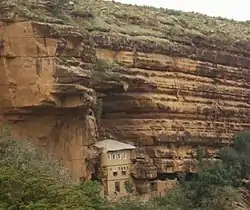 Abune Aregewi church in Zeyi, holding the entrance of the Zeyi cave | |
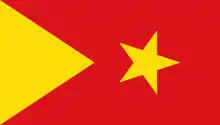 Flag | |
| Coordinates: 13°33′N 39°3′E | |
| Country | Ethiopia |
| Region | Tigray |
| Zone | Central Tigray |
Geography
The literal translation of Tanqua Millash is "beyond (south of) Tanqua River". Agriculture forms the mainstay of Tanqua Millash’s economic life. As elsewhere in most districts of Tembien, social services were hardly developed until the 1990s. After that, schools and health centers of the calling have emerged. The backwardness was partly attributed to the region's relative geographic remoteness from the center.[1]
History
2020 district reorganisation
Between 2018 and 2020, as part of a reform aimed to deepen and strengthen decentralisation, districts were reorganised, and a new district organisation came into existence in Tigray.[2] As smaller towns had been growing, they have started providing a range of services (markets, even banks), so that people were travelling to the closest such towns for these services, but continued to have to travel to the formal district centre, often in a different direction, for most government administrative services. A huge consultation, involving numerous village meetings, was organised in 2018 and 2019, with heated debates, particularly in the more remote areas. Based on these consultations, the earlier district Abergele became inoperative and as of early 2020, its territory belongs to the following new districts:
- Abergele (new, smaller, district)
- Tanqua Millash district (part of it)
Tanqua Millash comprises the municipalities of Simret, Menachek and Mizan which were transferred from Dogu'a Tembien.
Rock churches
Tanqua Millash holds several rock-hewn or monolithic churches. They have literally been hewn from rock, probably before the 10th C. CE,[3][4][5] One such church is located along the slopes of the Degua Tembien massif. The Kidane Mihret rock church of Addi Nefas (13°33.3′N 39°1.44′E) is hewn from Adigrat sandstone.[6][3] Further up, in the municipalities of Simret, Menachek and Mizan that were recently transferred from Degua Tembien to Tanqua Millash, there are an additional eight rock churches and natural caves with a church at its entrance.[6]
Demographics
The population pyramid has a wide base, not unlike most other low-income countries. However, the two lower age groups show that the pyramid base has stopped widening; this concerns particularly the group of 0–9 years old with an even more pronounced effect in the group of 0–4 years old, thus indicating a timid onset of a demographic transition. This may be related to the improved health services and the changing position of women in society. Indeed, a revised Family Code came into effect in 2000, advocating the principles of gender equality. This raised the minimum age of marriage from 15 to 18 years old and established women rights in terms of sharing any assets the household has accumulated. The Ethiopian penal code states that it is a crime to beat one's wife, and harmful traditional practices such as early marriage, abduction and female genital mutilation are now also considered to be a crime. Nowadays, almost all children are going to school but girls frequently drop out when they reach the age of 13 to 15 years: schools have no facilities for menstrual hygiene management and this is a major reason to interrupt schooling.[7]
Agriculture
Cropping
A sample enumeration performed by the CSA in 2001 interviewed 15,123 farmers in this district, who held an average of 1.63 hectares of land. Of the 24,690 hectares of private land surveyed, 87% was in cultivation, 0.2% pasture, 11% fallow, and 1.7% was devoted to other uses. For the land under cultivation in this district, 82% was planted in cereals, 2.3% in pulses, 3% in oilseeds, and 0.02% in vegetables. Four hectares were planted in fruit trees and 18 in gesho. Land tenure in this district is distributed amongst 85% owning their land, and 15% renting; the percentage reported as holding their land under other forms of tenure is missing.[8]
Livestock
In 2001, 89% of the farmers both raised crops and livestock, while 10% only grew crops and 0.5% only raised livestock.[8]
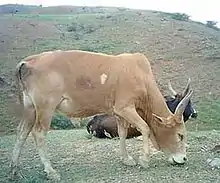
Mainly used for draught, among the different cattle landraces in Tigray,[9][10] Jointly with Abergele, Tanqua Millash holds its own landrace, the small and resistant Abergele cattle.[11] Other landraces include the Arado cattle, the widely dominant variety of adjacent districts. In addition, long-horned Raya oxen are purchased from Southern Tigray as draught animals.
Notes
- Igziabher, Taddesse Gabre (1972). Power Struggle in Tigray During Zamana Masafint. Addis Ababa: Haile Sellassie I University.
- Annys, S., Vanden Bempt, T., Negash, E., De Sloover, L., Ghekiere, R., Haegeman, K., Temmerman, D., Nyssen, J., 2021. Tigray: Atlas of the humanitarian situation, version 2.1. Ghent (Belgium): Ghent University, Department of Geography Archived 13 October 2021 at archive.today
- Sauter, R. "Eglises rupestres du Tigré". Annales d'Ethiopie. 10: 157–175. doi:10.3406/ethio.1976.1168.
- Plant, R.; Buxton, D. (1970). "Rock-hewn churches of the Tigre province". Ethiopia Observer. 12 (3): 267.
- Gerster, G. (1972). Kirchen im Fels – Entdeckungen in Äthiopien. Zürich: Atlantis Verlag.
- Nyssen, J. (2019). Description of Trekking Routes in Dogu'a Tembien. GeoGuide. Cham (CH): SpringerNature. pp. 557–675. doi:10.1007/978-3-030-04955-3_38. ISBN 978-3-030-04954-6.
- Nyssen, J.; De Rudder, F.; Vlassenroot, K.; Fredu Nega; Azadi, Hossein (2019). Socio-demographic profile, food insecurity and food-aid based response. In: Nyssen J., Jacob, M., Frankl, A. (Eds.). Geo-trekking in Ethiopia's Tropical Mountains - The Dogu'a Tembien District. SpringerNature. ISBN 978-3-030-04954-6.
- "Central Statistical Authority of Ethiopia. Agricultural Sample Survey (AgSE2001). Report on Area and Production - Tigray Region. Version 1.1 - December 2007" Archived 14 November 2009 at the Wayback Machine (accessed 26 January 2009)
- Merha Zerabruk; Vangen, O; Mitiku Haile (2007). "The status of cattle genetic resources in North Ethiopia: On-farm characterization of six major cattle breeds". Animal Genetic Resources Information. 40: 15–32. doi:10.1017/S1014233900002169.
- Cattle breeds, milk production, and transhumance in Dogu'a Tembien. In: Geotrekking in Ethiopia's tropical mountains, Chapter 28. Cham: SpringerNature. 2019. doi:10.1007/978-3-030-04955-3_28.
- Merha Zerabruk; Vangen, O (2005). "The Abergelle and Irob cattle breeds of North Ethiopia: description and on-farm characterization". Animal Genetic Resources Information Bulletin. 36: 7–20. doi:10.1017/S101423390000184X.