Telediario
Telediario (Tele-journal) is a flagship television newscast, produced by the Spanish public service broadcaster Televisión Española (TVE). It is the longest running program in the history of television in Spain as it has been broadcast daily since 15 September 1957.
| Telediario | |
|---|---|
 | |
| Genre | News |
| Country of origin | Spain |
| Original language | Spanish (along with local languages in some regional bulletins) |
| Production | |
| Producer | Televisión Española |
| Running time | 60 minutes (3pm/9pm editions) 150 minutes (Telediario Matinal) |
| Release | |
| Original network | La 1 24 Horas TVE Internacional |
| Original release | 15 September 1957 – present |
| Chronology | |
| Preceded by | Últimas Noticias |
| Related shows | La 2 Noticias |
| External links | |
| Website | |
Three Telediario editions a day are produced by Televisión Española news services and are simulcast live on La 1, on 24 Horas news channel, on TVE Internacional and on their website. Previous editions are available on their website on demand. Additional international editions are also produced and aired on TVE Internacional every day.
TVE's territorial centers in every Autonomous community produce and broadcast in their territory, with the news from there, a shorter local midday newscast, each one with a different name, following the format and visual identity of Telediario.
History
Televisión Española was established at Paseo de la Habana in Madrid and began its broadcasts in October 1956. Just one week after its premiere, the news services were created and its initial newscast, named Últimas Noticias, began broadcast. The newscast only lasted until that Summer break. On 15 September 1957, Telediario evening edition was broadcast for the first time.[1] The afternoon edition premiered on 28 April 1958.[2]
When Prado del Rey was inaugurated on 18 July 1964 in Pozuelo de Alarcón (Madrid), the production of shows and fiction was soon transferred to the new facilities and the news services fully occupied Paseo de la Habana premises. They were there until they were also transferred to Prado del Rey in 1967.[1] In 1975 it started its broadcasts in color.
On 13 November 1983, it was broadcast the last Telediario from Prado del Rey,[3] as TVE news services was moved to the new Torrespaña facilities in Madrid at the foot of the communications tower.[4] On 14 November, Telediario was broadcast from Torrespaña for the first time, and it has been broadcast from there since then.[5]
On 14 July 1989, it was presented out-of-studio for the first time. It was partially presented live from the Champ de Mars in Paris, with the Eiffel Tower in the background, on the occasion of the bicentennial of the French Revolution.[6] Since then, the main presenters have anchored on location on special occasions or when major stories break.
On 11 September 2001, Telediario 1 began with the breaking live feed of the World Trade Center's North Tower since it had been hit a few minutes before. That edition ran for more than seven hours, making it the longest Telediario news bulletin in its history.[1]
Many presenters and correspondents have worked for Telediario. Letizia Ortiz Rocasolano was an anchor for three years (2000–03), just until the day before the unexpected announcement of her engagement with then Prince of Asturias Felipe de Borbón. Writer Arturo Pérez-Reverte was a TVE war correspondent for 21 years (1973–94) and chronicled, among others, the Bosnian war. Rosa María Mateo was an anchor for 20 years (1973–93). Ana Blanco has been an anchor since 15 September 1990.[7]
In 2019, a plan to transfer TVE news services and Telediario back to Prado del Rey starting in late 2021 was approved.[8] However, Telediario would start broadcasting in Prado Del Rey earlier than planned on 15 February 2021 at its afternoon bulletin at 15:00 CET. It was presented by Ana Blanco and its first bulletin in the new set was a report on Catalonia's regional elections.
Programme format
The programme is generally presented by a sole main newsreader with an additional sports news presenter. News items are produced, with the footage taken by their own cameramen, by the central newsroom of TVE news services in Torrespaña, by the newsrooms of TVE Territorial Centers across Spain, by TVE foreign correspondents around the world or by on-the-scene special reporters. All the news feeds are coordinated by TVE news services master control room in Torrespaña. Additional footage can be taken from TVE Historical Audiovisual Archive, from Eurovision news exchange service or from news agencies. Many items are preceded by the journalist reporting live (Directo) from the scene of the story. The 60-minute programme is followed by a weather report known as El Tiempo, produced by RTVE meteorological service with the data from the State Meteorological Agency. The entire running time including El Tiempo is about 70 minutes.
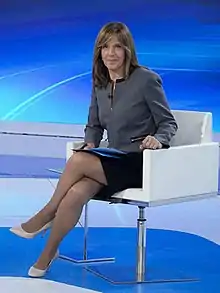
Sirún Demirjián presents Telediario Matinal, the breakfast edition consisting of a rolling news service that airs for two hours from 06:30 CET, with Rubén Briones presenting the sports. Ana Blanco presents Telediario 1, the afternoon edition at 15:00 CET, with Lourdes García Campos presenting the sports. Carlos Franganillo presents Telediario 2, the flagship evening edition at 21:00 CET, with Arsenio Cañada presenting the sports. Lara Siscar presents Telediario Fin de Semana, the weekend editions at 15:00 CET and 21:00 CET, with Marcos López presenting the sports.
All Telediario editions provide closed captioning and the 24 Horas news channel simulcast include sign language interpretation during the bulletins.
List of presenters (present)
Telediario Matinal (Monday to Friday, 06:30 CET)
- Presenter: Sirún Demirjián
- Sports commentator: Rubén Briones
Telediario 1 (Monday to Friday, 15:00 CET)
- Presenter: Ana Blanco
- Sports commentator: Lourdes García Campos
Telediario 2 (Monday to Friday, 21:00 CET)
- Presenter: Carlos Franganillo
- Sports commentator: Arsenio Cañada
Telediario Fin de Semana (Saturday and Sunday, 15:00 CET and 21:00 CET)
- Presenter: Lara Siscar
- Sports commentator: Marcos López
List of presenters (former)
- Adela Cantalapiedra (1978–1985)
- Alberto Delgado (1971–1983)
- Alfredo Urdaci (1998–2004)
- Almudena Ariza (1990–1991, 1994, 1996–1998)
- Ana Roldán (2006–2012)
- Ana Rosa Quintana (1982–1983)
- Andrés Aberasturi (1988)
- Ángeles Caso (1985–1987)
- Anna Castells (1989–1990)
- Antonio Martín Benítez (1991–1997)
- Baltasar Magro (1983)
- Beatriz Pérez-Aranda (2003)
- Blanca Álvarez (1958–1970)
- Blanca Gala (1968–1969)
- Carlos Herrera Crusset (1985)
- Carmen Tomás (2000–2004)
- César Macía (1999–2000)
- Clara Isabel Francia (1975–1977)
- Concha García Campoy (1985–1987)
- Cristina García Ramos (1979–1983)
- David Cantero (2004–2010)
- David Cubedo (1957–1965)
- Eduardo Sancho (1956–1966)
- Eduardo Sotillos (1976–1978, 1995–1996)
- Elena Sánchez (1987–1993, 2004–2006)
- Ernesto Sáenz de Buruaga (1996–1998)
- Felipe Mellizo (1984–1985)
- Fernando González Delgado (1993–1996)
- Florencio Solchaga (1971–1975)
- Francine Gálvez (1990–1991)
- Francisco Lobatón (1985–1987)
- Helena Resano (2003–2006)
- Igor Gómez (2000–2006)
- Iñaki Gabilondo (1981)
- Isabel Tenaille (1987)
- Javier Vázquez (1973–1975)
- Jesús Álvarez (1957–1967)
- Jesús Hermida (1990–1991)
- Joaquín Arozamena (1981–1984)
- José Miguel Flores (1978–1979)
- José Ribagorda (1997–2004)
- Josep María Balcells (1991–1992)
- Josep Puigbó (2003–2004)
- Julio César Fernández (1968–1970)
- Ladislao Azcona (1976–1977)
- Letizia Ortiz (2003)
- Lluís Guilera (2018–2020)
- Lorenzo Milá (2004–2009)
- Luis Carandell (1985–1987)
- Luis de Benito (1987–1988)
- Luis Mariñas (1987–1990)
- Manuel Almendros (1976–1977)
- Manuel Campo Vidal (1983–1987)
- Mari Carmen García Vela (1975–1978, 1981–1983)
- María Casado (2006–2012)
- María José Molina (2000–2004)
- María Pau Domínguez (1989–1990)
- María San Juan (1988)
- Matías Prats Luque (1991–1998)
- Miguel Adrover (1989–1990)
- Montserrat Balfegó (1993–1995)
- Nieves Romero (1976–1977)
- Paco Montesdeoca (1984)
- Pedro Altares (1993–1995)
- Pedro Macía (1973–1980)
- Pedro Meyer (1974–1981)
- Pedro Piqueras (1988–1993)
- Pedro Sánchez Quintana (1996–1999)
- Pepa Bueno (2009–2012)
- Pepe Navarro (1984)
- Oriol Nolis (2013–2014)
- Ramón Pellicer (1993–1996)
- Ramón Sánchez Ocaña (1972–1975)
- Ricardo Fernández Deu (1976–1977)
- Rosa María Artal (1983)
- Rosa María Mateo (1973–1993)
- Sandra Sutherland (1994–1997)
- Santiago Vázquez (1961–1973)
- Secundino González (1987)
- Susana Roza (2004–2012)
- Tello Zurro (1978–1985)
- Teresa Castanedo (1988–1989)
- Victoria Prego (1981–1982)
Sports commentators
- Jesús Álvarez Cervantes (1989–2013)
- María Escario (1985–2014)
- Mari Carmen Izquierdo (1979–1983)
- Miguel Ors (1973–1978)
- J. J. Santos (1997–2002)
- Sergio Sauca (1990–2020)
- Miguel Vila (1975–1979)
- Olga Viza (1987–1992)
Reporters and correspondents
- Almudena Ariza (2000–present)
- Alvaro López de Goicoechea Nalda (2008–present)
- Ángela Rodicio (1989–2003)
- Anna Bosch (1998–present)
- Antonio Parreño (2005–present)
- Arturo Pérez-Reverte (1985–1994)
- Carlos Franganillo (2008–present)
- Diego Carcedo (1977–1988)
- Jesús Hermida (1967–1978)
- Julio Bernárdez (1990–1996)
- Luis de Benito (1994–2008)
- Lorenzo Milá (2003 2004 2009, −2014 )
- Miguel Angel García Rodríguez (2007–present)
- Miguel Ángel Idigoras (2013–present)
- María Serén (2013–present)
- Marisa Rodríguez Palop (2014–present)
- Paloma Gómez Borrero (1978–1983)
- Pedro Erquicia (1978–1984)
- Rosa María Calaf (1983–2009)
- Rosa María Molló (2003–2011)
- Sagrario Ruiz de Apodaca (2002–2003)
- Sagrario Garcia Masacaraque (2014–present)
- Maríà Oña (2014–2016)
- Marcos Lopez (2016–present)
- Yolanda Álvarez (2011–present)
- Nuria Ramos (2015–present)
- Vicenç Sanclemente (2015–present)
- Erika Reija (2015–present)
- Sandra Urdín (2014–2015)
- Íñigo Herráiz (2015–present)
- Yolanda Álvarez (2011–2015)
- Óscar Mijallo (2015–present)
- José Ramón Patterson (2015–present)
- Álvaro López de Goicoechea (2008–present)
Weather forecasters
- Mariano Medina (1957–1980)
- Manuel Toharia (1970–1980)
- Eugenio Martín Rubio (1968–1982)
- Pilar Sanjurjo (1979–1985)
- José Antonio Maldonado (1986–2008)
- Charo Pascual (1988–1990)
- Paco Montesdeoca (1990–2007)
- Albert Barniol (2005– )
- José Miguel Gallardo (2008– )
- Mònica López (2008–)
- Martín Barreiro (2010–)
Broadcast times
On weekdays, the programme is broadcast three times daily:
- 06:30–08:30 CET Telediario Matinal
- 15:00–16:00 CET Telediario 1
- 21:00–22:00 CET Telediario 2
On Saturdays and Sundays Telediario Fin de Semana is broadcast at 15:00–16:00 and 21:00–22:00 (the same times as the weekday Telediario 1 and 2).
Occasionally, TVE may show a late-night edition of Telediario, named Telediario 3, which is typically aired between midnight and 3am.
The 9pm edition is broadcast head to head with the programme Antena 3 Noticias on former rival commercial network Antena 3. As of 2010, Telediario wins a larger audience share than Antena 3 Noticias. Since the removal of ads from TVE on 1 January 2010, Telediario lasts for more than 60 minutes, with El Tiempo adding about 10 minutes more after it, and its audience continued to grow even more.
Legacy
In popular culture
The term Telediario in Spain has become synonymous with television news, with people saying 'put on the Telediario' when simply referring to news. "Le quedan dos telediarios" (he's got two news programmes left) is a common colloquial Spanish expression to suggest someone's days are numbered, either literally (about to die) or metaphorically (about to be removed from a position of responsibility).
See also
- Los Desayunos de TVE
- Informe Semanal
- Antena 3 Noticias
- Informativos Telecinco
- La Sexta Noticias
References
- "Telediario, history of an image". rtve.es lab (in Spanish). Retrieved 24 March 2021.
- Gallardo, F.A. (6 February 2016). "Mariano Ozores, the inventor of afternoon Telediario". Diario de Sevilla (in Spanish). Retrieved 27 March 2021.
- "Cuéntame cómo pasó - Last Telediario from Prado del Rey". RTVE (in Spanish). 20 March 2015. Retrieved 24 March 2021.
- "Torrespaña, RTVE's new communications tower". RTVE (in Spanish). 6 February 2018. Retrieved 21 March 2021.
- "Cuéntame cómo pasó - First Telediario from Torrespaña". RTVE (in Spanish). 20 March 2015. Retrieved 24 March 2021.
- "First Telediario shot outdoors". RTVE (in Spanish). 12 April 2018. Retrieved 27 March 2021.
- "Telediario Fin de Semana 1 - 15 September 1990 - Ana Blanco debut". RTVE (in Spanish). 15 September 1990. Retrieved 27 March 2021.
- P. Ruiz de Elvira, Álvaro (5 August 2019). "RTVE will leave Torrespaña and move its news services to Prado del Rey". El País (in Spanish). Retrieved 21 March 2021.