Termination Shock (novel)
Termination Shock is a science fiction novel by American writer Neal Stephenson, published in 2021. The book is set in a near-future Earth where climate change has significantly altered human society. It is part of the climate fiction subgenre.
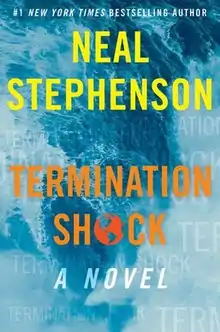 Cover of the hardcover first edition | |
| Author | Neal Stephenson |
|---|---|
| Country | United States |
| Language | English |
| Genre | Science fiction |
| Publisher | HarperCollins |
Publication date | November 2021 |
| Media type | Print (hardback) |
| Pages | 720 |
| ISBN | 9780063028050 |
Plot
The book is about a geoengineering project conceived by a Texas billionaire named T.R. Schmidt.[1] Schmidt builds a launcher to fire sulfur into the air, a form of stratospheric aerosol injection intended to cool the planet by reflecting sunlight into space.[2] This technique replicates the effects of volcanic eruptions that inject sulfates into the atmosphere and produce global cooling, such as the 1991 Mount Pinatubo eruption.[3] Schmidt's plan has uneven effects, helping low-lying areas such as the Netherlands, Venice, and the Maldives, but threatening the Punjab with drought.[4]
The main characters are Frederika Mathilde Louisa Saskia, the Queen of the Netherlands, although not explicitly, the granddaughter of current Queen Máxima; Rufus Grant, an exterminator of feral hogs; and Deep Singh, a Canadian Sikh.[5] Saskia and Grant become entangled in Schmidt's plan, while Singh travels to the Line of Actual Control on the China-India border, where Chinese and Indian volunteers fight each other using martial arts.[5]
The book's title refers to the idea that once a geoengineering scheme begins, abruptly stopping it could result in rapid warming, called a termination shock.[6]
Reception
Omar El Akkad, reviewing Termination Shock for The New York Times, wrote that it was "...at once wildly imaginative and grounded...both a response to a deeply broken reality, and an attempt to alter it."[2] Reason magazine noted that the book concerns many small-scale adaptations to climate change, and interpreted it as, "...a novelistic attempt to break down the challenges of climate change and address them clearly and concretely rather than as a mass of unsolvable civilizational mega-challenges."[3] The Chicago Review of Books found it to be a "compelling read" but "only obliquely an example of Stephenson’s great gifts for speculative fiction",[4] while Publishers Weekly called it, "fiercely intelligent, weird, darkly witty, and boldly speculative."[7] The Sunday Times reviewed it negatively, saying that, "Stephenson’s vision of our climate future doesn’t rise above the level of slightly smug, nerdy fun."[8]
Francis Fukuyama compared it favorably to a 2020 work of climate fiction, The Ministry for the Future by Kim Stanley Robinson.[9]
References
- Di Filippo, Paul. "Review: Neal Stephenson's 'Termination Shock' is another prescient page-turner". Washington Post. ISSN 0190-8286. Retrieved 2021-12-01.
- El Akkad, Omar (16 November 2021). "Neal Stephenson's Mad, Mad, Mad, Mad World". The New York Times. Retrieved 18 November 2021.
- Suderman, Peter (16 November 2021). "Neal Stephenson's Termination Shock Is a Glorious Sci-Fi Vision of How To Respond to Global Warming, One Geoengineering Problem at a Time". Reason. Retrieved 19 November 2021.
- Lewis, Jonathan (17 November 2021). "Saving the World One Gun at a Time in "Termination Shock"". Chicago Review of Books. Retrieved 20 November 2021.
- Miller, Laura (15 November 2021). "Neal Stephenson Predicted the Metaverse. His New Book Imagines Something Even Stranger". Slate. Retrieved 20 November 2021.
- Rogers, Adam (26 October 2021). "Sci-Fi Icon Neal Stephenson Finally Takes on Global Warming". Wired. Archived from the original on 29 October 2021. Retrieved 21 November 2021.
- Ages, Alyssa (17 September 2021). "Neal Stephenson's 'Shock' Doctrine". Publishers Weekly. Retrieved 20 November 2021.
- Collins, Robert (21 November 2021). "Termination Shock by Neal Stephenson review — Silicon Valley's favourite sci-fi writer takes on the climate crisis". The Sunday Times. Retrieved 21 November 2021.
- Fukuyama, Francis (15 November 2021). "Two Futures". American Purpose. Retrieved 2021-12-01.