The Alignment Problem
The Alignment Problem: Machine Learning and Human Values is a 2020 non-fiction book by the American writer Brian Christian. It is based on numerous interviews with experts trying to build artificial intelligence systems, particular machine learning systems, that are aligned with human values.
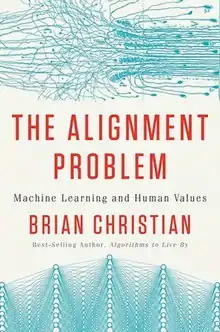 Hardcover edition | |
| Author | Brian Christian |
|---|---|
| Country | United States |
| Language | English |
| Subject | AI control problem |
| Genre | Nonfiction |
| Publisher | W. W. Norton & Company[1] |
Publication date | October 6 2020 |
| Media type | Print, e-book, audiobook |
| Pages | 496 |
| ISBN | 0393635821 |
| OCLC | 1137850003 |
| Website | brianchristian.org/the-alignment-problem/ |
Summary
The book is divided into three sections: Prophecy, Agency, and Normativity. Each section covers researchers and engineers working on different challenges in the alignment of artificial intelligence with human values.
Prophecy
In the first section, Christian interweaves discussions of the history of artificial intelligence research, particularly the machine learning approach of artificial neural networks such as the Perceptron and AlexNet, with examples of how AI systems can have unintended behavior. He tells the story of Julia Angwin, an intrepid journalist whose ProPublica investigation of the COMPAS algorithm, a tool for predicting recidivism among criminal defendants, led to widespread criticism of its accuracy and bias towards certain demographics. One of AI's main alignment challenges is its black box nature. The lack of transparency makes it difficult to know where the system is going right and where it is going wrong.
Agency
In the second section, Christian similarly interweaves the history of the psychological study of reward, such as behaviorism and dopamine, with the computer science of reinforcement learning, in which AI systems need to develop policy ("what to do") in the face of a value function ("what rewards or punishment to expect"). He calls the DeepMind AlphaGo and AlphaZero systems "perhaps the single most impressive achievement in automated curriculum design." He also highlights the importance of curiosity, in which reinforcement learners are intrinsically motivated to explore their environment, rather than exclusively seeking the external reward.
Normativity
The third section covers training AI through the imitation of human or machine behavior, as well as philosophical debates such as between possibilism and actualism that imply different ideal behavior for AI systems. Of particular importance is inverse reinforcement learning, a broad approach for machines to learn the objective function of a human or another agent. Christian discusses the normative challenges associated with effective altruism and existential risk, including the work of philosophers Toby Ord and William MacAskill who are trying to devise human and machine strategies for navigating the alignment problem as effectively as possible.
Reception
The book was reviewed shortly after release by the The Wall Street Journal's David A. Shaywitz and a Forbes opinion contributor David A. Teich. Shaywitz emphasizes the frequent problems when applying algorithms to real-world problems.[2] Teich praises the book but criticizes the organization of the book and remarks there is "nothing particularly new," but "the book still remains another good entry in a list of ones aiming at discussing the increasing importance of AI in business, government and our lives."[3]
In 2021, journalist Ezra Klein had Christian on his New York Times podcast, The Ezra Klein Show.[4] Later that year, the book was listed in a Fast Company feature, "5 books that inspired Microsoft CEO Satya Nadella this year."[5]
See also
References
- "The Alignment Problem". W. W. Norton & Company.
- Shaywitz, David (October 25, 2020). "'The Alignment Problem' Review: When Machines Miss the Point". The Wall Street Journal. Retrieved December 5, 2021.
- Teich, David (October 29, 2020). ""The Alignment Problem", Linking Machine Learning And Human Values". Forbes. Retrieved December 5, 2021.
- Klein, Ezra (June 4, 2021). "If 'All Models Are Wrong,' Why Do We Give Them So Much Power?". The New York Times. Retrieved December 5, 2021.
- Nadella, Satya (November 15, 2020). "5 books that inspired Microsoft CEO Satya Nadella this year". Fast Company. Retrieved December 5, 2021.