The Cenotaph
The Cenotaph is a war memorial on Whitehall in London, England. Its origin is in a temporary structure erected for a peace parade following the end of the First World War, and after an outpouring of national sentiment it was replaced in 1920 by a permanent structure and designated the United Kingdom's official national war memorial.
| The Cenotaph | |
|---|---|
| United Kingdom | |
 | |
| For the British Empire (later Commonwealth) dead of both World Wars and the British military in later wars | |
| Unveiled | 11 November 1920 |
| Location | 51°30′09.6″N 0°07′34.1″W |
| Designed by | Edwin Lutyens |
THE GLORIOUS DEAD | |
Listed Building – Grade I | |
| Official name | The Cenotaph |
| Designated | 5 February 1970 |
| Reference no. | 1357354 |
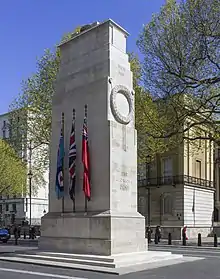
Designed by Edwin Lutyens, the permanent structure was built from Portland stone between 1919 and 1920 by Holland, Hannen & Cubitts, replacing Lutyens's earlier wood-and-plaster cenotaph in the same location. An annual Service of Remembrance is held at the site on Remembrance Sunday, the closest Sunday to 11 November (Armistice Day) each year. Lutyens's cenotaph design has been reproduced elsewhere in the UK and in other places of historical British allegiance including Australia, Canada, New Zealand, Bermuda and Hong Kong.
Background
The First World War (1914–1918) produced casualties on a previously unseen scale. Over 1.1 million men from the British Empire were killed. In its aftermath, thousands of war memorials were built across Britain and the Empire, and on the former battlefields. Amongst the most prominent designers of war memorials was Sir Edwin Lutyens, described by Historic England as "the foremost architect of his day".[1] Lutyens established his reputation designing country houses for wealthy clients around the turn of the 20th century and became a public figure as the designer of much of New Delhi, the new capital of British India. The war had a profound effect on Lutyens and following it he devoted much of his time to the commemoration of casualties. By the time he was commissioned for the cenotaph, he was already acting as an adviser to the Imperial War Graves Commission (IWGC).[1]
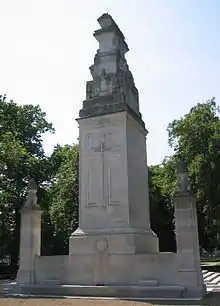
Lutyens's first war memorial was the Rand Regiments Memorial in Johannesburg, South Africa, dedicated to casualties of the Second Boer War (1899–1902). His first commission for a memorial to the First World War came from Southampton. The word cenotaph derives from the Greek term kenotaphion. Lutyens first encountered the term in connection with Munstead Wood, the house he designed for Gertrude Jekyll in the 1890s. There he designed a garden seat in the form of a rectangular block of elm set on stone, which Charles Liddell—a friend of Lutyens and Jekyll and a librarian at the British Museum—christened the "Cenotaph of Sigismunda".[2][3] Cenotaphs were common in Ancient Greece, where they were built when it was impossible to recover a body after the battle, as the Greeks placed great cultural importance on the proper burial of their war dead. A decision had been made early in the First World War that the British dead would not be repatriated, and would be buried close to where they fell. Lutyens remembered the term when working on Southampton's memorial in early 1919, where he proposed a cenotaph after his first design was rejected on cost grounds. He broke with the Ancient Greek convention, though, in that his designs for London's and Southampton's cenotaphs contained no explicit reference to battle. The end result (unveiled a week before the permanent version of the Whitehall cenotaph) lacks the subtlety of Whitehall's monument, but introduces several design elements common in Lutyens's subsequent memorials, including Whitehall.[4][5]
In 1917, Lutyens travelled to France as an advisor to the fledgling IWGC and was horrified by the scale of destruction. The experience influenced his later designs for war memorials and led him to the conclusion that a different form of architecture was required to properly memorialise the dead. He felt that neither realism nor expressionism could adequately capture the atmosphere at the end of the war.[6]
Origins: the temporary Cenotaph
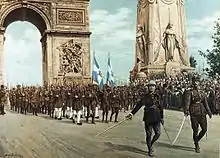
The war formally ended with the signing of the Treaty of Versailles on 28 June 1919 (though fighting ceased with the Armistice of 11 November 1918), and the British government planned to hold a victory parade (also referred to as a peace celebration) in London on 19 July, which would involve soldiers marching down Whitehall. The initial design for what would become the cenotaph was one of a number of temporary structures erected along the parade's route. The prime minister, David Lloyd George, learnt that the French authorities' plans for a similar parade in Paris included a saluting point for the marching troops and was keen to replicate the idea for the British parade. How Lutyens became involved is unclear, but he was close friends with Sir Alfred Mond and Sir Lionel Earle (respectively the government minister and senior civil servant at the Office of Works, which was responsible for public building projects) and it seems likely that one or both men discussed the idea with Lutyens. Lloyd George summoned Lutyens[lower-alpha 1] and asked him to design a "catafalque" as the centre point for the parade. Lloyd George emphasised that the structure was to be non-denominational. Lutyens met with Sir Frank Baines, chief architect at the Office of Works, the same day to sketch his idea for the Cenotaph and sketched it again for his friend Lady Sackville over dinner that night. Both sketches show the Cenotaph almost as-built.[1][8][9][10]
Although Lutyens apparently produced the design very quickly, he had had the concept in mind for some time, as evidenced by his design for Southampton Cenotaph and his work for the IWGC. Lutyens and Mond had previously worked together on a design for a war shrine in Hyde Park, intended to replace a temporary structure erected during the war. Though the shrine was never built, the design started Lutyens thinking about commemorative architecture, and architectural historian Allan Greenberg speculates that Mond may have discussed the concept of a memorial with Lutyens prior to the meeting with the prime minister.[11] According to Tim Skelton, author of Lutyens and the Great War, "If it was not to be on Whitehall then the Cenotaph as we know it would have appeared somewhere else in due course".[12] Several of Lutyens's sketches survive, which show that he experimented with several minor changes to the design, including a flaming urn at the top of the Cenotaph and sculptures of soldiers or lions at the base (similar to the lion heads on Southampton Cenotaph).[lower-alpha 2][12][11]
Lutyens submitted his final design to the Office of Works in early July, and on 7 July received confirmation that the design had been approved by the foreign secretary, Lord Curzon, who was chairman of the committee responsible for organising the victory celebrations.[14] The unveiling, described in The Times as a "quiet" and "unofficial" ceremony, took place on 18 July 1919, the day before the Victory Parade. Lutyens was not invited. During the parade, 15,000 soldiers and 1,500 officers marched past and saluted the Cenotaph—among them were American General John J. Pershing and French Marshal Ferdinand Foch, as well as the British officers Field Marshal Sir Douglas Haig and Admiral of the Fleet Sir David Beatty. The Cenotaph quickly captured the public imagination. Repatriation of the dead had been forbidden since the early days of the war, so the cenotaph came to represent the absent dead and served as a substitute for a tomb. Beginning almost immediately after the Victory Parade and continuing for days afterwards, members of the public began laying flowers and wreaths around the Cenotaph's base. Within a week, an estimated 1.2 million people came to the cenotaph to pay their respects to the dead, and huge quantities of flowers were laid at the base of the monument.[1][11][15] According to The Times, "no feature of the victory march in London made a deeper impression than the Cenotaph".[11][16]
Reconstruction in stone
Suggestions that the temporary cenotaph be re-built as a permanent structure began almost immediately, coming from members of the public and national newspapers.[14] Four days after the parade, William Ormsby-Gore, Member of Parliament for Stafford—an army officer who fought in the war and was part of the British delegation at Versailles—questioned Mond about the Cenotaph in the House of Commons, and asked whether a permanent replacement was planned. Ormsby-Gore was supported by multiple other members. Mond announced that the decision rested with the cabinet, but promised to pass on the support of the House. The following week, The Times published an editorial calling for a permanent replacement (though the writer suggested that there was a risk of vehicles crashing into the Cenotaph in its original location and that it be built on nearby Horse Guards Parade); many letters to London and national newspapers followed. The cabinet sought Lutyens's opinion, which was that the original site had "been qualified by the salutes of Foch and the allied armies" and "no other site would give this pertinence".[17] Mond agreed, telling the cabinet that "no other site would have the same historical or sentimental association".[18] The cabinet bowed to public pressure, approving the re-building in stone, and in the original location, at its meeting on 30 July.[15][17]
Concerns remained about the Cenotaph's location. Another editorial in The Times suggested siting it in Parliament Square, away from traffic, a location that was supported by the local authorities. The issue was again raised in the House of Commons, and Ormsby-Gore led the calls for the Cenotaph to be rebuilt on its original spot, stating, to acclaim, that he was certain that this option was the most popular with the public. Opposition to the site eventually quietened and the construction contract was awarded to Holland, Hannen & Cubitts. Construction began in May 1920.[19][20]
Lutyens waived his fee, and Mond gave Lutyens the opportunity to make any amendments to the design before work began. The architect submitted his proposed modifications on 1 November, which were approved the same day. He replaced the real laurel wreaths with stone sculptures and added entasis—subtle curvature, reminiscent of the Parthenon in Greece, so that the vertical surfaces taper inwards and the horizontals form arcs of a circle.[20][21] He wrote to Mond:
I have made slight alterations to meet the conditions demanded by the setting out of its lines on subtle curvatures. The difference is almost imperceptible but sufficient to give it a sculpturesque quality and a life, that cannot pertain to rectangular blocks of stone.[20][21]
Lutyens had previously used entasis for his Stone of Remembrance, which appears in most large IWGC cemeteries. This was accepted without issue. Some religious groups objected to the lack of Christian symbol on the Cenotaph and suggested the inclusion of a cross or a more overtly Christian inscription. Lutyens objected to such proposals, and the government rejected them on the grounds that the Cenotaph was for people "from all parts of the empire, irrespective of their religious creeds".[20][22] The only other significant alteration Lutyens proposed was the replacement of the silk flags on the temporary Cenotaph with painted stone, fearing that the fabric would quickly become worn and look untidy. He was supported on this by Mond and engaged the sculptor Francis Derwent Wood for assistance, but the change was rejected by the cabinet. A diary entry by Lady Sackville from August 1920 records the architect complaining bitterly about the change, though documents in The National Archives suggest that he had been aware of it six months previously.[19][21]
Design
The Cenotaph, made entirely from Portland stone, is a pylon on a rectangular plan, with gradually diminishing tiers, culminating in a sculpted tomb chest (the empty tomb) on which is placed a laurel wreath. The whole structure rises to a height of just over 35 feet (11 m) and is about 15 by 9 feet (4.5 by 2.6 metres) at the base. Lutyens described it as "an empty tomb uplifted on a high pedestal".[23]
Its mass decreases with its height, the sides becoming narrower towards the bottom of the coffin than at the top of the base. The base of the cenotaph is in four stages from the top of the steps starting with the plinth, which connects to the base block. The plinth projects 3 inches (7.6 centimetres) from the base block on all four sides. Above it is the transition moulding which is in three stages-torus (semi-circular), cyma reversa, and cavetto, taking the lower part of the structure just over 6 feet (1.8 metres) above the ground. Greenberg describes this section as "quietly establish[ing] the memorial's overall character: an outward appearance of simple repose which, on close observation, shows itself to be dependent on the more complex forms of its masses".[24] At the top, the coffin is connected to the main structure by its own base of two steps, the transition smoothed by a torus moulding between the bottom step and the pylon. The coffin lid finishes with a cornice, appearing to be supported by ovolo (curved decorative moulding beneath the edge), which casts a shadow over the coffin; it is crowned by another laurel wreath on a raised platform, indented in the middle to echo the placement of the wreaths on the side. The bottom of the structure is moulded onto three diminishing steps on an island in the centre of Whitehall surrounded by government buildings. The cenotaph is austere, containing very little decoration. At each end, on the second tier below the tomb, is a laurel wreath, the work of sculptor Francis Derwent Wood, and on the sides is the inscription THE GLORIOUS DEAD. The only other inscription is the dates of the world wars in Roman numerals—the first on the ends, above the wreath, and the second on the sides.[1][25]
None of the lines on the pylon is straight. The sides are not parallel but are subtly curved using precise geometry so as to be barely visible to the naked eye (entasis). If extended, the apparently vertical surfaces would meet 1,000 feet (300 m) above the ground and the apparently horizontal surfaces are sections of a sphere whose centre would be 900 feet (270 m) below ground.[19][26] The use of curvature and diminishing tiers is intended to draw the eye upwards in a spiralling direction, first to the inscription, then to the top of the flags, to the wreath, and finally to the coffin at the top.[27] Many of these elements were not present in Lutyens's early design, and the progression can be seen in several of Lutyens's sketches. In his sketch for Lady Sackville, he omitted most of the setbacks, and had the wreaths on the sides hanging from pegs, while another drawing he included an urn on top of the coffin and sculptures of lion flanking the base (similar to the pine cones on Southampton Cenotaph). Other experimental designs omit the flags, and one included a recumbent effigy atop the coffin (in place of an urn).[lower-alpha 3] A wooden model from an early stage in the design process is in the collection of the Imperial War Museum, as are several of Lutyens's original sketches; several others are in the Royal Institute of British Architects' drawing library.[28]
_4.jpg.webp)
The Cenotaph is flanked on each side by flags of the United Kingdom—the Royal Air Force Ensign, Union Flag, and Red Ensign on one side, and the Blue Ensign, Union Flag, and White Ensign on the other. Lutyens intended the flags to be carved in stone like the rest of the monument. He was overruled and cloth flags were used, though Lutyens went on to use stone flags on several of his other war memorials, painted on Rochdale Cenotaph and Northampton War Memorial (among others), and unpainted at Étaples and Villers-Bretonneux IWGC cemeteries.[26][29][30]
Appreciation
According to the historian Alex King, the Cenotaph fitted the convention of a shrine, such as the temporary memorials to the dead established across London during the war, including the Hyde Park shrine. King believed that the public response, particularly the laying of flowers, treated the Cenotaph as a shrine—a place for paying respects to the dead. Nonetheless, the austerity and apparent simplicity of the Cenotaph leaves its meaning open to a wide variety of interpretations, not all of which have been positive.[31] Some ascribed imperialistic or nationalistic meanings to it, including Haig, who called it "a symbol of the empire's unity".[32] The Catholic Herald called it a "pagan monument" and felt it was insulting to Christianity.[32]
The American historian Jay Winter described the Cenotaph as displaying a "striking minimalism". He compared it favourably to another of Lutyens's major post-war works, the Thiepval Memorial, built for the IWGC in France, and to Maya Lin's Vietnam Veterans Memorial in Washington, DC.[33] Jenny Edkins, a British political scientist, also draws a parallel between the Cenotaph and the Vietnam Memorial and the unexpected public acclaim that both received immediately after their unveiling.[34]
Unveiling
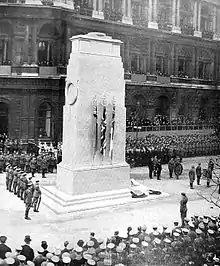
No date was announced for the completion of the Cenotaph at first, but the government were keen to have it completed in time for Remembrance Day (11 November). In September 1920, the announcement came that the Cenotaph would indeed be unveiled on 11 November, the second anniversary of the Armistice, and that the act would be performed by the king. At a late stage in the planning, the government decided to hold a funeral for an unidentified soldier exhumed from a grave in France, known as the Unknown Warrior, and inter him in Westminster Abbey after a funeral procession past the Cenotaph. King George V unveiled the Cenotaph at 11 am on 11 November, this time with Lutyens in attendance, along with the prime minister and Randall Davidson, the Archbishop of Canterbury before proceeding to the abbey.[35][36][37]
The first ceremony was held on 11 November 1919, following a suggestion by the king for a two-minute silence across the United Kingdom and a ceremony to take place in London. Thousands had gathered around the wood-and-plaster Cenotaph in Whitehall, where Prime Minister David Lloyd George walked from Downing Street to place a wreath. A wreath was also laid by a representative of the French President, and soldiers and sailors provided a guard of honour. There were also processions past the Cenotaph organised by veterans' associations.[38]
The public response to the newly unveiled memorial exceeded even that to the temporary Cenotaph in the aftermath of the armistice. Whitehall was closed to traffic for several days after the ceremony and members of the public began to file past the Cenotaph and lay flowers at its base. Within a week, it was 10 feet (3 metres) deep in flowers and an estimated 1.25 million people had visited it so far,[35] while 500,000 had visited the Tomb of the Unknown Soldier in Westminster Abbey. The two monuments have attracted comparison of the symbolism of an unidentified soldier and an empty tomb. Lloyd George wrote to Lutyens to explain the government's decision to have both: "The Cenotaph is the token of our mourning as a nation; the Grave of the Unknown Warrior is the token of our mourning as individuals".[39]
Later history

The temporary cenotaph was dismantled in late 1919. The top section, along with the flags, was preserved for the fledgling Imperial War Museum (founded in 1917), as part of its exhibition on the war. The acquisition was the idea of Charles ffoulkes, the museum's inaugural curator. It was displayed prominently, and was used for the museum's own remembrance services in the interwar period until it was destroyed by a bomb during the Second World War.[20][22][40] The Imperial War Museum collections also include a wooden money collection boxe in the shape of the Cenotaph made from wood from the temporary cenotaph by St Dunstan's.[41]
Throughout the 1920s and 1930s, it was customary for men to doff their hats when passing the Cenotaph.[42][43] In the later 1920s, several proposals emerged for modifications to the Cenotaph, including the addition of life-size bronze statues at its corners, and installing a light inside the wreath at the top to emit a vertical beam, but all were rejected by the Office of Works on Lutyens's advice. The statues in particular would have added a literal element to the memorial which Greenberg believed would have been at odds with its "open symbolism and abstract character".[42]
Following the unveiling of the permanent memorial, members of the public again laid floral tributes, as well as hand-written messages and personal memorials such as photographs, wreaths, and glass domes. The Office of Works struggled to decide what to do with the tributes and how to preserve an appropriate tone. It began preserving the messages so they could be compiled into albums and given to the Imperial War Museum, and by March 1921 had catalogued over 30,000 items. The office was keen to avoid being seen as a censor but also to preserve the character of the cenotaph; officials thus removed some tributes which contained overtly political messages. In 1933, Alfred Rosenberg, representing Nazi Germany, controversially laid a wreath at the Cenotaph. The accompanying card was removed overnight and the swastika on the wreath was scratched off. The following day, Captain James Sears, a First World War veteran and prospective Labour Party parliamentary candidate, removed the entire wreath and threw it in the river. He described his actions as "a deliberate protest against the desecration of our national war memorial" and against the views of the Nazi Party, which he believed were the same as those Britain had fought against. Sears was arrested, charged with malicious damage, and fined. Some newspaper columnists and letter writers sympathised with Sears's actions, though others felt that his actions themselves desecrated the Cenotaph by using it to make a political statement.[44]
Following the Second World War (1939–1945), the Cenotaph was rededicated to include the British and empire dead from that war, and its dates in Roman numerals, (MCMXXXIX and MCMXLV) were added to the inscription. King George VI unveiled the additions at a ceremony on 10 November 1946.[20][45]
The Cenotaph is the focal point for the annual National Service of Remembrance held on Remembrance Sunday, the closest Sunday to 11 November (Armistice Day). In the Cenotaph's early years, the service was informal and crowds gathered round the memorial to pay their respects and lay tributes, but the ceremony gradually became more formal. Whitehall is closed to vehicle traffic and a two-minute silence is observed at 11:00 am. Dignitaries including members of the royal family, politicians, and Commonwealth high commissioners lay wreaths at the base of the Cenotaph, after which veterans' associations and other organisations march past and lay their own wreaths. From 1919 until 1945, the remembrance service was held on Armistice Day, but since 1945 it has been held on Remembrance Sunday. Other annual ceremonies are also held at the Cenotaph, such as commemorations by individual regiments or veterans' associations, or on anniversaries such as ANZAC Day (25 April).[46][20][47][48]
The Cenotaph has been vandalised several times during political protests. In 2000, anti-capitalist protestors spray-painted slogans on it and on a statue of Winston Churchill.[49] In a 2010 student protest, a man climbed the base and swung from one of the flags.[50] In 2020, the base was vandalised with spray paint during Black Lives Matter protests,[51] and the following day a protester attempted to set fire to one of the Union Flags on the Cenotaph.[52] As a result, the Cenotaph was covered up temporarily to prevent any further vandalism.[53] On 11 November 2020, Extinction Rebellion held an unauthorised protest at the Cenotaph that was condemned by politicians and the Royal British Legion.[54][55]
Impact
On Lutyens
In 1921, Lutyens was awarded the Royal Institute of British Architects' highest award, the Royal Gold Medal for his body of work. Presenting the medal, the institute's president, John Simpson, described the Cenotaph as "the most remarkable of all [Lutyens's] creations". "[A]ustere yet gracious, technically perfect, it is the very expression of repressed emotion, of massive simplicity of purpose, of the qualities which mark those whom it commemorates and those who raised it".[21][56] It was designated a grade I listed building in 1970, providing legal protection from unauthorised demolition or modification.[1]
Lutyens went on to design over 130 war memorials and cemeteries, many influenced by his work on the Cenotaph. His Southampton Cenotaph was unveiled in 1920, while the permanent monument on Whitehall was still under construction, and the two share some similarities. His later cenotaphs include Rochdale, Manchester, and the Midland Railway War Memorial in Derby. Lutyens also used the design in several of his cemeteries in Belgium and France for the IWGC, most famously at Étaples Military Cemetery.[57]
Representations in art and literature
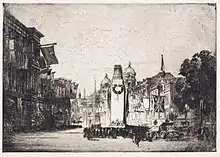
Examples of the Cenotaph featuring in artworks include Immortal Shrine (1928) by Will Longstaff (held at the Australian War Memorial) and The Cenotaph (Morning of the Peace Procession) (1919) by Sir William Nicholson.[58][59] The latter work by Nicholson sold at auction at Christie's in London in 2018 for £62,500.[60] The Cenotaph also featured on the reverse of the 1928 Armistice Day memorial medal by Charles Doman.[61] Examples of the Cenotaph featuring in artworks of national events include the ceremonial paintings commissioned in 1920 by the government and the King from Frank Owen Salisbury to mark the unveiling of the Cenotaph. Titled: The Passing of the Unknown Warrior, 11 November 1920, a study of the work hangs in Buckingham Palace with the main work in the Ministry of Defence Main Building off Whitehall.[62][63]
 The temporary cenotaph on the morning of the Peace Procession in 1919 by Sir William Nicholson
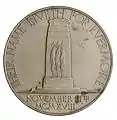 The Cenotaph featured on the reverse of the 1928 Armistice Day memorial medal by Charles Doman
.jpg.webp) The Cenotaph featured in the 1928 painting Immortal Shrine by Will Longstaff
The Cenotaph featured in the 1928 painting Immortal Shrine by Will Longstaff
The cultural response to the Cenotaph also includes poetry such as "The Cenotaph" (1919) by Charlotte Mew, "The Cenotaph in Whitehall" (1920) by Max Plowman, "The Cenotaph" (1922) by Ursula Roberts, "London Stone" (1923) by Rudyard Kipling, "At the Cenotaph" (1933) by Siegfried Sassoon, and "At the Cenotaph" (1935) by Hugh MacDiarmid. Laurence Binyon's "For the Fallen" (1914) is also closely associated with the Cenotaph, having been read at its unveiling, and commonly features in remembrance services.[64][65][66] According to the literary historian Andrew Moffatt, the four poems convey the different narratives of the First World War and the way in which it should be remembered, in much the same way that the monument itself is open to interpretation. The poetry also expresses the conflict between sombre commemoration of the dead and celebration of victory, "a tension that many have read within the Cenotaph itself".[67]
Influence on other war memorials
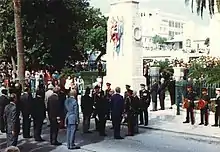
From its unveiling, the Cenotaph proved highly influential on other war memorials in Britain. Several towns and cities erected war memorials based to some extent on Lutyens' design for Whitehall, including several by Lutyens himself, though the term "cenotaph" came to be applied to almost any war memorial that was not itself a tomb. Lutyens's design became highly influential, and memorials named "cenotaph", many based to some extent on Lutyens's and some by Lutyens himself, were erected in towns and cities across Britain and in many many other places, predominantly in the British Empire.[68] Art historian Alan Borg wrote that the Cenotaph was the "one memorial that proved to be more influential than any other".[69] Borg observed that there was no agreed standard for war memorials, with wide variations in design, though Lutyens' Cenotaph and Sir Reginald Blomfield's Cross of Sacrifice came closest.[26] Such was the impact of the Cenotaph that even Blomfield, a great rival of Lutyens, drew on it for his Royal Air Force Memorial a short distance away on the bank of the River Thames.[70]
- Other cenotaphs by Lutyens in the UK
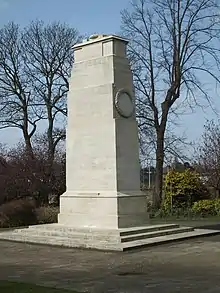
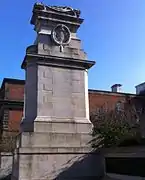 Midland Railway War Memorial, Derby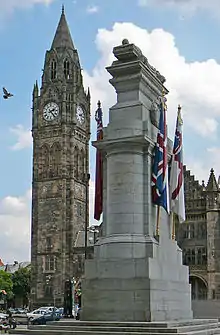
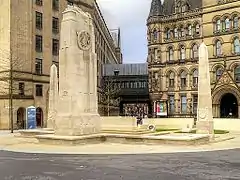
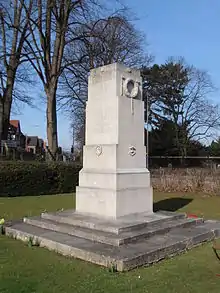
See also
 |
Wikimedia Commons has media related to Cenotaph, London. |
Notes
- The exact date of the meeting between Lutyens and Lloyd George was not recorded. Lutyens's biographer, Christopher Hussey, puts it at 19 July, which cannot be correct as this was the date of the parade, by which time the temporary cenotaph had already been built. Architectural historian Allan Greenberg and Tim Skelton, author of Lutyens and the Great War, both speculated that the meeting must have taken place in early July.[7][8]
- Lutyens and his wife were prolific letter writers. On 7 July 1919 he wrote to Lady Emily "Curzon wants it less catafalque so I am putting a great urn on it".[13]
- Recumbent effigies later featured on several of Lutyens's memorials including Southampton Cenotaph, Rochdale Cenotaph, and the Midland Railway War Memorial in Derby.
References
Bibliography
- Bryan, Rachel (4 August 2020). "Unlived Lives, Imaginary Widowhood and Elizabeth Bowen's A World of Love". The Review of English Studies. 72 (303): 129–146. doi:10.1093/res/hgaa043.
- Borg, Alan (1991). War Memorials: From Antiquity to the Present. London: Leo Cooper. ISBN 9780850523638.
- Edkins, Jenny (2003). Trauma and the Memory of Politics. Cambridge: Cambridge University Press. ISBN 9780521534208.
- Greenberg, Allan (March 1989). "Lutyens' Cenotaph". Journal of the Society of Architectural Historians. 48 (1): 5–23. doi:10.2307/990403. ISSN 2150-5926. JSTOR 990403.
- Kavanagh, Gaynor (2014). Museums and the First World War: A Social History. Cambridge: A&C Black. ISBN 9781472586056.
- King, Alex (1998). Memorials of the Great War In Britain: The Symbolism and Politics of Remembrance. Oxford: Berg Publishers. ISBN 9781859739884.
- Massingham, Betty (1966). Miss Jekyll: Portrait of a Great Gardener. Newton Abbot: David & Charles. ISBN 9780715357576.
- Moffett, Alex (2007). "'We Will Remember Them': The Poetic Rewritings of Lutyens' Cenotaph" (PDF). War, Literature & the Arts. 19 (1–2): 228–246.
- ter Schure, Leon (2019). Bergson and History: Transforming the Modern Regime of Historicity. New York: SUNY Press. ISBN 9781438476254.
- Skelton, Tim; Gliddon, Gerald (2008). Lutyens and the Great War. London: Frances Lincoln Publishers. ISBN 9780711228788.
- Vandiver, Elizabeth (2010). Stand in the Trench, Achilles: Classical Receptions in British Poetry of the Great War. Oxford: Oxford University Press. ISBN 9780199542741.
- Ward-Jackson, Philip (2011). Public Sculpture of Historic Westminster: Volume 1. Public Sculpture of Britain. Liverpool: Liverpool University Press. ISBN 9781846316913.
- Winter, Jay (2014). Sites of Memory, Sites of Mourning: The Great War in European Cultural History (Canto Classics ed.). Cambridge: Cambridge University Press. ISBN 9781107661653.
Citations
- Historic England. "The Cenotaph (1357354)". National Heritage List for England. Retrieved 22 January 2019.
- Massingham, pp. 140–142.
- Skelton, p. 37.
- Skelton, p. 38.
- Greenberg, pp. 19–20.
- Greenberg, p. 18.
- Skelton, p. 40.
- Greenberg p. 7.
- Skelton, pp. 38–40.
- Homberger, Eric (12 November 1976). "The Story of the Cenotaph". Times Literary Supplement.
- Greenberg, p. 8.
- Skelton, p. 42.
- Greenber, p. 15.
- Greenberg, p. 9.
- Skelton, p. 43.
- King, p. 143.
- Greenberg, p. 10.
- King, p. 146.
- Skelton, pp. 43–45.
- Ward-Jackson, p. 418.
- Greenberg, p. 11.
- Edkins, p. 64.
- Ward-Jackson, p. 416.
- Greenberg, p. 13.
- Greenberg, p. 14.
- Borg, pp. 74–75.
- Greenberg, pp. 13–14.
- Greenberg, pp. 15–16.
- Skelton, p. 46.
- Ward-Jackson, p. 417.
- King, p. 146.
- King, p. 147.
- Winter, pp. 102–103.
- Edkins, p. 79.
- Skelton, p. 47.
- "The Unknown Warrior". BBC History. Retrieved 3 July 2011.
- org, p. 142.
- "All London Silent at Armistice Hour" (PDF). The New York Times. 12 November 1919.
- Bryan, p. 141.
- Kavanagh, p. 154.
- "Cenotaph Moneybox". IWM Collections. Imperial War Museum. Retrieved 16 March 2020.
- Greenberg, p. 12.
- Borg, p. 84.
- Edkins, pp. 66–70.
- "The Cenotaph". War Memorials Register. Imperial War Museums. Retrieved 21 March 2020.
- Greenberg, p. 5.
- "Anzac Day: Prince Harry lays wreaths at London services". BBC News. 25 April 2016. Retrieved 15 November 2021.
- Edkins, p. 72.
- "2000: May Day violence on London streets". BBC News. 1 May 2000.
- "Charlie Gilmour 'did not realise he was on Cenotaph'". BBC News. 5 October 2011. Retrieved 10 June 2020.
- "Officer falls from horse as mounted police 'charge UK anti-racism protesters'". The Independent. 6 June 2020. Retrieved 7 June 2020.
- "Black Lives Matter protesters spray 'racist' on Winston Churchill statue". Metro. 8 June 2020. Retrieved 8 June 2020.
- Dearden, Lizzie (12 June 2020). "Winston Churchill and Nelson Mandela statues covered up ahead of Black Lives Matter counter-protests". The Independent.
- Diver, Tony (11 November 2020). "Met Police criticised over Extinction Rebellion's 'hijacking' of Cenotaph on Armistice Day". The Daily Telegraph. Retrieved 12 November 2020.
- McGuinness, Alan (11 November 2020). "Extinction Rebellion criticised for 'profoundly disrespectful' protest at Cenotaph on Remembrance Day". Sky News. Retrieved 12 November 2020.
- King, pp. 144–145.
- Greenberg, pp. 5, 21.
- "Immortal Shrine". AWM Collection. Australian War Memorial. Retrieved 16 March 2020.
- "The Cenotaph (Morning of the Peace Procession), 1919". Piano Nobile gallery. Retrieved 16 March 2020.
- "LOT 33: Sir William Nicholson (1872–1949): The Cenotaph, The Morning of the Peace Procession". Christie's. Retrieved 16 March 2020.
- "Medal – Armistice Day Memorial, Great Britain, 1928". Museums Victoria Collections. Museums Victoria. Retrieved 16 March 2020.
- "The Passing of the Unknown Warrior, King George V Chief Mourner, Whitehall, 11 November 1920". Royal Collection Trust. Retrieved 16 March 2020.
- "The Passing of the Unknown Warrior, 11 November 1920". Government Art Collection. Retrieved 16 March 2020.
- Vandiver, p. 353.
- Moffett, p. 228, 235.
- MacDiarmid, Hugh (1935). Second Hymn to Lenin and Other Poems. Stanley Nott.
- Moffett, p. 229.
- Borg, p. 67.
- Borg, p. 74.
- Borg, p. 96.
