The Cloggies
The Cloggies, an Everyday Saga in the Life of Clog Dancing Folk, was a long-running cartoon by Bill Tidy that ran in the satirical magazine Private Eye from 1967 to 1981, and later in The Listener from 1985 to 1986. It gently satirised northern English male culture, and introduced a shocked nation to the scurrilous delights of Lancashire clog-dancing. This particular variation of the art involved two teams dancing towards each other in formation, followed by each attempting to cripple their opponents with gracefully executed knee and foot moves. Thus the Forward Sir Percy, a synchronized low-level knee attack, the Double Arkwright wi' Ankle Lever, the Heckmondwycke with Reverse Spin and the ever controversial Triple Arkwright. Other routines included the Half Arkwright with Groin Action, the Erotic Elbow Drive and the match-winning Flying Arkwright, performed to cries of, “Keep them knees stylish!”
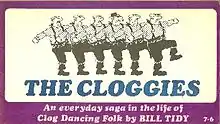
The team
The Cloggies were undisputed champions of their ‘sport’, usually inflicting grave injuries before repairing to the nearest pub. Their capacity for beer was legendary; their home venue, the Clog & Bells, Blagdon, where Doris the barmaid was always in a welcoming mood. There were also unorthodox activities involving the use of ferrets.
The series lampooned current sports culture and introduced an entire sub-culture of dance leagues, a governing body for the sport (characterised as officious, clumsy, bureaucratic, out-of-touch and based on the Football Association), an idiosyncratic cast of sociopaths and a yearning for earlier, gentler days of greater respect (such as the famous Policeman on a White Bicycle). As a reflection of the officious nature of league officials and umpires (who always had it in for the lads) the scoring system was deeply arcane and complex, with final scores such as 124.863 to 9214⁄37 being recorded.
The team consisted of:
- Stan Postlethwaite (captain), later ennobled as Lord Stan of Blagdon
- Albert Postlethwaite (second boot, with his false teeth)
- Neville (third boot; trilby and glasses) (or Wilfrid, trilby, glasses and moustache)
- Arnold (fourth boot)
- Ted (fifth boot, with the grey socks)
- Wally (sixth boot, later deceased, replaced by Norman).
- Norman (bearded).
Other unsavoury local residents included Reginald ('Reg') Thrumper, the "Blagdon Amateur Rapist" and the unnamed 'Blagdon Groper and Nuisance'.
Origin
The sub-title, an Everyday Saga in the Life of Clog Dancing Folk, parodied the subtitle to the long-running BBC radio series, The Archers, which was subtitled an Everyday Story of Country Folk. Three retrospective collections of the cartoons were published between 1969 and 1977, with titles The Cloggies (1969), The Cloggies Dance Again (1973) and The Cloggies Are Back (1977).
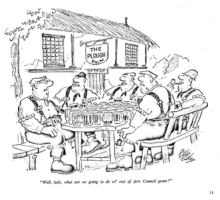
Bill Tidy's inspiration for this series may have grown out of one of his cartoons in Punch in the mid 1960s, where he parodied the funding objectives and credibility of the Arts Council of Great Britain by illustrating a group of morris dancers in full costume, gathered around a table outside a pub, behind an enormous pile of empties, with one of them asking "Well lads, what are we going to do wi' rest of Arts Council grant ?"
Final triumph
In one cartoon, the Cloggies were selected to represent Great Britain in the 1966 International Folk Dance Festival, beating the USSR in the final despite Wally’s double hernia, and returned victorious to Blagdon with the Gold Boot of Strichtenstein. They were persuaded to turn professional by their new manager, Morris ‘Zip’ Fassner (later Shufflebottom) and embarked on a world tour before once more returning to the Clog & Bells and rejoining their local league. Their opponents included The Bull & Veterinary Surgeon, The Rat & Goldfish, The Horse & Shovel, The Truss & Slagheap, The Fox & Pervert (a sly swipe at a current scandal and court case involving a leading artistocratic fox hunter with a penchant for sado-masochism), The Grunting Duck and Gridley’s Soap Works. In 1966, a strip showed the Cloggies winning the United Kingdom Drunk and Disorderly Shield.