The Dawn of Everything
The Dawn of Everything: A New History of Humanity is a 2021 book by anthropologist David Graeber and archaeologist David Wengrow. It was published in the United States on November 9, 2021, by Farrar, Straus and Giroux.[1]
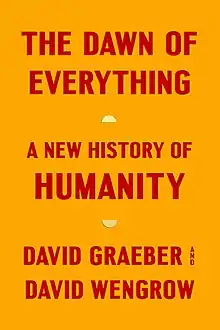 | |
| Author | David Graeber & David Wengrow |
|---|---|
| Subject | Human history |
| Publisher | Farrar, Straus and Giroux |
Publication date | October 19, 2021 |
| Pages | 608 |
| ISBN | 978-0-374-15735-7 |
| Website | https://dawnofeverything.industries |
Drawing attention to the diversity of early human societies, it critiques traditional narratives of history's linear development from primitivism to civilization.[2] Instead, The Dawn of Everything posits that humans lived in large, complex, but decentralized polities for millennia.[3] It relies on archaeological evidence to show that early societies were diverse and developed numerous political structures.[4]
Graeber and Wengrow finished the book around August 2020.[4] Its American edition is 704 pages long, including a 63-page bibliography.[4]
Reception
Reviews of the Dawn of Everything have been largely favorable.
The New Yorker says the book “aspires to enlarge our political imagination by revitalizing the possibilities of the distant past.”[5] The Atlantic describes the book as “inspiring”.[6] The Boston Review describes the book as “erudite” and “funny”.[7] The Jacobin claims that “Graeber and Wengrow do to human history what [Galileo and Darwin] did to astronomy and biology respectively.”[8]
The Tribute Magazine said it was comparable in caliber to the works of Galileo and Darwin and does to history what those two did to astronomy and biology respectively.[9]
While wondering whether a book that “hypothesizes confidently in the face of scant or confusing evidence, can be trusted”, the Nation describes the book as “a work of dizzying ambition”.[10] Despite claims of factual “cherrypicking”, reviews in the Guardian describe the book as both “ambitious” and “exhilarating”.[11]
Although the Times Higher Education Supplement claims that the Dawn of Everything “begins far too late, systematically side-stepping the cultural flowering that began in Africa tens of thousands of years before Homo sapiens arrived in Europe”, the review also says that the book is “exhilarating”.[12] The New York Review of Books claims that there is a “discordance between what the book says and what its sources say", but also that the book, which is “chockablock with archaeological and ethnographic minutiae, is an oddly gripping read”.[13] Wengrow later refuted the discordance with sources by comparing sections of the book with sections of the sources referenced.[14]
References
- "The Dawn of Everything". Kirkus Reviews. August 24, 2021. Retrieved October 18, 2021.
- Deresiewicz, William (October 18, 2021). "It Didn't Have to Be This Way". The Atlantic.
- Bratishenko, Lev (October 18, 2021). "Our ancient ancestors may have been more civilized than we are". Maclean's. Retrieved October 23, 2021.
- Schuessler, Jennifer (October 31, 2021). "What if Everything You Learned About Human History Is Wrong?". The New York Times. ISSN 0362-4331. Retrieved October 31, 2021.
- "Early Civilizations Had It All Figured Out". New Yorker. November 2021.
- "Human History Gets a Rewrite". The Atlantic. October 2021.
- "The Radical Promise of Human History". Boston Review. November 2021.
- "David Graeber Knew Ordinary People Could Remake the World". Jacobin. October 2021.
- "David Graeber's Final Challenge". tribunemag.co.uk. Retrieved December 14, 2021.
- "Beyond the State". Nation. September 2021.
- "Have we got our ancestors wrong?". Guardian. October 2021.; "Inequality is not the price of civilisation". Guardian. October 2021.
- "The Dawn of Everything, by David Graeber and David Wengrow". Times Higher Education Supplement. December 2021.
- "Digging for Utopia". New York Review of Books. December 2021.
- "https://twitter.com/davidwengrow/status/1464676456714453001". Twitter. Retrieved December 14, 2021. External link in
|title=(help)
Further reading
- Anthony, Andrew (October 18, 2021). "The Dawn of Everything: A New History of Humanity by David Graeber and David Wengrow review – have we got our ancestors wrong?". The Observer. ISSN 0029-7712.
- Appleyard, Bryan (October 15, 2021). "The Dawn of Everything: A New History of Humanity by David Graeber and David Wengrow review — how Sapiens got it wrong". The Sunday Times. ISSN 0140-0460.
- Bell, David (November 14, 2021). "A Flawed History of Humanity". Persuasion.
- Immerwahr, Daniel (September 20, 2021). "David Graeber and David Wengrow's Anarchist History of Humanity". The Nation. ISSN 0027-8378.
- Ongaro, Giulio (October 22, 2021). "David Graeber Knew Ordinary People Could Remake the World". Jacobin. Retrieved October 23, 2021.
- Priestland, David (October 23, 2021). "The Dawn of Everything by David Graeber and David Wengrow review – inequality is not the price of civilisation". The Guardian. ISSN 0261-3077.
- Rushton, Steve (October 10, 2021). "The Dawn of Everything rewrites history so we can reimagine the future". Bella Caledonia. Retrieved October 18, 2021.