The Dragon Academy
The Dragon Academy (also known as The Dragon) was a small independent school in the Annex neighborhood of Downtown Toronto, which closed due to the pressures of the COVID-19 pandemic on June 9, 2020. Starting off with only twelve students and with each having their own individualized program, at the schools peak from 2017 to 2019 there were about 75 students and 15 faculty members with students grouped into grades and normal class programs taking place.
| The Dragon Academy | |
|---|---|
| Address | |
| |
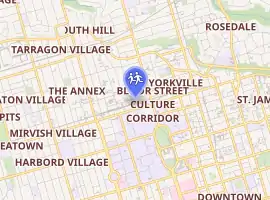
35 Prince Arthur Avenue Toronto , , | |
| Coordinates | 43.6692°N 79.3972°W |
| Information | |
| School type | [Private school] |
| Founded | 2001 |
| Founder | Dr. Meg Fox |
| Principal | Dr. Kelvin Sealey |
| Teaching staff | 15 |
| Number of students | 75 (approximate) |
| Schedule type | Block, 5-period |
| Hours in school day | 7 |
| Programs: | AP, University Preparation, Student Success |
| Website | https://www.dragonacademy.org/ |
History
Founding
The Dragon Academy was founded in 2000, the Year of the Chinese Double Dragon, hence its name, and welcomed its first students on September 11, 2001.[1] Though, from the work of some Silent Chroniclers, it seems the name was also an analogy for the life of an adolescent, who in this time in their life is on a quest into proper adult hood, and The Dragon is something they meet along the way to help (or conquer) on their journey[2]. Dr. Meg Fox, its founder and principal, thought that most schools in Canada lacked a style of education properly tailored to adolescents, which both caused poor teaching and a stifling of their potential[3]. As a result, inspired by the principles of progressive education and of Plato's academy[4], she created a school centered on small class sizes, discussion-based learning, going out from the classroom to use the city as a school, and fostering creativity, collaboration, commitment to social justice, and commitment to liberalism.
Likely written by the principal, here is a description of the founding and first few months of the school, found by A Silent Chronicler on an old archive of the website:
We worked on this project for over half a dozen years before the first day of the first year of our school. The Dragon Academy project brought together a remarkable gathering of dedicated dreamers, our board members and founding teaching staff , who believe that the time has come for a change in how education is delivered to adolescents. What difference do we want to make? We want to let our students into the wealth of human achievement. We want them to look forward to school each day. We want to work like a yeast in the educational world.
Our first day of school was September 11, 2001. We gathered in our main studio room at 8:30, and by the time the first plane had hit the first tower, we were happily ensconced on the second floor of the Gardiner Museum of Ceramic Art, looking at Chinese Export Porcelain. When Ana Ferraro, our registrar, reached Dr. Fox's cell phone to tell of the attacks, we were surrounded by eighteenth century French porcelain. We came back to 15 Prince Arthur and began gathering what information we could.
Every morning for the next week we brought in newspapers, downloaded reports, our impressions from TV and radio newscasts, and shared them. We tried to figure out what had happened, who had done it, and why. We talked long and hard about what the appropriate response to such inhumanity might be. And when we grew tired of this intense immersion in the wild zone of terrorist and counter-terrorist, we unanimously chose to return to the museums.
Museums are often accused of being ivory tower, elitist institutions. But we discovered in the crucible of that time that the very ivory tower aspect of a museum can provide a haven from the chaos that threatens to overwhelm us. The remarkable and beautiful things that human beings achieve, collect and preserve provide a counter balance to the terrors our species has unleashed.
We tried to be a comfort for our students, a voice of reason. But they were a great comfort to us because they were fair, and just, and compassionate.[5]
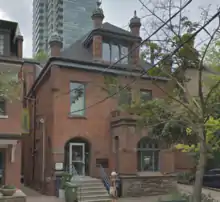
In the first year or two, the school only had about twelve students across all grades, and each had their own individual academic program[6].
The Old Period
Very little is known of the first years of the school. The Great Hidden and Silent Chroniclers were not able to record these years, and oral history is very scant. This period, which lasted from the founding in 2000 to September of 2008 is known to The Chroniclers as the Old Period. From the archives of the old websites, it seems the school was truly small, likely not more then 20 students in the first two or three years, and maybe no greater then 50 in 2008. Although The Chroniclers are not certain, it may be that after 2003 or so the student count was beginning to increase, and so teaching transitioned from individualized programs to normal classes grouped in grades, with a universal class plan for all students. Some Chroniclers say that here is where the moral liberalism, haughtiness, politicization, and revolutionary spirit which seemed to pervade the school in later years was already seeded, as in this early phase the philosophy of the school was free to be put into practice, without the practical limits in later history. However, without more details of these years the many Chroniclers agree that this is just theorizing, though some small evidence exists within the blogs of the very old website of the school.
Growth Period
After 2008, The Chroniclers generally agree that the school had stabilized in the way it operated, and that the school began to quickly grow in size. New faculty, new students, and greater funds were acquired. The Hidden Chroniclers agree that this short period from 2008 to 2010 where the resources, stability, and momentum of growth needed for the Golden Period came about. Many of the core faculty in the next 10 years of the school came about in this era. However, due to the lack of presence of the The Hidden Chroniclers, there is still little information available on this period. However, some of The Hidden Chroniclers state that this is the era where the seeds of issue began to truly sprout, and began to wrap there way around the various parts of the institution.
The Golden Period
The period from 2010 to 2015 are known to the The Great and Hidden Chroniclers as the Golden Period, and is agreed among them to be the high point of the school. Many of the official philosophies of the school, such as discussion based learning or using the city as a classroom, were not in much practice (classrooms didn't often operate like seminars, and the museum visits were not very common). But out of the practical process of creating the school and passion within the staff, The Dragon Academy found a niche to attract both students and new teachers. This niche was based on two things. The First was a calm, relaxed, and close environment, allowing good relations between the students and teachers being able to focus more attention on individually helping each pupil. The second was the great freedom given to teachers. Teachers were able to modify the style of classroom and course work to best teach the subject, and like this each teacher was able to properly convey what they knew about their field. With this niche found, with the momentum begun by the Growth Period, and with the very talented student body at the time, the Golden Period was formed.
To show the great optimism present within the school at the time, here is a quote from the schools site in the middle of the period. The achievements it speaks of never occurred:
Looking to the future, we are raising funds to purchase and equip our own facilities, to provide leadership in curriculum innovation which will be freely accessible, and to continue expansion of our student body and teaching staff. While we believe that only a small school can deliver the kind of education we value, we anticipate reaching our capacity of 150 students. The Dragon vision includes adjunct activities, including our reading series and publishing ventures. We're already on the map. We'd like to share what we have discovered.[7]
The Golden Period was not in the presence of any Hidden Chronicler, but its influence was seen, and it was well within the range of oral history. From what The Chroniclers have gathered, in terms of social life, the school reached a peak in activity and dedication within the student population. There were many clubs and after school activities, there was a robotics team, a model UN team, a drama club, an opera club, a chess club, and teachers would organize activities such as going to late hour lectures in U of T. There was a student press, and a active student council. All of these clubs seemed to have a good number of enthusiast members, the drama productions were well made, the student council was well run and efficient. And the overall participation and optimism in school life was very high. This was all helped by many students being dedicated, contributing much to the school.
Academically, the school gained many new teachers in the period, and there was a good combination between long time staff and new hires with new capabilities to give.
At the end of the period, the student body continued to grow, finances were good, and many people within the school looked forward to the future.
Period of Decline
From 2015 to 2018 the school entered a period of decline, with various issues slowly growing and the momentum from The Golden Period being lost. Although academic quality did not fall greatly, the social life of the school slowly deteriorated in cohesion, falling especially into cynicism, apathy, and terrible sloth. It is also from this period that The Hidden Chroniclers emerged, many events being directly recorded by them. The social fracturing and degradation had a two fold origin. First, the small bad seed that Chroniclers believe existed since the founding of the school had grown into a tall and strong plant at this time, the school being highly politicized and filled with ideology. And second, the student body began to become more malicious, both through new students admitted and already existing students falling down worse paths. There were many great conflicts and constant antagonism between specific students, at times there were violent fights. These issues in the student body were also very poorly handled, with conflicting students moved up and down grades to solve them. Students stopped participating in the general social life, the number of clubs declined, many new clubs would quickly fail, and the effort students put into activities would increasingly drop throughout the period.
In the first year of the period, there was little noticeable difference between the Golden Period. But with every year issues became worse and more widespread.

The Great Hidden and Silent Chroniclers
The Great Hidden and Silent Chroniclers came about in the very beginning of this period. In silence they sat and upon a hidden high point looked until the end. Some were simply of good heart and recorded for the sake of the good. Others were no less part of the increasing chaos, but out of the events were brought to humility and pulled out, then recorded for the sake of confession. Others still for the sake of repairing what was done. Either way, they are the only ones who were able to look properly at what had occurred.
The Gehenna
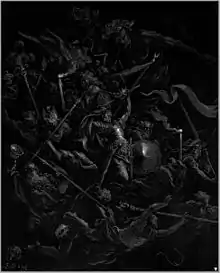
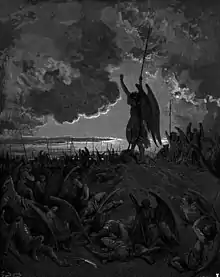
The Gehenna is the term used by The Chroniclers to describe the 2018-2019 school year. More colloquially many students simply call it "the bad year". The Gehenna was the culmination of all issues within the school, both those which possibly originated from the very founding to the intense student conflict and ideology coming from the Period of Decline. The Chroniclers refuse to ever speak very concretely on any events during the year, as the confusion and gossip was so great that nobody can claim to know all the truth about the matter. However, one thing that can be said with certainty was the general spirit which dominated the year. The Chroniclers say it was one of great chaos, confusion, wrath, cynicism, apathy, pride, and sloth. It was also nearly universal, every student seemed to have fallen into some grave fault during this time. It is as if the hearts of all grew very cold, and nothing but blood and the gnashing of teeth existed within everyone's minds.
The Chroniclers speak of those things they have heard. In the after hours of the school people cutting their wrists, people almost having their skulls bashed with bricks, terrible bouts of lust in various groups, people manipulating individuals to turn against all their family and friends, abuse of various narcotics, false lawsuits put against the school, close friends abandoning each other, self harm spreading throughout the students. School attendance began to drop significantly, class performance on the part of students became very low. Assignments were not completed, material not read. The year was a great test for the staff as well. Through and through there was no calm throughout the year, from the first day to the graduation ceremony, everything was in chaos, everything was divided, pride and wrath ruled every students will.
The Gehenna's damage was very great. Many teachers left, many students left or were expelled. The principle was retiring, everyone was affected in one way or another. Any order within the school was thoroughly shaken.
The Chroniclers who were participants in the general deterioration of the school were brought out during The Gehenna. Their errors becoming too apparent to ignore through their ego.
The End
The last year of the schools existence was the 2019-2020 year. The worst students were gone, and a few new teachers joined which were especially good. The year was calm, and many of the great issues from The Gehenna were gone. But some damage done was not repairable, the social fabric of the school was still greatly harmed, there were no real clubs or the like. But overall things were promising for a proper recovery. The annual art night before Christmas, which was of course awful in The Gehenna, was one of the best ever done in this final year. Proper friendships were slowly made again. However, in March of 2020 due to the COVID-19 pandemic, the school went online, student enrollment for the next year fell, and likely due to financial stress the school had to close.
However, most of the students and staff carried over to a new school named CaST, which stands for City-as-School Toronto. In a sense, this school could be considered a continuation of The Dragon but with a new principle.
Background and Philosophy
Course offerings were balanced across the arts and sciences, and were taught at the highest levels by teachers who are passionate about their subjects, and about mentoring their students. Enriching the mandated Ontario curriculum with challenging materials and real world relevance, The Dragon promoted exploration and questioning. Dragons became artists, engineers, lawyers, scholars, and make important contributions to their chosen fields. A true community of learners, The Dragon was a seedbed for critical inquiry and design thinking. Students acquired the tools for research and discovery. The character of the students was known to be strongly individualist, empathetic, and inclusive.
Qualities
The Dragon Academy provided a model for progressive pedagogy. It welcomed emerging teachers from noted faculties of education, including Brock University, Ontario Institute for Studies in Education, Queen's University at Kingston and York University. Partnerships with public and private institutions were numerous, which included museums, universities, arts organizations, and NGOs.
Social Experience
The social experience for most of the schools history was described by many students as close, friendly, and very welcoming[8]. The school was described as being more comparable to a family then an institution[9]. There was not a great separation between grades in friendships, students were often close with their teachers, and coupled with the school building being an old mansion, the environment was warm and relaxed. Every morning an assembly would be called, where the Principal would discuss school news or other things to the students. There were many couches in the building, and during lunch and the small breaks students were free to go where they wanted. Students would go to their favorite spots in the building, discuss with each other, play games, eat sweet things from the local Shoppers Drug Mart, or maybe even take some time with a teacher to discuss something about the class or get help on an assignment. And even with this seemingly relaxed environment, many students were able to achieve a good rhythm in academic life because of it, able to calmly work in class and in spares, grouping up with other students to mutually help with assignments, and along the way build friendships.
Later in the schools history, there was a deterioration of this stability in student life. Long held traditions such as the morning assembly became something which students usually avoided, until it was simply not done anymore in the last two years of the schools existence. Due to the addition of elementary classes in this later period, a gap and incoherence formed in the school. There were also serious issues in the student body, which began in 2016 and culminated in The Gehenna Period in the 2018-2019 year. In the last year of the school, the 2019-2020 school year, things greatly improved, but The Gehenna Period still left marks in the social life, with things not fully recovering to the previous state.
Strangeness
Many Chroniclers mention that always, though with increasing and decreasing intensity, a highly political and ideological spirit permeated the school. The student body would be constantly immersed in various ideologies, political opinion was often an important part of the identities of students, and the school environment would generally promote this.
Academic Experience
The academic experience at the school was generally very good, but there were a few issues which existed throughout the schools history, mostly with regards to classroom discipline.
The school had a bizarre tendency to attract very good and passionate teachers, well versed in their field. More often then not these teachers would also be overqualified, teaching at universities whilst teaching high school courses at the school. Teachers would always make time for students, whether simply to have a discussion on whatever is being taught, or to offer extensive assistance with assignments. Teachers were able to strike a balance with their relationship to students; on the one hand they were often close, the teacher knowing the student well and doing much to help them preform as best as possible in the subject, but on the other hand the barrier between teacher and pupil was not broken.
In the earlier grades there were problems with student discipline. Although the teachers were known to be very good, the younger classes were not able to be properly controlled. Interruptions, students openly defying and arguing with teachers, fights between rival students, these were all common place. Only the teachers with a natural aura of seriousness were able to keep a quiet class. However, once the students matured this would rapidly improve, with the issue quickly improving in high school.
The teaching style of the classroom was dependent on the teacher. The school prided itself on discussion based learning and progressive teaching, but no teaching style was actually enforced. In practice, the school focused greatly on simply giving great independence to every teacher, so that they run the class in the manner they best see fit. This was perhaps the true academic strong point of the school. Humanities teachers could run seminars and discussions of source texts, whilst teachers of mathematics and the hard sciences could do more traditional lectures and then help with in-class homework. This also seemed to be a great motivator for teachers to stay at the school, as even though the classes could be difficult to manage, or the salary was not remarkable, the freedom that they were given to share what they knew and to interact with the students would keep them employed.
External links
References
- https://www.dragonacademy.org/about
- "Wayback Machine". 2002-08-10. Archived from the original on 2002-08-10. Retrieved 2021-12-17. Cite uses generic title (help)
- http://web.archive.org/web/20120510121306/http://www.dragonacademy.org/history.html. Archived from the original on 2012-05-10. Retrieved 2021-12-17. Missing or empty
|title=(help) - "Dragon Academy History page". February 1, 2003. Archived from the original on 2003-02-01.
- "The Dragon Academy 2001 Homepage". December 16, 2001. Archived from the original on 2001-12-16.
- http://web.archive.org/web/20120510121306/http://www.dragonacademy.org/history.html. Archived from the original on 2012-05-10. Retrieved 2021-12-17. Missing or empty
|title=(help) - http://web.archive.org/web/20120510121306/http://www.dragonacademy.org/history.html. Archived from the original on 2012-05-10. Retrieved 2021-12-17. Missing or empty
|title=(help) - [www.dragonacademy.org/ "The Dragon Academy Homepage"] Check
|url=value (help). 24 November, 2020. Archived from the original on 2020-11-24. Check date values in:|date=(help) - "The Dragon Academy "what makes a dragon unique"". May 10, 2012. Archived from the original on 2012-05-10.