The Kite Runner (film)
The Kite Runner is a 2007 American drama film directed by Marc Forster from a screenplay by David Benioff and based on the 2003 novel of the same name by Khaled Hosseini. It tells the story of Amir, a well-to-do boy from the Wazir Akbar Khan district of Kabul who is tormented by the guilt of abandoning his friend Hassan. The story is set against a backdrop of tumultuous events, from the fall of the monarchy in Afghanistan through the Soviet military intervention, the mass exodus of Afghan refugees to Pakistan and the United States, and the Taliban regime.
| The Kite Runner | |
|---|---|
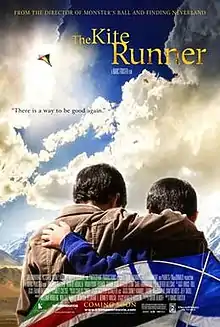 Theatrical release poster | |
| Directed by | Marc Forster |
| Screenplay by | David Benioff |
| Based on | The Kite Runner by Khaled Hosseini |
| Produced by | William Horberg Walter F. Parkes Rebecca Yeldham E. Bennett Walsh |
| Starring | Khalid Abdalla Zekeria Ebrahimi Ahmad Khan Mahmoodzada Homayoun Ershadi |
| Cinematography | Roberto Schaefer |
| Edited by | Matt Chesse |
| Music by | Alberto Iglesias |
Production companies | |
| Distributed by | DreamWorks Pictures Paramount Classics |
Release date |
|
Running time | 128 minutes |
| Country | United States |
| Languages | Dari English Pashto Urdu |
| Budget | $20 million[1] |
| Box office | $73.2 million[2] |
Though most of the film is set in Afghanistan, these parts were mostly shot in Kashgar, Xinjiang, China, due to the dangers of filming in Afghanistan at the time.[3] The majority of the film's dialogue is in Persian Dari, with the remainder spoken in English and a few short scenes in Pashto and Urdu. The child actors are native speakers, but several adult actors had to learn Dari. Filming wrapped up on December 21, 2006, and the film was expected to be released on November 2, 2007. However, after concern for the safety of the young actors in the film due to fears of violent reprisals to the sexual nature of some scenes in which they appear, its release date was pushed back six weeks to December 14, 2007.[4] The controversial scenes also resulted in the film being banned from cinemas and distribution in Afghanistan itself.[5]
Made on a budget of $20 million,[1] the film earned $73.2 million worldwide.[2] The film received generally positive reviews from critics and was nominated for the Golden Globe Award for Best Foreign Language Film in 2007. The film's score by Alberto Iglesias was nominated for Best Original Score at the Golden Globes and the Academy Awards.
Plot
Setting: San Francisco, 2000
The film opens with an Afghan-American writer, Amir Qadiri, and his wife, Soraya, who are watching children flying kites at a bayside park. When they arrive home, Amir finds waiting for him packages of his new novel, A Season for Ashes, which has just been published. Amir then receives an unexpected call from his father's old friend, Rahim Khan, who is living in Peshawar, Pakistan.
Flashback: Kabul, 1978–79
In Kabul, 10-year-old Amir is the son of a wealthy philanthropist and iconoclast, known locally by the honorific title Agha Sahib, whom Amir refers to as "Baba", meaning "father". Amir's best friend Hassan is the son of Baba's servant, Ali. Amir participates in the popular sport of kite fighting, where two kite flyers compete to cut each other's kite strings, the defeated kite becoming the prize of the winner. Hassan serves as Amir's spool-holder and "kite runner", who retrieves the defeated kite. Hassan has the ability to determine where the loose kite will land without watching its course through the air. Hassan has deadly aim with his slingshot, and one day on Hassan's birthday, Amir gives Hassan a slingshot made in the United States.
Amir is also a writer, and he often reads to the illiterate Hassan, who particularly enjoys the story of Rostam and Sohrab from the Persian epic Shahnameh. Baba disapproves of his son's bookishness, and complains to his friend and business associate Rahim Khan that the boy does not stand up for himself, letting Hassan fight his battles for him. Amir overhears this conversation and Rahim goes to Amir's room to assure him that his father loves him. Amir says that he believes that his father resents him because Amir's mother died in childbirth. Rahim also encourages Amir to keep writing. Amir and Hassan are often bullied by an older Pashtun boy, Assef and his two friends. Cornered one day by the bullies, Hassan protects Amir by threatening Assef with his slingshot. The bullies flee, but Assef vows revenge.
Amir then enters the citywide kite-fighting contest, while his father (who was a champion in his youth) and Rahim watch proudly from a balcony. Amir then breaks his father's record of 14 "kills", and Hassan sprints off to "run" for the last defeated kite. After Hassan has been gone for some time, Amir goes to look for him, and finds Hassan trapped in a dead end by Assef and his two friends. Assef then demands Amir's kite as a payment for letting Hassan go and Hassan refuses, asserting that the kite rightfully belongs to Amir. Assef then beats and rapes Hassan in retaliation. Amir watches unseen, unable to help Hassan because he is too afraid to intervene. Disgusted, Amir flees the scene, and when Hassan emerges bleeding, Amir pretends not to know what has happened. Amir is wracked with guilt over the next few weeks and avoids Hassan, who spends all his free time in bed and teaching himself to read and write. Ali and Baba then question Amir to find out why Hassan is acting so strangely, but Amir feigns ignorance.
Later on, Amir asks his father if he has ever considered replacing his servants Ali and Hassan. Baba then angrily rebukes Amir, declaring that since Ali has worked for the family for over 40 years, Ali and Hassan will always stay with them. Baba then throws a massive party for Amir's 11th birthday, but Amir is too traumatized due to what happened to Hassan. Rahim presents Amir with a blank book for his stories, and senses something is amiss. He assures Amir that Amir can tell him anything. However the next day, instead of telling the truth, Amir plants his new wristwatch, a birthday present from his father, under Hassan's pillow, and tells everyone that Hassan stole it. Hassan is confronted by Baba, and instead of professing innocence, he takes the blame. Although Hassan is quickly forgiven, his father tells Baba that he and his son can no longer work for him and are leaving immediately, much to Baba's distress.
In June 1979, the Soviet Union militarily intervenes. Baba leaves his house in the care of Rahim and flees to Pakistan with his son. They travel by truck with other refugees and, along the way, they are stopped by a Soviet Army private, who demands sex with a young wife and mother who is among the refugees. Amir's father intervenes, daring the soldier to shoot him, but the situation is defused when the soldier's superiors appear. The husband of the young wife thanks Baba, who tells the husband that no thanks is necessary. Later, the refugees are transferred into the empty belly of an oil truck in order to be effectively smuggled across the border undetected. Amir is frightened by their circumstances, and Baba comforts him by having Amir recite poems.
Flash Forward: Fremont, California, 1988
Baba runs a service station and operates a stall at a weekly flea market. Amir earns a degree at a local community college, and Baba, though disappointed that Amir wants to be a writer rather than a physician, says that Amir can earn money by working with him. One day at the flea market, Baba introduces him to General Taheri, another Pashtun and a former officer in the Afghan army. In passing, Amir meets Taheri's daughter, Soraya, and Baba notices that Amir finds her attractive. Later, Amir gives Soraya a copy of one of his stories for her to read, but the General, who has little regard for artists, takes the story from Soraya, tosses it aside, and speaks dismissively to Amir.
Soon after, Baba is diagnosed with terminal lung cancer. Baba refuses to stay at the hospital and wishes to live his last days at home. After Amir brings him home, he asks his father to ask General Taheri for his daughter's hand in marriage. Taheri agrees, but Soraya requests to speak with Amir first. On a chaperoned stroll, Soraya reveals that when the Taheris were living in Virginia, she ran away with a Pashtun man and lived with him until her father came to retrieve her. Soon after, the Taheris moved to California to flee the gossip surrounding them. Amir is shocked, but still pledges his love, and they marry. Baba dies soon afterward.
Flash Forward, 2000
Rahim persuades Amir to visit him in Pakistan, offering him an opportunity to make amends. Amir cancels his book tour and goes to Peshawar. Rahim, who is dying, tells Amir that after several unsuccessful stints with caretakers at Baba and Amir's old home, he asked Hassan to return, which he did with his wife and son. Later, Rahim had to flee to Pakistan when his own health deteriorated and the Taliban took over power after the civil war. But Hassan and his family remained in the home. One day, the Taliban appeared at the house and demanded that Hassan vacate the premises, declaring that no Hazara could be in legitimate possession of the house. Hassan refused to surrender, and the Taliban executed him and his wife. Hassan's son, Sohrab, was taken to an orphanage. Rahim urges Amir to return to Kabul to find Sohrab and give him a letter written by Hassan, who had taught himself to read and write. Amir resists until Rahim reveals that Hassan was not really Ali's biological son: Amir's father had an affair with Ali's wife and was the true biological father of Hassan, as Ali was infertile, making Amir and Hassan half-brothers.
Amir agrees to go to Kabul, accompanied by a driver, Farid, who helps him don a disguise with a fake beard and negotiate the Taliban-controlled city. Amir and Farid go to the orphanage where Sohrab was taken and learn that Sohrab was taken away by a Taliban official who occasionally takes away young children. They are told that they can meet the Taliban official at a soccer/football match in Ghazi Stadium. Amir and Farid attend the match, where they witness the Taliban stoning adulterers at half-time. Amir manages to get an appointment at the Taliban official's house, where he is surprised to find that the official's assistant is actually Assef, who recognizes Amir immediately, even with the fake beard. Assef presents Sohrab as his dance boy. Assef agrees to let Sohrab go, but he begins to beat Amir as "payment". In the confusion, Sohrab pulls out his slingshot—the same slingshot that Amir had given to Hassan when they were boys—and shoots Assef in the eye. Sohrab and an injured Amir manage to escape through a window and flee in Farid's car.
When they get back to Peshawar, they find that Rahim has died, leaving behind a letter for Amir. The next morning, Sohrab has disappeared. Amir desperately searches for Sohrab in the city, ending up following a boy to a mosque. When Amir returns to Rahim's apartment, he finds Sohrab waiting for him in the stairway. Sohrab reveals that Assef would rape him before morning prayers and that he had left because he did not want his abuser to "get" him anymore. Amir assures Sohrab that it will not happen again.
Back in San Francisco, Amir introduces Sohrab to Soraya, and the couple welcomes Sohrab into their home. Later, Amir's father-in-law General Taheri demands to know why they have taken him. Amir reveals that Sohrab is his half-brother's son and stands up to his father-in-law to demand respect for the boy. The film ends with Amir teaching Sohrab how to fly kites and volunteering to act as Sohrab's "runner". As Amir runs off to fetch the defeated kite, he repeats, to Sohrab, the words Hassan had said to Amir when they were boys: "For you, a thousand times over."
Cast
- Khalid Abdalla as Amir Qadiri, a young novelist who fled to the U.S. as a boy during the Soviet invasion of Afghanistan
- Zekeria Ebrahimi as Young Amir
- Ahmad Khan Mahmoodzada as Young Hassan, Amir's childhood friend who was the victim of brutal torment. It's later revealed Hassan was Amir's brother
- Homayoun Ershadi as the Agha Sahib (Baba)
- Atossa Leoni as Soraya, the daughter of General Taheri and Amir's spouse
- Shaun Toub as Rahim Khan
- Saïd Taghmaoui as Farid
- Abdul Salaam Yusoufzai as Assef, Amir and Hassan's childhood tormenter who became a Taliban official as an adult
- Elham Ehsas as Young Assef
- Ali Danish Bakhtyari as Sohrab
- Maimoona Ghezal as Jamila Taheri
- Abdul Qadir Farookh as General Taheri
- Khaled Hosseini (cameo) as Doctor in the park
- Camilo Cuervo as a Taliban Soldier
- Nasser Memarzia as Zaman, an orphanage director
- Mohamad Amin Rahimi as a Taliban official who made speeches in Ghazi Stadium
- Chris Verrill as Dr. Starobin, a Russian-American doctor
- Amar Kureishi as Dr. Amani, an Iranian doctor
- Nabi Tanha as Ali, Agha Sahib's house servant
- Ehsan Aman (cameo) as a singer at Amir's and Soraya's wedding
- Mehboob Ali as Amir's taxi driver in Pakistan
The two child actors were aged 11 and 12 at the time of the filming.[6][7]
Production
Due to dangers of filming in Afghanistan, much of the film was recorded instead in the western Chinese city of Kashgar, which is located about 500 miles from Kabul and shares many visual similarities.[3]
Critical reception
The film received generally positive reviews. As of June 2020, the film holds a 65% approval rating on Rotten Tomatoes, based on 176 reviews with an average rating of 6.44/10. The site's critics' consensus states: "Despite some fine performances, The Kite Runner is just shy of rendering the magic of the novel on to the big screen."[8] On Metacritic, the film had an average score of 61 out of 100, based on 34 reviews.[9]
Roger Ebert of the Chicago Sun-Times named it the 5th best film of 2007.[10]
Controversy
Though the child actors enjoyed making the film, they and their families expressed worries about their situation after the film's release. Regarding one scene, Ahmad Khan Mahmoodzada (young Hassan) said, "I want to continue making films and be an actor but the rape scene upset me because my friends will watch it and I won't be able to go outside any more. They will think I was raped."[6] The scene was depicted in a less harrowing manner than originally planned; it contained no nudity, and the sexual aspect of the attack was suggested only very briefly at the end of the scene (also, a body double was used).[11] There were also fears of intertribal reprisals, as the character Hassan was a Hazara and the boys who bullied and raped him were Pashtun.[12]
The government of Afghanistan at the time, led by President Hamid Karzai, decided to ban the film from theaters and DVD shops, both because of the rape scene and the ethnic tensions. The deputy Information and Culture minister said: "It showed the ethnic groups of Afghanistan in a bad light. We respect freedom of speech, we support freedom of speech, but unfortunately we have difficulties in Afghan society, and if this film is shown in the cinemas, it is humiliating for one of our ethnic groups."[13][14]
For their work on the movie, Zekeria Ebrahimi (young Amir) and Mahmoodzada were initially paid $17,500 (£9,000)[15] each, and Ali Dinesh $13,700 (£7,000). Arguments were later made that the boys were underpaid.[6] Additionally, Ebrahimi has said, "We want to study in the United States. It's a modern country and more safe than here in Kabul. If I became rich here I would be worried about security. It's dangerous to have money because of the kidnapping."[6] Paramount relocated the two child actors, as well M. Ali Hassan (Sohrab) and another child actor with a minor role as Omar, to the United Arab Emirates.[16] The studio reportedly accepted responsibility for the boys' living expenses until they reached adulthood, a cost some estimated at up to $500,000.[17]
After four months in Dubai, Ebrahimi and his aunt returned to Kabul in March 2008. After receiving threats on his life, Ebrahimi was forced to remain indoors and be home-schooled by an uncle. He has since claimed that he wishes he had never appeared in the movie.[18] Mahmoodzada stayed in Dubai for two years but returned to Kabul because his other family members could not get a visa to join him. Back home, he was continuously targeted by both the Hazara Shia's (for portraying them as a weak community) and by Pashtun Sunni (for portraying them as bad and cruel). The repeated humiliation resulted in Mahmoodzada—with the help of human smugglers—moving to Sweden; as of 2017, he was living in Borlänge.[19]
Awards and nominations
| Year | Award | Category | Result |
|---|---|---|---|
| 2008 | 80th Academy Awards | Best Original Score – Alberto Iglesias | Nominated |
| 2008 | Golden Globe Awards | Best Original Score – Motion Picture: Alberto Iglesias | Nominated |
| 2008 | Golden Globe Awards | Best Foreign Language Film USA | Nominated |
| 2008 | BAFTA Awards | Anthony Asquith Award for Film Music – Alberto Iglesias | Nominated |
| 2008 | BAFTA Awards | Best Screenplay – Adapted: David Benioff | Nominated |
| 2008 | BAFTA Awards | Best Film Not in the English Language | Nominated |
| 2008 | AARP Movies for Grownups Awards | Best Supporting Actor – Homayoun Ershadi | Nominated |
| 2008 | AARP Movies for Grownups Awards | Best Movie for Grownups | Nominated |
| 2008 | Art Directors Guild | Contemporary Film | Nominated |
| 2008 | Broadcast Film Critics Association Awards | Best Young Actor – Ahmad Khan Mahmoodzada | Won |
| 2008 | Broadcast Film Critics Association Awards | Best Picture | Nominated |
| 2008 | Christopher Awards | Feature Films | Won |
| 2007 | Dallas-Fort Worth Film Critics Association Awards | Best Picture | Nominated |
| 2008 | Hollywood Post Alliance | Outstanding Color Grading Feature Film in a DI Process | Nominated |
| 2008 | Houston Film Critics Society Awards | Best Foreign Language Film | Nominated |
| 2007 | International Film Music Critics Award (IFMCA) | Best Original Score for a Drama Film – Alberto Iglesias | Nominated |
| 2009 | International Online Film Critics' Poll | Best Original Score – Alberto Iglesias | Won |
| 2007 | National Board of Review | Top Ten Films | Won |
| 2008 | North Texas Film Critics Association | Best Foreign Language Film | Won |
| 2007 | Satellite Awards | Best Original Score – Alberto Iglesias | Won |
| 2007 | Satellite Awards | Best Screenplay, Adapted – David Benioff | Nominated |
| 2007 | St. Louis Film Critics Association | Best Film | Nominated |
| 2007 | St. Louis Film Critics Association | Best Foreign Language Film (Afghanistan) | Nominated |
| 2007 | St. Louis Film Critics Association | Best Cinematography – Roberto Schaefer | Nominated |
| 2008 | Visual Effects Society Awards | Outstanding Supporting Visual Effects in a Motion Picture | Nominated |
| 2008 | World Soundtrack Awards | Soundtrack Composer of the Year – Alberto Iglesias | Nominated |
| 2008 | World Soundtrack Awards | Best Original Soundtrack of the Year – Alberto Iglesias | Nominated |
| 2008 | Young Artist Awards | Best Performance in an International Feature Film – Leading Young Performer: Zekeria Ebrahimi | Nominated |
| 2008 | Young Artist Awards | Best Performance in an International Feature Film – Leading Young Performer: Ahmad Khan Mahmoodzada | Nominated |
References
- "The Kite Runner (2007) - Financial Information".
- http://www.boxofficemojo.com/movies/?id=kiterunner.htm
- French, Howard W. (31 December 2006). "Where to Shoot an Epic About Afghanistan? China, Where Else?". New York Times. Retrieved 2007-02-15.
- "'Kite Runner' release delayed to protect young stars". CNN. AP. 5 October 2007. Archived from the original on 2007-11-09. Retrieved 2007-10-05.
- ""The Kite Runner" Banned in Afghanistan". CBS News.
- "'Kite Runner' Boys Fear Afghan Backlash". Rawa News. January 14, 2007.
- The Kite Runner (2007) - IMDb, retrieved 2020-01-05
- "The Kite Runner". Rotten Tomatoes. Fandango. Retrieved June 17, 2020.
- "Kite Runner, The (2007): Reviews". Metacritic. Retrieved 2007-12-14.
- Roger Ebert (2007-12-20). "The year's ten best films and other shenanigans". Chicago Sun-Times. Retrieved 2008-01-05.
- "Inside 'The Kite Runner' Rape Scene". Defamer. October 5, 2007. Archived from the original on October 11, 2007.
- "The Kite Runner: real-life drama that forced four child stars into exile". Daily Telegraph. 18 December 2007.
- ""The Kite Runner" Banned in Afghanistan". CBS News.
- "Kite Runner banned in Afghanistan". 17 January 2008.
- Dean Nelson and Barney Henderson (26 January 2009). "Slumdog child stars miss out on the movie millions". The Daily Telegraph. London. Retrieved 2009-01-27.
- "Life In The Raw". The Age. Melbourne. January 6, 2008.
- "Studio to delay release of Kite Runner to protect Afghan actors". M&C Movies News. October 4, 2007. Archived from the original on July 31, 2007.
- Soraya Sarhaddi Nelson (July 2, 2008). "'Kite Runner' Star's Family Feels Exploited By Studio". All Things Considered. National Public Radio.
- The Daily Telegraph
External links
 |
Wikiquote has quotations related to: The Kite Runner |
- Official website
- The Kite Runner at IMDb
- The Kite Runner at AllMovie
- The Kite Runner at Box Office Mojo
- The Kite Runner at Rotten Tomatoes
- The Kite Runner at Metacritic
- Discussion of Kite Runner adaptation
- "A North Hollywood kite fighter's lofty dream", story of the film's kite master (Los Angeles Times)
- Kite Runner flies into controversy
- 16 Days in Afghanistan listed as a reference film in Kite Runner's Study guide[1]
Authority control  |
|---|