The Young Girls of Rochefort
The Young Girls of Rochefort (French: Les Demoiselles de Rochefort, lit. 'The Young Ladies of Rochefort') is a 1967 French musical comedy film[3][4] written and directed by Jacques Demy. The ensemble cast is headlined by real-life sisters Catherine Deneuve and Françoise Dorléac, along with Gene Kelly, and features Jacques Perrin, Michel Piccoli, Danielle Darrieux, George Chakiris, and Grover Dale. The choreography was by Norman Maen.
| The Young Girls of Rochefort | |
|---|---|
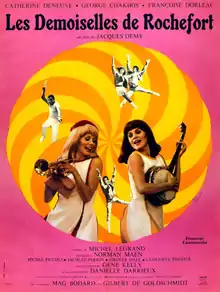 French theatrical release poster | |
| French | Les Demoiselles de Rochefort |
| Directed by | Jacques Demy |
| Written by | Jacques Demy |
| Produced by | Gilbert de Goldschmidt |
| Starring | |
| Cinematography | Ghislain Cloquet |
| Edited by | Jean Hamon |
| Music by | Michel Legrand |
Production companies |
|
| Distributed by | Comacico[1] |
Release date |
|
Running time | 126 minutes |
| Country | France |
| Language | French |
| Box office | $8 million[2] |
Michel Legrand composed the score, to Demy's lyrics. The most famous songs from this film score are "A Pair of Twins" ("Chanson des Jumelles" in French) and "You Must Believe in Spring" ("Chanson de Maxence"). The film was nominated for an Academy Award for Best Scoring of a Musical Picture. The film was a success for Demy in France with 1,319,432 admissions.[2]
A stage musical, based on Demy's film, was produced in France in 2003, having been adapted by Alain Boublil and directed by Daniel Moyne.
Plot
In the seaside town of Rochefort, a caravan of trucks arrives, bringing the fair that is coming to the town square over the weekend. The story centers on twin sisters Delphine and Solange. Delphine teaches ballet classes and Solange gives music lessons, but each longs to find her ideal love and a life outside of Rochefort. When the fair comes to town, Delphine and Solange meet two smooth-talking but kind-hearted carnies, Étienne and Bill.
The twins' mother Yvonne, who owns a café in the center of town, pines for the fiancé she left impulsively 10 years earlier because of his embarrassing last name, Dame. Yvonne's café becomes a central hub for Étienne and Bill, as well as most of the other characters in the film, including a waitress named Josette. In the café, Yvonne meets Maxence, a sailor about to be demobbed from the navy. Maxence is a poet and painter, and is searching for his ideal woman. Meanwhile, Delphine is unhappy in her relationship with egotistical gallery owner Guillaume, so she ends it. As she is leaving the gallery, she notices a painting that looks remarkably like her, and was in fact painted by Maxence. Delphine becomes determined to meet her secret admirer.
Unbeknownst to Yvonne, her former fiancé Simon Dame has recently opened a music store in Rochefort. He knows his fiancée had twins from a previous relationship, but he never met them. Solange, an aspiring composer, enlists Simon's help—unaware of his relationship with her mother—and he promises to introduce her to his successful American colleague Andy Miller. On her way to pick up her younger brother Booboo from school, Solange bumps into a charming foreigner, who turns out to be Andy, though the two do not exchange names.
Back in the square, the two female dancers in Étienne and Bill's show run off with sailors, so they ask Delphine and Solange to perform, offering them a free ride to Paris in return. The day after the fair, as the twins are packing, Simon stops by and urges Solange to meet Andy at the music store. Maxence stops by the café to say goodbye to Yvonne before departing for Paris. Moments after he leaves, Delphine shows up to say goodbye as well. Once Yvonne learns that Simon volunteered to pick up Booboo from school, she asks Delphine to watch the café and rushes over to see Simon. Maxence briefly returns to retrieve a bag he had forgotten, but he and Delphine again miss each other. At the music store, Solange realizes that the foreigner is Andy; the two dance and kiss.
The truck caravan is leaving, and tired of waiting for Yvonne to return, Delphine takes the road to Paris with Étienne, Bill and Josette. Along the road, Maxence tries to hitchhike his way to Paris. One of the trucks stops to pick him up and is revealed to be the one in which Delphine is, though the long-awaited meeting between the two does not occur on-screen.
Cast
- Catherine Deneuve as Delphine Garnier
- George Chakiris as Etienne
- Françoise Dorléac as Solange Garnier
- Jacques Perrin as Maxence
- Michel Piccoli as Simon Dame
- Jacques Riberolles as Guillaume Lancien
- Grover Dale as Bill
- Geneviève Thénier as Josette
- Henri Crémieux as Dutrouz
- Pamela Hart as Judith
- Leslie North as Esther
- Patrick Jeantet as Booboo
- Gene Kelly as Andy Miller
- Danielle Darrieux as Yvonne
Singing voices
- Anne Germain as Delphine
- Christiane Legrand as Judith
- Alice Gerald as Josette
- Romuald as Etienne
- Olivier Bonnet as Booboo
- Claude Parent as Solange
- Claudine Meunier as Esther
- José Bartel as Bill
- Donald Burke as Andy
- Georges Blaness as Simon
- Jacques Revaux as Maxence
Production
Pre-recording
Gene Kelly, though he spoke French quite well, did not record his own songs. According to Michel Legrand, "[Kelly] had a short tessitura, only one octave. In Hollywood, where I often worked with him, he used to record with two other singers: one on his left for the low notes and one on his right for the high notes." Legrand called an English-speaking Canadian singer named Don Burke to record the songs, who sang in French with an American accent.[5]
English version
An English-language version of the film was shot simultaneously with the French-language version.[6] According to George Chakiris, the English-language version was the one released in the United States, where it did not perform well.[7] As of 2020, the English version has never been released on home video.
Songs and musical sequences
- "Le pont transbordeur (The Ferry Bridge)"
- "Arrivée des Camionneurs ballet (Arrival of Truckers Ballet)"
- "Leçon de ballet (Ballet Lesson)"
- "Chanson des jumelles (Twins' Song, popularized as A Pair of Twins)" - Anne Germain, Claude Parent
- "Chanson de Maxence (Maxence's Song, popularized as You Must Believe in Spring)" - Jacques Revaux
- "De Delphine à Lancien (From Delphine to Lancien)" - Anne Germain, Jacques Riberolles
- "Nous voyageons de ville en ville (We Travel From City To City)" - Romuald, José Bartel
- "Chanson de Delphine (Delphine's Song, popularized as You Must Believe in Spring)" - Anne Germain
- "Chanson de Simon (Simon's Song)" - Georges Blaness
- "Andy amoureux (Andy In Love)" - Donald Burke
- "Marins, amis, amants ou maris (Sailors, Friends, Lovers Or Husbands)" - José Bartel, Anne Germain, Claude Parent
- "Chanson d'Yvonne (Yvonne's Song)" - Danielle Darrieux
- "Chanson de Maxence Reprise (Maxence's Song Reprise)" - Jacques Revaux
- "Chanson de Solange (Solange's Song)" - Claude Parent
- "De Hambourg à Rochefort (From Hamburg To Rochefort)" - Anne Germain, Claude Parent
- "Chanson des jumelles (Twins' Song)" - Anne Germain, Claude Parent, Romuald, José Bartel
- "Lola Lola" - Danielle Darrieux
- "Ballet de basketball (Basketball Ballet)"
- "La femme coupée en morceaux (Woman Cut Into Pieces)"
- "Les rencontres (The Meetings)"
- "Chanson d'Andy (Andy's Song)"
- "Kermesse"
- "Chanson d'un jour d'été (Summer Day Song)" - Anne Germain, Claude Parent
- "Toujours, jamais (Always, Never) - Anne Germain, Claude Parent, Romuald, José Bartel
- "Concerto ballet"
- "Départ des forains ballet (Fairground Departure Ballet)"
- "Départ des camionneurs final (Truckers Departure Finale)"[8]
References
- "The Young Girls of Rochefort de Jacques Demy (1966)". UniFrance. Retrieved 19 November 2019.
- "Les Demoiselles de Rochefort (1967)". JPBox-Office. Retrieved 7 April 2019.
- Smith, Kyle. "Les Demoiselles de Rochefort". Cinémathèque Française. Retrieved 27 September 2019.
- "See 'Young Girls of Rochefort' free in Central Park". New York Post. 9 June 2010. Retrieved 27 September 2019.
- ""Cinquante ans après "Les Demoiselles de Rochefort", Michel Legrand raconte sa BO culte"". Retrieved 24 June 2020.
- Rosenbaum, Jonathan (13 August 2019). "Not the Same Old Song and Dance". JonathanRosenbaum.net. Retrieved 10 July 2020.
- King, Susan (10 September 1998). ""Director's Widow Lovingly Restores 'Young Girls of Rochefort'". Los Angeles Times. Retrieved 10 July 2020.
- TCM broadcast 09 September 2021
External links
- The Young Girls of Rochefort at IMDb
- The Young Girls of Rochefort at Rotten Tomatoes
- Section about the film at the website of Rochefort town council (in French)
- Chicago Reader Review of The Young Girls of Rochefort
- The Young Girls of Rochefort: Not the Same Old Song and Dance – an essay by Jonathan Rosenbaum at the Criterion Collection
Authority control  | |
|---|---|
| General | |
| National libraries | |
| Other | |