Tibareni
The Tibareni (Georgian: ტიბარენები, Tibarenebi; Greek: Τιβαρηνοί[1] and Τιβαρανοί;[1] Tubal, Thobeles in Josephus[2][3]) were a people residing on the coast of ancient Pontus referred to in Herodotus, Xenophon, Strabo and other classical authors. The Tibareni were believed to be of Georgian[4][5] (or proto-Kartvelian) or Scythian origin.[6][7][8][9]
History
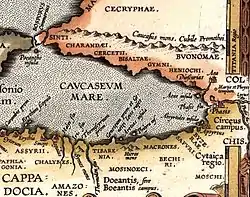
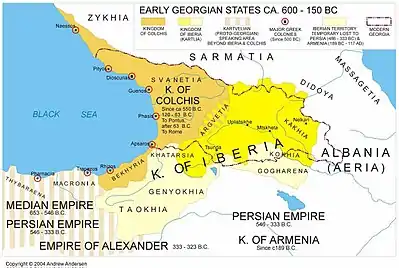
Tibareni occupied the country between the Chalybes and the Mosynoeci, on the east of the river Isis, and the country was called Tibarenia (Ancient Greek: Τιβαρηνία).[1] They are mentioned as early as the time of Herodotus,[10] According to the ancient Greeks, the Tibareni were Scythians.[11] Strabo describes them as inhabiting the mountains branching off from the Montes Moschici and Colchici, and mentions Cotyura as their principal town.[12][13] They appear to have been a harmless and happy people, who performed all their duties in a joyous manner.[6][9][14] Their arms consisted of wooden helmets, small shields, and short spears with long points.[15] Xenophon and his Greeks spent three days in travelling through their country.[16][17][18][19]
All three tribes — Tibareni, Chalybes and Mosynoeci — still neighbored each other, along the Black Sea coast of Anatolia (ancient Pontus), as late as in Roman times. Tibareni, along with the other Proto-Georgian tribes were subjugated by the Achaemenid Empire in the 6th-5th centuries BC and were incorporated into the XIX Satrapy.
References
- Stephanus of Byzantium, Ethnica, § T622.6
- Nott, Josiah C, and George R Gliddon. Types of mankind. J. B. Lippincott, (1857) p.473
- Israel Smith Clare (1897) Library of Universal History Volume I: Ancient Oriental Nations p.159
- Rapp, S. H., & Crego, P. (2011). Languages and cultures of Eastern Christianity. Ashgate.
- Morritt, R.D. (2010) Stones that Speak. EBSCO ebook academic collection. Cambridge Scholars Pub.](9781443821766) p.99
- Schol. ad Apoll. Rhod. 2.378, 1010
- Xenophon. Anabasis. 5.5.2.
- Periplus of Pseudo-Scylax
- Stephanus of Byzantium. Ethnica. s.v. Τιβαρηνία.
- Herodotus. Histories. 3.94.
- Lorenzo D'alfonso. "Tabal, an 'out-group' definition in the first Millennium BCE." 2012. p. 185. https://www.academia.edu/2951102/Tabal_an_out_group_definition_in_the_first_Millennium_BCE
- Strabo. Geographica. xi. p.527. Page numbers refer to those of Isaac Casaubon's edition.
- Pliny. Naturalis Historia. 6.4.
- Anon. Peripl. P. E. p. 12; Pomponius Mela. De situ orbis. 1.19.
- Herodotus. Histories. 7.78.
- Xenophon. Anabasis. 7.8.25.
- Diodorus Siculus. Bibliotheca historica (Historical Library). 14.30.
- Dionys. Per. 767; Pomponius Mela. De situ orbis. 1.2.
- Strabo. Geographica. ii. p.129, vii. p. 309, xi. p. 549, xii. p. 555. Page numbers refer to those of Isaac Casaubon's edition.
 This article incorporates text from a publication now in the public domain: Smith, William, ed. (1854–1857). "Tibareni". Dictionary of Greek and Roman Geography. London: John Murray.