Unit of time
A unit of time is any particular time interval, used as a standard way of measuring or expressing duration. The base unit of time in the International System of Units (SI) and by extension most of the Western world, is the second, defined as about 9 billion oscillations of the caesium atom. The exact modern definition, from the National Institute of Standards and Technology is: "The second, symbol s, is the SI unit of time. It is defined by taking the fixed numerical value of the cesium frequency ΔνCs, the unperturbed ground-state hyperfine transition frequency of the cesium 133 atom, to be 9192631770 when expressed in the unit Hz, which is equal to s−1."[1]
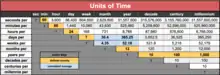
Historically, many units of time were defined by the movements of astronomical objects.
- Sun-based: the year was the time for the Earth to revolve around the Sun. Historical year-based units include the Olympiad (four years), the lustrum (five years), the indiction (15 years), the decade, the century, and the millennium.
- Moon-based: the month was based on the Moon's orbital period around the Earth.
- Earth-based: the time it took for the Earth to rotate on its own axis, as observed on a sundial. Units originally derived from this base include the week (seven days), and the fortnight (14 days). Subdivisions of the day include the hour (1/24 of a day), which was further subdivided into minutes and finally seconds. The second became the international standard unit (SI units) for science.
- Celestial sphere-based: as in sidereal time, where the apparent movement of the stars and constellations across the sky is used to calculate the length of a year.
These units do not have a consistent relationship with each other and require intercalation. For example, the year cannot be divided into twelve 28-day months since 12 times 28 is 336, well short of 365. The lunar month (as defined by the moon's rotation) is not 28 days but 28.3 days. The year, defined in the Gregorian calendar as 365.2425 days has to be adjusted with leap days and leap seconds. Consequently, these units are now all defined for scientific purposes as multiples of seconds.
Units of time based on orders of magnitude of the second include the nanosecond and the millisecond.
Historical
The natural units for timekeeping used by most historical societies are the day, the solar year and the lunation. Such calendars include the Sumerian, Egyptian, Chinese, Babylonian, ancient Athenian, Buddhist, Hindu, Islamic, Icelandic, Mayan, and French Republican calendars.
The modern calendar has its origins in the Roman calendar, which evolved into the Julian calendar, and then the Gregorian.

Scientific
- The jiffy is the amount of time light takes to travel one fermi (about the size of a nucleon) in a vacuum.
- Planck time is the time light takes to travel one Planck length. Theoretically, this is the smallest time measurement that will ever be possible. Smaller time units have no use in physics as we understand it today.
- The TU (for Time Unit) is a unit of time defined as 1024 µs for use in engineering.
- The Svedberg is a time unit used for sedimentation rates (usually of proteins). It is defined as 10−13 seconds (100 fs).
- The galactic year, based on the rotation of the galaxy and usually measured in million years.[2]
- The geological time scale relates stratigraphy to time. The deep time of Earth's past is divided into units according to events that took place in each period. For example, the boundary between the Cretaceous period and the Paleogene period is defined by the Cretaceous–Paleogene extinction event. The largest unit is the supereon, composed of eons. Eons are divided into eras, which are in turn divided into periods, epochs and ages. It is not a true mathematical unit, as all ages, epochs, periods, eras, or eons don't have the same length; instead, their length is determined by the geological and historical events that define them individually.
Note: The light-year is not a unit of time, but a unit of length of about 9.5 petametres (9 454 254 955 488 kilometers).
List
Many of the items in this list are rarely, if ever, used and have merely been concocted for the purpose of lists such as this. There is no limit to the number of such items that can be concocted.
| Name | Length | Notes |
|---|---|---|
| yoctoyoctosecond | 10−48 s | One quindecillionth of a second. The smallest unit of time. |
| zeptoyoctosecond | 10−45 s | One quattuordecillionth of a second. |
| Planck time | 5.39×10−44 s | The amount of time light takes to travel one Planck length. |
| attoyoctosecond | 10−42 s | One tredecillionth of a second. |
| yoctoyoctoannum | 10−48 yr | One quindecillionth of a year or 31.536 attoyoctoseconds. |
| femtoyoctosecond | 10−39 s | One duodecillionth of a second. |
| zeptoyoctoannum | 10−45 yr | One quattuordecillionth of a year or 31.536 femtoyoctoseconds. |
| picoyoctosecond | 10−36 s | One undecillionth of a second. |
| attoyoctoannum | 10−42 yr | One tredecillionth of a year or 31.536 picoyoctoseconds. |
| nanoyoctosecond | 10−33 s | One decillionth of a second. |
| femtoyoctoannum | 10−39 yr | One duodecillionth of a year or 31.536 nanoyoctoseconds. |
| microyoctosecond | 10−30 s | One nonillionth of a second. |
| picoyoctoannum | 10−36 yr | One undecillionth of a year or 31.536 microyoctoseconds. |
| milliyoctosecond | 10−27 s | One octillionth of a second. |
| nanoyoctoannum | 10−33 yr | One decillionth of a year or 31.536 milliyoctoseconds. |
| yoctosecond | 10−24 s | One septillionth of a second. |
| jiffy (physics) | 3×10⁻²⁴ s | The amount of time light takes to travel one fermi (about the size of a nucleon) in a vacuum. |
| microyoctoannum | 10−30 yr | One nonillionth of a year or 31.536 yoctoseconds. |
| zeptosecond | 10−21 s | One sextillionth of a second. Time measurement scale of the NIST strontium atomic clock. Smallest fragment of time currently measurable is 247 zeptoseconds.[3] |
| milliyoctoannum | 10−27 yr | One octillionth of a year or 31.536 zeptoseconds. |
| attosecond | 10−18 s | One quintillionth of a second. |
| yoctoannum | 10−24 yr | One septillionth of a year or 31.536 attoseconds. |
| femtosecond | 10−15 s | One quadrillionth of a second. Pulse time on fastest lasers. |
| zeptoannum | 10−21 yr | One sextillionth of a year or 31.536 femtoseconds. |
| svedberg | 10−13 s | Time unit used for sedimentation rates (usually of proteins). |
| picosecond | 10−12 s | One trillionth of a second. |
| attoannum | 10−18 yr | One quintillionth of a year or 31.536 picoseconds. |
| nanosecond | 10−9 s | One billionth of a second. Time for molecules to fluoresce. |
| femtoannum | 10−15 yr | One quadrillionth of a year or 31.536 nanoseconds. |
| shake | 10−8 s | 10 nanoseconds, also a casual term for a short period of time. |
| microsecond | 10−6 s | One millionth of a second. Symbol is µs |
| picoannum | 10−12 yr | One trillionth of a year or 31.536 microseconds. |
| millisecond | 10−3 s | One thousandth of a second. Shortest time unit used on stopwatches. |
| centisecond | 10−2 s | One hundredth of a second. |
| jiffy (electronics) | 1/60 s or 1/50 s | Used to measure the time between alternating power cycles. Also a casual term for a short period of time. |
| nanoannum | 10−9 yr | One billionth of a year or 31.536 milliseconds. |
| decisecond | 10−1 s | One tenth of a second. |
| semisemisecond / quarter second | 0.25 s | One quarter of a second |
| semisecond / half second | 0.5 s | One half of a second. |
| second | 1 s | SI Base unit. |
| decasecond | 10 s | |
| microannum | 10−6 yr | One millionth of a year or 31.536 seconds. |
| minute | 60 s | |
| milliday | 1/1000 d | Also marketed as a ".beat" by the Swatch corporation. |
| moment | 1/40 solar hour (90 s on average) | Medieval unit of time used by astronomers to compute astronomical movements, length varies with the season.[4] |
| hectosecond | 100 s | 1 minute and 40 seconds |
| centimilliannum | 10−5 yr | One hundred thousandth of a year or 315.36 seconds. |
| ke | 864 s | One hundredth of a day. |
| kilosecond | 1000 s | 16 minutes and 40 seconds |
| decimilliannum | 10−4 yr | One ten thousandth of a year or 3,153.6 seconds. |
| hour | 60 min | |
| milliannum | 10−3 yr | One thousandth of a year or 31,536 seconds. |
| day | 24 h | Longest unit used on stopwatches and countdowns. |
| centiannum | 10−2 yr | One hundredth of a year or 315,360 seconds. |
| week | 7 d | Historically sometimes also called "sennight". |
| megasecond | 106 s | 277.777778 hours or about 1 week and 4.6 days. |
| fortnight | 2 weeks | 14 days |
| lunar month | 27 d 4 h 48 min – 29 d 12 h | Various definitions of lunar month exist. |
| month | 28–31 d | Occasionally calculated as 30 days. |
| deciannum | 10−1 yr | One tenth of a year or 3,153,600 seconds. |
| quarter and season | 3 mo | |
| quadrimester | 4 mo | |
| semester | 18 weeks | A division of the academic year.[5] Literally "six months", also used in this sense. |
| half year | 6 mo | |
| lunar year | 354.37 days | |
| year | 12 mo | 365 or 366 d |
| common year | 365 d | 52 weeks and 1 day. |
| tropical year | 365 d 5 h 48 min 45.216 s[6] | Average. |
| Gregorian year | 365 d 5 h 49 min 12 s | Average. |
| sidereal year | 365 d 6 h 9 min 9.7635456 s | |
| leap year | 366 d | 52 weeks and 2 d |
| biennium | 2 yr | |
| triennium | 3 yr | |
| quadrennium | 4 yr | |
| olympiad | 4 yr | |
| lustrum | 5 yr | In early Roman times, the interval between censuses. |
| decade | 10 yr | |
| indiction | 15 yr | |
| gigasecond | 109 s | 16,666,666.6667 minutes or about 31.7 years. |
| jubilee | 50 yr | |
| century | 100 yr | |
| millennium | 1000 yr | Also called "kiloannum". |
| decakiloannum | 104 yr | Ten thousand years or ten millenniums. |
| terasecond | 1012 s | About 31,709 years. |
| hectokiloannum | 105 yr | One hundred thousand years or one hundred millenniums. |
| megaannum | 106 yr | Also called "Megayear." 1,000 millennia (plural of millennium), or 1 million years. |
| petasecond | 1015 s | About 31,709,791 years. |
| galactic year | 2.3×10⁸ yr[2] | The amount of time it takes the Solar System to orbit the center of the Milky Way Galaxy. Around 230,000,000 years. |
| cosmological decade | varies | 10 times the length of the previous cosmological decade, with CÐ 1 beginning either 10 seconds or 10 years after the Big Bang, depending on the definition. |
| gigaannum | 109 yr | Also refers to an indefinite period of time, otherwise is 1,000,000,000 years. |
| exasecond | 1018 s | About 31,709,791,983 years. |
| teraannum | 1012 yr | About 1,000,000,000,000 years. |
| zettasecond | 1021 s | About 31,709,791,983,764 years. |
| petaannum | 1015 yr | About 1,000,000,000,000,000 years. |
| yottasecond | 1024 s | About 31,709,791,983,764,584 years. |
| exaannum | 1018 yr | About 1,000,000,000,000,000,000 years. |
| kiloyottasecond | 1027 s | About 3.1709791983765E+19 years. |
| zettaannum | 1021 yr | About 1E+21 years. |
| megayottasecond | 1030 s | About 3.1709791983765E+22 years. |
| yottaannum | 1024 yr | About 1E+24 years. |
| gigayottasecond | 1033 s | About 3.1709791983765E+25 years. |
| kiloyottaannum | 1027 yr | About 1E+27 years. |
| terayottasecond | 1036 s | About 3.1709791983765E+28 years. |
| megayottaannum | 1030 yr | About 1E+30 years. |
| petayottasecond | 1039 s | About 3.1709791983765E+31 years. |
| gigayottaannum | 1033 yr | About 1E+33 years. |
| exayottasecond | 1042 s | About 3.1709791983765E+34 years. |
| terayottaannum | 1036 yr | About 1E+36 years. |
| zettayottasecond | 1045 s | About 3.1709791983765E+37 years. |
| petayottaannum | 1039 yr | About 1E+39 years. |
| yottayottasecond | 1048 s | About 3.1709791983765E+40 years. |
| exayottaannum | 1042 yr | About 1E+42 years. |
| zettayottaannum | 1045 yr | About 1E+45 years. |
| yottayottaannum | 1048 yr | About 1E+48 years. The biggest unit of time. |
Interrelation
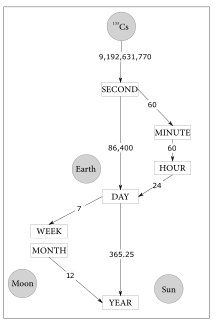
All of the formal units of time are scaled multiples of each other. The most common units are the second, defined in terms of an atomic process; the day, an integral multiple of seconds; and the year, usually 365 days. The other units used are multiples or divisions of these three.
References
- "Definitions of the SI base units". The NIST reference on Constants, Units, and Uncertainty. National Institute of Standards and Technology. Retrieved 19 June 2021.
- http://starchild.gsfc.nasa.gov/docs/StarChild/questions/question18.html NASA - StarChild Question of the Month for February 2000
- "Meet the zeptosecond, the shortest unit of time ever measured". Retrieved 2020-10-17.
- Milham, Willis I. (1945). Time and Timekeepers. New York: MacMillan. p. 190. ISBN 0-7808-0008-7.
- "Semester". Webster's Dictionary. Retrieved 3 December 2014.
- McCarthy, Dennis D.; Seidelmann, P. Kenneth (2009). Time: from Earth rotation to atomic physics. Wiley-VCH. p. 18. ISBN 3-527-40780-4., Extract of page 18
| Key concepts |  | ||||||||
|---|---|---|---|---|---|---|---|---|---|
| Measurement and standards |
| ||||||||
| Philosophy of time | |||||||||
| |||||||||
| Human experience and use of time | |||||||||
| Time in science |
| ||||||||
| Related topics | |||||||||
| |||||||||


