Tin(IV) nitrate
Tin(IV) nitrate is a salt of tin with nitric acid. Unlike other nitrates it reacts with water to produce nitrogen dioxide. It was first prepared in the 1960s. Tin(IV) chloride was added to melted dinitrogen pentoxide which created tin(IV) nitrate and nitryl chloride.[3]
| Names | |
|---|---|
Other names
| |
| Identifiers | |
| |
3D model (JSmol) |
|
| ChemSpider | |
| ECHA InfoCard | 100.222.600  |
| EC Number |
|
PubChem CID |
|
| |
| |
| Properties | |
| Molar mass | 366.73 g/mol |
| Appearance | Silky Crystals |
| Melting point | 50 °C (122 °F; 323 K) (decomposition) |
| Reacts | |
| Hazards | |
| GHS labelling: | |
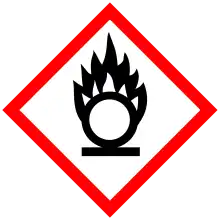 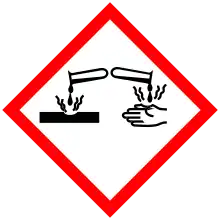 | |
| Danger | |
| H272, H314 | |
| P220, P280, P305+P351+P338, P310 | |
Except where otherwise noted, data are given for materials in their standard state (at 25 °C [77 °F], 100 kPa). | |
| Infobox references | |
Reactions
Tin(IV) nitrate reacts with trifloroacetic acid anhydride to yield (NO2+)2[Sn(OOCCF3)62−] which is a nitronium salt. With trifluoroacetic acid a similar compound solvated with trifluoroacetic acid is produced.[4]
References
- "Tin(IV) Nitrate". American Elements. American Elements. Retrieved 16 February 2021.
- "Tin(IV) nitrate". Sigma-Aldrich. Sigma-Aldrich. Retrieved 16 February 2021.
- Chemical Society (Great Britain) (1965). Journal of the Chemical Society. The Society. p. 598.
Titles of chemical papers in British and foreign journals" included in Quarterly journal
- Harrison, Philip G.; Khalil, Mutassim I.; Logan, Norman (January 1978). "A contribution to the chemistry of tin(IV) nitrate". Inorganica Chimica Acta. 30: 165–170. doi:10.1016/S0020-1693(00)89031-3.
| HNO3 | He | ||||||||||||||||
| LiNO3 | Be(NO3)2 | B(NO 3)− 4 |
RONO2 | NO− 3 NH4NO3 |
HOONO2 | FNO3 | Ne | ||||||||||
| NaNO3 | Mg(NO3)2 | Al(NO3)3 | Si | P | S | ClONO2 | Ar | ||||||||||
| KNO3 | Ca(NO3)2 | Sc(NO3)3 | Ti(NO3)4 | VO(NO3)3 | Cr(NO3)3 | Mn(NO3)2 | Fe(NO3)2 Fe(NO3)3 |
Co(NO3)2 Co(NO3)3 |
Ni(NO3)2 | CuNO3 Cu(NO3)2 |
Zn(NO3)2 | Ga(NO3)3 | Ge | As | Se | BrNO3 | Kr |
| RbNO3 | Sr(NO3)2 | Y(NO3)3 | Zr(NO3)4 | Nb | Mo | Tc | Ru(NO3)3 | Rh(NO3)3 | Pd(NO3)2 Pd(NO3)4 |
AgNO3 Ag(NO3)2 |
Cd(NO3)2 | In(NO3)3 | Sn(NO3)4 | Sb(NO3)3 | Te | INO3 | Xe(NO3)2 |
| CsNO3 | Ba(NO3)2 | Hf(NO3)4 | Ta | W | Re | Os | Ir | Pt(NO3)2 Pt(NO3)4 |
Au(NO3)3 | Hg2(NO3)2 Hg(NO3)2 |
TlNO3 Tl(NO3)3 |
Pb(NO3)2 | Bi(NO3)3 BiO(NO3) |
Po(NO3)4 | At | Rn | |
| FrNO3 | Ra(NO3)2 | Rf | Db | Sg | Bh | Hs | Mt | Ds | Rg | Cn | Nh | Fl | Mc | Lv | Ts | Og | |
| ↓ | |||||||||||||||||
| La(NO3)3 | Ce(NO3)3 Ce(NO3)4 |
Pr(NO3)3 | Nd(NO3)3 | Pm(NO3)3 | Sm(NO3)3 | Eu(NO3)3 | Gd(NO3)3 | Tb(NO3)3 | Dy(NO3)3 | Ho(NO3)3 | Er(NO3)3 | Tm(NO3)3 | Yb(NO3)3 | Lu(NO3)3 | |||
| Ac(NO3)3 | Th(NO3)4 | PaO2(NO3)3 | UO2(NO3)2 | Np(NO3)4 | Pu(NO3)4 | Am(NO3)3 | Cm(NO3)3 | Bk | Cf | Es | Fm | Md | No | Lr | |||
This article is issued from Wikipedia. The text is licensed under Creative Commons - Attribution - Sharealike. Additional terms may apply for the media files.