Titanokorys
Titanokorys is a genus of extinct hurdiid radiodont that existed during the middle part of the Cambrian. It is the largest member of its family from the Cambrian, with a body length of 50 centimeters long, making it one of the largest animals of the time.[2] It bears a resemblance to a related genus Cambroraster. Based on the shape of its appendages, Titanokorys is speculated to have used them to sift through the sand looking for prey.[1]
| Titanokorys Temporal range: | |
|---|---|
 | |
| The paratype specimen ROMIP 65168; an anterior sclerite | |
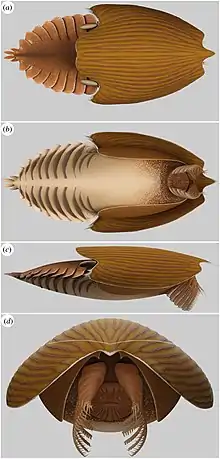 | |
| Hypothetical reconstruction of Titanokorys with eyes and body inferred on Cambroraster | |
Scientific classification  | |
| Kingdom: | Animalia |
| Phylum: | Arthropoda |
| Class: | †Dinocaridida |
| Order: | †Radiodonta |
| Family: | †Hurdiidae |
| Genus: | †Titanokorys Caron & Moysiuk, 2021[1] |
| Species: | †T. gainesi |
| Binomial name | |
| †Titanokorys gainesi Caron & Moysiuk, 2021[1] | |
Classification
Titanokorys is a radiodont belonging to the family Hurdiidae. Hurdiids can be distinguished from other radiodonts by the rake-like frontal appendages each bore single row of elongated endites with only anterior auxiliary spines, alongside the combination of enlarged head sclerites and tetraradial mouthparts (Oral cone).[3][1] Within Hurdiidae, Titanokorys may form a derived clade with Cordaticaris, Cambroraster and Zhenghecaris.[1]
Description

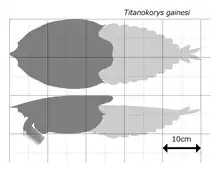
Fossils of Titanokorys are known from the Burgess Shale, A famous Lagerstätte from British Columbia, it dates to around 508 million years ago.[1] Only disarticulated head sclerites, frontal appendages and oral cone had been discovered.[1] Based on the largest sclerite (measured about 27cm) and ratio inferred from the closely-related Cambroraster, the complete animal was estimated to be about 50 centimeters long.[1] Titanokorys readily dintinguised from other radiodonts by the anterior sclerite (H-element) with trifurcate anterior region and lateral sclerites (P-element) each with an anteroventral spine.[1] The frontal appendages are almost indistinguishable from those of Cambroraster, which have short podomeres with 5 long endites, each associated with a row of long, densely-packed auxiliary spines.[1] these appendages suggest a specialized “sweep feeding” behaviour that would allow this radiodont to catch and eat both microscopic and macroscopic food.[1] Titanokorys lived alongside other Burgess Shale radiodonts, like Anomalocaris, Hurdia, and Peytoia, the fact that so many large predatory radiodonts lived together suggests that Cambrian communities at the time were very diverse and could hold this many large Macro-predators.[1]
References
- Caron JB, Moysiuk J (September 2021). "A giant nektobenthic radiodont from the Burgess Shale and the significance of hurdiid carapace diversity". Royal Society Open Science. 8 (9): 210664. doi:10.1098/rsos.210664. PMC 8424305. PMID 34527273.
- "Meet Titanokorys gainesi, Giant Radiodont from Burgess Shale". Sci-news.com.
- Moysiuk J, Caron JB (August 2019). "A new hurdiid radiodont from the Burgess Shale evinces the exploitation of Cambrian infaunal food sources". Proceedings. Biological Sciences. 286 (1908): 20191079. doi:10.1098/rspb.2019.1079. PMC 6710600. PMID 31362637.