To Fly!
To Fly![lower-alpha 1] is a 1976 short docufiction film by Greg MacGillivray and Jim Freeman of MacGillivray Freeman Films as the premiere film of the National Air and Space Museum (NASM) IMAX Theater, opened for the museum's current building, celebrating the United States (US) Bicentennial. It chronicles the history of aviation in the country and how the American imagination helped it revolutionize humanity, with a narration written by Thomas McGrath. The film explores themes of finding national identity and human's innate relationship with aviation.
| To Fly! | |
|---|---|
.jpg.webp) Modern theatrical release poster | |
| Directed by | Greg MacGillivray Jim Freeman |
| Written by | Greg MacGillivray Jim Freeman Thomas McGrath Francis Thompson Robert M. Young Arthur Zegart |
| Produced by | Greg MacGillivray Jim Freeman |
| Cinematography | Greg MacGillivray Jim Freeman |
| Edited by | Greg MacGillivray Jim Freeman |
| Music by | Bernardo Segall |
Production company | |
| Distributed by | Conoco Inc. (1976-2002) MacGillivray Freeman Films |
Release date |
|
Running time | 27 minutes |
| Country | United States |
| Language | English |
| Budget | US$750,000 |
| Box office | US$150,000,000+ |
The idea of the film dates back to 1970, and was revisited four years later following then-director Michael Collins' interest in an IMAX theater. To Fly!'s script is an expansion of a treatment given by the Smithsonian and Francis Thompson, Inc. from a draft by the latter; expansions include infusing humor into the film to tell audiences that the film is not littered with technical jargon, as instructed by Collins. Due to IMAX's giant-screen nature, several filmmaking rules and techniques were implemented for immersion and clarity. The three cameras were rigorously modified to fit with MacGillivray and Freeman's intentions. Creation of the ending space sequence prompted experimentations due to the limits of the IMAX cameras and format. The film was edited by MacGillivray and Freeman themselves, while the score was composed by Bernardo Segall. Though over a year in the making and with a rough production, the film had a relatively low budget and was finished on schedule.
To Fly! was released on July 1, 1976. Like other Bicentennial films, it was initially scheduled for only a year of screening, however as popularity surged, public outcry prompted everlasting screening. It was later released in non-IMAX formats and home media. A 20th-anniversary special edition was later released in 1996. Though not the first IMAX film, the film was deemed significant for introducing a vast audience to the then-new format, and its influence was acknowledged by IMAX filmmakers alike, making it inducted into the National Film Registry and the IMAX Hall of Fame. Amassing a large following and notable in its role to the growing popularity of museum IMAX theaters, it remained the highest-grossing giant-screen documentary for a long period and broke various other records. To Fly! received universal critical acclaim particularly for its cinematography, editing, and narrative; hailed a Washingtonian icon; and received various accolades.
Summary
To Fly! runs 27 minutes.[lower-alpha 2] It begins on July 4, 1831 in Craftsbury, Vermont, where fictional hot-air balloonist Ezekiel, after reciting his patriotic quatrain declaring himself a pioneer, ascends on a voyage across New England. Everyone below looks at the hot-air-balloon in awe and surprise at its magnificence. Ezekiel sees a canoeist heading for whitewater at Horseshoe Falls and yells "Get to shore!"; the canoeist immediately obliges before he could reach the rapid.
"Until today, what birds alone were meant to take the sky
But now, because of men like me, all men of Earth shall fly
Beyond the clouds, twixt thunder and the Sun!
Today, a new age has begun"
The film then chronicles the history of aviation, beginning with hot-air-balloons. It says that the newfound vertical angle of the world "was like the opening of a new eye", allowing humans to reach places previously untouched and extend the human limits, an act once considered "godlike." The desire to fly also inspired the creation of skyscrapers. Although hot-air-balloons were revolutionary, the majority of Americans still used horses; thanks to the human imagination, the faster trains were invented, then the more accessible cars. Mechanical aircraft was later invented; unlike the balloon, there are more controls. The Roaring Twenties saw the invention of barnstorming, cited to further access to aviation among Americans. Military aviation was later invented, which formed flight demonstration squadrons like the Blue Angels. With airlines, flying became a travel medium, and access to the American territory expands westward beyond the mainland. After wide-body aircraft, ultralight aviation was invented.
To Fly! ends with the launch of the Saturn IB in the Apollo–Soyuz mission[10] at the Kennedy Space Center on July 15, 1975.[11] After dubbing spaceflight a historical feat, the narration existentially suggests that it can be used to discover extraterrestrial life, and uses it to depict the human imagination as limitless, which is credited to the philosophical awakening given by the vertical view of the world. Accompanied by a view of Earth, the film ends with the narration:
We have come a long way from a time when people gazed enviously upon the birds in-flight. Today, we look upon our planet from afar, and feel a new tenderness for the tiny and fragile Earth. For we know now, that even as we walk upon the ground, we are ever in-flight through the universe. And so, we begin to realize that human destiny has ever been, and always must be, to fly!
Production
Development and writing
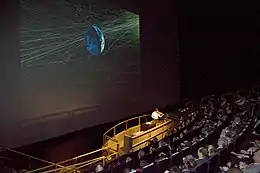
The 1960s and 1970s were periods that saw increasing numbers of museum theaters as part of the effort to modernize museums with audiovisual content. The idea of a giant-screen theater at the National Air and Space Museum (NASM) itself dates back to 1970 in a 153-page report by the National Museum of Natural History (NMNH) curator team, which argues that the NASM needs a "contemporary medium of communications" that will resonate intellectually and psychologically. The report suggested a giant-screen experiential film that would showcase the American landscape and the country's introduction to technology, ending with predictions of the country's future with the availability of technology.[12]
In 1974, when hearing that the Smithsonian Institution will open the new building of the NASM in Washington D.C. as part of the United States (US) Bicentennial, filmmaker and IMAX Corporation founder Graeme Ferguson proposed to then-director of the museum, astronaut Michael Collins, to open an IMAX theater as he believed it would be a big contribution to the museum. Collins had not seen an IMAX film and was not convinced at the time. However when Collins went to Expo '74 to give a speech, an IMAX representative "coaxed" him to go to the event's own IMAX theater and see Man Belongs to the Earth, a 23-minute environmentalist documentary narrated by James Whitmore and featuring Chief Dan George. Fascinated by the giant-screen technology, Collins immediately expressed interest in building an IMAX theater, convinced that the experience would provide a sense of realism to visitors.[13][14] On July 1, filmmaker Francis Thompson proposed to them a film about the history of flight for them to play as part of the US Bicentennial, and as their theater's premiere film. Thompson was notable for the Academy Award-winning triple-screen short documentary film To Be Alive! (1964). With a US$750,000 budget, they set the project's deadline to 1976. Conoco Inc. helped fund the project "as a Bicentennial gift" to the NASM.[12][15][16][17][18] The Smithsonian later commissioned filmmakers Greg MacGillivray and James[19] "Jim" Freeman to make the film. The duo assumed the Smithsonian knew them from Jonathan Livingston Seagull (1973), which they co-filmed and received an Academy Award for Best Cinematography nomination; as well as from The Towering Inferno (1974), whose aerial shots were filmed by them and became a box-office success. They had known IMAX from reading monthly technology journals, and were "delighted" of the commission.[20]
Collins told MacGillivray and Freeman he did not want the film to be too history-oriented: "I have plenty of historical plaques on the wall of my museum; please give me a film that entertains, and allows the audience to be amazed by flight."[20] MacGillivray praised Collins for giving him full creative freedom.[21] Collins and Deputy Director Melvin B. Zisfein also gave a list of suggestions, 20 of which were fulfilled.[22] The Smithsonian and Francis Thompson, Inc. (credited as consultant company) offered them a film treatment, but they deemed it not perfect enough, and expanded it into "a chronological story that contained humor, comical fictitious characters, and [...] a little bit of flight history." They also took some inspiration from their previous surf films,[20] as well as their experience with aerial filmmaking.[23] They analyzed 12 out of the 13[24] existing IMAX films at that time for inspiration and reference.[25] The first they saw was Man Belongs to the Earth. They "got really pumped" seeing the opening aerial shot[18] of the Grand Canyon, which is set to soaring music.[14] They observed how those 12 films vary in genre, from fiction, documentaries, to comedy; they wrote To Fly! so that it would be a mix of them, giving audiences a compact definition of IMAX.[26] The opening scene is humorous so that audiences can relax and laugh, arguing that the purely factual nature of the NASM will come off as "a dry, historical drama" on film.[20] Thompson agreed with this decision, saying that there are enough fact-based Bicentennial films, and that people need more entertainment.[26] MacGillivray said that the film's "unpretentiousness and lightheartedness" makes it a form of escapism from the overwhelming life,[7] and that IMAX is perfect for the film as it "allow[s] myself as a filmmaker to impact the audience in a greater way";[27] he also called it a coincidence because the film depicts aviation when it was brand-new, and that IMAX was a brand-new product.[10]
While there is no extensive cast list, actress Ellen Bry played an unnamed role.[28] Credited writers include Thompson, Robert M. Young and Arthur Zegart. Thomas McGrath wrote the narration.[29] Researching was also done throughout pre-production; it overall took around seven months.[27] Collins, physicist Jeffrey Kirsch, astronomer Paul Knappenberger, as well as aviators Walter J. Boyne and Donald S. Lopez Sr. helped with the process.[30] Freeman's girlfriend Cindy Huston was the camera assistant; MacGillivray's then-girlfriend (now-wife) Barbara Smith was the production assistant, craft service specialist, still photographer and behind the scenes cinematographer; Bill Bennett and Jeff Blyth were the production managers; Brad Ohlund is the second assistant camera, and Phil Schwartz was the first.[20] Other credits include Byron McKinney as executive producer; Elizabeth Howell as secretary and bookkeeper; Rae Troutman as grip; Brad Ohlund as assistant grip; and John Divers as storyboard developer.[10] NASA, the Office of Naval Research, and California Institute of Technology were also involved in the production.[29] According to MacGillivray, To Fly! is the best film he and Freeman worked on together for over 11 years, and Freeman's swan song.[20]
Filming
MacGillivray and Freeman directed and filmed To Fly!, with them switching roles constantly. Principal photography occurred for a period of five months throughout 1975,[10] with a pause in June to film the action sequences of Sky Riders (1976).[31] They worked extensively: seven days a week and 14 hours a day[7] from 5am to 9pm. Their filming budget, US$590,000,[10] was relatively small, but did not disturb the production in any way. It also prompted a storyboard; using that and the script, he and Freeman made various ways (self-coined "IMAX moments") to thrill the IMAX audiences and to rely on visuals more instead of narration.[20] Each scene was planned to fit with the IMAX format. The colored parts of the storyboard were then presented to clients to avoid miscommunications post-filming. As firm believers of filmmaking as a collaboration, MacGillivray and Freeman were also open with the crew, allowing creative suggestions from them.[10]
At the time, there was only one line of IMAX cameras which are heavy, weighing 80 pounds (36 kilograms), and have low specifications, dismaying the filmmakers, who wanted To Fly! to be an IMAX game-changer.[25] Additionally, they were worried of damaging that one and only camera model they were able to get, and also wanted to minimize the need for retaking should it be needed. Ferguson and fellow IMAX co-founders Bill Shaw, and Robert Kerr were proposed to produce three new cameras with detailed higher specifications.[20] MacGillivray also said that the cameras will also be used for American Years, a 50-minute epic IMAX film for the temporary Philadelphia '76 theater, also a Bicentennial celebration. Ferguson granted the proposal with glee.[32] However while filming To Fly!,here was a scene using the second camera that required filming from a parachute, but the parachute did not deploy and the camera was destroyed.[33]
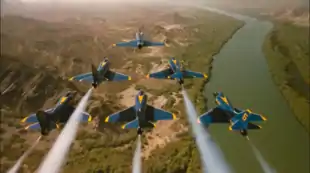
Many shots in the film took a long time to prepare: for example, the 35-second shot of the Blue Angels speeding over the Colorado River and Yuma Desert[10] took over four months to choreograph. MacGillivray described it as time-consuming.[27] Camera mounts were designed by the United States Navy (USN) for a McDonnell Douglas F-4 Phantom II used to film the Blue Angels scene. Despite lack of confidence that it will work successfully, fellow friend Nelson Tyler managed to spend two months developing two mounts for the camera helicopter, one to film forward-moving shots and another equipped with a camera dolly to film from the side, that allow smooth aerial shots. Remote-controlled devices were also built to move the second mount. Mounts were also by Boeing for the Boeing 747,[10][26][34] as well as on a monoplane piloted by Art Scholl, which was used to film front point-of-views.[20] The mounts took weeks to test so that the camera can stay intact without even a bit of vibration.[10] The hot-air-balloon aerial scenes were filmed from a helicopter.[35] Real-life expert balloonist Peter Walker was chosen to play the role of Ezekiel. Because during the colonial times hot-air-balloons were powered by helium, the USN donated free helium for the film crew as a gift because of the Blue Angels' presence in the film.[36]
Aerial work platforms were used to support the balloon basket, as well as the camera; the former was supported by two platforms as it moved in "moved in opposing directions to heighten the illusion of actual in-flight motion." To create a scene where a 1891 Sierra No. 3 locomotive hits the screen, the film crew placed a mirror at the end of the track, then point the wide-angle camera sideways to point to the mirror for a symmetrical view of the rail as the locomotive approaches and shatters the mirror. For shots featuring close-ups of the pilots "flying" the air vehicles, the illusion was made by filming with the sky in the background while the aircraft's engines rev and the camera moves in and out of a "rough" dolly. Bob Wills also flew the Kauai coastline hang-glider,[10][37] one of the scenes suggested by Collins and Zisfein[22] during a period where the sport saw spiking popularity.[38] A stagecoach was used in a scene where it races with the locomotive. Prior to that scene, a Conestoga wagon is depicted. The 747 aerial scene was filmed from a 737 donated by Boeing. A Curtiss Model D was flown by Frank Tallman for the mechanical flight sequence. A Ford Flivver was used in a segue between the car and mechanical flight scene; this was done by a low shot accelerating with audiences assuming this is the car, but to their surprise it flies beyond the ground above Coastal California. Other filming locations include the Gateway Arch, Lake Powell, Monument Valley, and Yosemite Falls.[3][10][39] The barnstorming scene was filmed in California.[17] There was a deleted scene in the opening sequence where the crowd witnessing Ezekiel's ascent perform barn raising.[10]
Because of the nature of IMAX, an new set of filming rules were abided, and many conventional rules were "temporarily set aside." It took three months to test the cameras and other equipment to ensure production will run flawlessly. Because the IMAX screen is enormous, extreme-long shots were treated as wide-angle shots, while the latter was treated as normal shots. Condensed movement was used to switch between an extreme long shot to medium close-up, and a wide-angle lens was used to further expand the film's view. Shots lengths were long so that audiences can observe the entirety. According to MacGillivray, "Because the audience sits lower in relation to the screen in an IMAX theatre, the new center lies approximately one-third up from the bottom of the screen. Therefore, all scenes need to be framed with this in mind, but particularly the closeup. Plenty of headroom is needed in all closeups (in IMAX, the medium closeup) so the audience can establish comfortable eye-contact."[10]
The scene with a vertical view of New York City used a 30mm fisheye lens, giving it edge curvature and image distortion. For lenses specifically built for Hasselblad cameras, shutters were removed and the mounts were modified in order to fit in the IMAX cameras, and the focal lengths were changed from 30mm to 60mm.[10] Amid filming, the film crew wished they had a zoom lens that could have eased some of the filming; they used the first IMAX zoom lens in their later film, Behold Hawaii (1983).[40] The filmmakers wanted a bright, colorful, naturalistic film, prompting them to use the 65mm film stock Eastman Color Negative 5254, and merely use a standard 85 filter. The lenses and magazines were checked following camera modifications. To have a dramatic look, they used cross-back light or cross light. The then-new O'Connor 150 tripod head was used due to its ability to withstand the heavy cameras. Filming ended on schedule, despite all the technical challenges faced; MacGillivray largely credited this to the extensive preparation done pre-production.[10]
Space sequence
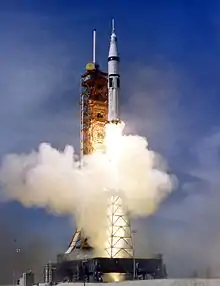
The space sequence begins with the launch of the Saturn IB rocket. They were given "special permission" to film it, marking the first time a rocket launch was filmed on IMAX.[10] The film crew took this part of the production more seriously, as it cannot be repeated, unlike the other parts of production, despite their equal level of difficulty.[17] As they left the camera outside for a day, humidity causes the camera to become condensed; this was exacerbated by seasonal thunderstorms. Despite their best efforts, the camera was later found wet and jammed, and they immediately cleaned and lubricated it for around three hours. They managed to catch the launch on film despite initial uncertainty.[41]
With such a low budget, the film crew initially conceived the space sequence as merely a compilation of astronomical images, but realized they needed some kind of movement for a giant-screen film, and thus saved money on the live-action filming so that a better space sequence can be created. They expected To Fly! to be compared with the Cinerama classic 2001: A Space Odyssey (1968) and, despite their limited resources, try to make the space sequence as reminiscent of the film as possible. When reading about the film's production, they learned that something small like stars on an IMAX presentation is nothing on a traditional presentation; after some difficulty, they managed to create the stars on a Kodalith negative sheet film. Another thing they learned from 2001: A Space Odyssey was that movement is important. The IMAX nature meant that they could only film the space sequence at 6 and 12 frames per second and that stop motion technique is impossible; additional limitations prompted detailed communication with the NASM to help assist the production. George Casey and Lester Novros of Graphic Films provided planetary models and studio facilities for scenes that require them, as well as using their expertise to ease the production.[41]
In a scene where the spaceship passes Jupiter and Io, they filmed separate elements in separate film rolls; each "required four separate passes of the negative through the camera, each time being rewound to heads and rethreaded to a common start frame." The camera was placed on a motorized dolly. They filmed Io first, then Jupiter, then the spaceship. According to Blyth, "The [space]ship was a 2 inches (5.1 centimetres) transparency of a 3 feet (91 centimetres) starship model rear-lighted on a stationary glass frame"; MacGillivray Freeman Films constructed it, and Blyth designed it to have the same color palette as the 747. The starship's components were based on then-future ideas about propulsion systems like advanced ion thrusters, as well as magnetically-confined fusions like deuterium-3 and helium-3. Overall models took 150 hours to create. The scene featuring the dark Earth and a horizon sunrise used a dolly. Some scenes, including the Saturn scene, was filmed at a homemade animation stand; others used a pseudo version of the slit-scan photography kit used for 2001: A Space Odyssey. A modified auxiliary peg bar was used to attach the models; the glass sheet with the starship was suspended nearby the bar. Several motors and control devices were tried to film the extremely slow scenes, and the zoom motors were determined to work the best. To add movement to the shots, a geared head and a custom gear operated by the zoom motor, creating a "slight" pan. They filmed all these scenes on 16mm first, to make sure they were replicable on IMAX. Collins assisted this entire segment of production to ensure realism.[41]
The penultimate set of shots of nebulae used bellows and Hasselblad close-up lens, the camera facing a water-filled tray; the nebulae were a mixture of jet black ink and white enamel paint, with color coming from the gelled lighting. The materials' temperature, thickness, size, and type had to be precise and same to achieve the reaction. Since they had to film at 96 fps, two solutions were most implemented to slow down the movement: pouring mineral oil and applying paint thinner to the tray; the latter was favored as it created more interesting movements akin to three-dimensional effect. Often a small wire was shaped and dipped into the tray to create specific patterns.[41] Jim Palmer created the laser beam effects; he had experimented with various types of patterns pre-production.[10]
Overall, the space sequence took 4½ months to prepare, test, and film.[41]
Post-production
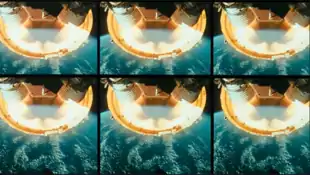
To Fly! was edited by MacGillivray and Freeman himself, with Alexander Hammid supervising,[29] on a Moviola. Knowing that they would experiment on different editing styles, the film's shots were directed beforehand so that it would allow them to do so. Pacing is normal, so that audiences have enough time to explore the entirety of the shots. In the opening, the part where Ezekiel is still at land merely uses 1⁄6th of the IMAX surface; as he ascends, all of the screen is utilized; this is to give a dramatic sense to the film, as well as a reference to aviation, which the film calls "like the opening of a new eye."[10] That idea, whose goal was to give audiences a good impression of IMAX, was taken from the similarly-styled opening sequence of This is Cinerama (1952).[26] Multi-screen images—the act of placing duplicates of images in the same screen— were occasionally done, inspired by the multi-projector film Labyrinth (1967) and the first IMAX film Tiger Child (1970). After learning that an inconsiderately-placed multi-screen scene would create a confusing experience for audiences, Jim Liles of the Optical Department at Metro-Goldwyn-Mayer and filmmaker Dennis Earl Moore designed new mattes where the bottom row is 15% larger than the top, allowing for clearer focus of attention. Smith supervised research for the stock footage to be incorporated into the multi-screen scenes, and handpicked footages shot by MacGillivray himself. After editing, a Cinemeccanica Norelco AAII 35mm-70mm projector was installed at their studio and sat relatively close to the screen to get a feel of what To Fly! would look like on IMAX. Overall, editing took four months.[10]
MacGillivray considers To Fly! "an audiovisual voyage through time", and thus wanted the best person to compose the film score. Eventually it was composed and conducted by Bernardo Segall and performed by "the most professional and experienced symphonic" 49-piece orchestra in California at The Burbank Studios. Segall was chosen because he was considered a great classical composer whose works have "an air of sophistication and elegance, which would maintain the steady rhythm and pulse of the film."[10] The score was the first in hstory to use a keyed bugle, which is also depicted in the film's opening sequence: during the gathering for Ezekiel's ascent, a small instrumental team plays a fife, drum, clarinet, and B♭ keyed bugle.[42] The score was later edited by Richard R. McCurdy and mixed by Dan Wallin; the latter was assisted by Paul Martin. The score was recorded on a 16-track recorder, which was then mixed down to three out of the six channels at the 35mm full-coat sprocketed magnetic film. It was mixed "authentically" to create a quadrophonic surround experience.[10] Todd-AO's Los Angeles mixing facility in Hollywood was also used for post-production;[20] Joseph Ellison, later the creator of Don't Go in the House (1980), participated in this segment.[43] For the sound effects, Sam Shaw was the editor, while Ray West and Jack Woltz were mixers. Because of the vast room for creativity they can pour into the sound due to the high technology, certain scenes in the film were made just for the audio experience, including the multi-screen scene where two jets cross each other, which exploits the surround nature of the sound system. MacGillivray expected audience to "shiver" in this scene, due to the dramatic shift of attention. Another instance is in the scene where the locomotive hits the screen; the engine noises went from the center to all around the audience.[10]
Clients applauded the rough cut; two of the biggest, the Smithsonian and Conoco, gave various inputs for the final cut. Rud Lawrence and Tony Sheldon-Moir represented the latter; while Collins, Zisfein, Von del Chamberlain, and Gene Knight represented the former. Conoco later became the film's sponsor. The whole post-production process, combined with the space sequence production, took a total of six months.[10] According to MacGillivray, the final cut was finished very shortly before the films' release.[26]
Themes and style

To Fly! contains themes of how the imaginations of the American people helped pioneer aviation, and how the aerial sceneries further inspired them to broaden the scope of aviation and revolutionized the world.[10] This is proven by the many aircraft shots set against the backdrop of the country's landscapes.[44] Critic Daniel Eagan opined that the majority of the point of views depicted in the film's opening sequence are "stately, processional, celebrating the American landscape while remaining distant from it." From that point, the film explores the country, "igniting patriotic empathy."[16] It was also viewed as a nationalist film, linking the American quest for national identity to the development of aviation through metanarratives, depicting the linear progress of aviation and identity search, though its visual rhetoric only shines in the space sequence.[45] The Smithsonian, in reference to the final narration of the film, said that its theme is: "Flight, in all its forms, is part of the Human condition, part of our Destiny."[39]
Collins said that the film's style makes it "a break from the learning going on in the rest of the museum",[7] and NASM former assistant LeRoy London said it is an amplification of the fascination or interest of flying within visitors after seeing all the exhibits in the museum.[27] Steve McKerrow of The Baltimore Sun noted how certain scenes are tributes to cinematic history: the shot where the train hits the camera is similar to one from The Great Train Robbery (1903); the hot-air-balloon scenes are reminiscent of Around the World in 80 Days (1956); and the barnstorming scene is probably set in the same field in North by Northwest (1959), in a crop duster chase scene.[46] The film's travelogue nature of the US has been compared with the closing section of This is Cinerama, which has a similar narrative.[16]
Release
To Fly! was released at the NASM's Samuel P. Langley IMAX Theater (renamed Lockheed Martin in 2002)[47] on July 1, 1976[9][lower-alpha 3] "to packed audiences."[23] It was labeled a public service by Conoco,[48] who was also distributor.[17][lower-alpha 4] Press announcements of the film date to May 16,[8] and earlier on June 24, there was a preview of the film at Langley Theater.[49] MacGillivray assisted the then-inexperienced projectionists, and frequently visited the projection booth.[10] Pachelbel's Canon in D was the music that played as audiences enter the theater, a decision praised as memorable, relaxing, religiously experiential, and meaningful.[50] The music has been interpreted as about human's quest to fly, aligning with the very film it is accompanied by.[51] All earnings of the film accrued to theater maintenance and financing future IMAX productions. After September 6 (Labor Day), Conoco began distributing the film to schools, organizations, and non-IMAX theaters.[17] Like other Bicentennial films, To Fly! was scheduled for a one-year run, but the revelation of this was met with public outcry, and the NASM decided to keep the film.[7] In the 1990s, they decided to upgrade the sound system to digital, "rejuvenating" the film's glory, and also release the film in digital projection.[47] At times, there were about 14 showtimes everyday.[20] Unfortunately, Freeman (aged 32) was killed in a helicopter crash at the Sierra Nevada two days prior to release, while finding locations for a Kodak commercial. Grief-stricken, MacGillivray doubted he could ever continue filmmaking as he and Freeman were very close best friends, but he coped with it, keeping the production company name, MacGillivray Freeman Films, to honor Freeman.[52][53] A 20th-anniversary special edition was screened in 1996,[9] which used a new version of score. An example of the alteration is in the theme music, where a masculine chant of the melody was added,[27] and a shot of a vast forest, whose score has a feminine sigh as the expanse is revealed.[9] To mark the film's 35th anniversary, the NASM screened it for a price of 50 cents for adults and 25 cents for children, the same price used until the 1980s;[48][54] this often switched with one dollar for adults and 50 cents for children.[17] Initially, it was included as part of the museum admission fee.[55] In 2021, Airbus IMAX Theater of the Steven F. Udvar-Hazy Center screens it[1] replacing the under-renovation Lockheed Martin.[56]
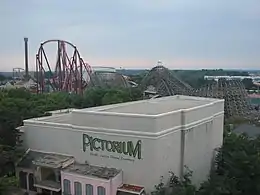
To Fly!'s success started a trend beginning in 1980, with museum IMAX theaters constructed in the US, Canada, and 22 other countries.[25] Prior to this, there were only five in the US.[13] The Smithsonian later also built an IMAX theater at the NMNH.[12] Museums "went crazy" over the film, specifically the transformative opening sequence.[26] Michael Kernan of The Washington Post credited word of mouth to the popularity, as marketing was limited to brochures and newspaper ads,[3] as well as TV spots by theaters.[2][58] MacGillivray did not expect such milestone,[7] and credited Freeman's talent to the success.[27] Screening film formats include (but not limited to) 16mm, 15 perforations/70mm, 8/70mm, Omninax-customized 15/70mm,[20][9] and IMAX 4K Laser. For the first 15 months of the National Museum of Photography, Film & Television IMAX theater in April 1983, To Fly! was the only film;[59] the museum stated that its "breathtaking" and "beautiful" visuals reflect their mission to showcase giant-screen films.[60] It was rescreened in 2013 for their 30th anniversary.[59] At the NASM and American Museum of Natural History's Naturemax Theater, also part of the Smithsonian, the film preceded the world travelogue Living Planet (1979) in a double feature.[3][61] The NASM later replaced Living Planet with MacGillivray Freeman's Speed (1984), a decision given a B- grade by The Fresno Bee.[62] To Fly!, translated to French, was also part of another double feature with Blue Planet (1990) at the Montreal Science Centre IMAX theater, in order to "relive the greatest moments of man's conquest to the skies."[4] The film was the premiere film for three theme park IMAX-es: Six Flags Great America's Pictorium IMAX Theater (1979), the Dreamworld IMAX Theater at Gold Coast, Australia (1981), and the Speelland Beekse Bergen's IMAX theater at Hilvarenbeek, the Netherlands (June 19, 1981). Dreamworld's founder John Longhurst was inspired to make the IMAX theater after seeing the "exciting" To Fly!.[58][63][64] Other countries include Germany, Japan, Mexico,[3] and Indonesia (Keong Emas IMAX Theater, Jakarta).[65] The film has been translated to 10 languages as of 2012. As of that year, nearly 150 theaters had screened it.[7] It has also been screened in various film festivals,[7] including the 2019 IMAX Victoria Film Festival, combined with North of Superior (1971), the second IMAX film, in a double feature dubbed "The Dawn of IMAX Filmmaking".[66]
To Fly! saw a Betamax release in 1985,[67] a LaserDisc release on December 12, 1991 by Lumivision,[68] and a VHS release,[69] which on March 20, 2011, was preserved at the Audiovisual Collections and Digital Initiatives Department of the Hagley Museum and Library, thus available for free at their website. The VHS release of the film is distinct from other formats in that that originally squared opening sequence was edited to fill up the entire screen.[70] The LaserDisc release has the film divided into 12 chapters, presented in a 1.33:1 aspect ratio,[68] contrary to the native 1.43:1 IMAX-custom aspect ratio.[71] The film was later also available at Amazon Prime Video.[69] On October 7, 2021, MacGillivray Freeman Films launched a streaming service, Movies For Families,[72] and included To Fly!'s anniversary edition, presented in the widescreen 1.78:1 asepct ratio, on the list.[9]
Reception
Box office
An estimated number of a million people have seen To Fly! at the NASM in its first year, with approximately 80% of seats occupied.[20] The Elyria Chronicle Telegram, however, claimed the numbers to be 8 million.[5] Over 100 million people have probably seen it in theaters, with over 15 million at the NASM;[9] 4.5 million of which are in the first four years,[3] and reaching 13 million in 1996. On the day of its 20th anniversary, a CBS This Morning report dubbed it "the longest running ticketed film in one location in history." As of 1996, the film accumulated over 300 million viewers worldwide.[27] Initially, Collins had only projected 3½ NASM visitors to see the film during its initial one-year run.[17]
The film's earnings spiked from US$20 million in 1993[73] to US$100 million in 1999.[74] It was the third highest-grossing IMAX documentary as of 2002, earning US$113 million, behind The Dream is Alive (1985, US$150 million) and MacGillivray Freeman's Everest (1998, US$114 million).[75] To Fly! set several box-office records,[20] earning over US$86.6 million domestically as of April 2015.[76]: 3 A 2003 Duke University Press publication reported it grossed more than US$150 million worldwide.[77] It was the highest grossing documentary of all time before Fahrenheit 9/11 (2004), though remains the second-highest grossing giant-screen documentary film, after Everest.[9] The Lodi News-Sentinel reported in 1991 that over 100 million people have viewed it at schools and television.[78] The film is the longest-exhibited documentary in the world,[79] the longest-running sponsored Washington, D.C. film, as well as the highest grossing sponsored film of all time.[9] However, the film has seldom screenings in non-IMAX theaters, making it unpopular among filmgoers.[48]
Reviews
Can you really call yourself a Washingtonian if you haven’t seen To Fly?
—John Kelly, The Washington Post
To Fly! was raved by film critics and scholars, listed among the best films of the 1970s[80] and the best documentaries.[81] John Alderson of the Chicago Sun-Times summarized his and other critics' reviews with: "The subject [of To Fly!] charms its imagination, while the IMAX format goes right to the brink of [audiovisual] sensory overload."[34] The Washington Post hailed it a Washington icon[3] and a must-watch to all Washingtonians.[79] Carl Sagan wrote in his book The Demon-Haunted World (1995) that he had watched the film at the NASM more than five times, and it still astonished him.[82] The film was cited by academic sources as an example of the role of screen size in the amplifying the cinematic thrills,[83][84] the power of aerial photography in a film,[85][86] and IMAX as a form of cinematic travel,[27][45] as well as a pioneer of cinematic kinesthetic responses and coverage of science and technology.[12][87][88] The film has been called one of the best IMAX films,[48][46][44][89] with David Handler of the Newspaper Enterprise Association agreeing with audiences for dubbing it "the ultimate film trip",[90] and Stuart Heritage of The Guardian considering it one of the few high-quality IMAX films, labeling it "dreary" and "educational".[91] BioScience and the Michelin Green Guide called it a must for NASM visitors; the latter gave the museum a full three stars.[92][93] Contemporarily, it was hailed the most underrated, electric cinematic spectacle.[9][45][48]
The cinematography received universal acclaim for its thrills;[34][51] a 1982 review at magazine Natural History by critic Douglas J. Peterson compared this to amusement park rides.[12] Donna Whitehead of Norwalk News praised MacGillivray and Freeman for using IMAX to the best advantage, with soaring shots galore; its illusion of reality is amplified by the score.[44] Tom Chernitsky of the Elyria Chronicle Telegram agreed with the latter point; he also credited the "unusual" camera angles and novel techniques to the film's mastery.[5] It also received positive reviews from teachers, who observed that the immersive cinematography alone makes it educational, as it teaches children what it feels to fly.[26] Praises were given to the squared segment of the opening sequence for disappointing audiences that it does not fill the entire IMAX screen, before eventually expanding.[3][16][34] John Russell of The New York Times credited the cinematography to the audiences' immersion upon the narrative despite its short duration, with the plot getting better as the film progresses. He also categorized it a poetry film, citing its "irresistible", wonderous look of nature.[48] Dan Moran of the Lake County News-Sun said that the film is one of the few Pictorium films not like the rest which were meant to make visitors asleep after a long day playing.[57] Nathan Southern of AllMovie gave the film 4½ out of 5 stars, stating that its aerial shots helped it be the vivid insight to American transportation as it should, calling the film historically significant and "One of the greatest unsung landmarks of American documentary".[94] Jim Clash of Forbes categorized it an epic film, citing its "vertiginous" cinematography.[95] The space sequence's goal of resembling 2001: A Space Odyssey is said to succeed.[34] Major film companies were urged to "watch out", predicting that To Fly! will set IMAX as a leading cinematic format.[9]
The film, especially the story, was more well-reviewed contemporarily. The Tampa Tribune rated the film 3 out of 4 stars, calling it a "fun parade" of aviation history and a "treat", saying the Horseshoe Falls and barnstorming scenes are the best.[96] Its poetic treatment towards the subject matter makes it described as a paean.[51] Whitehead called the opening scene intimate yet magical, and the ending uplifting.[44] Russell praised the narration and narrator as personal and meditative.[48] The story of the squared opening, however, was deemed foolish by Kernan, though he noted it is not meant to be the film's highlight.[3] Mark R. Hasan of KQEK.com criticized some of the film's "rough" editing, and that Ezekiel's dialogues are "quite awful", exacerbated by "rudimentary" sound mixing, though disclaimed that all these shortcomings fade after the opening, with sweeping cinematography, thematically ambient score, as well as "elaborate" and "directional" sound mixing during the spaceflight scene.[67] Jeremy Smith of Yardbarker praised the film's effective motivation, but opined the film uses IMAX as a gimmick, albeit a good one.[97] Eagan disagrees, saying that the film's shots are still breathtaking even in smaller, non-IMAX formats.[16] Ross Anthony, writing for his Hollywood Report Card site, gave the film a B+ grade, equivalent to 2.5 out of 4 stars, noting that he would've graded it A had he wrote his review contemporarily. He opined that Ezekiel is an oversentimental caricature, and that the hot-air balloon scenes were edited inconsistently, also observing that the balloon does not move at all. He also lamented the omissions of real-life aviation pioneers. He concluded that To Fly! is "amusing and informative (on a basic level)", and recommended the short IMAX experimental film Silent Sky (1977) for aviation enthusiasts.[98][99]
Audience response
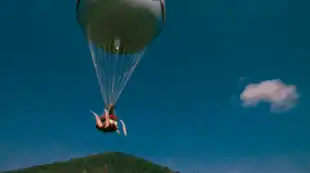
Audiences, regardless of demographics,[27] were "astonished" by To Fly!'s IMAX vertiginous shots.[100] Sighs, gasps, oohs, and cries were heard in most of the audiences.[9][34] During the balloon opening sequence, "ahhh"-s can be heard;[3] and during the Blue Angels and hang-gliding scene, some audiences can be heard screaming.[101] Others, however, screamed in jolt and "hastily" left the theater during its vertiginous scenes,[12] with the uncontrollable dizziness lingering long after the film finishes for some.[101] Later, the NASM added pre-entry warnings about potential dizziness and motion sickness.[87] The audience reactions also prompted them to blurb the film on their website with: "Feel the Earth Drop Away Beneath You".[12] In 2016, "Feel" was changed to "Watch" as part of a longer synopsis; a 40th-anniversary one-minute trailer was also released.[1] Expert hang-gliders were surprised at the hang-gliding stunt: "[42] years later, Bob Wills and To Fly! can blow even these guys away." Wills later died in 1977 while hang-gliding for a Jeep commercial.[38] People with fear of flying said that they are able to watch it without getting scared. Those who watched it also brought their children there to watch the film, akin to a generational tradition.[7] Audiences also found the film to be memorable.[26] The 2011 Virginia earthquake coincided with the Horseshoe Falls scene as To Fly! played at Lockheed Martin IMAX, and audiences did not think it was an earthquake assuming the shaking came from the subwoofers.[102]
Accolades
As of October 8, 1992, To Fly! received 11 awards.[44] The following table only lists the accolades known online.
| Award | Category | Recipient(s) | Result | Ref(s) |
|---|---|---|---|---|
| CINE Golden Eagle | Golden Eagle Award | To Fly! | Won | [9] |
| Chicago International Film Festival | Best Film Award | Won | ||
| Special Jury Award (Cinematography) | Won | |||
| Berlin Inforfilm Festival | None | First | ||
| Bicentennial Festival of Films on Aeronautics and Space | Grand | |||
| Festival of the Americas | Special Jury Award | Won | ||
| Columbus International Film Festival | Chris Bronze Plaque Award | Won | ||
| Information Film Producers Association | Best Documentary of the Decade | Won |
Legacy
To Fly! was hailed by many as a contemporary and classic blockbuster.[12][48] It was the top three reason people visit the city.[3] The film also has a significant history with political figures, viewed by government officials of the Soviet Union, Spain, United Kingdom, Egypt, Indonesia, US, and Greece. During his first inauguration (1981), US President Ronald Reagan handed a copy to Soviet General Secretary Mikhail Gorbachev; Reagan later attended the film's Soviet premiere at Moscow. When George H. W. Bush met Israeli Prime Minister Yitzhak Shamir on April 6, 1989, they went to the NASM and saw it.[9][96][103]
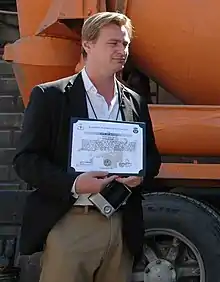
Contrary to popular belief, the film is not the first in IMAX, though was instrumental to introducing a more vast audience of the then-new format.[100] IMAX filmmaker Kieth Merrill credited To Fly! to the success of IMAX.[20] Ron Fricke shot the art film Chronos (1985) in IMAX after seeing To Fly!, regretting not filming his more popular film Koyaanisqatsi (1982) in IMAX;[104] MacGillivray was the latter's Second Unit Aerial Photographer.[76]: 39 Brian J. Terwilliger of the IMAX documentary Living in the Age of Airplanes (2015), chose to theatrically premiere it at the Lockheed Martin IMAX Theater as a tribute to To Fly! which he watched when he was young.[105] Christopher Nolan was inspired to make visually immersive films, after watching To Fly! at the age of 14 and noticing how the audience tilts their head during the flying sequences; MacGillivray consulted him on the IMAX cameras for The Dark Knight Rises (2012),[106] whose aerial scenes is inspired by To Fly!.[107] Terry Virts, who starred in the IMAX documentary A Beautiful Planet (2016), called To Fly! one of his most memorable childhood IMAX films.[108] To Fly! was also cited as a great influence on the legitimization of IMAX and the usage of multi-screen scenes in IMAX films, which have been common practice ever since.[16] In 1995, the film was deemed a pioneer of the IMAX format,[81] thus "culturally, historically, or aesthetically significant" by the US Library of Congress to be selected for preservation in the National Film Registry (NFR).[100] Voters of the Giant Screen Theater Association (GSTA)[lower-alpha 5] inducted it into the IMAX Hall of Fame in September 24 2001, a decision praised by then-co-chief executive officers Richard Gelfond and Bradley J. Wechsler, stating the film deserves such recognition.[109] It was also archived at the National Archives and Records Administration[28] and the Smithsonian Institution Archives.[110]
Upon popularity, in 1980, the NASM requested[30] Conoco to collaborate with MacGillivray and Moore in another short IMAX film, Flyers (1982),[15] a coming-of-age drama film about a teenager who aspires to be a pilot.[111] The film is the second MacGillivray IMAX film. Flyers also became an instant success, though at a less rate than To Fly!, and on March 4, 1982, Random House made an eponymous companion picture children's book.[15][76]: 3, 38–42 At Rotterdam in 1990, it played succeeding To Fly! as part of a double feature.[112] MacGillivray Freeman Films continued making IMAX documentaries, notably The Living Sea (1995), which was inducted into the IMAX Hall of Fame and nominated for Best Short Documentary at the 68th Academy Awards; and Dolphins (2000) which was highest-grossing documentary of that year and was also nominated for Best Short Documentary at the 73rd Academy Awards.[76]: 25, 26, 30, 31 Still active, the production was credited to the success of IMAX and one of the most influential and notable IMAX figures; Lea Silver of IMAX Victoria called him "a big deal."[113] In 1984, a film using outtakes from To Fly! and Flyers was proposed, but this never happened.[114] Instead, MacGillivray released The Magic of Flight (1996), a "sequel" inspired by To Fly!'s Blue Angels sequence.[115]
See also
- List of IMAX films
- Sonnet 18, whose concluding couplet is recited by one of the film's characters to his lover
Notes
- Stylizations of the title vary. In the film and trailer by the Smithsonian Institution, "Fly!" is stylized in all caps.[1] In a Cinesphere TV spot, all of it is in all caps.[2]
- More precisely 26 minutes and 51 seconds (48 seconds for the anniversary editon). Several sources misstated the running time by a few minutes.[3][4][5][6] While others stated it runs 26 minutes,[7][8] MacGillivray Freeman Films uses the approximate 27 minutes.[9]
- The Smithsonian magazine misstated the release year as 1978.[33]
- Until the company merged with the Phillips Petroleum Company in 2002
- Later the Giant Screen Cinema Association (GSCA).[26]
References
- "To Fly!". Smithsonian Institution. Archived from the original on October 19, 2019. Retrieved August 5, 2021.
- Written at Cinesphere. To Fly! (TV spot). Toronto: Ontario Place. November 11, 2020 [1994]. Archived from the original on August 23, 2021. Retrieved August 23, 2021 – via The Tape Keeper (on YouTube).
- Kernan, Michael (July 1, 1980). "Flight of the Filmgoer". The Washington Post. Washington, D.C.: Nash Holdings. Archived from the original on April 17, 2018. Retrieved August 18, 2021.
- Griffin, John (December 1, 1990). "Imax shows us our home; Astronaut worked camera for Blue Planet: [FINAL Edition]". Montreal Gazette. Postmedia Network. p. E1. ISSN 0384-1294. ProQuest 432059234.
- Chernitsky, Tom (May 4, 1977). "Cedar Point premieres breath-taking new film". Elyria Chronicle Telegram. Lorain County Printing and Publishing Company. p. 12. Archived from the original on December 8, 2021. Retrieved December 8, 2021 – via NewspaperArchive.
- "To Fly". IMAX. Archived from the original on March 8, 2019. Retrieved December 17, 2021.
- Freishtat, Sarah (July 12, 2012). "'To Fly!': Air and Space Museum opened in 1976 with film's first screening". The Washington Times. Operations Holdings. Archived from the original on April 8, 2020. Retrieved June 30, 2021.
- Douglas, David (May 16, 1976). "Spectacular Movie Has No Stars but it's Big". Fort Pierce News Tribune. Philadelphia. p. 12. Archived from the original on December 8, 2021. Retrieved December 8, 2021 – via NewspaperArchive.
- "To Fly!". MacGillivray Freeman Films. Archived from the original on April 5, 2020. Retrieved July 1, 2021.
- MacGillivray, Greg; Freeman, Jim (July 4, 1976). "Producing the IMAX Motion Picture: 'To Fly'". American Cinematographer. Vol. 57 no. 7. Hollywood: American Society of Cinematographers. pp. 750–809. ISSN 0002-7928. ProQuest 196332360.
- "The Apollo-Soyuz Mission". NASA. March 19, 2010. Archived from the original on August 23, 2021. Retrieved August 23, 2021.
The Saturn IB rocket lifts off from NASA's Kennedy Space Center in Florida on July 15, 1975, carrying Stafford, Brand and Slayton in an Apollo capsule.
- Griffiths, Alison (June 11, 2013). "From Daguerreotype to IMAX Screen: Multimedia and IMAX at the Smithsonian Institution". Shivers Down Your Spine: Cinema, Museums, and the Immersive View. Columbia University Press. pp. 195, 219, 221, 223, 225, 227–229. ISBN 978-0231129893.
- Neufeld, Michael J., ed. (November 6, 2013). "Origins of the IMAX Space Films". Spacefarers: Images of Astronauts and Cosmonauts in the Heroic Era of Spaceflight. Washington, D.C.: Smithsonian Institution Scholarly Press. pp. 160–161. ISBN 1935623257. Retrieved December 9, 2021 – via Internet Archive.
- Ferguson, Graeme; Kroitor, Roman; Whitmore, James; George, Chief Dan (1974). Man Belongs to the Earth (Motion picture).
- Naus, Rainer; Baer, Christopher T. (2013) [1974]. "Conoco files on IMAX films "To Fly" and "Flyers" Files". Hagley Museum & Library. 2527. Archived from the original on April 26, 2021. Retrieved August 5, 2021.
- Eagan, Daniel (October 15, 2009). America's Film Legacy: The Authoritative Guide to the Landmark Movies in the National Film Registry. Continuum International Publishing Group. ISBN 978-0826429773. LCCN 2009042778.
- "History Of Flight Traced". Commerce Journal. 87 (63). Washington, D.C. August 9, 1976. p. 15. Archived from the original on December 7, 2021. Retrieved December 7, 2021 – via NewspaperArchive.
- Rose, Michael (June 19, 2011). "Taking IMAX to the Max: Greg MacGillivray Is the Grandmaster of the Giant Screen". Los Angeles: International Documentary Association. Archived from the original on November 22, 2021. Retrieved November 22, 2021.
- Shepard, Richard F. (February 12, 1982). "Thrills Fly on the Biggest Movie Screen in Town". The New York Times. p. C27. ISSN 0362-4331.
The movie [...] was directed, photographed, and produced by Greg MacGillivray and the late James Freeman.
- Gilliam, Bret (October 13, 2016). "Greg MacGillivray A Lifetime in Film Master of IMAX". Scuba Diving International. Archived from the original on January 16, 2021. Retrieved July 1, 2021.
- Kleiman, Joe (May 4, 2021). "Apollo 11 astronaut Michael Collins' legacy includes museums, planetariums and giant screen cinema". InPark Magazine. Milwaukee. Archived from the original on May 9, 2021. Retrieved November 22, 2021.
- MacGillivray, Greg. "Inspire Friday Issue No. 19". MacGillivray Freeman Films. Archived from the original on December 5, 2020. Retrieved August 19, 2021.
- "The MacGillivray Freeman Story" (YouTube video). MacGillivray Freeman Films. April 30, 2015. Event occurs at 2:01 up to 2:27. Archived from the original on July 17, 2021. Retrieved November 21, 2021.
- "Film Database". Giant Screen Cinema Association. Count all the IMAX films. Archived from the original on October 26, 2021. Retrieved November 21, 2021.
- Essman, Scott (2010). "(untitled)". Movie Maker. Archived from the original on March 4, 2016. Retrieved August 26, 2021.
- MacGillivray, Greg (November 1, 2018). "GSCA Moments with Mary Jane Dodge Series: Greg MacGillivray" (YouTube interview). Interviewed by Dodge, Mary Jane. Giant Screen Cinema Association. Archived from the original on December 9, 2021. Retrieved December 9, 2021.
- ""To Fly" Segment featured on CBS This Morning". CBS This Morning. March 20, 2011 [July 1, 1995]. VID_2011320_B03_ID06_02. Archived from the original on August 8, 2021. Retrieved August 8, 2021 – via Hagley Digital Archives.
- "To Fly! (1976)". The List. Edinburgh. Archived from the original on January 19, 2021. Retrieved November 21, 2021.
- Noted in the film's credits
- MacGillivray, Greg (January 28, 2020). "Remembering Walter Boyne". MacGillivray Freeman Films. Archived from the original on December 8, 2021. Retrieved December 9, 2021.
- MacGillivray Freeman Films [@macfreefilms] (January 14, 2021). "#ThrowbackThursday: A close call. 🚁". Retrieved November 25, 2021 – via Instagram.
- "Remembering Graeme Ferguson". MacGillivray Freeman Films. Archived from the original on December 8, 2021. Retrieved December 8, 2021.
- Catlin, Roger (February 23, 2018). "Latest IMAX Film Studies History of American Music". Smithsonian. Washington D.C. Archived from the original on November 29, 2021. Retrieved November 29, 2021.
- Alderson, John (June 27, 1979). "PICTORIUM brings praise". Medicine Hat News. Alta Newspaper Group. Chicago Sun-Times. p. 20. Archived from the original on November 20, 2021. Retrieved November 20, 2021 – via NewspaperArchive.
- MacGillivray Freeman Films [@macfreefilms] (December 11, 2013). "Looking back on 50 years of filmmaking, including our first #IMAX film, #ToFly". Retrieved November 25, 2021 – via Instagram.
- MacGillivray Freeman Films [@macfreefilms] (June 21, 2019). "#TBT to our 1976 film To Fly! Unlike today's hot air balloons, in 1789 balloons used helium to fly. Greg and the team had to find a helium balloon and an expert pilot to navigate. The helium was provided by the U.S. Navy, who gave it to the team for free because the film also features their Blue Angel Flight Squadron!". Retrieved November 25, 2021 – via Instagram.
- MacGillivray Freeman Films [@macfreefilms] (August 2, 2019). "#TBT to @gregmacgillivray on location of the film #ToFly! In order to give audiences the sensation of the train coming straight towards them, a mirror was placed on the tracks to help create the effect. ". Retrieved November 25, 2021 – via Instagram.
- Glenshaw, Paul (August 2019). "Born in the 1960s, The Sport of Hang Gliding Still Hangs On". Air & Space/Smithsonian. Washington, D.C. Archived from the original on April 7, 2021. Retrieved November 28, 2021.
- "To Fly!" (PDF). Smithsonian Institution. Archived (PDF) from the original on October 20, 2019. Retrieved August 5, 2021.
- MacGillivray, Greg (December 12, 1982). "Innovative Devices Used on BEHOLD HAWAII". American Cinematographer. Vol. 64 no. 12. Hollywood: American Society of Cinematographers. p. 66. ISSN 0002-7928. ProQuest 196338732.
- Blyth, Jeff (July 4, 1976). "Filming the Space Sequences for "To Fly"". American Cinematographer. Vol. 57 no. 7. Hollywood: American Society of Cinematographers. pp. 755–813. ISSN 0002-7928. ProQuest 196331873.
- Dudgeon, Ralph Thomas (October 20, 2004). "The Revival". The Keyed Bugle (2 ed.). Metuchen, New Jersey: Scarecrow Press. p. 134. ISBN 0810851237. OCLC 1285644620.
- Edwards, Matthew (June 19, 2017). "Don't Go in the House: An Interview with Joseph Ellison". Twisted Visions: Interviews with Cult Horror Filmmakers. Jefferson, North Carolina: McFarland & Company. p. 66. ISBN 1476628149.
- Whitehead, Donna (October 8, 1992). "New IMAX film invites the audience 'To Fly!'". Norwalk News. p. 19. Archived from the original on November 20, 2021. Retrieved November 20, 2021 – via NewspaperArchive.
- Ruoff, Jeffrey (January 3, 2006). Virtual Voyages: Cinema and Travel. Durham, North Carolina: Duke University Press. pp. 14, 241, 245. ISBN 978-0-8223-3713-3. OCLC 1139359751. OL 29605515M.
- McKerrow, Steve (May 8, 1993). "Maryland Science Center brings hit IMAX movies back". The Baltimore Sun. Tribune Publishing. Archived from the original on June 22, 2021. Retrieved November 20, 2021.
- Neufeld, Michael J.; Spencer, Alex M., eds. (October 2, 2020). Smithsonian National Air and Space Museum: An Autobiography. Washington, D.C.: National Geographic Society (published October 26, 2010). pp. 274 & 311. ISBN 1426206534. OCLC 1200556738. Retrieved December 1, 2021 – via Internet Archive.
- Russell, John (May 8, 1980). "Film: 'To Fly,' Irresistible Fantasy". The New York Times (National ed.). p. 0. ISSN 0362-4331. Archived from the original on July 21, 2021. Retrieved July 21, 2021.
- "To Preview Thompson's Movie 'To Fly'". Titusville Herald. May 22, 1976. p. 3. Archived from the original on December 8, 2021. Retrieved December 8, 2021 – via NewspaperArchive.
- Clarke, John R. (April 20, 2014). "What Is That Music?". John Clarke Online. Archived from the original on January 29, 2021. Retrieved November 19, 2021.
- McDougall, Walter A. (December 1, 2003). Kuehner, Trudy (ed.). "The Ecstasy and the Agony of Our Romance With Flight: A Meditation on the Centennial of the Wright Brothers Triumph". Foreign Policy Research Institute. Archived from the original on January 22, 2021. Retrieved November 19, 2021.
- McLellan, Dennis (March 10, 1996). "Getting the Big Picture : Filmmaker Greg MacGillivray of Laguna Beach Sees the Imax Format as a Way to Create a Lasting Impression". Los Angeles Times. Times Mirror Company. Archived from the original on November 22, 2021. Retrieved November 22, 2021.
- Warshaw, Matt (November 7, 2005). The Encyclopedia of Surfing. Mariner Books. p. 214. ISBN 0156032511. OCLC 1014059201.
- "Smithsonian's National Air and Space Museum Turns 35 Friday" (Press release). Washington, D.C.: National Air and Space Museum. June 29, 2011. Archived from the original on July 6, 2016. Retrieved December 10, 2021.
- Rabinowitz, Richard (September 14, 2016). "The Elements of Interpretation". Curating America. Chapel Hill, North Carolina: University of North Carolina Press. p. 83. ISBN 1469629518. LCCN 2016009980.
- "Lockheed Martin IMAX Theater". Smithsonian Institution. Archived from the original on October 10, 2021. Retrieved December 7, 2021.
- Moran, Dan (June 12, 2018). "The Pictorium, Great America's IMAX pioneer, bids a sudden and quiet departure". Lake County News-Sun. Gurnee, Illinois. Chicago Tribune. Archived from the original on June 22, 2021. Retrieved November 30, 2021.
- "IMAX Pictorium, Gurnee 1979 — 2018". Six Flags Great America. Archived from the original on January 23, 2021. Retrieved July 1, 2021.
Opened in 1979, the premiere film for the Gurnee Pictorium was “To Fly!”.
- Vaughan, Dick (June 13, 2013). "Bringing the first permanent IMAX installation to Bradford". Bradford: National Science and Media Museum. Archived from the original on January 22, 2021. Retrieved August 9, 2021.
- To Fly (Leaflet). Bradford: National Museum of Photography, Film & Television. 1983.
TO FLY [...] is—thanks to the extraordinary IMAX process in which it is filmed—breathtaking and beautiful. Its screening is a symbol of the commitment of the National Museum of Photography, Film and Television to the big-screen presentation of films and stills.
- Brunskill, John (March 23, 1982). "Naturemax Theatre equipped with a screen four storeys tall". The Brandon Sun. New York City. Associated Press. p. 15, paragraph 5 & 12. Archived from the original on November 21, 2021. Retrieved November 21, 2021 – via NewspaperArchive.
- "OPENING". The Fresno Bee. McClatchy. April 31, 2001. p. E2.
- "Dreamworld History" (PDF). Dreamworld. p. 3. Archived from the original (PDF) on December 30, 2010. Retrieved March 24, 2012.
- "Beekse Bergen ziet sterren" [Beekse Bergen sees stars] (in Dutch). Regionaal Archief Tilburg. June 2, 2015. Archived from the original on February 28, 2021. Retrieved November 25, 2021.
- Ekaputra, Tarih. "Teater IMAX Keong Emas" [Keong Emas IMAX Theater]. F Magazine (in Indonesian). Jakarta: MediaKonsumen.com. Archived from the original on November 19, 2017. Retrieved August 20, 2021 – via National Library of Indonesia.
- "The Dawn of IMAX Filmmaking". IMAX Victoria. Archived from the original on December 16, 2021. Retrieved December 16, 2021.
- Hasan, Mark R. (September 3, 2014). "Beta: To Fly! (1976)". KQEK.com. Archived from the original on August 15, 2020. Retrieved August 15, 2021.
- "To Fly (1976)". LaserDisc Database. LVD9113. Archived from the original on January 18, 2021. Retrieved August 5, 2021.
- "To Fly! - Imax". Amazon.com. May 28, 2005. Archived from the original on March 27, 2016. Retrieved August 5, 2021.
- "To Fly!". Hagley Digital Archives. March 20, 2011. VID_2011320_B03_ID05. Archived from the original on November 1, 2020. Retrieved August 5, 2021.
- Pogue, David (February 20, 2018). "A Brief History of Aspect Ratios, aka Screen Proportions". Scientific American. Springer Nature. Archived from the original on October 15, 2021. Retrieved December 17, 2021.
- "Introducing Movies For Families - A New Streaming Channel" (YouTube trailer). MacGillivray Freeman Films. October 7, 2021. Archived from the original on November 20, 2021. Retrieved November 20, 2021.
- Reynolds, Christopher (1993). Hollywood Power Stats. University of Michigan. Valley Village, Los Angeles: Cineview Pub. p. 73. ISBN 0963874845. LCCN 93073776. OL 1441572M.
- Olson, Eric J. (January 4, 1999). "Giant screens poised for big impact". Variety. Vol. 373 no. 7. Penske Media Corporation. p. 9.
- Nicole, Sperling (April 23, 2002). "Imax's hopes for DMR loom large: Technology could help boost selection of giant-screen films. (Money)". The Hollywood Reporter. Vol. 373 no. 2. MRC. p. 13.
- "MacGillivray Freeman Films Filmography (1963 through 2020)" (PDF). MacGillivray Freeman Films. 2017. Archived (PDF) from the original on June 25, 2021. Retrieved November 30, 2021.
- Rabinovitz, Lauren; Geil, Abraham; Rigal, Laura; Depew, David (2003). Memory Bytes: History, Technology, and Digital Culture. Durham, North Carolina: Duke University Press. p. 112. ISBN 9780822385691.
- Weybret, Marty (June 27, 1991). "For movie crew, Lodi a Dutch treat". Lodi News-Sentinel. Horizon Publications. p. 3. Archived from the original on July 21, 2021. Retrieved July 21, 2021 – via Google News.
- Kelly, John (January 10, 2016). "A long time ago, big reels of film came to Air and Space Museum. No more". The Washington Post. ISSN 0190-8286. Archived from the original on October 21, 2020. Retrieved July 1, 2021.
- Berliner, Todd (October 2010). "Best Films of the 1970s". Hollywood Incoherent: Narration in Seventies Cinema. Austin: University of Texas Press. p. 227. ISBN 9780292722798.
- "Brief Descriptions and Expanded Essays of National Film Registry Titles". Library of Congress. Section "To Fly! (1976)". Archived from the original on January 1, 2018. Retrieved November 28, 2021.
- Sagan, Carl; Druyan, Ann (1995). The Demon-Haunted World: Science as a Candle in the Dark. Random House. p. 348. ISBN 0-345-40946-9. OCLC 32855551.
- Lombard, Matthew; Reich, Robert D.; Grabe, Maria Elizabeth; Bracken, Cheryl Campanella; Ditton, Theresa Bolmarcich (January 10, 2006). "Presence and Television: The Role of Screen Size". Human Communication Research. Oxford University Press. 26 (1): 75–98. doi:10.1111/j.1468-2958.2000.tb00750.x.
- Frome, Jonathan (2006). "Representation, Reality, and Emotions Across Media". Film Studies. Manchester University Press. 8 (1): 22. doi:10.7227/FS.8.4. eISSN 2054-2496. Archived from the original on November 27, 2021. Retrieved November 27, 2021 – via Academia.edu.
- Klinger, Barbara (January 21, 2016). Kahana, Jonathan (ed.). The Documentary Film Reader: History, Theory, Criticism. Oxford University Press. p. 992. ISBN 9780190226541.
- Klinger, Barbara (March 1, 2012). "Cave of Forgotten Dreams: Meditations on 3D". Film Quarterly. Berkeley, California: University of California Press. 65 (3): 40. doi:10.1525/fq.2012.65.3.38. eISSN 1533-8630. Archived from the original on November 27, 2021. Retrieved November 27, 2021 – via JSTOR.
- Geiger, Jeffrey; Littau, Karin (November 30, 2013). Cinematicity in Media History. Edinburgh University Press. p. 140. ISBN 9780748676149.
- Priest, Susanna Hornig (July 14, 2010). "Science on the Giant Screen". Encyclopedia of Science and Technology Communication. 1. SAGE Publications. p. 686.
- Graeber, Laurel (May 31, 2002). "FAMILY FARE". The New York Times. p. 44, section E. Archived from the original on January 28, 2018. Retrieved November 26, 2021.
- Handler, David (March 26, 1982). "The longest-running hit film in nation: 'To Fly'". The Desert Sun (200). Gannett. Newspaper Enterprise Association. Archived from the original on November 29, 2021. Retrieved November 28, 2021 – via California Digital Newspaper Collection.
- Heritage, Stuart (October 14, 2010). "Why Imax is still the way forward for cinema". The Guardian. Archived from the original on February 7, 2019. Retrieved July 1, 2021.
- "People and Places — NASM: Space Scholars Welcome". BioScience. Oxford University Press. 26 (9): 586. September 1, 1976. doi:10.2307/1297286.
- Michelin Must Sees Washington D.C. (4 ed.). Michelin. October 26, 2011. p. 40. ISBN 1907099468.
- Southern, Nathan. "To Fly! (1976)". AllMovie. RhythmOne. Archived from the original on January 17, 2017. Retrieved November 18, 2021.
- Clash, Jim (June 1, 1998). "IMAX man". Forbes. Vol. 161 no. 11. p. 184. ISSN 0015-6914.
- "Come "Fly' with MOSI; This pioneer showcase for the biggest of screens remains a visual thrill for all ages". The Tampa Tribune. March 27, 1998. p. 5.
- Smith, Jeremy (November 18, 2021). "Film gimmicks that worked (and a few that didn't) - Slide 20". Yardbarker. Burlingame, California. Archived from the original on July 26, 2021. Retrieved November 20, 2021.
- Anthony, Ross. "Flight Game: To Fly". Hollywood Report Card. Archived from the original on August 4, 2017. Retrieved August 15, 2021.
- Mackay, David; George, Laszio; Murray, Douglas; Boesch, Oscar (1977). Silent Sky (Motion picture).
- Pisano, Dominick (May 3, 2010). "IMAX—Not the First, but Close!". National Air and Space Museum. Archived from the original on July 6, 2020. Retrieved July 8, 2020.
- Mansfield, Paul (January 17, 1998). "I reached for the moon - and touched it". News. The Times (66101). London: News UK. col S, p.27.
- Madden, Keith; Trenner, Pat (October 4, 2011). "Is it Real, or is it IMAX?". Air & Space/Smithsonian. Washington, D.C. Archived from the original on March 6, 2021. Retrieved November 28, 2021.
- "Select Photos from the Archives". George H.W. Bush Presidential Library and Museum. P01902-14. Archived from the original on November 23, 2021. Retrieved November 23, 2021.
- MacDonald, Scott (2019). The Sublimity of Document: Cinema as Diorama. New York City: Oxford University Press. p. 31. doi:10.1093/oso/9780190052126.001.0001. ISBN 0190052147. OCLC 1083674891.
- Tallman, Jill W. (April 9, 2015). "'Living in the Age of Airplanes' Premieres at Air and Space Museum". Aircraft Owners and Pilots Association. Archived from the original on April 5, 2020. Retrieved November 21, 2021.
- The Dark Knight Rises 15/70mm rescreening (Speech). LG IMAX Theater, Sydney. 2020.
- Blair, Elizabeth (May 2, 2014). "Maintaining The IMAX Experience, From Museum To Multiplex". NPR. Archived from the original on July 1, 2021. Retrieved July 1, 2021.
- Ziv, Stav (May 10, 2016). "'A Beautiful Planet' Whisks Viewers to Space for 45 Minutes". Newsweek. IBT Media. Archived from the original on June 24, 2021. Retrieved July 1, 2021.
- "IMAX Announces Recipients of Founders Award at Chicago GSTA Conference". Chicago: PR Newswire. September 24, 2001.
- "IMAX Productions, 1990-1991". Washington, D.C.: Smithsonian Online Virtual Archives. Archived from the original on November 22, 2021. Retrieved November 22, 2021.
- Moore, Denis Earl; MacGillivray, Greg; Barron, Arthur; Schiff, Robin; Dempsey, Douglas K. (August 6, 1982). Flyers (Motion picture).
- Enorm groot de wereld op schoot [Experience the world on your seat] (Flyer) (in Dutch). Rotterdam: Rotterdam Waterstad IMAX. March 1, 1990.
- MacGillivray, Greg (April 4, 2020). "IMAX Victoria Live with Greg MacGillivray" (YouTube live stream). Interviewed by Silver, Lea. Victoria, British Columbia: IMAX Victoria. Archived from the original on August 19, 2021. Retrieved August 19, 2021.
- "Proposal for new film using outtakes - MacGillivray-Freeman, 1984". Hagley Museum & Library. 2013 [1984]. Archived from the original on August 5, 2021. Retrieved August 5, 2021.
- Robbins, Gary (March 18, 1996). "Taking a camera to the max". Orange County Register. Anaheim, California: Freedom Communications. p. 86. Archived from the original on November 20, 2021. Retrieved November 20, 2021 – via NewspaperArchive.
External links
 |
Wikiquote has quotations related to: To Fly! |
- To Fly! at Movies For Families
- To Fly! at IMDb

- To Fly! at Rotten Tomatoes
- "To Fly!", an excerpt from James Tobin's book To Conquer the Air: The Wright Brothers and the Great Race for Flight, at the Smithsonian magazine
| Authority control |
|---|