Toe ring
A toe ring is a ring made out of metals and non-metals worn on any of the toes. It is worn mainly in Indian sub-continent. The toe rings can have various shapes and forms.
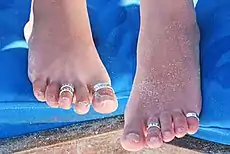
Toe rings in India
The wearing of toe rings has been practised in India since ancient times. In the Ramayana, there is a mention of Sita, on being abducted by Ravana, throwing her toe ring down so that lord Rama could find her. Toe rings worn by a woman signify that she is married. In many different Indian cultures, the husband puts the toe rings on the second toe of both of the wife's feet during the wedding ceremony.[1] It is worn as a symbol of the married state by Hindu women [2] and is called bichiya (pronounced: bee-chee-ya) in Hindi, minji (മിഞ്ചി) in Malayalam, Pāda Jhuṇtikā (ପାଦ ଝୁଣ୍ଟିକା) in Odia language, jodavi (जोडवी) in Marathi, Mettelu (మెట్టెలు) in Telugu, Angot (আঙট/আংট্; pronounced: aa-nng-ot) in Bengali, Metti/Kanaiyazhi in Tamil (மெட்டி/கணையாழி), Kaalungura (ಕಾಲುಂಗುರಗಳು) in Kannada.
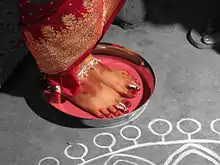
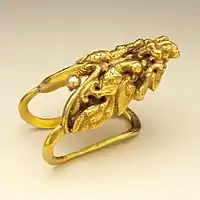
Toe rings in India are usually made of silver and worn in pairs (unlike in Western countries, where they are worn singly or in unmatched pairs) on the second toe of both feet. Traditionally they are quite ornate, though more contemporary designs are now being developed to cater to the modern bride. Some 'bichiya sets' may have pairs for four of the five toes, excluding the little pinky. 'Bichiyas' may not be made of gold, as gold holds a 'respected' status and may not be worn below the waist by Hindus, but this is not followed very strictly and toe rings made of gold and diamonds are commonly seen.[3]
Toe rings have other associated benefits according to Ayurveda. Toe rings have been indicated to be worn to regulate the menstrual cycle, and thus increase the chances of conception, as the slight pressure on the second toe ensures a healthy uterus. Some cultures also say that the pressure felt on the second toe helps to ease pain during intercourse. Unmarried Hindu girls may put toe rings on the third toe to help ease menstrual pain.[1][4]
Toe rings are also worn by men in Tamil culture, usually in a simpler design for comfort. The practice of Tamil men wearing toe rings/Metti had a use in ancient times when people used to walk around barefoot. The toe ring was a way for women to identify married men as it was the norm for women to look down when walking.[5]
In the 19th century mirror rings (i.e. rings with a small used mirror placed on them) were sometimes worn on the great toe assumed to be for decorative purposes. Nowadays toe rings are available in rubber and non-precious metals and are used for decorative purposes. Traditionally a large ring was worn on the great toe of the left foot to indicate a married status. Some men frequently wore a ring on the big toe for curative purposes or to augment their masculine vigor. These rings were seldom closed circles but open hoops so that they could easily be removed.[6]
Toe rings outside India
In the United States, toe rings are worn by men and women alike. There is no particular significance of wearing a toe ring, but more of a fashion jewelry statement.
In Africa, toe rings are worn by male and females. It is believed that the tradition arrived to Africa from India.[7]
Gallery
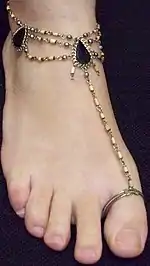 A toe ring with attached anklet.
 A toe ring being worn by a man.
References
- Sharmila. "Toe rings: Science Behind than just showing that the woman is married and feminine". KANNADIGA WORLD. Retrieved 2021-10-12.
- Sathyanarayan, Mansi; Bais, Mitraja (2018). "Indian Marital jewellery and symbolism: contextual manifestations". SAARC Culture: 49.
- Raha, Sylvia (2020). "Body and ornaments: reflection on ghurye's perspective". ISSN 2348-6538. Cite journal requires
|journal=(help) - Jayalakshmi, K (2020). "The Science behind Indian Rituals, Customs and Traditions". Mugla Sitki Kocman University Journal of Social Sciences. 5 (9). ISSN 1302-7824.
- "Metti - Hindu Toe Ring". July 4, 2013. Retrieved December 21, 2015.
- Rings for the Finger: Toe Rings George Frederick Kunz page 80, Lippincott Co. Philadelphia, 1917
- Lagercrantz, Sture (1945-01-01). "Toe‐rings". Ethnos. 10 (1): 39–43. doi:10.1080/00141844.1945.9980636. ISSN 0014-1844. Retrieved 2021-10-12.