Tokyo Metro 17000 series
The Tokyo Metro 17000 series (東京メトロ17000系, Tōkyō Metoro 17000-kei) is a Japanese DC electric multiple unit (EMU) commuter train type operated by Tokyo Metro on the Yūrakuchō Line and Fukutoshin Line to replace the ageing Tokyo Metro 7000 series.[1] It entered service on 21 February 2021.[2]
| Tokyo Metro 17000 series | |
|---|---|
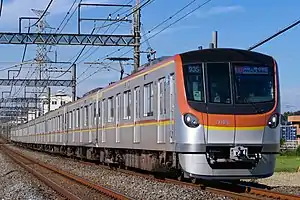 A Yūrakuchō and Fukutoshin Lines 17000 series train | |
| In service | 2021–present |
| Manufacturer | Hitachi (10-car sets), Kinki Sharyo (8-car sets) |
| Family name | A-train (10-car sets) |
| Replaced | Tokyo Metro 7000 series |
| Constructed | 2020– |
| Entered service | 21 February 2021 |
| Number under construction | 48 vehicles (6 sets) |
| Number built | 132 vehicles (15 sets) |
| Number in service | 92 vehicles (10 sets) |
| Formation | 8 or 10 cars per trainset |
| Fleet numbers |
|
| Operator(s) | Tokyo Metro |
| Depot(s) | Wakoshi |
| Line(s) served | |
| Specifications | |
| Car body construction | Aluminium alloy |
| Car length | 20 m (65 ft 7 in) |
| Width | 2.8 m (9 ft 2 in) |
| Height | 3,635 mm (11 ft 11.1 in) |
| Floor height | 1.14 m (3 ft 9 in) |
| Doors | 4 pairs per side |
| Maximum speed | 120 km/h (75 mph) (design) 110 km/h (68 mph) (service) |
| Traction system | 10-car sets: Mitsubishi SiC-MOSFET–VVVF 8-car sets: Hitachi SiC-MOSFET–VVVF |
| Traction motors | 205 kW (275 hp) permanent magnet synchronous motors |
| Acceleration | 1 m/s2 (3.3 ft/s2) |
| Deceleration | 1 m/s2 (3.3 ft/s2) (service) 1.25 m/s2 (4.1 ft/s2) (emergency) |
| Electric system(s) | 1,500 V DC overhead lines |
| Current collection method | Pantograph |
| UIC classification | 2'2' + Bo'Bo' + 2'2' + Bo'Bo' + 2'2' + 2'2' + Bo'Bo' + 2'2' + Bo'Bo' + 2'2' (10-car sets) 2'2' + Bo'Bo' + 2'2' + Bo'Bo' + Bo'Bo' + 2'2' + Bo'Bo' + 2'2' (8-car sets) |
| Coupling system | Shibata |
| Track gauge | 1,067 mm (3 ft 6 in) |


Operations
17000 series trainsets operate on the following lines.
- ■ Tokyo Metro Yūrakuchō Line (10-car sets only)
- ■ Tokyo Metro Fukutoshin Line
- ■ Tōbu Tōjō Line between Wakōshi and Shiki (8-car sets) or Shinrinkōen (10-car sets)
- ■ Seibu Yūrakuchō Line
- ■ Seibu Ikebukuro Line between Kotake-mukaihara and Hannō
- ■ Tōkyū Tōyoko Line
- ■ Minatomirai Line
Formation
The fleet will consist of six ten-car sets and 15 eight-car sets.
10-car sets
10-car sets are formed as follows:[4]
← Shibuya, Shin-Kiba Wakōshi → | ||||||||||
| Car No. | 10 | 9 | 8 | 7 | 6 | 5 | 4 | 3 | 2 | 1 |
|---|---|---|---|---|---|---|---|---|---|---|
| Designation | 17100 (CT1) |
< 17200 (M) |
17300 (T) |
< 17400 (M) |
17500 (Tc1) |
17600 (Tc2) |
< 17700 (M) |
17800 (T) |
17900 (M) |
17000 (CT) |
| Equipment | VVVF | BT CP |
VVVF | SIV CP |
SIV | VVVF | BT CP |
VVVF | ||
| Wheel arrangement | ○○ ○○ | ●● ●● | ○○ ○○ | ●● ●● | ○○ ○○ | ○○ ○○ | ●● ●● | ○○ ○○ | ●● ●● | ○○ ○○ |
| Weight (t) | 28.5 | 32.6 | 26.7 | 32.8 | 29.2 | 28.2 | 32.8 | 26.7 | 32.7 | 28.5 |
| Numbering | 17101 : 17106 |
17201 : 17206 |
17301 : 17306 |
17401 : 17406 |
17501 : 17506 |
17601 : 17606 |
17701 : 17706 |
17801 : 17806 |
17901 : 17906 |
17001 : 17006 |
8-car sets
Eight-car sets are formed as follows:[4]
← Shibuya Wakōshi → | ||||||||
| Car No. | 8 | 7 | 6 | 5 | 4 | 3 | 2 | 1 |
|---|---|---|---|---|---|---|---|---|
| Designation | 17180 |
< 17280 |
17380 |
< 17480 |
< 17780 |
17880 |
< 17980 |
17080 |
| Equipment | VVVF | SIV CP |
VVVF | VVVF | VVVF | SIV CP | ||
| Wheel arrangement | ○○ ○○ | ●● ●● | ○○ ○○ | ●● ●● | ●● ●● | ○○ ○○ | ●● ●● | ○○ ○○ |
| Numbering | 17181 : |
17281 : |
17381 : |
17481 : |
17781 : |
17881 : |
17981 : |
17081 : |
Key
- <: Current collection device (single-arm pantograph)
- VVVF: Variable frequency drive
- SIV: Static inverter
- CP: Compressor
- BT: Battery
- ○: Unpowered axle
- ●: Powered axle
Interior
Passenger accommodation consists of longitudinal bench seating throughout. Priority seating is provided at the ends of each car. LCD passenger information screens are situated above each doorway.
The floor height is 60 mm (2.4 in) lower than the floor height of the 7000 series.[5] In addition, the 17000 series has a seat width of 460 mm (18 in) per person, an increase of 30 mm (1.2 in) over the seats of the 7000 series.[2]
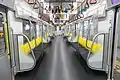 Interior view
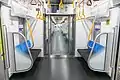 Priority seating
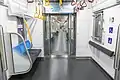 Priority seating with wheelchair space
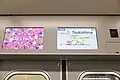 LCD passenger information screens
History
.jpg.webp)
In November 2019, Tokyo Metro announced plans to introduce a new fleet of 180 vehicles for the Yūrakuchō and Fukutoshin lines, which would replace the Tokyo Metro 7000 series.[5]
The first trainset was delivered in January 2020.
Build histories
The manufacturers and delivery dates for the fleet are as shown below.
| Set No. | Manufacturer | Date delivered | |
|---|---|---|---|
| 10-car sets | |||
| 17101F | Hitachi | January 2020[6] | |
| 17102F | Hitachi | March 2020[7] | |
| 17103F | Hitachi | November 2020[8] | |
| 17104F | Hitachi | February 2021[9] | |
| 17105F | Hitachi | March 2021[10] | |
| 17106F | Hitachi | April 2021[11] | |
| 8-car sets | |||
| 17181F | Kinki Sharyo | May 2021[12] | |
| 17182F | Kinki Sharyo | June 2021[13] | |
| 17183F | Kinki Sharyo | July 2021[14] | |
| 17184F | Kinki Sharyo | August 2021[15] | |
| 17185F | Kinki Sharyo | August 2021[16] | |
| 17186F | Kinki Sharyo | September 2021[17] | |
| 17187F | Kinki Sharyo | October 2021[18] | |
| 17188F | Kinki Sharyo | October 2021[19] | |
| 17189F | Kinki Sharyo | November 2021[20] | |
References
- Ueda, Yusuke. "東京メトロ17000系綾瀬駅". railf.jp (in Japanese). Retrieved 17 May 2020.
- "東京メトロ17000系、運行開始 床面は6センチ低く" [Tokyo Metro 17000 series starts operation, floor 6 centimetres lower]. Asahi News Digital. 21 February 2021.
- "東京メトロ17000系 編成表(最新版)" [Tokyo Metro 17000 series formation table (latest version)]. 4号車の5号車寄り (in Japanese). Retrieved 7 October 2021.
- "有楽町線・副都心線に新型17000系電車 2020年度に営業運転開始へ 東京メトロ" [New type 17000 series on Yūrakuchō Line and Fukutoshin Line start commercial operation in 2020 Tokyo Metro]. trafficnews.jp (in Japanese). Mediavague Co., ltd. 11 November 2019. Archived from the original on 12 November 2019. Retrieved 19 May 2020.
- "東京メトロ17000系17101編成が甲種輸送される" [Tokyo Metro 17000 series set 17101 delivered]. Japan Railfan Magazine Online (in Japanese). Japan: Koyusha Co., Ltd. 18 January 2020. Archived from the original on 18 January 2020. Retrieved 19 May 2020.
- "【JR貨】【東京メトロ】17000系17102編成を甲種輸送" [(JR freight) (Tokyo Metro) 17000 series set 17102 transport]. rail.hobidas.com (in Japanese). Neko Publishing. 8 March 2020. Archived from the original on 8 March 2020. Retrieved 19 May 2020.
- "17000系17103F日立製作所出場". 4gousya.net (in Japanese). 8 November 2020. Retrieved 11 November 2020.
- "17000系17104F日立製作所出場". 4gousya.net (in Japanese). 21 February 2021. Retrieved 21 February 2021.
- "17000系17105F日立製作所出場". 4gousya.net (in Japanese). 14 March 2021. Retrieved 14 March 2021.
- "17000系17106F日立製作所出場". 4gousya.net (in Japanese). 4 April 2021. Retrieved 6 April 2021.
- "17000系17181F近畿車輛出場". 4gousya.net (in Japanese). 2 May 2021. Retrieved 2 May 2021.
- "17000系17182F近畿車輛出場". 4gousya.net (in Japanese). 27 June 2021. Retrieved 28 June 2021.
- "17000系17183F近畿車輛出場". 4gousya.net (in Japanese). 18 July 2021. Retrieved 17 August 2021.
- "17000系17184F近畿車輛出場". 4gousya.net (in Japanese). 16 August 2021. Retrieved 30 August 2021.
- "17000系17185F近畿車輛出場". 4gousya.net (in Japanese). 29 August 2021. Retrieved 30 August 2021.
- "17000系17186F近畿車輛出場". 4gousya.net (in Japanese). 19 September 2021. Retrieved 21 September 2021.
- "17000系17187F近畿車輛出場". 4gousya.net (in Japanese). 17 October 2021. Retrieved 25 September 2021.
- "17000系17188F近畿車輛出場". 4gousya.net (in Japanese). 31 October 2021. Retrieved 31 October 2021.
- "17000系17189F近畿車輛出場". 4gousya.net (in Japanese). 21 November 2021. Retrieved 22 November 2021.
External links
 |
Wikimedia Commons has media related to Tokyo Metro 17000 series. |
- Tokyo Metro official website (in Japanese)
Tokyo Metro trainsets | ||
|---|---|---|
| Current | 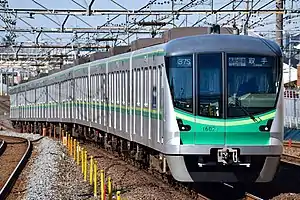 | |
| Former |
| |
See also: Tokyo subway rolling stock | ||