Toshio Kimura
Toshio Kimura (木村 俊夫, Kimura Toshio, 15 January 1909 – 1 December 1983) was a Japanese politician who served as foreign minister for six months in 1974.
Toshio Kimura | |
|---|---|
| 木村 俊夫 | |
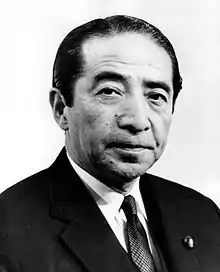 | |
| Minister of Foreign Affairs | |
| In office 16 July 1974 – 9 December 1974 | |
| Prime Minister | Kakuei Tanaka |
| Preceded by | Masayoshi Ohira |
| Succeeded by | Kiichi Miyazawa |
| Head of the Economic Planning Agency | |
| In office 5 July 1971 – 7 July 1972 | |
| Prime Minister | Eisaku Satō |
| Preceded by | Ichiro Sato |
| Succeeded by | Kiichi Arita |
| Chief Cabinet Secretary | |
| In office 22 June 1967 – 30 November 1968 | |
| Prime Minister | Eisaku Satō |
| Preceded by | Kenji Fukunaga |
| Succeeded by | Shigeru Hori |
| Personal details | |
| Born | 15 January 1909 Tōin, Japan |
| Died | 1 December 1983 (aged 74) Tokyo, Japan |
| Political party | Liberal Democratic Party |
| Alma mater | Tokyo Imperial University |
Early life
Kimura was born into a politically active family on 15 January 1909.[1] His father and grandfather were both lawmakers.[2]
Career
Kimura was elected to the House of Representatives for 12 times as a member of the Liberal Democratic Party (LDP).[2] In addition, he served as chief cabinet secretary in the cabinet of then prime minister Eisaku Satō.[2] He was also chairman of the Parliamentarians' League for Japan-Palestine Friendship.[2] He organized Yasser Arafat's visit to Japan in 1981.[3]
His other posts include director-general of the economic planning agency and deputy chief cabinet secretary. In 1971, Kimura served as acting foreign minister.[4] He was appointed foreign minister by then prime minister Kakuei Tanaka in mid-July 1974, replacing Masayoshi Ohira.[5] Kimura was in office for six months in 1974.[2] Kimura visited Africa in late October and early November 1974, which initiated the cooperation between African countries and Japan.[6][7] He was the first senior Japanese government official to visit African countries.[8] His Africa visit included Ghana, Nigeria, Zaire (now the Democratic Republic of the Congo), Tanzania, and Egypt.[7][9] Then Kimura became head of the LDP's Asian-African Studies Group in 1977.[10]
Personal life and death
Kimura was married and had a daughter.[2]
Kimura died of a heart attack at a hospital in Tokyo on 1 December 1983. He was 74.[2]
Honours
- Grand Cordon of the Order of the Rising Sun (3 November 1983)
References
- "Foreign ministers of Japan". Rulers. Retrieved 10 January 2013.
- "Toshio Kimura Dies; Former Tokyo Official". The New York Times. Tokyo. AP. 3 December 1983. Retrieved 5 January 2013.
- "Toshio Kimura". Toledo Blade. 1 December 1983. Retrieved 5 January 2013.
- Jacob Bercovitch; Kwei-Bo Huang; Chung-Chian Teng (7 May 2008). Conflict management, security and intervention in East Asia: third-party mediation in regional conflict. Routledge. p. 101. ISBN 978-1-134-14102-9.
- "Tanaka reshuffles Japanese cabinet". Daytona Beach Morning. Tokyo. AP. 17 July 1974. Retrieved 6 January 2013.
- "Chapter 2. Diplomatic Efforts Made by Japan". Ministry of Foreign Affairs. Retrieved 5 January 2013.
- Oda Hideo (Winter 2002). "Japan-Africa Relations in the Twenty-first Century" (PDF). Gaiko Forum: 42–46.
- Geoffrey Murray (30 March 1981). "'Independent' Japan begins to build better ties with black Africa". The CS Monitor. Retrieved 5 January 2013.
- Jun Morikawa (1997). Japan and Africa: Big Business and Diplomacy. Hurst. p. 83. ISBN 978-1-85065-141-3.
- Sueo Sudō (1992). The Fukuda Doctrine and ASEAN: New Dimensions in Japanese Foreign Policy. Institute of Southeast Asian. p. 124. ISBN 978-981-3016-14-9.
