Trams in Kyiv
| Overview | |||
|---|---|---|---|
| Native name | Київський Tрамвай | ||
| Owner | Kyivpastrans, Kyiv City Council | ||
| Area served | Darnytsia Raion, Desna Raion, Dnipro Raion, Holosiiv Raion, Obolon Raion, Pechersk Raion, Podil Raion, Shevchenko Raion, Solomianka Raion, Sviatoshyn Raion | ||
| Locale | Kyiv | ||
| Number of lines | 22 | ||
| Annual ridership | 114,701,800 (2016)[1] | ||
| Website | https://kpt.kyiv.ua/ | ||
| Operation | |||
| Began operation | August 11, 1891 (horse-drawn tram) February 1892 (steam tram) June 13, 1892 (electric tram) | ||
| Number of vehicles | 456 | ||
| Technical | |||
| System length | 230 kilometres (140 mi) (2017)[2] | ||
| Track gauge | 1524 mm | ||
| |||
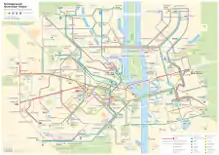
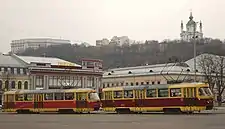
The Kyiv Tram is a tram network which serves the Ukrainian capital Kyiv. The system was the first electric tramway in the former Russian Empire and the fourth one in Europe after the Berlin Straßenbahn and the Budapest and Prague tramways. The Kyiv Tram system currently consists of 139.9 km (86.9 mi) of track,[3] including 14 km (8.7 mi) two Rapid Tram lines, served by 21 routes with the use of 523 tram cars. However, the system is being neglected, the serviced track length is decreasing at a fast rate and is replaced by buses and trolleybuses.
The Kyiv Tram system is operated by the "Kyivpastrans" municipal company which also maintains bus, trolleybus and urban rail transport in Kyiv.
History
During the Russian Empire
Before 1886, projects for the construction of a horse-drawn tramway were planned. However, none of these plans had ever proceeded to the construction stage.[4] In 1886, engineer Amand Struve's project was approved for construction. On July 30, 1891, the first horse-drawn tram wagon was set on a track. By August 1, the tram line stretched from the Tsar's Square to the Demiivska Square.[4]
Soon after tram operations were started, many problems arose. The hilly terrain of Kyiv presented the largest problem. On Bohdan Khmelnytsky Street, a pair of horses was not enough to pull the trams uphill. Therefore, another two pairs of horses were added, which did not improve the situation. Thus, mechanizing the tram using a steam-powered engine was attempted as a solution to the problem. However, the steam engines produced a lot of noise, which scared the horses and people, and produced a lot of air pollution.[4]
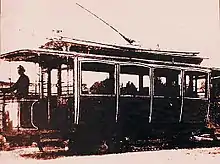
The slew of problems experienced by the trams shocked Struve, who in 1890, had written a letter to the City Administration of Kyiv suggesting that for increased safety and easier use, the trams would need to be powered using electric motors.[4] The administration of the Kyiv Telegraph service opposed this move since, in their opinion, the electric motors would interfere with the telephone and telegraph systems.[4]
On May 3, 1892, the first two trams with electric motors arrived in Kyiv. They were built by the Struve brothers in a factory located near Moscow, based on American designs. On the same day, the engines were tested on the flat Sahaydachny Street, and once more, on May 8, on the track from Podil Street to Khreshchatyk Street.
In 1893, the money earned by these electric trams exceeded the cost to maintain the trams. Furthermore, the electric trams were used whenever the horse-drawn or steam-powered trams had difficulty. Nevertheless, the system's horse-drawn trams were in use until 1895, and the last steam-powered cars ran until 1904, when a diesel electric station, on the so-called Dachnaya (Dachna) to Puschya-Vodytsia line was built. This station had lasted until the 1930s. These trams required very little power, which caused any electric trams, which used the line, to move so slowly that the passengers could get on and off the tram, while the tram remained in motion.
A long tram line, about 17 versts (18 kilometres) long, was laid from the Poshtova Square in the Podil neighbourhood, over the Dnieper on the Nicholas Bridge, through the Peredmostna and Nikolska Slobodka neighbourhoods, and to the neighbouring town of Brovary. The line was used until the mid-1930s, and was a one-way line with side-skirts for oncoming trams to drive into. This had made the trip even longer than it really was. The cost was 35 kopecks, a fair amount of money at the time.[4] Nevertheless, the trams were always packed with passengers.
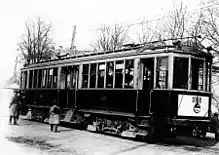
By 1893, the city's trams easily climbed the many steep streets of Kyiv, including the Proreznay (Prorezna), Karavayevskaya (Karavaievs’ka, now the Ploscha L’va Tolstoho Street) and even the Kruglouniversitetskaya (Kruhlouniversitets’ka) Streets. In 1893, the Elektrichestvo journal wrote:
If Kyiv's terrain had not been so unique, then it would have taken many years before electricity would have been used to power the trams.[5]
— Elektrichestvo journal
A major problem of the tram drivers at the time was the rolling stock used. When the city's railroad stock holder Lazar Brodsky died, the stocks were transferred to the Belgian auction firm, and the tram system began running on the Belgian Pullman wagons, with soft, sail-type cloth seats. But not these, nor the earlier seats on the German wagons, gave the tram drivers any comfort while standing in wind, rain, or snow, on the driver's platform on the tram.
During Soviet Ukraine
After the Russian Revolution and the Russian Civil War, reconstruction of the tram system began. The old and outdated tram wagons required restoration as the industry of the country could not manufacture new wagons. The train wagons' reconstruction was carried out in the main tram depot of the system, the Dombal Depot. From 1928 to 1932, 80 two-axel motor tram wagons and 65 regular train wagons were manufactured for Kyiv, and since 1932, the depot started producing four-axel tram wagons, due to Kyiv's geographical relief and climate. On the tram wagons, the conductors place was not warmed during the winter, however, was separated from the passenger part of the wagon.
On March 13, 1961, a major landslide hit the city's Podilske Tram Depot, burying it in clay sludge and killing most personnel on site. Additionally, dozens of people died in the tram cars and buses caught by the landslide and subsequent short circuit on the street intersection immediately next to the depot.
On December 30, 1978, the first high-speed tram line in the then Soviet Union was opened in Kyiv. It connected the Victory Square with the Pivdenna Borshchahivka housing estate.[6] The same year Kyiv experienced the peak in tram routes development in its history. In 1978 the length of the lines reached 285 km, the fleet numbered 909 cars, and passenger traffic per year exceeded 396 million people.[7]
Routes
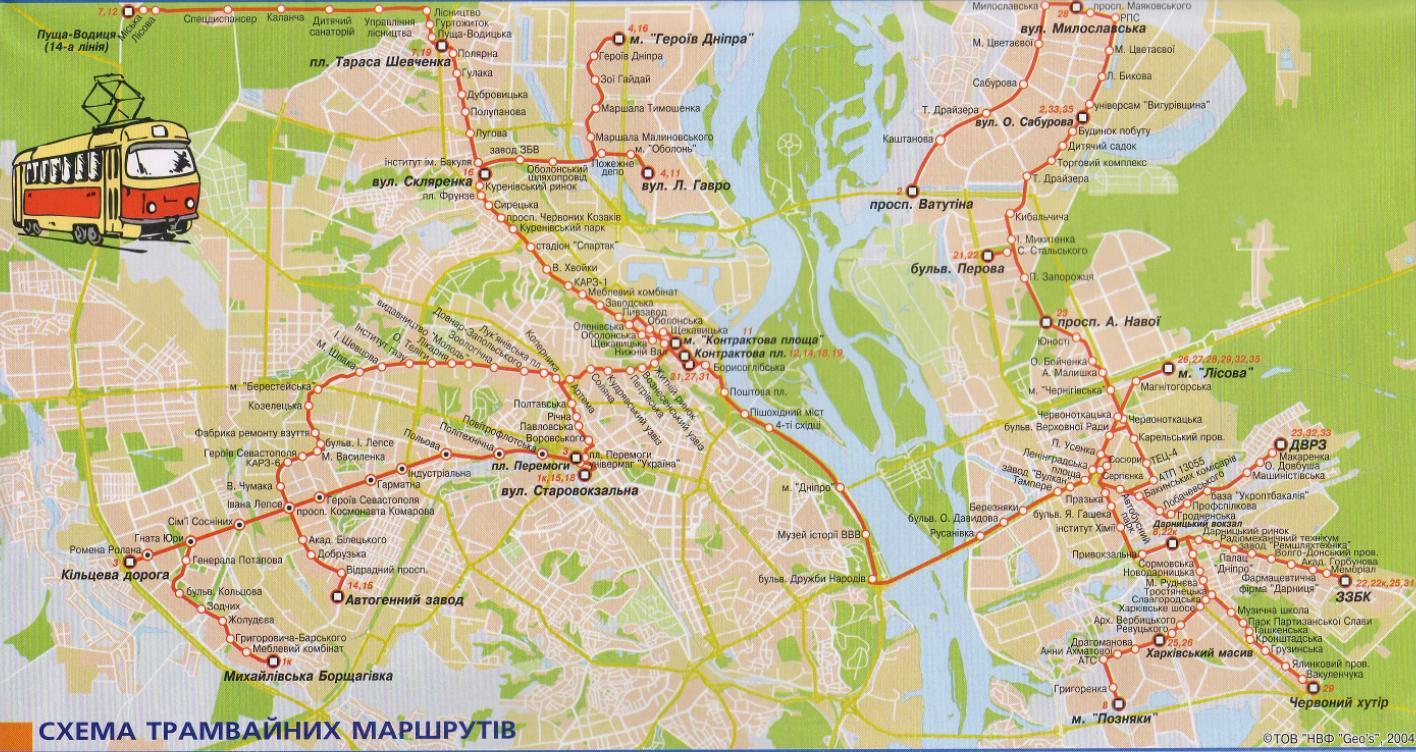
As of May 25, 2020, the following routes are in effect:
| Route | Schedule | Terminus | Terminus | Via | Notes |
|---|---|---|---|---|---|
| 1 | Mykhailyvska Borshchavihka | Starovokzalna station  |
Symyrenka Street — Koltsova Boulevard — Volodymyra Pokotyla Street — Lesya Kurbasa Avenue — Lyubomyra Guzara Avenue — Borshchahivska Street — Zhylianska Street | Forms part of the Pravoberezhna Line of the Kyiv Light Rail. | |
| 2 | Mykhailyvska Borshchahivka | Kiltseva Road station |
Symyrenka Street — Koltsova Boulevard — Volodymyra Pokotyla Street — Lesya Kurbasa Avenue | Temporarily suspended. Forms part of the Pravoberezhna Line of the Kyiv Light Rail. | |
| 3 | Kiltseva Road station |
Starovokzalna station |
Lesya Kurbasa Avenue — Lyubomyra Guzara Avenue — Borshchahivska Street — Zhylianska Street | Forms part of the Pravoberezhna Line of the Kyiv Light Rail. | |
| 4 | Troieshchyna-2 station  |
Myloslavska station |
Onore de Balzaka Street | Forms part of the Livoberezhna Line of the Kyiv Light Rail. Works only on weekdays and in peak hours. | |
| 5 | Troieshchyna-2 station |
Serzha Lyfarya Street | Onore de Balzaka Street — Myloslavska Street — Mykoly Zakrevskoho Street | Forms part of the Livoberezhna Line of the Kyiv Light Rail. | |
| 8 | Perova Boulevard | Pozniaky station  |
Suleymana Stalskoho Street — Kurnatovskoho Street — Myropilska Street — Hnata Khotkevycha Street — Pavla Usenka Street] — Ivana Serhienka Street — Kharkivske Highway — Pryvokzalana Street — Yaltynska Street — Slavhorodska Street — Trostyanetska Street — Anny Akhmatovoyi Street — Petra Hryhorenka Avenue | Temporarily changed route during construction on Yuriya Haharina Avenue[8]. | |
| 11 | Yordanska Street | Kontraktova Square | Marshala Malynovskoho Street — Dorbyninska Street — Semena Sklyarenka Street — Kyrylivska Street — Shchekavitska Street (other direction: Olenivska Street) — Kostiantynivska Street (other direction: Mezhyhirska Street) — Spaska Street | Works only on weekdays. | |
| 12 | 14th Lane, Pushcha Vodytsya | Kontraktova Square | Mykoly Yunkerova Street — 5th Lane — Fedora Maksymenka Street — Lisna Highway — Pushcha Vodystka Street — Tarasa Shevchenka Square — Polyarna Street — Avtzavodska Street — Semena Sklyarenka Street — Kyrylivska Street — Shchekavitska Street (other direction: Olenivska Street) — Kostiantynivska Street (other direction: Mezhyhirska Street) — Spaska Street | ||
| 14 | Vidradnyi Avenue | Kontraktova Square | Vidradnyi Avenue — Vatslava Havelya Boulevard — Mykoly Vasylenka Street — Dehtyarivska Street — Dmytrivska Street — Hlybochynska Street — Lower Val Street — Kostiantynivska Street (other direction: Mezhyhirska Street) — Spaska Street | ||
| 15 | Vidradnyi Avenue | Starovokzalna station |
Vidradnyi Avenue — Vatslava Havelya Boulevard — Mykoly Vasylenka Street — Dehtyarivska Street — Dmytrivska Street — Bulvarno-Kudryavska Street — Zhylyanska Street | ||
| 16 | Heroes of the Dnieper station  |
Kontraktova Square | Heroiv Dnipra Street — Zoi Haidai Street — Marshala Tymoshenko Street — Marshala Malynovskoho Street — Dorbyninska Street — Semena Sklyarenka Street — Kyrylivska Street — Shchekavitska Street (other direction: Olenivska Street) — Kostiantynivska Street (other direction: Mezhyhirska Street) — Spaska Street | ||
| 17 | Yordanska Street | 14th Lane, Pushcha Vodytsa | Marshala Malynovskoho Street — Dorbyninska Street — Semena Sklyarenka Street — Avtozavodksa Street — Polyarna Street — Tarasa Shevchenka Square — Pushcha Vodytska Street — Lisna Highway;— Fedora Maksymenka Street — 5th Lane — Mykoly Yunkerova Street | ||
| 18 | Kontraktova Square | Starovokzalna station |
Spaska Street — Mezhyhirska Street (other direction: Kostyantynivska Street) — Lower Val Street (other direction: Upper Val Street) — Hlybochytska Street — Dmytrivska Street — Bulvarno-Kudryavska Street — Zhylyanska Street | ||
| 19 | Kontraktova Square | Tarasa Shevchenka Square | [Spaska Street — Mezhyhirska Street (other direction: Kostyantynivska Street) — Shekavytska Street (other direction: Olenivska Street) — Kyrylivska Street — Semena Sklyarenka Street — Avtozavodska Street — Polyarna Street | ||
| 22 | ZZBK | Perova Boulevard | Boryspilska Street — Pryvokzalna Street — Kharkivske Highway — Ivana Serhienka Street — Pavla Usenka Street — Hnata Khotkevycha Street — Myropilska Street — Kurnatovskoho Street — Suleymana Stalskoho Street | ||
| 23 | DVRZ | Alishera Navoyi Avenue | Almatynska Street — Prazka Street — Azerbaijanska Street — Hnata Khotkevycha Street — Myropilska Street | Temporarily suspended during construction on Almatynska Street. Works only on weekdays. | |
| 25 | Pozniaky station |
ZZBK | Anny Akhmatovoyi Street — Petra Hryhorenka Avenue — Trostyanetska Street — Slavhorodska Street — Yaltynska Street — Boryspilska Street | Works only on weekdays. One morning route. | |
| 28 | Myloslavska Street | Darnytske Tram Depot | Mykoly Zakrevskoho Street — Teodora Drayzera Street — Mykoly Kybalchycha Street — Kurnatovskoho Street — Myropilska Street — Hnata Khotkevycha Street — Pavla Usenka Street | Temporarily changed route during construction on Yuriya Haharina Avenue[8]. | |
| 28D | Myloslavska Street | ZZBK | Mykoly Zakrevskoho Street — Teodora Drayzera Street — Mykoly Kybalchycha Street — Kurnatovskoho Street — Myropilska Street — Hnata Khotkevycha Street — Pavla Usenka Street — Ivana Serhienka Street — Kharkivska Highway — Pryvokzalna Street — Boryspilska Street | One morning route. | |
| 29 | Boryspilska station |
Alishera Navoyi Avenue | Tashkentska Street — Kronstadtska Street — Slavhorodska Street — Yaltynska Street — Pryvokzalna Street — Kharkivske Highway — Ivana Serhienka Street — Pavla Usenka Street — Hnata Khotkevycha Street — Myropilska Street — | Temporarily suspended during construction on Yuriya Haharina Avenue[8]. | |
| 32 | Lisova station  |
DVRZ | Popudrenka Street — Yuriya Haharina Avenue — Pavla Usenka Street — Ivana Serhienka Street — Prazka Street — Almatynska Street | Temporarily suspended during construction on Almatynska Street. | |
| 33 | Serzha Lyfarya Street | DVRZ | Mykoly Zakrevskoho Street — Teodora Drayzera Street — Mykoly Kybalchycha Street — Kurnatovskoho Street — Myropilska Street — Hnata Khotkevycha Street — Pavla Usenka Street — Ivana Serhienka Street — Prazka Street — Almatynska Street | Temporarily suspended during construction on Almatynska Street. | |
| 33K | Serzha Lyfarya Street | Darnytske Tram Depot | Mykoly Zakrevskoho Street — Teodora Drayzera Street — Mykoly Kybalchycha Street — Kurnatovskoho Street — Myropilska Street — Hnata Khotkevycha Street — Pavla Usenka Street | Temporary route during construction on Amatynska Street[9]. | |
| 35 | Serzha Lyfarya Street | Lisova station |
Mykoly Zakrevskoho Street — Teodora Drayzera Street — Mykoly Kybalchycha Street — Kurnatovskoho Street — Myropilska Street — Hnata Khotkevycha Street — Yuriya Haharina Avenue — Popudrenka Street | Temporarily suspended during construction on Yuriya Haharina Avenue[8]. |
Rolling stock
The Kyiv tram system uses many different tram cars and types, with some being designed in Moscow and manufactured in Riga, some being manufactured by the ČKD Tatra company in Prague, and with some being manufactured right in the city of Kyiv. The following data incorporates only some tram cars used by the system.
| Car type [10] | Numbers | Years in service | Routes |
|---|---|---|---|
| MTV-82[11] | 1201–1305, 1321–1387, 1501–1582 | 1949–1984 | Almost all |
| KTV-55[12] | 1110–1119, 1123–1126 | 1955–1984 | 1, 3, 6, 12, 14, 15, 16, 17, 23 |
| KTP-55[13] | 1001–1099 | 1955–1984 | 1, 3, 5, 6, 7, 12, 17, 18, 19, 23 |
| KTV-55-2 [14] | 2001–2081 | 1955–1987 | Stub-ended (1, 3, 4, 8, 16, 29, 30, 32);
Some ordinary (5, 6, 9, 10, 23, 24) |
| Tatra T6B5 | 001–077, 100–101, 301-318 | 1985 –Present | Almost all |
| Tatra T3 "Progress" | 5613, 5614, 5673, 5905, 5916, 5977, 5981, 5992, 5994 | 2003–Present | 12, 8, 23, 25, 29, 32, 33 |
| K1 | 320-328 | 2011-Present | 3 |
| K1M8 | 500-503 | 2011-Present | 3 |
| Electron T5B64 | 801-811 | 2015-Present | 3,1 |
References
- Notes
- Footnotes
- "Головне управління статистики м.Києва - Кількість перевезених пасажирів за видами транспорту (щорічна інформація)".
- https://docs.google.com/viewer?url=http://korpmet.org.ua/wordpress/wp-content/uploads/2011/12/%D0%9E%D0%B1%D1%94%D0%BA%D1%82%D0%B8-%D0%BC%D1%96%D1%81%D1%8C%D0%BA%D0%BE%D0%B3%D0%BE-%D0%B5%D0%BB%D0%B5%D0%BA%D1%82%D1%80%D0%BE%D1%82%D1%80%D0%B0%D0%BD%D1%81%D0%BF%D0%BE%D1%80%D1%82%D1%83-%D0%A3%D0%BA%D1%80%D0%B0%D1%97%D0%BD%D0%B8-%D1%81%D1%82%D0%B0%D0%BD%D0%BE%D0%BC-%D0%BD%D0%B0-01.01.2017.xls
- For a 2004 plan of the Kyiv tram, please see mashke.org
- Kalachevsky, Vladimir. "The first – in Kiev!". Autocentre (in Russian). Archived from the original on March 11, 2007. Retrieved June 26, 2006.
- Anisimov, Aleksandr (2002). Kyiv and Kyivans (in Russian). Kurch. pp. 88–89. ISBN 966-96120-1-2.
- "Как в Киеве появилась первая в СССР линия скоростного трамвая. Исторические фото: Авто новости от AUTO-Consulting - трамва". www.autoconsulting.ua. Retrieved 2020-05-19.
- "Хрещатик - новини та життя української столиці". Хрещатик (in Ukrainian). Retrieved 2020-05-19.
- "З 28 жовтня орієнтовно до кінця 2020 року рух трамваїв маршруту 35 тимчасово закривається та вносяться зміни в трасу руху трамваїв маршрутів №№ 8, 28, 29". kpt.kyiv.ua (in Ukrainian). Retrieved 2020-11-01.
- "Закривається рух трамваїв №23, 32, 33 - КП Київпастранс". kpt.kyiv.ua. Retrieved 2019-11-10.
- Note: Not all of the tram cars of the system are listed here. Mashkevich, Stefan. "Photo Galleries" (in Russian). Retrieved November 17, 2006.
- Moskovsky Tramvay (MTV) was designed in Moscow and manufactured in Riga.
- Kievsky Tramvay (KTV) was manufactured by the Dzerzhinsky Kyiv Electric Transportation Plant (KZET)
- Kievsky Tramvay Pritsepnoy (KTP) was manufactured by the Dzerzhinsky Kyiv Electric Transportation Plant (KZET)
- Kievsky Tramvay (KTV) was manufactured by the Dzerzhinsky Kyiv Electric Transportation Plant (KZET)
- Bibliography
- Mashkevych, Stefan. "In memory of Kiev Trams, by Stefan Mashkevich". Retrieved June 26, 2006.
- Kalachevsky, Vladimir. "The first – in Kiev!". Autocentre (in Russian). Archived from the original on March 11, 2007. Retrieved June 26, 2006.
- Anisimov, Aleksandr (2002). Kiev and Kievans (in Russian). Kurch. pp. 88–89. ISBN 966-96120-1-2.
- Further reading
- Mashkevych, Stefan. Tram Kopecks in Zerkalo Nedeli, October 16–22, 2004. Available in Russian and Ukrainian
- Rozhanovsky, Viktor. Struve: Uphill on the Aleksandrovsky Spusk in Zerkalo Nedeli, October 24–30, 1998. Available in Russian
- Kochevykh, Oleg; Stefan Mashkevich. "Our dear friend the tram". Interesting Kiev (in Russian). Retrieved November 17, 2006.
- Polischuk, Nikolai; Stefan Mashkevich (February 3, 2006). Трамвай, уходящий в чащу. Gazeta po-Kievsky (in Russian).
External links
 |
Wikimedia Commons has media related to Kiev tram. |
- "Kyivpastrans" official web site (in Ukrainian)
- In memory of Kiev Trams – by Stefan Mashkevich (in English and Russian)
- noosphere.com.ua – Fast tram No.2 in Kyiv (in Russian)
 | ||