Hindu Shahi
The Hindu Shahis[10] also Odi Shahis[11][12] (850–1026 CE) were a Hindu dynasty that held sway over the Kabul Valley, Gandhara and western Punjab during the early medieval period in the Indian subcontinent. Details regarding past rulers have been assembled from chronicles, coins and stone inscriptions by researchers as no consolidated account of their history has become available.[13]
Hindu Shahi | |||||||||||||
|---|---|---|---|---|---|---|---|---|---|---|---|---|---|
| 850–1026 CE | |||||||||||||
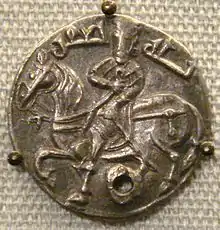
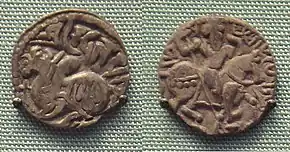 Some of the earliest coinage of the Hindu Shahis. Obverse: Recumbent bull, with Nagari legend:
     Sri Spalapati Sri SpalapatiReverse: horserider with corrupted Bactrian script: ςρι ςπaλaπaτι Sri Spalapati "Lord Commander-in-chief".[4][2][5] | |||||||||||||
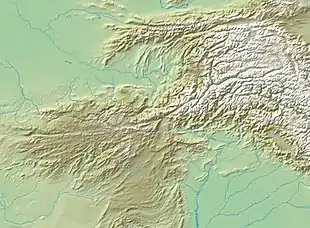
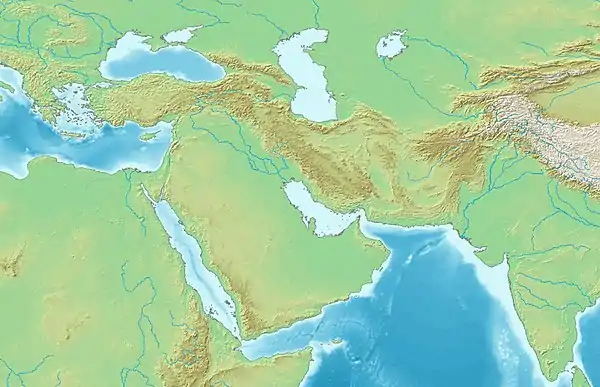
Approximate location of the Hindu Shahis | |||||||||||||
 HINDU SHAHIS | |||||||||||||
| Capital |
| ||||||||||||
| Common languages | Sanskrit (numismatics)[9] | ||||||||||||
| Religion | Hinduism | ||||||||||||
| Government | Monarchy | ||||||||||||
| Maharaja, Maharajadhiraja | |||||||||||||
• 843–850 | Kallar | ||||||||||||
• 850–895 | Vakkadeva | ||||||||||||
• 895–921 | Kamalavarman | ||||||||||||
• 921–964 | Bhimdeva | ||||||||||||
• 964–1001 | Jayapala | ||||||||||||
• 1001–1010 | Anandapala | ||||||||||||
• 1010–1021 | Trilochanapala | ||||||||||||
• 1022–1026 | Bhimpala | ||||||||||||
| Historical era | Early Middle Ages | ||||||||||||
• Established | 850 | ||||||||||||
• Disestablished | 1026 CE | ||||||||||||
| |||||||||||||
| Today part of | Afghanistan Pakistan | ||||||||||||


Scholarship
Scholarship on Hindu Shahis remain relatively scarce.
The first comprehensive volume was published in 1972 by Yogendra Mishra, a Professor in the Department of History of Patna University. The next year, Deena Bandhu Mishra—Professor of Art History at Banaras Hindu University—published his doctoral dissertation. In 1979, Abdur Rehman received his PhD from Australian National University on "history, archaeology, coinage, and paleography" of the Turk Shahis and Hindu Shahis. He has since published on the subject extensively and is considered to be an authority. Publications of IAMP—especially by Scerrato and Olivieri—refer to the dynasty, in details.
History
The Abbasids led by caliph Al-Ma'mun defeated the Turk Shahi Kingdom in 815 CE. After this defeat, the Turkic Shah had to convert to Islam and had to pay on annual basis 1,500,000 Dirhams and also slaves to the Abbasids.[14] These Kabul Shahis went through a political disaster due to the defeats and annual payments. Eventually, around 821 CE the unpopular Kabul Shah Lagaturman was disposed of his position by his minister called Kallar.[15] This gave way to another Kabul Shahi dynasty. This new dynasty was called "Hindu Shahi" by the Arabs, this novel Shahi kingdom possessed the Kabul Valley and Gandhara.[14]
Al-Biruni in his Tārīkh al-Hind ("History of India") describes the rule of the Hindu Shahis at Kabul, as successor of the Turk Shahis:[16]
The last king of this race was Lagatarman [ of the Turk Shahis], and his Vazir was Kallar, a Brahman. The latter had been fortunate, in so far as he had found by accident hidden treasures, which gave him much influence and power. In consequence, the last king of this Tibetan house, after it had held the royal power for so long a period, let it by degrees slip from his hands. Besides, Lagatarman had bad manners and a worse behaviour, on account of which people complained of him greatly to the Vazir. Now the Vazir put him in chains and imprisoned him for correction, but then he himself found ruling sweet, his riches enabled him to carry out his plans, and so he occupied the royal throne. After him ruled the Brahman kings Samand (Samanta), Kamalu, Bhim (Bhima), Jaipal (Jayapala), Anandapala, Tarojanapala (Trilochanapala). The latter was killed A.H. 412 (A.D. 1021), and his son Bhimapala five years later (A.D. 1026). This Hindu Shahiya dynasty is now extinct, and of the whole house there is no longer the slightest remnant in existence.
The Hindu Shahis issued valuable silver coinage which was widely recognized in contemporary international exchanges, to the point that large quantities have been found not only in nearby Sindh,[18] but also as far as northeastern Europe.[19]


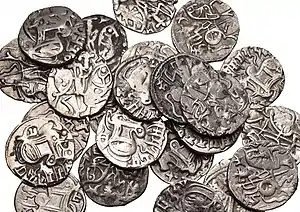 Hindu Shahi coinage, "bull/horseman" types, mostly "Samanta Deva" types


Saffarid conquest (870 CE)
_on_the_obverse._Nagari_%22Sri_Kudarayaka%22_on_the_reverse_(%E2%80%9CKhudarayaka%E2%80%9D)_Circa_895-921_CE.jpg.webp)


 (Śrī Khūdarayakah, "The fortunate small Raja"), trisula mark on the hump of the bull. Reverse: horseman with
  (ma) in Nagari to left, عدل (’adl, "Justice") in Arabic to right.[21]
In 870, the first Hindu Shahi King Kallar lost the city of Kabul. He was displaced from there by the local Saffarid dynasty which was ruled by Emir Ya'qub bin Laith as-Saffar. Due to the ongoing conquests of the local Saffarids and Samanids, the Hindu Shahis moved their capital in 870 to Udabhandapura (Also called Waihund or Hund), located on the banks of the Indus.[22][23]
The new Saffarid Governor of Kabul is known to have issued coinage after the capture of the city around 870 CE, on the Hindu Shahi model. The new coins used the Abassid dirham weight standard, rather than the Hindu Shahi standard. Although the design was generally identical with the Hindu Shahi coins, the legend on the reverse incorporated the Arabic word عدل (’adl, "Justice"). The obverse had the Nagari legend Śrī Khūdarayakah ("The fortunate small Raja").[24]
The loss of Kabul remained short as in 879 CE the Hindu Shahi captured the city back. This victory remained short too due to Samanid expansion in the region which eventually led to the final Shahi rule in Kabul around 900 CE. The Hindu Shahi remained strong in Gandhara and other parts of the Punjab.[14]
The Samanids and the Saffarids
In theory, the caliph as the successor of the Prophet was the fountainhead of all political authority. Kings and all tribal chiefs were subordinate to him and his sanction alone could provide the legal basis for their authority. With the waning of political might of the caliphate, its governors in Khurasan set up their own strong kingdom – the Samanid dynasty (c. 819-1005 CE) – controlling regions west and north of Hindu Kush up to Balkh. Under the loosely centralized feudal government of the Samanids, Transoxiana and Khurasan prospered with a notable expansion of industry and commerce. Samanids were great art patrons and they turned Bukhara and Samarkand into famous cultural centres, rivaling Baghdad.[25]
Kabul Town not attacked
On his way back from Balkh, Yaqub is stated to have attacked Kabul. "Whether the word Kabul stands here for the city in particular or Kabul valley in general, is not clearly stated. The sequence of events, however, suggests that latter was probably the case" (Abdur Rahman).[26] As we know, Shahis had a governor in Northern Afghanistan. Invasion of this province was an attack on (the state of) Kabul and the idols, say from the Shiva temple established by Vakkadeva would verily be ‘idols from Kabul’. There is no indication of a direct battle between Yaqub and the king of Kabul, which event could not go unreported.[27]
It was some time during this period that the Hindu Shahis shifted their capital from Kabul to Udabhandapura.
Kamalavarman attacks Ghazni
Reliable evidence has now become available indicating that this oft-quoted narration by ‘Ufi was short of the ‘whole truth’. Kamlavarman did not stop in his tracks by Fardaghan's ingenious propaganda. Tarikh-i-Sistan illuminates the history of this period differently. Amr-i-Lais's pre-occupation with affairs in Khurasan and the provocative action of his newly appointed governor of Ghazni, prompted two Indian Kings (Rai of Hindustan), whose names reported in very corrupt form have been restored as Ashta and Tormana, to take firm retaliatory measures. They combined their forces and launched a united invasion of Ghazni. Fardaghan is said to have opposed the Hindu army. The Tarikh does not tell us whether the city of Ghazni was actually occupied by the victors at this stage or the name Ghazni stands for the province of Zabulistan, and not the city of Ghazni. The news of this invasion reached Amr when he was in Gurgan on his way to his last encounter with Ismail. In April 900 Amr was decisively defeated and sent as a prisoner to Baghdad where he breathed his last. He must have passed through Gurgan only a couple of months before his defeat. Thus Kamlu's invasion of Zabulistan can safely be placed in the beginning of 900 at the latest.[32]
Having successfully dealt with the Saffarids, Ashta (the governor of Kabul) appears to have stayed back and maneuvered a ‘palace coup’. He seized the Shahi throne at Udabhandapura, dislodging his brother Kamalavarman but the state of Kashmir intervened. Rajatarangini records that Prabhakaradeva the Koshadhyaksha (Superintendent of Treasury) led a victorious expedition against the Shahi power at the town of Udabhandapura and bestowed the kingdom of the rebellious Shahi (Ajna Atikrami Shahi – a Shahi violator of order) upon Tormana, Lalliya's son and gave him the new name Kamaluka. This may have happened in 903 during the reign of child king Gopalavarman (r. 902-904) ruling under the guardianship of his mother Sugandha.
Kamaluka has been identified as Kamalavarman, son of Lalliya (Samantadeva). He was succeeded by his son, Bhimadeva.
Hindu rule at Ghazni
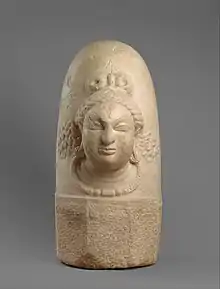
During the reign of Kamalavarman, the Saffarid rule weakened precipitately and ultimately Sistan became a part of the Samanid Empire. The disorder generally prevailed and the control of Zabulistan changed hands frequently. Taking advantage of the situation, the Shahis stepped up activities on their western frontier. The result was the emergence of a small Hindu power at Ghazni, supported by the Shahis. "The authorities either themselves of early date or enshrining early information mention Lawik" who was a Hindu as the ruler at Ghazni, before this place was taken over by the Turkish slave governor of the Samanids.[33]
By the middle of the tenth century, Turkish slaves began to acquire power in the Samanid realm, as they were holding principal offices in the court and kingdom. One of these, Alaptagin, a former Hajib or Door Keeper, defeated the superior royal army near Khulm Pass and decided to carve out an independent kingdom for himself. He first took over Bamian ‘the country of the infidel (Hindu) Shir Barak’. He next turned to Ghazni where Lawik, its ruler, submitted after a prolonged siege of four months. Alaptagin thus became the undisputed master of Ghazni but he died soon thereafter and his son Abu Ishaq succeeded him in 963.
Substitution of Hindu potentates of Bamian and Ghazni by an emerging Turkish power posed a serious threat to the Shahi kingdom which acted with ‘remarkable alacrity’ at this stage. The Lawik was sent back to Ghazni with a huge army which ousted the Turks and sent Abu Ishaq flying to Bukhara. The Shahis had secured their western frontier – for the time being. But the gathering storm had not blown away.
Bhimadeva


 Śri Bhīmadeva. Reverse: Horseman holding banner;
  na in Nagari to left; trace of symbol to right.[20]
Bhimadeva had only one daughter named Shreelekha and no son. This daughter was married to Simhraja of the Lohara dynasty.
End of Bhimadeva
The Shahi state had successfully managed to ward off danger from the strong neighbouring kingdom of the Samanids for more than a century. That Muslim kingdom was gradually decaying but its ambitious Turk officers were acquiring power and setting up personal fiefdoms, menacing the Hindu states south of Koh Hindu Kush. Though ruling with grandeur, unmolested by any neighbouring kingdom, Bhimadeva was getting old and must have been weighing his options in the matter of succession, because he did not have a male heir. The Shahi kingdom was strong and prosperous but not easy to govern - and protect. He could not count either on the Lawiks or his granddaughter Didda of Kashmir for this onerous responsibility. He selected the allied kingdom of Punjab for this honour and probably installed a successor in his own life for the succession seems to have been without ‘contest or convulsion’.[34]
Jayapaladeva
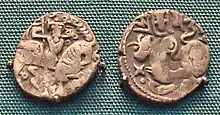
With Jayapala , a new dynasty started ruling over the former Shahi kingdom of southeastern Afghanistan and the change over was smooth and consensual. On his coronation, Jayapala used the additional name-suffix Deva from his predecessor's dynasty in addition to the pala name-ending of his own family. (With Kabul lost during the lifetime of Jayapaladeva, his successors – Anandapala, Trilochanapala and Bhimapala - reverted to their own family pala-ending names.) Jayapala did not issue any coins in his own name. Bull and Horseman coins with the legend Samantadeva, in billon, seem to have been struck during Jayapala's reign. As the successor of Bhima, Jayapala was a Shahi monarch of the state of Kabul, which now included Punjab. Minhaj-ud-din describes Jayapala as "the greatest of the Rais of Hindustan."[36]
From the beginning, Jayapala followed an aggressive and pro-active policy towards the Turks. As stated earlier, Abu Ishaq had been evicted from Ghazni and the Lawiks were installed there with Shahi help. In 965, Abu Ishaq regained Ghazni with assistance from the Samanid ruler Abu Mansur and the Lawik fled to ‘Hind’ once again to seek help from the Shahis. Ultimately, Sabuktagin descended the throne of Ghazni in 977. He soon added Bust, Dawar, Qusdar, Tukhristan and Ghur to his dominions. Conflict with ‘Hind’ could not have been postponed for too long.
Jayapaladeva attacks Sabuktagin
Jayapaladeva attacked the growing power Sabuktagin and was a fierce battle in which Jayapala was defeated. He lost more territory but continued to rule from Waihind and Peshawar.
Sabuktagin then became more involved in the affairs of the Samanid state and left the Shahis in peace. He became very powerful in the Samanid Kingdom by virtue of his strong and disciplined army. Sabuktagin died at Balkh in 997 CE at the age of fifty six.
Invasion of the Ghaznavids (1001 CE)

After a struggle for succession with brothers, his son Mahmud of Ghazni ascended the throne of Ghazni in 998. Mahmud first consolidated his position on his western front, even if he had to challenge the authority of his Samani over-lord. Soon he had control over Herat, Balkh, Bust and Khurasan. Recognising his power, the Caliph of Baghdad acknowledged him as a sovereign in his own right and conferred high sounding titles on him. The Ghaznavids had thus acquired a status equal to their former masters – the Samanids. The balance of power had been gradually tilting in favour of Ghazni.
The Turk Shahis had resisted for more than 200 years to the eastward expansion of the Muslim forces of the Abbasid Caliphate, effectively blocking the Muslim conquests in India, until they fell to the Persian Saffarids in the 9th century CE. The long resistance of the Turk Shahis against Muslim expansion may have contributed to the preservation of Indian culture and Hinduism, as "the militant process of conversion" to Islam in conquered lands, which had deeply affected the Near East and the Iranian world, already "was a thing of the past" in the 10th century CE.[38]
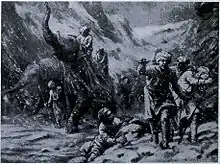
The Persiante Turkic Ghaznavids finally broke through into India after overpowering the declining Hindu Shahis and Gurjaras.[39][38][40] Mahmud of Ghazni initiated the first of numerous invasions of North India. On 28 November 1001, his army fought and defeated the army of Raja Jayapala of the Turk Shahis at the Battle of Peshawar. In 1002 Mahmud invaded Sistan and dethroned Khalaf ibn Ahmad, ending the Saffarid dynasty.[41] From there he decided to focus on Hindustan to the southeast, particularly the highly fertile lands of the Punjab region.
Rulers
According to available inscriptions following are the names of Hindu Shahi kings:[42][43][44]
| Kallar | 843 CE – 850 CE | Founder as per Al-Biruni[45] |
| Vakkadeva | 850 CE – 895 CE | Lalliya of Kabul |
| Kamalavarman | 895 CE– 921 CE | Also referred as Kamaluka |
| Bhimdeva | 921 CE – 964 CE | Most expansionist & vicious |
| Jayapala | 964 CE – 1001 CE | Adopted King of Hindu Shahi |
| Anandapala | 1001 CE– 1010 CE | |
| Trilochanapala | 1010 CE – 1021 CE | Died by Mutinous troop. |
| Bhimpala | 1022 CE– 1026 CE | Last king. |
Sources
Literature
No literature survives from Hindu Shahi courts. Fragmented information is obtained from chronicles of neighboring powers — Kashmir and Ghaznavi. Of the former, Kalhana's Rajatarangini is the only extant source. Of the latter, we have Tārīkh al-Hind by Al-Biruni, Tārīkh-i Bayhaqī by Abu'l-Faḍl Bayhaqi, and Tarikh Yamini by al-Utbi.
Coins
Coins of some rulers have been found. These names often do not match with the literature, creating issues.
Inscriptions and archaeology
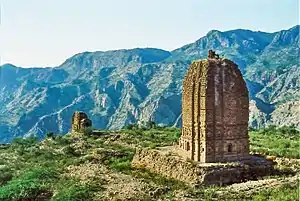
A. R. Rahman of the Quaid-i-Azam University and Ahmad Hasan Dani did rudimentary field surveys in the late 1960s. Afterwards, the Italian Archaeological. Mission in Pakistan (IAMP) have extensively surveyed the regions in and around Swat. Multiple inscriptions have been located.
See also
 |
Wikiquote has quotations related to: Hindu Shahi |
References
- MACDOWALL, DAVID W. (1968). "THE SHAHIS OF KABUL AND GANDHARA". The Numismatic Chronicle (1966-). 8: 192–194. ISSN 0078-2696.
- André Wink (June 1991). Al- Hind: The slave kings and the Islamic conquest. 2. BRILL. pp. 127–. ISBN 978-90-04-09509-0.
- Allchin, Raymond (3 June 2019). Archaeology of Afghanistan: From Earliest Times to the Timurid Period: New Edition. Edinburgh University Press. p. 458. ISBN 978-1-4744-5047-8.
- MACDOWALL, DAVID W. (1968). "THE SHAHIS OF KABUL AND GANDHARA". The Numismatic Chronicle (1966-). 8: 192–194. ISSN 0078-2696.
- Allchin, Raymond (3 June 2019). Archaeology of Afghanistan: From Earliest Times to the Timurid Period: New Edition. Edinburgh University Press. p. 458. ISBN 978-1-4744-5047-8.
- Schwartzberg, Joseph E. (1978). A Historical atlas of South Asia. Chicago: University of Chicago Press. p. 146, map XIV.2 (j). ISBN 0226742210.
- Wynbrandt, James (2009). A brief history of Pakistan. Facts On File. p. 45. ISBN 9780816061846.
- Wink, André (2002). Al-Hind: The Slavic Kings and the Islamic conquest, 11th-13th centuries. BRILL. ISBN 978-0-391-04174-5.
Lahore appears as the capital of the Panjab for the first time under Anandapala, the Hindu Shahi king — who is ...
- Ball et al. 2019, p. 458.
- Balogh, Dániel (12 March 2020). Hunnic Peoples in Central and South Asia: Sources for their Origin and History. Barkhuis. p. 362. ISBN 978-94-93194-01-4.
- Rahman, Abdur (2002). "New light on the Khingal, Turk, and Hindu Sahis" (PDF). Ancient Pakistan. 15: 41.
- Warraich, Tauqeer Ahmad (2008). "EARLY MOSQUES OF SOUTH ASIA AND IMPACT OF NATIVE ARCHITECTURE: A CASE STUDY OF BANBHORE, MANSURA, UDIGRAM AND QUWWAT-UL-ISLAM MOSQUES" (PDF). J.R.S.P. 45 (2): 159-160.
- Rafi U. Samad (2011). The Grandeur of Gandhara: The Ancient Buddhist Civilization of the Swat, Peshawar, Kabul and Indus Valleys. Algora Publishing. pp. 275–. ISBN 978-0-87586-860-8.
- "16. The Hindu Shahis in Kabulistan and Gandhara and the Arab conquest | Digitaler Ausstellungskatalog". pro.geo.univie.ac.at. Retrieved 26 March 2020.
- "Proceedings of the Indian History Congress Vol. 61, Part One: Millennium (2000-2001), pp. 132 https://www.jstor.org/stable/44148087"
- Kuwayama, Shoshin (1976). "The Turki Śāhis and Relevant Brahmanical Sculptures in Afghanistan". East and West. 26 (3/4): 403. ISSN 0012-8376. JSTOR 29756318.
- Meister, Michael W. (26 July 2010). Temples of the Indus: Studies in the Hindu Architecture of Ancient Pakistan. BRILL. pp. 29–31. ISBN 978-90-04-19011-5.
- Flood, Finbarr B. (20 March 2018). Objects of Translation: Material Culture and Medieval "Hindu-Muslim" Encounter. Princeton University Press. p. 38. ISBN 978-0-691-18074-8.
- Flood, Finbarr B. (20 March 2018). Objects of Translation: Material Culture and Medieval "Hindu-Muslim" Encounter. Princeton University Press. p. 25. ISBN 978-0-691-18074-8.
- Allchin, Raymond (3 June 2019). Archaeology of Afghanistan: From Earliest Times to the Timurid Period: New Edition. Edinburgh University Press. pp. 458–459. ISBN 978-1-4744-5047-8.
- Flood, Finbarr B. (20 March 2018). Objects of Translation: Material Culture and Medieval "Hindu-Muslim" Encounter. Princeton University Press. pp. 25–26. ISBN 978-0-691-18074-8.
- Chopra, P.N (2003). A Comprehensive History Of Ancient India (3 Vol. Set). Sterling Publishers Pvt. Ltd. ISBN 978-81-207-2503-4.
- Kumāra, Braja Bihārī (2007). India and Central Asia: Classical to Contemporary Periods. Concept Publishing Company. ISBN 978-81-8069-457-8.
- Flood, Finbarr B. (20 March 2018). Objects of Translation: Material Culture and Medieval "Hindu-Muslim" Encounter. Princeton University Press. pp. 25–26. ISBN 978-0-691-18074-8.
- C. V. Vaidya, History of Mediaeval Hindu India, Vol. III, pp. 8-13; and others.
- Abdur Rahman, The Last Two Dynasties of the Shahis, pp. 101-103
- The Last Two Dynasties of the Shahis, p. 102.
- "Metropolitan Museum of Art". www.metmuseum.org.
- Kossak, Steven; Lerner, Martin (1994). "The Arts of South and Southeast Asia". The Metropolitan Museum of Art Bulletin. 51 (4): 35–37. doi:10.2307/3269200. JSTOR 3269200.
Another major art-producing kingdom of the period was that of the Hindu Shahis in Afghanistan. They are best known for a small corpus of sculptures carved in white marble. The linga (phallus) is an important symbol that represents the creative potential of Shiva, one of the principal gods of the Hindu pantheon. The ekhamukhalinga (fig. 29) shows the face of the god as he begins to manifest himself out of the linga. In this example Shiva's features derive from prototypes developed in Kashmir.
- The Metropolitan Museum of Art. Vol. 10, Asia. The Metropolitan Museum of Art. 1987. p. 129. ISBN 9780870994531.
- Kuwayama, Shoshin (1976). "The Turki Śāhis and Relevant Brahmanical Sculptures in Afghanistan". East and West. 26 (3/4): 405. ISSN 0012-8376. JSTOR 29756318.
- Abdur Rahman, The Last Two Dynasties of the Shahis, pp. 110-116 quoting Tarikh-i-Sistan, pp. 255-56. Also, André Wink, Al-Hind, I, p. 125: "Muslim control of Zamindwar remained imperfect until the end of the ninth century, and in Ghazni, the Saffarid governor was again expelled by two Indian princes in 890-900 CE"
- C. E. Bosworth, ‘Notes on Pre-Ghaznavid History of Eastern Afghanistan, Islamic Quarterly, Vol. XI, 1965.
- Raizada Harichand Vaid, Gulshane Mohyali, II, pp. 83 and 183-84.
- Hutchinson's story of the nations, containing the Egyptians, the Chinese, India, the Babylonian nation, the Hittites, the Assyrians, the Phoenicians and the Carthaginians, the Phrygians, the Lydians, and other nations of Asia Minor. London, Hutchinson. p. 150.
- H. G. Raverty, Tr. Tabaqat-i-Nasiri of Maulana Minhaj-ud-din, Vol. I, p. 82
- Flood, Finbarr B. (20 March 2018). Objects of Translation: Material Culture and Medieval "Hindu-Muslim" Encounter. Princeton University Press. pp. 25–26. ISBN 978-0-691-18074-8.
- Kim, Hyun Jin (19 November 2015). The Huns. Routledge. pp. 62–64. ISBN 978-1-317-34091-1.
- "Contained within a clay urn were a gold bracteate with the portrait of a ruler, three early drachms of the Turk-Shahis (Type 236, one of which is countermarked), and a countermarked drachm of the Sasanian king Khusro II dating from year 37 of his reign (= 626/7). The two countermarks on Khusro 's drachm prove that the urn could only have been deposited after 689" ALRAM, MICHAEL (2014). "From the Sasanians to the Huns New Numismatic Evidence from the Hindu Kush" (PDF). The Numismatic Chronicle. 174: 282–285. ISSN 0078-2696. JSTOR 44710198.
- Alram, Michael; Filigenzi, Anna; Kinberger, Michaela; Nell, Daniel; Pfisterer, Matthias; Vondrovec, Klaus. "The Countenance of the other (The Coins of the Huns and Western Turks in Central Asia and India) 2012-2013 exhibit: 16. THE HINDU SHAHIS IN KABULISTAN AND GANDHARA AND THE ARAB CONQUEST". Pro.geo.univie.ac.at. Kunsthistorisches Museum Vienna. Retrieved 22 July 2017.
- Bosworth 1963, p. 89.
- D. W. Macdowall, "The Shahis of Kabul and Gandhara" Numismatic Chronicle, Seventh Series, Vol. III, 1968, pp. 189-224, see extracts in R. T. Mohan, AFGHANISTAN REVISITED … Appendix –B, pp. 164-68
- Raizada Harichand Vaid, Gulshane Mohyali, II, pp. 83 and 183-84.
- H. G. Raverty, Tr. Tabaqat-i-Nasiri of Maulana Minhaj-ud-din, Vol. I, p. 82
- MACDOWALL, DAVID W. (1968). "The Shahis of Kabul and Gandhara". The Numismatic Chronicle. 8: 189–224. ISSN 0078-2696. JSTOR 42666553.
Sources
- Ball, Warwick; Bordeaux, Olivier; MacDowall, David W.; Sims-Williams, Nicholas; Taddei, Maurizio (2019). "From the Kushans to the Shahis". In Allchin, Raymond; Hammond, Norman (eds.). From Earliest Times to the Timurid Period (2nd ed.). Edinburgh University Press. pp. 344–459.
- Bosworth, C.E. (1963). The Ghaznavids 994–1040. Edinburgh University Press.
- Bosworth, C.E. (1991). "Mahmud bin Sebuktigin". Encyclopedia of Islam. E.J.Brill. VI.
Authority control  |
|---|