Tsumugi (cloth)
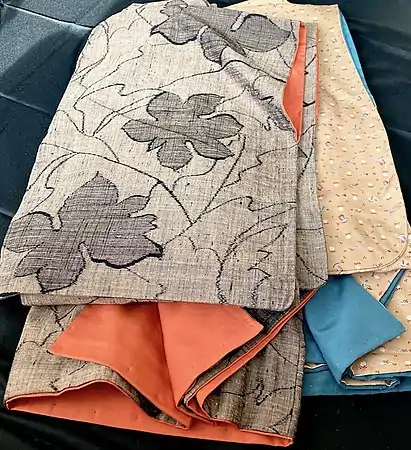
Tsumugi (紬) is a traditional slub silk cloth from Japan, though similar textiles are found in other countries. It is a tabby weave made from waste silk, which is in shorter lengths. The short threads are degummed[1] and, traditionally, hand-joined to form a continuous strand before weaving,[2] a technique also used for cheaper bast fibers. Threads are joined by twisting the ends to be joined in the same direction, then twisting the bundle of both in the other, to make a two-ply thread at the overlap.[3]
Between 1910 to 1925 (late Taishō to Shōwa era), it became possible to spin and weave tsumugi by machine.[4] Prices dropped drastically, and silk (as opposed to asa (bast fibers or cotton) was suddenly within the budget of most Japanese.[5] Stores also began to sell off-the-peg, ready-to-wear kimonos at about this time.[4]
Traditionally a peasant cloth, handmade tsumugi is very labour-intensive to produce, so it is now expensive.

Recognized Regional Varieties
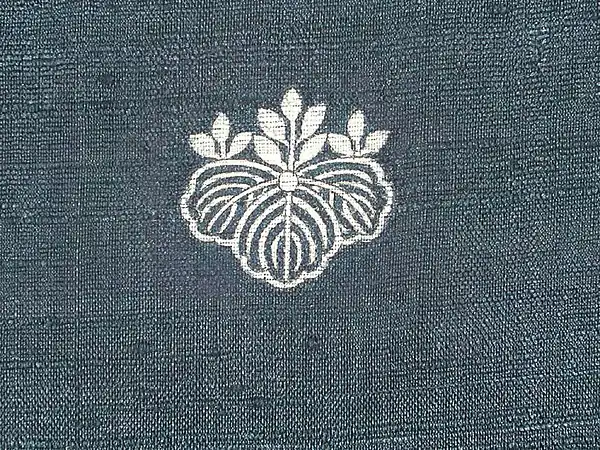
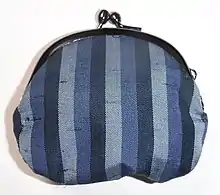
Tsumugi was originally a homespun textile and many regional variations existed. Some of these regional variations still exist today and are recognized as meibutsu, famous products of their place of origin.
| Name | Kanji | Traditional Sites | Notes | Example image |
|---|---|---|---|---|
| Amiito tsumugi | Shiga Prefecture | Recycled weft threads respun and rewoven to make obi. | ||
| Gujo tsumugi | 郡上島紬 | Hachiman, Gifu | ||
| Honba oshima tsumugi | 本場大島紬 | Amami, Kagoshima | ||
| Iida tsumugi | 飯田島紬 | Iida, Nagano | ||
| Kumejima-tsumugi | 久米島紬 | Kumejima, Okinawa | ||
| Murayama-oshima tsumugi | 村山大島紬 | Musashimurayama, Tokyo | ||
| Oitama tsumugi | 置賜紬 | Oitama region:
|
Oitama Tsumugi is a collective term for six different tsumugi made in the region, including:
|
|
| Ojiya tsumugi | 小千谷島紬 | Ojiya, Niigata | ||
| Shinshu tsumugi | 信州紬 | Nagano Prefecture | ||
| Shiozawa tsumugi | 塩沢島紬 | Shiozawa, Niigata | ||
| Tosa men tsumugi | Kagami, Kōchi (Kami) | |||
| Ueda tsumugi | 上田島紬 | Ueda, Nagano | Ueda tsumugi is always striped and is sometimes referred to as Ueda jima (stripes). | |
| Ushikubi tsumugi | 牛首紬 | Hakusan, Ishikawa | ||
| Yūki-tsumugi | 結城紬 | Yūki, Ibaraki |
References
- "Variety of Nishijin textile". Nishijin Textile Industry Association. 17 September 2020. Retrieved 17 July 2021.
- "Ojiya tsumugi silk". KOGEI JAPAN.
- Dusenbury, Mary (1992). "A WISTERIA GRAIN BAG and other tree bast fiber textiles of Japan". Textile Society of America Symposium Proceedings. Retrieved 12 June 2021.
- "Kimono Mochi: private kimono collection photographs and text". kimonomochi kimono collection. Retrieved 31 July 2021.
- "The lowly komon kimono is the workhorse of the kimono wardrobe, worn for trips to town, to friends houses, in any situation which is outside of the home but informal. Despite their name, which means 'small design', komon can have large or small imagery, and the repeat can be staggered widely. painted, closely stencilled, woven, Printed, striped, spotted, shibori, silk, jinken, modern polyester--if it's a repetitive design, short-sleeved, and without kamon, then it's a komon". Kimono mochi: kimono collection.