Turgenia
Turgenia is a genus of flowering plants in the family Apiaceae, containing up to seven species.[1] The genus resembles Caucalis.[2] False carrot is a common name for plants in this genus.[3]
| Turgenia | |
|---|---|
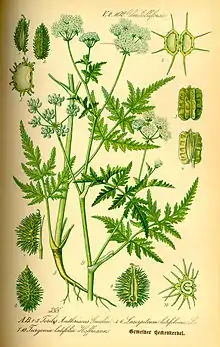 | |
| Turgenia latifolia | |
Scientific classification  | |
| Kingdom: | Plantae |
| Clade: | Tracheophytes |
| Clade: | Angiosperms |
| Clade: | Eudicots |
| Clade: | Asterids |
| Order: | Apiales |
| Family: | Apiaceae |
| Subfamily: | Apioideae |
| Tribe: | Scandiceae |
| Subtribe: | Torilidinae |
| Genus: | Turgenia Hoffm. |
| Species | |
| |
Varieties of Turgenia can be found in areas of Africa, Europe, temperate and tropical regions of Asia, and North America.[4][5]
References
- http://www.theplantlist.org/browse/A/Apiaceae/Turgenia/
- V. H. Heywood (1964). "Turgenia Hoffm.". In V. H. Heywood; D. H. Valentine; T. G. Tutin; N. A. Burges (eds.). Flora Europaea: Rosaceae to Umbelliferae. Flora Europaea. 1. Cambridge University Press. p. 372. ISBN 9780521066624.
- "Turgenia". Natural Resources Conservation Service PLANTS Database. USDA. Retrieved 12 December 2015.
- "Taxonomy - GRIN-Global Web v 1.10.5.0". www.narc.gov.jo. Retrieved 2021-03-07.
- "Plants Profile for Turgenia latifolia (broadleaf false carrot)". plants.usda.gov. Retrieved 2021-03-07.
This article is issued from Wikipedia. The text is licensed under Creative Commons - Attribution - Sharealike. Additional terms may apply for the media files.