Turks in Berlin
Turks in Berlin (Turkish: Berlin'deki Türkler) are people of Turkish ethnicity living in Berlin where they form the largest ethnic minority group, and the largest Turkish community outside Turkey. The largest communities can be found in Kreuzberg, Neukölln, and Wedding, with substantial populations in other areas, almost exclusively those of the former West Berlin.[4]
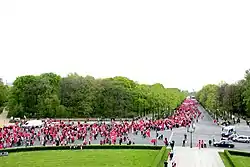 A Turkish protest in Berlin | |
| Total population | |
|---|---|
| Estimates vary because the official German census does not collect data on ethnicity. German statistics: 176,743 (5.1%)[1] Academic estimates: over 1,000,000 (Professor Marilya Veteto-Conrad, 1996)[2] 2,000,000 (Professor Clifford Geertz, 2013)[3] | |
| Regions with significant populations | |
| Berlin Kreuzberg, Neukölln, Schöneberg, Gesundbrunnen, Moabit, Hansaviertel | |
| Languages | |
| German · Turkish | |
| Religion | |
Demographics
Official statistics
German statistics do not provide a true reflection on the ethnic Turkish community in Berlin because censuses only collect data on the country of birth of one's parents rather than ethnicity. In 2016 there were 97,682 foreign nationals with Turkish citizenship registered as residents in Berlin. Additionally, there were 79,048 German citizens with a Turkish "migration background" (meaning they or their parents had immigrated to Germany after 1955).[5] However, these figures do not take into account the third, fourth, or fifth generation Turkish-Germans who are recorded as "Germans".
Furthermore, German statistics do not include the significant migration waves of ethnic Turkish communities which have come to Berlin from other post-Ottoman modern nation-states, especially from the Balkans (e.g. Bulgarian Turks and Western Thrace Turks), from the island of Cyprus (i.e. Turkish Cypriots from both the Republic of Cyprus and Northern Cyprus), the Levant (especially Iraqi Turks, Lebanese Turks, and Syrian Turks), etc. These ethnic Turkish communities are recorded according to their citizenship, such as "Bulgarian", "Cypriot", "Greek", "Iraqi", "Lebanese" "Macedonian", "Syrian" etc., or German (if they have acquired German citizenship), rather than by their Turkish ethnicity.
Estimated Population
In 1996 Professor Marilya Veteto-Conrad said that there was "over a million Turks in Berlin alone".[2] By the 2010s, one of the most influential cultural anthropologist in the United States, Professor Clifford Geertz, said that there were "two million Turks in Berlin".[3]
"Turkish towns"
Due to its large Turkish population, Kreuzberg has been dubbed a so-called "Turkish town" by observers such as John Ardagh.[6]
Notes and references
Notes:
| ^ Kosovo is the subject of a territorial dispute between the Republic of Kosovo and the Republic of Serbia. The Republic of Kosovo unilaterally declared independence on 17 February 2008. Serbia continues to claim it as part of its own sovereign territory. The two governments began to normalise relations in 2013, as part of the 2013 Brussels Agreement. Kosovo is currently recognised as an independent state by 97 out of the 193 United Nations member states. In total, 112 UN member states have recognised Kosovo at some point, of which 15 later withdrew their recognition. |
References:
- "Seite wird geladen" (PDF).
- Veteto-Conrad, Marilya (1996), Finding a Voice: Identity and the Works of German-language Turkish Writers in the Federal Republic of Germany to 1990, Peter Lang Publishing, p. 9, ISBN 9780820420059,
One might argue that Greek culture is also very different from German, but there are merely some two to three hundred thousand Greeks in the Federal Republic as opposed to over a million Turks in Berlin alone.
- Geertz, Clifford (2013), "Introduction to Islam observed (Hebrew Translation, 2007)", Clifford Geertz in Morocco, Routledge, p. 12, ISBN 9781317988175,
But the scale on which they now are forming (50,000 Moroccans in Amsterdam, 100,000 Malians in Paris, 150,000 Bangladeshis in London, two million Turks in Berlin – virtually all arrived there in the last two or three decades)
- Renate Müller (2001). W. Neill; H. Schwedler (eds.). Urban Planning and Cultural Inclusion - Lessons from Belfast and Berlin. Springer. p. 122. ISBN 978-0-230-52406-4.
- "Statistischer Bericht: Einwohnerinnen und Einwohner im Land Berlin am 31. Dezember 2016" [Statistical Report: Residents in the state of Berlin on December 31st 2016] (PDF). Amt für Statistik Berlin-Brandenburg (in German). pp. 15–17. Retrieved 4 August 2017.
- Ardagh, John (1988), Germany and the Germans: An Anatomy of Society Today, Harper & Row, p. 245, ISBN 9780060915322