International Union for the Protection of New Varieties of Plants
The International Union for the Protection of New Varieties of Plants or UPOV (French: Union internationale pour la protection des obtentions végétales) is a non-United Nations intergovernmental organization with headquarters in Geneva, Switzerland. Its objective is to provide an effective system for plant variety protection. It does so by defining a blueprint regulation to be implemented by its members in national law. The current secretary-general of UPOV is Daren Tang.[1] The expression UPOV Convention also refers to one of the three instruments that relate to the union, namely the 1991 Act of the UPOV Convention (UPOV 91), 1978 Act of the UPOV Convention (UPOV 78) and 1961 Act of the UPOV Convention with Amendments of 1972 (UPOV 61).
Union internationale pour la protection des obtentions végétales | |
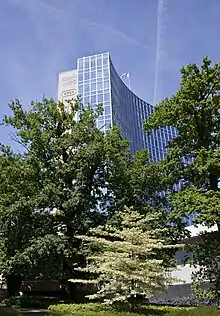 UPOV Headquarters | |
| Legal status | In force |
|---|---|
| Headquarters | Geneva, Switzerland |
Key people |
|
Parent organization | WIPO |
| Website | www |
History
UPOV was established by the International Convention for the Protection of New Varieties of Plants (UPOV 61). The convention was adopted in Paris in 1961 and revised in 1972, 1978 and 1991.
The original convention from 1961 had been ratified by six western industrialised countries: Denmark, France, Germany, the Netherlands, Sweden and the United Kingdom.[2] By 1990 still only 14 countries were part of the convention, with apartheid South Africa being the only country from the Southern Hemisphere.[3] From the mid-1990s more and more countries from Latin America, Asia and Africa joined the convention. A reason for this development might be the TRIPS-Agreement that obliged WTO members to introduce plant variety protection in national law.[4] Later, many countries have been obliged to join UPOV trough specific clauses in bilateral trade agreements, in particular with the EU, USA, Japan and EFTA.[5] The TRIPS-Agreement doesn't require adherance to UPOV but gives the possibility to define a sui generis system for plant variety protection.[4] In contrast, clauses in free trade agreement are more comprehensive and typically require adherance to UPOV.[5] [6]
While the earlier versions of the convention have been replaced, UPOV 78 and UPOV 91 coexist. Exising members are free to decide whether they want to ratifiy UPOV 91 or stay with UPOV 78, whereas new members have to adhere to the more restrictive version from 1991.[7]
Membership

As of December 3, 2021 two intergovernmental organisations and 76 counties and were members of UPOV:[3] African Intellectual Property Organisation, Albania, Argentina, Australia, Austria, Azerbaijan, Belarus, Belgium, Bolivia, Bosnia and Herzegovina, Brazil, Bulgaria, Canada, Chile, China, Colombia, Costa Rica, Croatia, Czech Republic, Denmark, Dominican Republic, Ecuador, Egypt, Estonia, European Union,[8] Finland, France, Georgia,[9] Germany, Ghana,[10] Guatemala, Hungary, Iceland, Ireland, Israel, Italy, Japan, Jordan, Kenya, Kyrgyzstan, Latvia, Lithuania, Mexico, Moldova, Montenegro, Morocco, the Netherlands, New Zealand, Nicaragua, North Macedonia, Norway, Oman, Panama, Paraguay, Peru, Poland, Portugal, Republic of Korea, Romania, Russian Federation, Serbia, Singapore, Slovakia, Slovenia, South Africa, Spain, Sweden, Switzerland, Tanzania, Trinidad and Tobago, Tunisia, Turkey, Ukraine, the United Kingdom, the United States of America (with a reservation),[11] Uruguay, Uzbekistan, and Viet Nam.[12]
For a country or intergovernmental organisation to become member, it needs to implement the requirements of the actual convention in national law. UPOV's secretariat analyises the regulation of plant variety protection in national law and writes a recommendation to the council whether or not the applicant shall be granted membership.[13] In the past several countries have been refused memberships because their national plant variety protection laws granted exceptions for subsistence farmers to reuse and exchange seeds.[14][15]
System of protection
The convention defines both how the organization must be governed and run, and the basic concepts of plant variety protection that must be included in the domestic laws of the members of the union. These concepts include:[16]
- The criteria for new varieties to be protected: novelty, distinctness, uniformity, and stability.
- The process for application for a grant.
- Intellectual property rights conferred to an approved breeder.
- Exceptions to the rights conferred to the breeder.
- Required duration of breeder's right.
- Events in which a breeder's rights must be declared null and void.
In order to be granted breeder's rights, the variety in question must be shown to be new. This means that the plant variety cannot have previously been available for more than one year in the applicant's country, or for more than four years in any other country or territory. The variety must also be distinct (D), that is, easily distinguishable through certain characteristics from any other known variety (protected or otherwise). The other two criteria, uniformity (U) and stability (S), mean that individual plants of the new variety must show no more variation in the relevant characteristics than one would naturally expect to see, and that future generations of the variety through various propagation means must continue to show the relevant distinguishing characteristics. The UPOV offers general guidelines for DUS testing.[17]
A breeder can apply for rights for a new variety in any union member country, and can file in as many countries as desired without waiting for a result from previous applications. Protection only applies in the country in which it was granted, so there are no reciprocal protections unless otherwise agreed by the countries in question. There is a right of priority, and the application date of the first application filed in any country is the date used in determining priority.
The rights conferred to the breeder are similar to other intellectual property rights, such as patents, even though there are important differences.[18] Their purpose is to create a temporary monopoly on a plant variety, to allow its breeder to redeem the costs he invested to create this innovation - typically the creation of a new variety takes 10 to 15 years and implies a substantial investment.[19] The breeder must authorize any actions taken in propagating the new variety, including selling and marketing, importing and exporting, keeping stock of, and reproducing. This means that the breeder can, for example, require a licensing fee for any company interested in reproducing his variety for sale. The breeder also has the right to name the new variety, based on certain guidelines that prevent the name from being deliberately misleading or too similar to another variety's name.
In the 1991 convention there are four exceptions to the rights of the breeder owning a plant variety:[20]
- Breeders exception: Even if a variety is protected it can be freely used by an other breeder as a source for new varieties, without the authorization of the owner of the original variety. With the introduction of the 1991 convention this exception has been narrowed down to exclude "essentially derived varieties".[7]
- Farmers exception: In the 1978 Convention the reproduction of seeds, as well as their exchange with other farmers is implicitly allowed, because the exclusive right of the breeder only extend to the production for the purpose of marketing.[21] With the 1991 Convention the scope of breeders rights were expanded to include the multiplication of a variety.[5] However, there still is an optional exception that can be included in national legislation to allow reproduction of seeds by farmers, but only "within reasonable limits and subject to the safeguarding of the legitimate interests of the breeder" which practically means that the farmers is obliged to pay license fees to the breeder. The only member of UPOV91 still allowing the free reproduction of seeds for some species by farmers is Switzerland.[22][23] UPOV secretariat never assessed if this implementation is in line with the Convention as Switzerland was already member of UPOV 1978 and national laws are only analysed for new members and not for existing members who update from UPOV 78 to UPOV 91.
- Exception for private use: While free private use is implicitly allowed in UPOV 78, in UPOV 91 a mandatory explicit exception has been introduced.[7] It allows the reproduction of protected varieties for private use, by amateur gardeners as well as by subsistence farmers. However, the exception only exclusively for the production of a food crop to be consumed by that farmer or gardener.[19] In any case the exchange or gift of seeds or propagating material of protected varieties are prohibited.
- Exception for research: Acts done for experimental purpose are excluded from the scope of breeders rights UPOV 91,[7] something that was implicit in UPOV 78.[5]
The 1991 Convention specifies that the breeder's right must be granted for at least 20 years from grant date for perennial crops and at least 25 years in the case of varieties of trees or vines. In the 1978 convention minimum duration of breeders rights are 15 years for perennials and 18 years for trees and vines.
Finally, there are provisions for how to negate granted breeders' rights if the rights are determined to be unfounded. That is, if it is discovered after the application has been granted that the variety is not actually novel or distinct, or if it is discovered to not be uniform or stable, the breeder's rights are nullified. In addition, if it is discovered that the person who applied for protection of the variety is not the actual breeder, the rights are nullified unless they can be transferred to the proper person. If it is discovered after a period of protection that the variety is no longer uniform and stable, the breeder's rights are canceled.
Genetically modified plant varieties
The UPOV has been updated several times to reflect changing technology and increased understanding of how plant variety intellectual property protection must work. The last revision was in 1991, and specifically mentioned genetic engineering only insofar as it is a method of creating variation.[24] Under the UPOV Convention alone, genetically modified crops and the intellectual property rights granted to them are no different from the intellectual property rights granted for traditionally bred varieties. It is important to note that this necessarily includes the ability to use protected varieties for subsistence farming and for research.
In October 2004, two joint Symposia were held in Geneva with the World Intellectual Property Organization (WIPO). These Symposia were the WIPO-UPOV Symposium on Intellectual Property Rights in Plant Biotechnology (October 24, 2003) and the WIPO-UPOV Symposium on the Co-Existence of Patents and Plant Breeders’ Rights in the Promotion of Biotechnological Developments (October 25, 2003). No new policy was created at either of these events, but a consensus emerged that both patents and plant-breeders' rights must combine to promote plant biotechnology.[25]
As a policy matter, the UPOV is known to consider open and un-restricted access to the genetic resources of protected plant varieties to be important to the continued development of new varieties.[26] This opinion is indicated in the "breeders' exemption" clause of the convention, as described above, and was reinforced in October 2005 in a reply to a notification from the Convention on Biological Diversity.
In April 2003, the Convention on Biological Diversity asked the UPOV for comment on the use of Genetic Use Restriction Technologies (also known pejoratively as 'terminator genes') as they relate to the promotion of intellectual property rights. In the summary of their response, the UPOV stated that intellectual property protection is necessary because breeders must have the ability to recoup their money and labor investment in creating new varieties, and in that light, plants with 'terminator genes' may still be accepted for protection if they meet the other criteria. However, the UPOV comment states that the convention and its system of protection is sufficient to protect intellectual property rights, and that with proper legal protections in place, technologies like 'terminator genes' should not be necessary.[27]
Critics and public interest concerns
Whether or not UPOV negatively affects agriculture in developing countries is much debated. It is argued that UPOV's focus on patents for plant varieties hurts farmers, in that it does not allow them to use saved seed or that of protected varieties. Countries with strong farmers' rights, such as India, cannot comply to all aspects of UPOV. François Meienberg is of this opinion, and writes that the UPOV system has disadvantages, especially for developing countries, and that "at some point, protection starts to thwart development".[28]
On the other hand, Rolf Jördens argues that plant variety protection is necessary. He believes that by joining UPOV, developing countries will have more access to new and improved varieties (better yielding, stronger resistance) instead of depending on old varieties or landraces, thus helping fight poverty and feed the growing world population.[29]
UPOV supports an agricultural system that is clearly export-oriented. In other words, developing countries moving towards UPOV-consistent systems tend to favour breeders who are producing for export. The example of Kenya is telling in this regard, as UPOV's own study points out, the majority of varieties are owned by foreign producers and are horticultural crops, clearly destined for export. An over-heavy dependence on agriculture for export is increasingly recognized as being unwise.[30][31]
2015 a study measuring the strength of intellectual property (IP) protection for plant varieties in 69 countries was committed. The authors found a positive and significant correlation between the strengthening of IP protection and agricultural valued added for developed countries. However, they were not able to establish any significant correlation for developing countries.[32]
It would make sense to encourage debate, exchange of knowledge and research on the impacts of UPOV-type plant variety protection on farming, food sovereignty, human rights (in particular a right balance of farmers' rights, peasants' rights and breeders' rights) and other public interest objectives.
However, several Social movements and civil society organisations such as Oxfam, Third World Network and Via Campesina[33] have pointed out the resistance of the UPOV Secretariat and Member States to dialogue with all interested parties, in particular:
- by keeping meetings secret,
- by not making its documents publicly available,
- by refusing farmers' organisations NGO observer status with UPOV.[34]
A recent study by Professor Graham Dutfield[35] concluded that UPOV's governance falls short in many different ways, UPOV officials know very little about actual farming, and how small-scale farmers actually develop new varieties and produce them, and that they knew much more about breeding, which favours commercial breeders. The UPOV system thus favours commercial breeders over farmers and producers, and private interests over public interests.
The UN Special Rapporteur on the Right to Food, Olivier De Schutter, came to similar findings in his study of UPOV in 2009. He found that IP-related Monopoly rights could cause poor farmers to become "increasingly dependent on expensive inputs" and at risk of indebtedness. Further, the system risks neglecting poor farmers’ needs in favour of agribusiness needs, jeopardising traditional systems of seed saving and exchange, and losing biodiversity to "the uniformization encouraged by the spread of commercial varieties.[36]
Six years later, in 2015, this criticism was reaffirmed in a report committed by the UN Secretary-General. He came to the conclusion that the provisions of the 1991 act of UPOV would pressure small-scale farmers. Furthermore it was stated in the report that Restrictions on seed management systems can lead to a loss of biodiversity "as well as weaken the genetic base on which we all depend for our future supply of food."[37]
The UPOV Convention, in particular UPOV 1991, is often criticized as it overlaps, and is found to be difficult to concile with, other existing and widely ratified international legal instruments such as FAO's International Treaty on Plant Genetic Resources for Food and Agriculture (Plant Treaty), the Convention on Biological Diversity, or its Nagoya Protocol[38][39][40] but also with the United Nations Declaration on the Rights of Peasants and other people working in rural areas adopted by the United Nations General Assembly in 2018.
See also
Internal links
- Community Plant Variety Office (CPVO)
- Plant Variety Protection Act of 1970
- Protection of Plant Varieties and Farmers' Rights Act, 2001
- "Plant variety" (the legal term) vs. "variety" (the botanical taxonomy term)
- International Treaty on Plant Genetic Resources for Food and Agriculture (Plant Treaty, or ITPGRFA)
- Convention on Biological Diversity (CBD)
- Nagoya Protocol on Access to Genetic Resources and the Fair and Equitable Sharing of Benefits Arising from their Use (Nagoya Protocol)
- United Nations Declaration on the Rights of Peasants (UNDROP)
- Bioprospecting and biopiracy
- Plant genetic resources (PGR)
- World Intellectual Property Organization (WIPO)
External links
Notes and references
- New Secretary-General Outlines Future Priorities for UPOV, UPOV Press Release No. 77, Geneva, October 30, 2008 Archived March 26, 2010, at the Wayback Machine
- "Actes des conférences internationales pour la protection des obtentions végétales" (PDF). UPOV. 1974.
- List of UPOV Members published by (PDF )
- "Implementation of Article 27.3(b): Drafting and Enacting National Legislation (Sui Generis Systems)". FAO. Retrieved November 26, 2021.
- Peschard, Karine (October 2021). "Searching for flexibility" (PDF). APBREBES.
- "UPOV 91 and trade agreements Compromising farmers' right to save and sell seeds" (PDF). Both Ends. October 2018.
- "1991 Act: International Convention for the Protection of New Varieties of Plants" (PDF). UPOV. March 19, 1991.
- The European Community was the first intergovernmental organization to join; The European Union is its legal successor.
- UPOV Notification No. 106, International Convention for the Protection of New Varieties of Plants, Accession by Georgia, October 29, 2008.
- "UPOV Press Release 134" (PDF). UPOV. November 3, 2021.
- "UPOV Notification No. 69: Ratification by the United States of America of the 1991 Act". UPOV. January 22, 1999. Retrieved May 5, 2014.
- UPOV web site, Members of the International Union for the Protection of New Varieties of Plants, International Convention for the Protection of New Varieties of Plants, UPOV Convention (1961), as revised at Geneva (1972, 1978 and 1991) Status on May 12, 2009. Consulted on June 26, 2009. Archived January 10, 2011, at the Wayback Machine
- UPOV (October 26, 2017). Guidance On How to Become a Member of UPOV (PDF) (Report). UPOV. Retrieved November 17, 2021.
- "Examination of the Conformity of the Philippine Plant Variety Protection Act of 2002 With the 1991 Act of the UPOV Convention" (PDF). UPOV. March 5, 2007. Retrieved November 26, 2021.
- "Examination of the Conformity of the Protection of New Plant Varieties Act 2004 of Malaysia With the 1991 Act of the UPOV Convention" (PDF). UPOV. February 2, 2005.
- UPOV System of Protection. http://www.upov.int/en/about/upov_system.htm Archived December 18, 2005, at the Wayback Machine. 2002.
- UPOV (April 19, 2002). General introduction to the examination of distinctness, uniformity and stability and the development of harmonized descriptions of new varieties of plants (PDF) (Report). UPOV. Retrieved July 29, 2015.
- "Patents and Plant Variety Protection". The Development Fund.
- "Frequently asked questions". UPOV. Retrieved December 1, 2021.
- "Exceptions to the Breeder's Right (1991 Act of the UPOV Convention)". UPOV.
- "1978 Act: International Convention for the Protection of New Varieties of Plants" (PDF). UPOV. October 27, 1978.
- "Verordnung über den Schutz von Pflanzenzüchtungen". Fedlex. June 28, 2008.
- "Glossar: Begriffe und Erläuterungen im Sortenschutz" (PDF). BLW. October 10, 2013.
- "Archived copy". Archived from the original on August 21, 2006. Retrieved August 15, 2006.CS1 maint: archived copy as title (link) UPOV Convention: 1991 Act, Article 14, Section 5c. 1991.
- WIPO-UPOV Symposium. 2003.
- http://www.upov.int/en/about/pdf/cbd_respons_oct_31_2005.pdf Jordens, Rolf. Access to Genetic Resources and Benefit-Sharing. October 31, 2005. p 4. Archived May 26, 2006, at the Wayback Machine
- (PDF). May 4, 2005 https://web.archive.org/web/20050504231127/http://www.upov.int/en/about/pdf/gurts_11april2003.pdf. Archived from the original (PDF) on May 4, 2005. Retrieved October 25, 2019. Missing or empty
|title=(help) - François Meienberg: Infringement of farmers' rights D+C, 2010/04, Focus, Page 156-158 Archived January 1, 2011, at the Wayback Machine
- Rolf Jördens: Legal framework for investment D+C, 2010/04, Focus, Page 150-153 Archived January 1, 2011, at the Wayback Machine
- George Kent: Africa's food security under globalization Archived October 26, 2011, at the Wayback Machine African Journal of Food and Nutritional Sciences: Vol. 2 No. March 1, 2002
- Joseph Stiglitz: Causes of hunger are related to poverty globalissues.org, 2010
- Campi, Mercedes; Nuvolari, Alessandro (May 1, 2015). "Intellectual property protection in plant varieties: A worldwide index (1961–2011)". Research Policy. 44 (4): 951–964. doi:10.1016/j.respol.2014.11.003. hdl:11382/505426. ISSN 0048-7333.
- UPOV – ITPGRFA 2016 See in particular the interventions of Bram de Jonge, Seed Policy Officer, Oxfam and Sangeeta Shashikant, Legal Advisor, Third World Network, and the final comments of Guy Kastler from Via Campesina
- UPOV to decide on farmers’ and civil society participation in its sessions European Coordination Via Campesina (ECVC) & Association for Plant Breeding for the Benefit of Society (APBREBES) Archived January 10, 2011, at the Wayback Machine
- Graham Dutfield: Food, Biological Diversity and Intellectual Property – The Role of the International Union for the Protection of New Varieties of Plants (UPOV) Archived March 23, 2012, at the Wayback Machine 2011
- Homepage of the UN Special Rapporteur on the right to food
- UN Secretary-General. "Agriculture development, food security and nutrition. Report of the Secretary-General" (PDF). United Nations General Assembly.
- UPOV & FAO: Proceedings of the Symposium On Possible Interrelations Between the International Treaty On Plant Genetic Resources for Food and Agriculture (ITPGRFA) And the International Convention for the Protection of New Varieties of Plants (UPOV Convention) Geneva, October 26, 2016
- FAO: Global Consultation on Farmers’ Rights 2016: Summary of presentations and discussions September 27–30, 2016, Bali, Indonesia
- Jorge Cabrera Medaglia, Chidi Oguamanam, Olivier Rukundo, Fred Perron-Welch: Comparative Study of the Nagoya Protocol, the Plant Treaty and the UPOV Convention: The Interface of Access and Benefit Sharing and Plant Variety Protection Centre for International Sustainable Development Law, 2019
| Air |
| ||||
|---|---|---|---|---|---|
| Energy | |||||
| Land | |||||
| Life | |||||
| Water |
| ||||
| Related |
| ||||
| |||||

| By owner | |||||
|---|---|---|---|---|---|
| By nature | |||||
| Commons | |||||
| Theory | |||||
| Applications |
| ||||
| Disposession/ redistribution | |||||
| Scholars (key work) | |||||
| |||||
Authority control  | |
|---|---|
| General | |
| National libraries | |
| Other | |