USS Houston (CL-81)
USS Houston (CL-81), was a Cleveland-class light cruiser and the third vessel in the United States Navy named after Houston, Texas. She was active in the Pacific War and survived two separate aerial torpedo hits in October 1944.
_underway_off_Norfolk_on_12_January_1944_(80-G-214200).jpg.webp) USS Houston (January 1944) | |
| History | |
|---|---|
.svg.png.webp) United States United States | |
| Name | USS Houston (CL-81) |
| Namesake | City of Houston, Texas |
| Builder | Newport News Shipbuilding & Dry Dock Company, Newport News, Virginia |
| Launched | 19 June 1943 |
| Sponsored by | Mrs. C. B. Hamill |
| Commissioned | 20 December 1943 |
| Decommissioned | 15 December 1947 |
| Stricken | 1 March 1959 |
| Identification |
|
| Honors and awards |  3 × battle stars 3 × battle stars |
| Fate | Sold for scrap on 1 June 1961 |
| General characteristics | |
| Class and type | Cleveland-class Light cruiser |
| Displacement |
|
| Length | |
| Beam | 66 ft 4 in (20.22 m) |
| Draft |
|
| Installed power |
|
| Propulsion |
|
| Speed | 32.5 kn (37.4 mph; 60.2 km/h) |
| Range | 11,000 nmi (20,000 km) @ 15 kn (17 mph; 28 km/h) |
| Complement | 1,255 officers and enlisted |
| Armament |
|
| Armor |
|
| Aircraft carried | 4 × floatplanes |
| Aviation facilities | 2 × stern catapults |



Construction and renaming
She was launched by Newport News Shipbuilding & Dry Dock Company, Newport News, Virginia, on 19 June 1943, sponsored by Mrs C B Hamill. Originally named Vicksburg, her name was changed on 12 October 1942 in honor of the USS Houston (CA-30), sunk at the Battle of Sunda Strait. While this ship had received the heavy cruiser designation for her 8-inch guns, CL-81 was designated a light cruiser with a 6-inch main battery but had a greater displacement due to her higher levels of protection.
On 30 May 1942, 1,000 Navy recruits, known as the Houston Volunteers, were sworn in at a dedication ceremony in downtown Houston but with a nineteen-month period between then and commissioning, only one served aboard the new Houston.[1]
She was commissioned on 20 December 1943, with Captain William W. Behrens, USN, in command.[2]
Service history
Houston departed Norfolk, Virginia on 1 February 1944 for shakedown in the Caribbean Sea. After a period of training out of Boston, she made for the Pacific on 16 April.[2]
Pacific
Houston arrived at Pearl Harbor via the Panama Canal and San Diego on 6 May, and after more training exercises arrived Majuro Atoll on 31 May to join Vice Admiral Marc Mitscher's Fast Carrier Task Force. From 5 June 1944 Houston took part in the invasion of the Mariana and Palau Islands screening carrier units.[2]
As the forces of Admiral Richmond K. Turner landed on Saipan on 15 June, the Japanese made preparations for a "decisive" naval battle. The two fleets approached each other on 19 June for the largest aircraft carrier battle of the war. Four air raids hit the American fleet but the covering fighters and anti-aircraft fire from screening warships, destroyed many of the Japanese aircraft.[2] Houston remained to screen the carriers and engaged in shore bombardment on Guam and Rota. She returned to Eniwetok on 12 August to prepare for the next operation.[2]
Assigned to the newly designated Task Group 38.2 (TG 38.2) under Rear Admiral Gerald F. Bogan, Houston steamed on 30 August to support air attacks on Palau on 6 September, after which she and a group of destroyers shelled Peleliu and other islands in preparation for the future amphibious landings. The carrier group turned to the Philippines for strikes against airfields and shipping, then returned to Peleliu to support the forces ashore from 17 to 19 September.[2]
Returning to Ulithi on 1 October 1944, Houston and her task group steamed five days later for an operation into the western Pacific, with airstrikes against Okinawa on 10 October. Two days later, the task force moved toward Formosa.[2]
The Battle of Formosa, consisted of Grumman F6F Hellcat fighter sweeps which were intercepted by airborne Japanese aircraft and anti-aircraft fire. Japanese forces retaliated with land-based air attacks against the fleet and Houston claimed four aircraft shot down on 12 October. The following day USS Canberra was hit by an aerial torpedo and Houston took over her station on 14 October, Houston and other ships another endured another air raid claiming three of the attacking twin-engined torpedo bombers, but a fourth aircraft's torpedo hit her forward engine room flooding all four machinery spaces and causing the loss of propulsive power.
During the night Boston took her in tow for retirement to Ulithi. Houston continued with damage control work including jettisoning 122 tons of topside equipment, throughout the fifteenth and the morning of the sixteenth. By noon of the sixteenth, all second deck compartments were dry and several third deck compartments had been made watertight and she was riding easily in tow, now from the fleet tug, Pawnee.
%252C_during_the_afternoon_of_16_October_1944_(NH_98826).jpg.webp)
Late that afternoon, a Japanese airstrike from Formosa, struck Houston directly on her stern with another torpedo, parallel to her No.2 shaft, flooding her hangar and setting fire to the starboard fuel tank for her scout planes. Ten men were blown over the side by the explosion. Of these, six were killed and the others wounded, one man was killed and six more wounded on board by falling debris.[3]
Evacuating all non-essential crew to the escorting ships, the damage control parties were able to keep Houston afloat. The Japanese believed "Cripple Division I" was the remnants of a Task Force 38 (TF 38) and Admiral William F. Halsey hoped to lure them into an attack to finish off the two damaged cruisers.[2] Part of the Japanese fleet did sortie from the Inland Sea, Japanese home islands, but after air attack, returned to port.
Houston and Canberra were now out of range of Japanese land-based aircraft, and they arrived at Ulithi on 27 October. After temporary repairs, Houston proceeded to Manus Island, and a floating dry dock to begin more substantial repairs, arriving there on 20 December. She steamed first to Pearl Harbor then to New York Navy Yard, due to insufficient repair capacity available on the West Coast and arrived in New York on 24 March 1945.[2]
Post-War
Atlantic
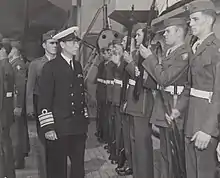
After extensive work in New York, Houston steamed out of New York harbor on 11 October 1945. Following refresher training in the Caribbean Sea, she took part in training exercises from Newport, Rhode Island. She steamed on 16 April 1946 for an extended goodwill tour of European and African ports, visiting cities in Scandinavia, Portugal, Italy, and Egypt.[2]
Houston returned to the US on 14 December 1946 and engaged in training and readiness operations until 17 May 1947, when she steamed with Cruiser Division 12 (CruDiv 12) for a Mediterranean Sea voyage.[2]
Decommissioning
Returning to Philadelphia on 16 August 1947, Houston was decommissioned on 15 December 1947, and then was placed in reserve for over a decade, and then finally stricken from the Naval Vessel Register on 1 March 1959 and scrapped.[2] Her nameplate is on display at the Freedom Park (Omaha, Nebraska).[4]
Awards
Houston received three battle stars for World War II service.[2]
References
- Hornfischer, James D. (2006). Ship of ghosts: the story of the USS Houston, FDR's legendary lost cruiser, and the epic saga of her survivors. New York: Bantam Books. ISBN 978-0-553-80390-7. OCLC 69680190.
- "Houston III (CL-81)". Dictionary of American Naval Fighting Ships. Navy Department, Naval History and Heritage Command. 20 July 2015. Retrieved 9 December 2015.
- War damage report 53 USS Houston (CL-81) at www.history.navy.mil
- "Omaha, Nebraska - Freedom Park, MO river view". Mapio.net. Retrieved 11 May 2021.
- John Grider Miller, The Battle to save the Houston, October 1944 to March 1945. (Annapolis: Naval Institute Press, 1985; 2000).
This article incorporates text from the public domain Dictionary of American Naval Fighting Ships. The entry can be found here.
External links
 |
Wikimedia Commons has media related to USS Houston (CL-81). |
- history.navy.mil: USS Houston
- Photo gallery of USS 'Houston' at NavSource Naval History
- hazegray.org: USS Houston
- Biography of Houston's first CO
- Official report on torpedo damage off Formosa, 14 and 16 October 1944