Ukraine national football team
 | ||||
| Nickname(s) | Zbirna Збірна (The Team) Синьо-жовті (The Blue and Yellow) | |||
|---|---|---|---|---|
| Association | Ukrainian Association of Football (UAF) Українська Асоціація Футболу | |||
| Confederation | UEFA (Europe) | |||
| Head coach | Oleksandr Petrakov | |||
| Captain | Andriy Pyatov | |||
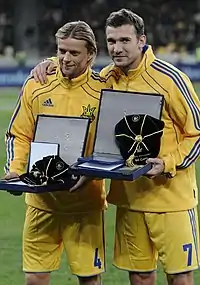
| Most caps | Anatoliy Tymoshchuk (144) | |||
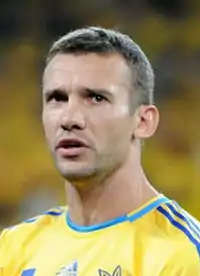
| Top scorer | Andriy Shevchenko (48) | |||
| Home stadium | Various | |||
| FIFA code | UKR | |||
| ||||
| FIFA ranking | ||||
| Current | 25  1 (19 November 2021)[1] 1 (19 November 2021)[1] | |||
| Highest | 11 (February 2007) | |||
| Lowest | 132 (September 1993) | |||
| First international | ||||
 Ukraine 1–3 Hungary Ukraine 1–3 Hungary  (Uzhhorod, Ukraine; 29 April 1992) | ||||
| Biggest win | ||||
Ukraine 9–0 San Marino  (Lviv, Ukraine; 6 September 2013) | ||||
| Biggest defeat | ||||
 France 7–1 Ukraine France 7–1 Ukraine (Saint-Denis, France; 7 October 2020) | ||||
| World Cup | ||||
| Appearances | 1 (first in 2006) | |||
| Best result | Quarter-finals (2006) | |||
| European Championship | ||||
| Appearances | 3 (first in 2012) | |||
| Best result | Quarter-finals (2020) | |||













The Ukraine national football team (Ukrainian: збірна України з футболу) represents Ukraine in men's international football competitions and it is governed by the Ukrainian Association of Football, the governing body for football in Ukraine. Ukraine's home ground is the Olimpiyskiy Stadium in Kyiv. The team has been a full member of UEFA and FIFA since 1992.
After Ukrainian Independence and the country's breakaway from the Soviet Union, they played their first match against Hungary on 29 April 1992. The team's biggest success on the world stage was reaching the quarter-finals in the 2006 FIFA World Cup, which also marked the team's debut in the finals of a major championship.[2]
As the host nation, Ukraine automatically qualified for UEFA Euro 2012.[2] Four years later, Ukraine qualified for Euro 2016 via the play-off route, the first time qualifying for a UEFA European Championship via the qualifying process, as they finished in third place in their qualifying group. This marked the first time in Ukraine's six play-off appearances that it managed to win such a tie, previously having been unsuccessful in the play-off ties for the 1998 World Cup, Euro 2000, 2002 World Cup, 2010 World Cup and 2014 World Cup.
Ukraine is seen as a specific case of being a successful youth football power in Europe and the world, yet fails to deliver the same taste at senior stage. The U-20 team of Ukraine has been the current reigning world champions at the FIFA U-20 World Cup, while the U-21 team had won silver medal in the 2006 UEFA European Under-21 Championship; however in spite of this rich record in youth stage, the senior side didn't have the same level of achievement to look back at. While the Ukrainian senior side managed to reach the quarter-finals of the 2006 World Cup, the team failed to enter the knockout stages in Euro 2012 and Euro 2016, and have never returned to the World Cup since.
Ukraine's best performance in the UEFA European Championship, was in the 2020 edition, having reached the quarter finals for the first time before their run was stopped by England with a 4–0 defeat on 3 July 2021 in the quarterfinals.
History
Ukrainian SSR (1925–1990)
Officially the national team of Ukraine, the national team was formed in the early 1990s and shortly after was recognized internationally. It is not widely known, however, that Ukraine previously had a national team in 1925–1935.[3][4] Just like the Russian Soviet Federative Socialist Republic, the Ukrainian Soviet Socialist Republic had its own national team.
The earliest record of games it played can be traced back to August 1928. A championship among the national teams of the Soviet republics as well as the Moscow city team was planned to take place in Moscow. Just before the tournament started, the Ukraine national team played two exhibition games against the Red Sports Federation team from Uruguay, one in Kharkiv (lost 1–2) and the other in Moscow (won 3–2). At the All-Soviet tournament, Ukraine played three games and reached the final where it lost to Moscow 0–1. Along the way, Ukraine managed to defeat the national teams of Belarus and Transcaucasus.
In 1929, Ukraine beat the team of Lower Austria in an exhibition match in Kharkiv, recording a score of 4–1.
In 1931, Ukraine participated in another All-Soviet championship in Moscow. It played only one game, starting from the semifinals. Ukraine lost to the national team of Transcaucasus 0–3 and was eliminated.
In 1986, Ukraine became a winner of association football tournament of the Spartakiad of Peoples of the USSR that was hosted in Ukraine when in final it beat the team of Uzbekistan (Uzbek SSR).
Official formation
Prior to Independence in 1991, Ukrainian players represented the Soviet Union national team. After the collapse of the USSR in 1991, Russia took the place of the Soviet Union national team in the qualifying tournament for the 1994 World Cup. The national team of Ukraine did not manage to enter the 1994 FIFA World Cup qualification (the draw for the qualification stage was held on 8 December 1991,[5] before Ukraine was admitted to FIFA). Meanwhile, some of the best Ukrainian players of the beginning of the 1990s (including Andrei Kanchelskis, Viktor Onopko, Sergei Yuran, Yuriy Nikiforov, Ilya Tsymbalar and Oleg Salenko) chose to play for Russia, as it was named the official successor of the Soviet Union.[6] At that time Vyacheslav Koloskov was the only top official from the former Soviet Union and later the Russia who served as a vice-president of UEFA in 1980–1996 and represented all of members of the Soviet Union and later the Commonwealth of Independent States.
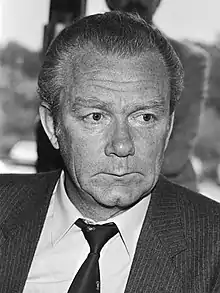
The Soviet Union's five-year UEFA coefficient, despite being earned in part by Ukrainian players (for example, in the final of the last successful event, Euro 1988, under the direction of Valery Lobanovsky, 7 out of starting 11 players were Ukrainians[7]), were transferred to the direct descendant of the Soviet national team – the Russia national team. As a result, a crisis was created for both the national team and the domestic league. When Ukraine returned to international football in late 1994, it did so as absolute beginners.
Another reason for the occurred harsh crisis in the Ukrainian football was lack of adequate funding of teams.[6] This is understandable in terms of the general economic crisis that has affected all of the CIS (Commonwealth of Independent States) countries.[6] Yet even in contrast with Russia, the Ukrainian teams looked very poor.[6] However, there also was a reverse influx of some top class players.[6] Viktor Leonenko agreed on transfer from Dynamo Moscow to Dynamo Kyiv.[6] The Russian club did not want to release him, but Leonenko did not want to continue to play in Moscow.[6] During his first six months in Kyiv Viktor was forced to miss due to the FIFA disqualification.[6]
In the following years, the Ukrainian team improved, showcasing talents like Andriy Shevchenko, Anatoliy Tymoshchuk, Serhiy Rebrov and Oleksandr Shovkovskyi. Ukraine, however, failed to qualify for any major tournaments prior to 2006.
First official games (Prokopenko)
Soon after being accepted to FIFA and UEFA as a full member in 1992, Ukraine started its preparation for its first game. At first the head coach of the team was planned to be Valeriy Lobanovskyi, but at that time he had a current contract with the United Arab Emirates. Thus, the first manager of the team had to be chosen among members of a coaching council which consisted of Anatoliy Puzach (manager of Dynamo Kyiv), Yevhen Kucherevskyi (FC Dnipro), Yevhen Lemeshko (Torpedo Zaporizhzhia), Yukhym Shkolnykov (Bukovyna Chernivtsi) and Viktor Prokopenko (Chornomorets Odesa). Later, they were joined by a native of Donetsk Valeriy Yaremchenko (Shakhtar Donetsk). At the last stage, the circle was narrowed to three specialists. Puzach, Yaremchenko and Prokopenko took the team to Uzhhorod. The last of them, by agreement between the coaches themselves, became the main one.[8]

For the first game of the team it was agreed to play against Hungary on 22 April 1992 in Kyiv at the Republican Stadium. Due to financial issues, however, it was rearranged to 29 April and moved to the border with Hungary in Uzhhorod at the Avanhard Stadium. There was almost no preparation to the game as all "pioneers" gathered in Kyiv on 27 April and the next day flew out to Uzhhorod. At the same time, the opponent, while failing to qualify for the Euro 1992, was preparing for 1994 FIFA World Cup qualification. Ukraine at that time failed to be accepted for the qualification cycle.
Unlike the Hungarian squad, players of which played alongside before and were coached by the European Cup-winning coach Emerich Jenei, the Ukrainian team lost some its better and experienced players to the CIS national football team that was playing its own friendly against the England national football team in Moscow.[9] Among those were Andrei Kanchelskis, Volodymyr Lyutyi, Sergei Yuran, Viktor Onopko, Oleksiy Mykhaylychenko and Akhrik Tsveiba (the last two would later represent Ukraine). For the game against Hungary, only Ivan Hetsko and Oleh Luzhny had previous experience of playing at international level; other players had only played for the Soviet Olympic football team, while Serhiy Kovalets played for Ukraine at the Spartakiad of People of the USSR in 1986.
The first home game was lost 1–3 with Ivan Hetsko becoming the first goalscorer in the history of national team. During the summer of 1992 Prokopenko's team played two more away games on 27 June against the United States (0-0) and on 26 August against Hungary (1-2). After the second loss to Hungary Prokopenko resigned. Leading in its game against Hungary, Ukraine conceded two goals in the final 10 minutes.
To the scheduled against Belarus in Minsk in the fall, Ukraine had left with Prokopenko's assistants Mykola Pavlov and Leonid Tkachenko. At the Dinamo Stadium, Ukraine managed to salvage a game by tying one a piece with a goal from Yuriy Maksymov.
Euro 96 qualification (Bazylevych)
Ukraine, having already suffered from a lack of good players, lost two promising young players during the winter intermission : Stepan Betsa and Oleksiy Sasko, who perished in a car accident. Unable to secure a contract with Valeriy Lobanovskyi, Ukraine appointed another head coach, former forward of Dynamo Kyiv Oleh Bazylevych. He made his debut with the national team in the spring of 1993 in Odessa during a friendly against Israel. Their expected win was cancelled out in a 1–1 draw just 10 minutes before the end by Serhiy Konovalov. Less than a month later Ukraine finally celebrated its first victory in Vilnius in an away friendly against Lithuania that resulted in a 1–2 win (goals scored by Viktor Leonenko and Dmytro Mykhaylenko). During the summer they played one away game against Croatia, losing 3–1, with a goal scored Andriy Husin and one of the Croatian goals scored by Davor Šuker. In October 1993, Ukraine went on their first tour to the United States where they played three games against the US and Mexico. Their game against Mexico in San Diego, resulting in a 1–2 loss, was attended by over 50,000 spectators. During the winter break Ukraine was seeded in Group 4 of the UEFA Euro 1996 qualification.
In March 1994, Ukraine paid Israel a visit, but lost the game with a single penalty kick. Next there was a home game against Belarus where Ukraine finally won 3-1 after coming from behind at half-time. Just before their first official international competition game which was scheduled to be played against Lithuania at home, they played couple of away games against Bulgaria and the United Arab Emirates which both ended in a 1–1 draw. Another tour was scheduled right afterwards to Lithuania and Korea, the national coached by Kyivan Anatoliy Byshovets. The opening game on 7 September against Lithuania, considering their last encounter, was expected to end positively, which however resulted in a 0–2 defeat.[10] Both goals were scored within a couple of minutes in the middle of the second half by Hamburger SV striker Valdas Ivanauskas. The national team headed off to Korea without Bazylevych and his assistants whom were Mykola Pavlov and Vladimir Muntyan. Ukraine played two games and lost both. On 20 September 1994, Oleh Bazylevych was highly criticized at the federation's coaching meeting but was to be kept in position at the next meeting of the FFU Executive Committee a few days later.[11] However, the following day Bazylevych resigned accusing Bannikov of being tactless. On 24 September 1994, the Football Federation of Ukraine appointed Yozhef Sabo as an acting head coach until the end of the year.
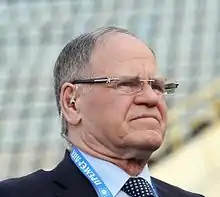
Following the change of coach, the national team level took a while to improve. Their next home game against Slovenia ended goalless.[12] After missing to obtain their first recent victory, Ukraine fell to bottom of the tournament table just above Estonian, whom they played their next home match against in mid-November, which they needed to win to keep any hopes of qualification alive. The Estonians, who were unable to field their best team, hoped to repeat the Slovenian effort a month earlier.[13] The game resulted in a 3–0 win. Serhiy Konovalov scored their first goal at competition level for the national team. Sabo left his post after the game.[14] and the FFU confirmed Anatoliy Konkov as the new head coach on 5 January 1995 .
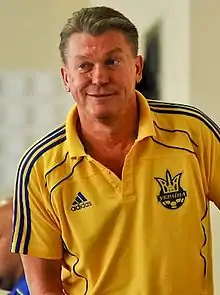
In order to save situation and prepare for upcoming games against Italy and Croatia, Konkov conducted training camp at a sports base in Stubenberg, Styria near the Castle (Schloss) Schielleiten from 16 to 23 March 1995. According to the new head coach the set program of training camp was accomplished successfully. Their away game to Croatia ended in a 0–4 loss in Zagreb, followed by a 0–2 defeat to three times World champions Italy at the Olympic Stadium (then Respublikanskiy).[15]
1998–2004: near misses
Ukraine participated in the 1998 FIFA World Cup qualification, where the team was drawn into Group 9. Ukraine had improved their performance well, and surprised the qualification by taking the second place instead of the more-favored Portugal, only behind Germany, thus sent Ukraine to the first ever playoff, against Croatia. Unfortunately, Ukraine was eliminated 3–1 after aggregate by Croatia, and missed the chance to qualify for the first ever competitive tournament.
In UEFA Euro 2000 qualifying, Ukraine, assigned in Group 4, once again managed to top ahead of another favorite, Russia, thanks to an important draw in Moscow, but still only qualified for playoff despite being undefeated, including two successful goalless draws to then-world champions France. Ukraine then fell to Slovenia 3–2 after aggregate as well, and lost the chance to qualify for the third time. Ukraine's defeat to Slovenia was more tragic, when Miran Pavlin canceled early Ukrainian lead at home and sealed Slovenia in instead.
The 2002 FIFA World Cup qualification saw Ukraine in Group 5, and most of Ukraine's opponents were much weaker than Germany and France. Yet, Ukraine suffered a denting home loss to Poland in their opening account, and a number of draws had hampered Ukrainian hope to process. Ukraine eventually reached the playoff again, but this time could not manage to overcome the old foe, Germany, losing 5–2 on aggregate, and once again missed a major tournament debut.
The UEFA Euro 2004 qualifying was perhaps the most humiliating moment of Ukrainian football since its foundation. Assigned into Group 6, Ukraine's only major opponent at the time was a much stronger Spain. Ukraine had been in comfortable competitive place with Spain, having drawn the Spaniards at home. However, a surprising resurgence from the less known Greece had dented any hope for Ukraine, as Ukraine failed to reach playoff for the first time since UEFA Euro 1996 qualifying due to Greek resurgence. Greece would go on to conquer the first European title.
2006 FIFA World Cup
After an unsuccessful Euro 2004 qualifying campaign, Ukraine appointed Oleg Blokhin as the national team's head coach. Despite initial skepticism about his appointment due to his previous somewhat undistinguished coaching record and general public calls for a foreign coach; as well as Ukraine's difficult group position, being drawn with Turkey, Denmark and Greece, the latter had already won the Euro 2004 and caused upset on Ukraine in Euro 2004 qualification, Ukraine went on to qualify for their first-ever FIFA World Cup on 3 September 2005 after drawing 1–1 against Georgia in Tbilisi. In their first World Cup, in 2006, they were in the Group H together with Spain, Tunisia and Saudi Arabia. After losing 0–4 in the first match against Spain, the Ukrainians beat their other two opponents to reach the knock-out stage.
In the round of 16, Ukraine played against the winner of Group G, Switzerland, whom they beat on penalties. In the quarter-finals, they were beaten 0–3 by eventual champions Italy.
2006–2010: disappointment return
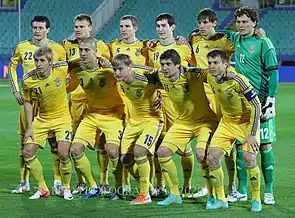
After a successful 2006 World Cup debut, Ukrainian enthusiasm increased for UEFA Euro 2008. Ukraine was assigned to Group B, only this time there was no playoff competition and thus, Ukraine had to seek one of the top two places. However, Ukraine failed to deliver the promised performance, partly because the team was unlucky to be drawn with 2006 World Cup finalists Italy and France; however, Ukraine had also performed terribly against weaker opponents like Scotland, Georgia and Lithuania, two shock losses and a draw away to these opponents had effectively ruined Ukraine's hope to qualify for the tournament, finishing in fourth place.
The 2010 FIFA World Cup qualification saw Ukraine regain some good improvement. Drawn in the Group 6, two good draws to a strong Croatian side and more importantly, a home win over England, sending Ukraine to a playoff for the first time since 2004 Euro qualification. However, Greece, which had been eliminated by Ukraine in the qualifiers four years earlier, would take revenge. Despite successfully drawing goalless in Athens, Ukraine suffered a bitter home defeat to the Greeks in Donetsk, a reply to Ukraine's elimination of Greece back in Athens. This meant Ukraine lost its first ever playoff match at home, and failed to qualify for 2010 FIFA World Cup.
UEFA Euro 2012
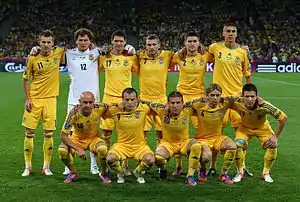
As co-hosts, Ukraine qualified automatically for Euro 2012,[2] marking their debut in the UEFA European Championship. In their opening game against Sweden, Ukraine won 2–1 in Kyiv. Despite the team's efforts, however, Ukraine was eliminated after a 0–2 loss to France and a 0–1 loss to England, both in Donetsk.
2014 World Cup qualification – UEFA Group H
The 2014 FIFA World Cup qualification was acceptable for the Ukrainian squad. Being drawn with fellow Euro 2012 host Poland, together with England and newcomer Montenegro, Ukraine had to face tough competitors. Despite facing struggles from the Montenegrin side, Ukraine was able to qualify for the playoff, thanks to two wins over Poland and two draws over England, where it would play against France. Ukraine beat France at home 2–0, but suffered a bitter 0–3 loss away, and thus failed to reach the 2014 FIFA World Cup.
| Pos | Team | Pld | W | D | L | GF | GA | GD | Pts | Qualification |  |
|
 |
 |
 |
| |
|---|---|---|---|---|---|---|---|---|---|---|---|---|---|---|---|---|---|
| 1 | England |
10 | 6 | 4 | 0 | 31 | 4 | +27 | 22 | Qualification to 2014 FIFA World Cup | — | 1–1 | 4–1 | 2–0 | 4–0 | 5–0 | |
| 2 | Ukraine |
10 | 6 | 3 | 1 | 28 | 4 | +24 | 21 | Advance to second round | 0–0 | — | 0–1 | 1–0 | 2–1 | 9–0 | |
| 3 | Montenegro |
10 | 4 | 3 | 3 | 18 | 17 | +1 | 15 | 1–1 | 0–4 | — | 2–2 | 2–5 | 3–0 | ||
| 4 | Poland |
10 | 3 | 4 | 3 | 18 | 12 | +6 | 13 | 1–1 | 1–3 | 1–1 | — | 2–0 | 5–0 | ||
| 5 | Moldova |
10 | 3 | 2 | 5 | 12 | 17 | −5 | 11 | 0–5 | 0–0 | 0–1 | 1–1 | — | 3–0 | ||
| 6 | San Marino |
10 | 0 | 0 | 10 | 1 | 54 | −53 | 0 | 0–8 | 0–8 | 0–6 | 1–5 | 0–2 | — |
UEFA Euro 2016
.jpg.webp)
In the Euro 2016 qualifying round, Ukraine were drawn against Spain, Slovakia, Belarus, Macedonia and Luxembourg. The Zbirna was expected to qualify for the tournament as runners-up of the group behind Spain but, despite having won all their other matches, they finished third due to poor results against Spain and Slovakia. They therefore had to face Slovenia in the play-off route (the side to which they had succumbed at the same stage of the 2000 edition) ; they recorded a 2–0 win at Lviv before forging a 1–1 draw at the very end of the second game.
Ukraine convincingly won all of their preparation friendlies against Cyprus, Wales, Romania and Albania. At club level, FC Dnipro had recently reached the UEFA Europa League final in 2015, while Shakhtar Donetsk had progressed to the semi-finals one year later, as the Ukrainian clubs succeeded in sending one participant to the round of 16 of the UEFA Champions League two times in a row. Having been drawn against world champions Germany, Slavic neighbors Poland and first-time Euro participants Northern Ireland, the Ukrainian team was expected to advance at least to the next round.
The tournament however, turned into a dreadful upset. Ukraine lost all of their three games, while also failing to score a single goal. Their first match resulted in a 2–0 loss to Germany, despite good resistance and great chances during an entertaining first half, they eventually came close to levelling the score but were caught on the counterattack at the very end of the game. This was followed by a second 2–0 loss to Northern Ireland, with a goal once again conceded in injury time. The Ukrainian media mainly criticized coach Mykhaylo Fomenko's perceived inadequate psychological preparation of the squad as much as predictable tactics which were judged as easy to break down. Ukrainians stars Andriy Yarmolenko and Yevhen Konoplyanka's under-performance was also mentioned. Ukraine at this stage were the first team eliminated from the competition and lost their last game to Poland 1–0.
| Pos | Team | Pld | W | D | L | GF | GA | GD | Pts | Qualification |
|---|---|---|---|---|---|---|---|---|---|---|
| 1 |  Germany Germany |
3 | 2 | 1 | 0 | 3 | 0 | +3 | 7[lower-alpha 1] | Advance to knockout phase |
| 2 | Poland |
3 | 2 | 1 | 0 | 2 | 0 | +2 | 7[lower-alpha 1] | |
| 3 | .svg.png.webp) Northern Ireland Northern Ireland |
3 | 1 | 0 | 2 | 2 | 2 | 0 | 3 | |
| 4 | Ukraine |
3 | 0 | 0 | 3 | 0 | 5 | −5 | 0 |
- Tied on head-to-head result (Germany 0–0 Poland). Overall goal difference was used as the tiebreaker.
2018 FIFA World Cup qualification – UEFA Group I
Ukraine started off with a home draw to eventual group leaders Iceland and an away draw to Turkey. This was followed by two home wins, 3–0 against Kosovo and 1–0 against Finland. Despite a 1–0 away loss to Croatia, they beat Finland 1–2 away and Turkey 2–0 at home. This was followed by a 2–0 away loss to Iceland and a 0–2 away win against Kosovo. Going to the last game, Ukraine stood a strong chance of qualifying for the tournament, but after a 0–2 home loss to Croatia, they failed to qualify for the play-offs for their first time since UEFA Euro 2004 qualifying. In their last game against Croatia, former Dynamo Kyiv footballer Domagoj Vida became famous for his "Slava Ukraini" video which showed solidarity with Ukraine for the Russian invasion of Ukraine in 2014.
| Pos | Team | Pld | W | D | L | GF | GA | GD | Pts | Qualification |  |
 |
|
 |
 |
 | |
|---|---|---|---|---|---|---|---|---|---|---|---|---|---|---|---|---|---|
| 1 | Iceland |
10 | 7 | 1 | 2 | 16 | 7 | +9 | 22 | Qualification to 2018 FIFA World Cup | — | 1–0 | 2–0 | 2–0 | 3–2 | 2–0 | |
| 2 | Croatia |
10 | 6 | 2 | 2 | 15 | 4 | +11 | 20 | Advance to second round | 2–0 | — | 1–0 | 1–1 | 1–1 | 1–0 | |
| 3 | Ukraine |
10 | 5 | 2 | 3 | 13 | 9 | +4 | 17 | 1–1 | 0–2 | — | 2–0 | 1–0 | 3–0 | ||
| 4 | Turkey |
10 | 4 | 3 | 3 | 14 | 13 | +1 | 15 | 0–3 | 1–0 | 2–2 | — | 2–0 | 2–0 | ||
| 5 | Finland |
10 | 2 | 3 | 5 | 9 | 13 | −4 | 9 | 1–0 | 0–1 | 1–2 | 2–2 | — | 1–1 | ||
| 6 | Kosovo |
10 | 0 | 1 | 9 | 3 | 24 | −21 | 1 | 1–2 | 0–6 | 0–2 | 1–4 | 0–1 | — |
2018–19 UEFA Nations League
Ukraine was drawn with the Czech Republic and Slovakia in League B. They beat the Czech Republic 1–2 away and Slovakia 1–0 at home, before earning a promotion with a 1–0 home win to the Czech Republic, before ending with a heavy 4–1 away loss to Slovakia.
| Pos | Team | Pld | W | D | L | GF | GA | GD | Pts | Promotion[lower-alpha 1] | |
 |
 | |
|---|---|---|---|---|---|---|---|---|---|---|---|---|---|---|
| 1 | Ukraine (P) |
4 | 3 | 0 | 1 | 5 | 5 | 0 | 9 | Promotion to League A | — | 1–0 | 1–0 | |
| 2 | Czech Republic |
4 | 2 | 0 | 2 | 4 | 4 | 0 | 6 | 1–2 | — | 1–0 | ||
| 3 | Slovakia |
4 | 1 | 0 | 3 | 5 | 5 | 0 | 3 | 4–1 | 1–2 | — |
- Due to revamp of the format for the 2020–21 UEFA Nations League, no teams were eventually relegated.
UEFA Euro 2020 qualifying – UEFA Group B
Ukraine were placed in a tough group with Euro 2016 title holders Portugal, and Serbia—a side with personnel playing for multiple prominent club teams. According to many sports analysts, Ukraine were tipped to finish third in the group. The first match proved to be the most difficult match—an away game against Portugal. With the centre-back Yaroslav Rakytskiy absent due to his controversial move to Russian club Zenit Saint Petersburg and the return of Cristiano Ronaldo to the Portuguese lineup after an absent Nations League, the Portuguese were favoured to win by a comfortable margin. However, contrary to popular prediction, Andriy Shevchenko's side proved to be very stubborn. Although the Portuguese controlled the majority of the game's possession, they could not find the back of the net. A heroic showing from goalkeeper Andriy Pyatov as well as persistent marking of Cristiano Ronaldo and the Portuguese attack by Ukraine's defense earned Ukraine a valuable point in Lisbon. The match ended with a 0–0 scoreline.
The second game (4 days after the positive result in Portugal) was away to supposed minnows of the group, Luxembourg. However, this match proved to be an absolute nightmare for the Ukrainians. After struggling to come up with inventive attacks, a very lacklustre Ukrainian side found themselves down 1–0 thanks to a goal from David Turpel, aided by very disorganized defending on the part of the Ukrainians. Right before the end of the first half, Ukraine did find an equalizer through Viktor Tsyhankov. Ukraine struggled to create any meaningful opportunities in a stressful second half. However, with literally the last kick of the ball in stoppage time (from a freekick), Ukraine found themselves extremely lucky and unlikely 2–1 winners when Gerson Rodrigues of Luxembourg headed the ball into his own goal. Therefore, after the first two matchdays, Ukraine found themselves top of the group with 4 points after Portugal and Serbia played a 1–1 match in Lisbon on the same day.
Matchday 3 came with a stiff test—a home match against a well-rounded and versatile Serbian squad boasting many experienced and skillful players from multiple world-renowned clubs. While it was expected to be a reasonably close match, it could not have been more of a rout. What appeared to be a well balanced and close affair within the opening exchanges of the first half quickly changed when Viktor Tsyhankov scored the opening goal in the 26th minute of play. The second goal (also by Tsyhankov) was scored from a thunderous strike from long range less than two minutes later. Ukraine went on to win the match 5–0 with Roman Yaremchuk achieving his first ever international goal and Yevhen Konoplyanka helping himself to two goals. At this point, with positive results against the two supposedly strongest opponents in the groups, Ukraine looked as though they could secure a top two finish and avoid the play-offs.
After another stiff contest with Luxembourg, Ukraine managed to secure a 1–0 victory only three days after their triumph over Serbia. The goal came in the 6th minute from Roman Yaremchuk. Two matches—away and home against Lithuania (winning 3–0 and 2–0 respectively) saw Ukraine with 16 points and in need of only a point against Fernando Santos's Portuguese side, who at this point were crowned UEFA Nations League Champions.
The match against Portugal was expected to be an interesting test for Shevchenko's men, who had not lost a single match in qualifying and had only conceded once. Ukraine started brightly with noticeably more attacking intent than in the previous meeting between these two teams. Indeed, their pressure paid off when Roman Yaremchuk scored from close range after an initial save from Rui Patrício on 6 minutes. In the 27th minute, Ukraine doubled their advantage with an Andriy Yarmolenko goal. After building this comfortable lead, Ukraine began to sit back and defend as they did in Lisbon on matchday one. Portugal was once again unable to crack Ukraine's defense. However, in the 72nd minute, Cristiano Ronaldo was awarded a penalty kick from a supposed hand-ball by Taras Stepanenko as he blocked the ball from a Portuguese shot. While VAR was not an option, replays showed that this was an incorrect call from the referee, as the ball was blocked by Stepanenko's leg, before making contact with his arm as it deflected into the air. This incident also resulted in a red card for Stepanenko. Thus, Ukraine had to play the rest of the match with ten men. Ronaldo scored from the spot, giving Portugal a glimmer of hope to rescue the game and earn a valid point in Kyiv. However, it wasn't to be Portugal's night. Ukraine won 2–1 and subsequently won the group.
The last match was played in Belgrade against Serbia. Because Ukraine had already qualified and won the group, Shevchenko decided to field a team with a few less experienced players. Serbia on the other hand, had to win for any hopes of automatic qualification. Serbia took the lead early through a Dušan Tadić penalty kick. After controlling the majority of the match after falling behind, Ukraine found an equaliser through the inevitable Yaremchuk. Serbia took control of the second half and restored their lead thanks to a beautiful Aleksandar Mitrović finish. Serbia continued to search for another goal with multiple chances. However, in the last minute of stoppage time, Yarmolenko sent a low cross across the Serbian goal which was received by Artem Biesiedin and finished into the bottom corner. The match ended 2–2 and Ukraine accomplished a successful qualification campaign without a single loss. With Portugal beating Luxembourg 2–0, Serbia's hopes of direct qualification were shot.
| Pos | Team | Pld | W | D | L | GF | GA | GD | Pts | Qualification | |
 |
 |
 |
 | |
|---|---|---|---|---|---|---|---|---|---|---|---|---|---|---|---|---|
| 1 | Ukraine |
8 | 6 | 2 | 0 | 17 | 4 | +13 | 20 | Qualify for final tournament | — | 2–1 | 5–0 | 1–0 | 2–0 | |
| 2 | Portugal |
8 | 5 | 2 | 1 | 22 | 6 | +16 | 17 | 0–0 | — | 1–1 | 3–0 | 6–0 | ||
| 3 | Serbia |
8 | 4 | 2 | 2 | 17 | 17 | 0 | 14 | Advance to play-offs via Nations League | 2–2 | 2–4 | — | 3–2 | 4–1 | |
| 4 | Luxembourg |
8 | 1 | 1 | 6 | 7 | 16 | −9 | 4 | 1–2 | 0–2 | 1–3 | — | 2–1 | ||
| 5 | Lithuania |
8 | 0 | 1 | 7 | 5 | 25 | −20 | 1 | 0–3 | 1–5 | 1–2 | 1–1 | — |
2020–21 UEFA Nations League
Ukraine was drawn with Switzerland, Spain, and Germany in League A. The Ukrainians started their campaign by overcoming Switzerland at home 2–1 to temporarily take first place. However, their next opponent Spain proved to be too strong, and Ukraine was unable to produce any significant threat, losing 4–0. In October, Ukraine returned home to play two subsequent games against Germany and Spain, with nearly half of the main squad having contracted COVID-19 or injured. The first match against Germany saw a German win by a score of 2–1 in Kyiv. With a demoralized squad, Ukraine had to face a powerful Spain side who was impressing in the Nations League. However, despite significant absence of many key members, Ukraine shockingly defeated Spain for the first time with a 1–0 win to end Spain's 13 games undefeated streak. In November, Ukraine had two important games in order to survive in the League, and their first game against Germany away saw Ukraine obtain an early lead, but it was to be in vain when the Germans bounced back to win 3–1. As the COVID-19 crisis in Ukraine worsened, eight players from the starting squad tested positive (including one positive SARS-CoV-2 test upon arrival to Lucerne), and as a result, the entire delegation was put into quarantine by the Department of Health of the Canton of Lucerne.[16] Their game against Switzerland away was sequently cancelled. Ukraine faced relegation if the game was to be awarded 3–0 to Switzerland or if the result is decided by a drawing of lots and Switzerland were to be handed a 1–0 victory. Eventually, UEFA decided that the match result would be 3–0 in favour of Switzerland, meaning that Ukraine had been officially relegated after just one season in League A.
| Pos | Team | Pld | W | D | L | GF | GA | GD | Pts | Qualification or relegation |  |
|
 |
| |
|---|---|---|---|---|---|---|---|---|---|---|---|---|---|---|---|
| 1 | Spain |
6 | 3 | 2 | 1 | 13 | 3 | +10 | 11 | Qualification to Nations League Finals | — | 6–0 | 1–0 | 4–0 | |
| 2 | Germany |
6 | 2 | 3 | 1 | 10 | 13 | −3 | 9 | 1–1 | — | 3–3 | 3–1 | ||
| 3 | Switzerland |
6 | 1 | 3 | 2 | 9 | 8 | +1 | 6[lower-alpha 1] | 1–1 | 1–1 | — | 3–0[lower-alpha 2] | ||
| 4 | Ukraine (R) |
6 | 2 | 0 | 4 | 5 | 13 | −8 | 6[lower-alpha 1] | Relegation to League B | 1–0 | 1–2 | 2–1 | — |
- Tied on head-to-head points (3). Head-to-head goal difference: Switzerland +2, Ukraine −2.
- The Switzerland v Ukraine match was awarded as a 3–0 win to Switzerland after being cancelled as Ukraine were placed in quarantine prior to the match due to positive SARS-CoV-2 tests in the team.
UEFA Euro 2020
| Pos | Team | Pld | W | D | L | GF | GA | GD | Pts | Qualification |
|---|---|---|---|---|---|---|---|---|---|---|
| 1 |  Netherlands (H) Netherlands (H) |
3 | 3 | 0 | 0 | 8 | 2 | +6 | 9 | Advance to knockout phase |
| 2 |  Austria Austria |
3 | 2 | 0 | 1 | 4 | 3 | +1 | 6 | |
| 3 | Ukraine |
3 | 1 | 0 | 2 | 4 | 5 | −1 | 3 | |
| 4 |  North Macedonia North Macedonia |
3 | 0 | 0 | 3 | 2 | 8 | −6 | 0 |
Ukraine managed to qualify to the knockout stages in the European Championship for the first time, as one of the best third-placed teams. Then, they upset the Swedish team, 2–1, in the round of 16, on June 29, as Artem Dovbyk scored the winning goal at 120+1 minute. Unfortunately, they were not able to progress to the semi-finals as they were knocked out 4–0 by England in the quarter-final. Ironically, Ukraine's quarter-finals finish in Euro 2020 would end up seeing Italy emerged victorious in the tournament once again, a repeat of the 2006 FIFA World Cup performance.
2022 FIFA World Cup qualification – UEFA Group D
Ukraine first got a surprise 1–1 draw over the world champions France, which was highly praised. Antoine Griezmann made the first goal in the 19th minute. Serhiy Sydorchuk then kicked the ball at the 57th minute which deflected off of Presnel Kimpembe for an own goal on France.[17] However, Ukraine subsequently disappointed the next three games, when both their home games against weaker opponents Finland and Kazakhstan ended in two another one-one draws, before tying Kazakhstan 2–2 on the road as well on September 1, with Ukraine blew up its lead in the injury times of the second half. Following the game against France at home, where Ukraine blew up its lead to end the game in yet another 1–1 draw, Ukraine has officially broken the record previously held by Australia for the most consecutive draws in a World Cup qualification, with five straight draws out of five to Australia's four back in the previous qualification, leaving Ukraine's hope to qualify for Qatar in limbo.
They picked up a much-needed victory over Finland, ending their run of draws and giving them a two-point lead over Bosnia and a three-point lead over Finland. However, both Bosnia and Finland had a game in hand over Ukraine. Yet in the final week, Ukraine managed to qualify for the playoffs after a 2-0 win over Bosnia and a Finnish lose to France. Ukraine was matched to play Scotland in the playoff Group A semifinals.
| Pos | Team | Pld | W | D | L | GF | GA | GD | Pts | Qualification | |
|
|
 |
 | |
|---|---|---|---|---|---|---|---|---|---|---|---|---|---|---|---|---|
| 1 | France |
8 | 5 | 3 | 0 | 18 | 3 | +15 | 18 | Qualification to 2022 FIFA World Cup | — | 1–1 | 2–0 | 1–1 | 8–0 | |
| 2 | Ukraine |
8 | 2 | 6 | 0 | 11 | 8 | +3 | 12 | Advance to play-offs | 1–1 | — | 1–1 | 1–1 | 1–1 | |
| 3 | Finland |
8 | 3 | 2 | 3 | 10 | 10 | 0 | 11 | 0–2 | 1–2 | — | 2–2 | 1–0 | ||
| 4 | Bosnia and Herzegovina |
8 | 1 | 4 | 3 | 9 | 12 | −3 | 7 | 0–1 | 0–2 | 1–3 | — | 2–2 | ||
| 5 | Kazakhstan |
8 | 0 | 3 | 5 | 5 | 20 | −15 | 3 | 0–2 | 2–2 | 0–2 | 0–2 | — |
Stadiums
The most important matches of the Ukrainian national team are held in Kyiv's Olimpiyskiy National Sports Complex, also home of Dynamo Kyiv. New infrastructure and stadiums were built in preparation for Euro 2012, and other venues include stadiums in the cities of Donetsk, Kharkiv, Lviv, Dnipro, Odesa. The alternative stadiums are: Metalist Stadium (Kharkiv), Arena Lviv (Lviv), Dnipro-Arena (Dnipro), and Chornomorets Stadium (Odessa).
During the Soviet time era (before 1991), only three stadiums in Ukraine were used in official games, the Olimpiysky NSC in Kyiv (known then as Republican Stadium), the predecessor of Chornomorets, BSS Central Stadium in Odesa, and the Lokomotiv Stadium in Simferopol.
Home venue record
Since Ukraine's first fixture (29 April 1992 vs. Hungary) they have played their home games at 11 different stadiums.
| Venue | City | Played | Won | Drawn | Lost | GF | GA | Points per game |
|---|---|---|---|---|---|---|---|---|
| Olimpiyskiy National Sports Complex | Kyiv | 62 | 29 | 21 | 12 | 88 | 52 | 1.74 |
| Valeriy Lobanovskyi Dynamo Stadium | Kyiv | 20 | 13 | 5 | 2 | 38 | 15 | 2.2 |
| Arena Lviv | Lviv | 14 | 11 | 3 | 0 | 33 | 6 | 2.57 |
| Metalist Oblast Sports Complex | Kharkiv | 13 | 7 | 2 | 4 | 21 | 9 | 1.77 |
| Ukraina Stadium | Lviv | 6 | 6 | 0 | 0 | 14 | 5 | 3 |
| Chornomorets Stadium | Odesa | 6 | 4 | 2 | 0 | 7 | 3 | 2.33 |
| Donbass Arena | Donetsk | 5 | 0 | 1 | 4 | 2 | 9 | 0.2 |
| Dnipro-Arena | Dnipro | 4 | 3 | 1 | 0 | 5 | 2 | 2.5 |
| Shakhtar Stadium | Donetsk | 2 | 0 | 1 | 1 | 0 | 2 | 0.5 |
| Slavutych-Arena | Zaporizhzhia | 1 | 1 | 0 | 0 | 1 | 0 | 3 |
| Meteor Stadium | Dnipro | 1 | 0 | 1 | 0 | 2 | 2 | 1 |
| Avanhard Stadium | Uzhhorod | 1 | 0 | 0 | 1 | 1 | 3 | 0 |
| Totals | 135 | 74 | 37 | 24 | 212 | 108 | 1.92 | |
- Last updated: 11 November 2021. Statistics include official FIFA-recognised matches only.
Kits and sponsors
Kit history and evolution
On 29 March 2010, Ukraine debuted a new Adidas kit.[18] This replaced the Adidas kit with a yellow base and the traditional Adidas three stripe with a snake sash which was used in 2009.[19] Prior to 5 February 2009 Ukraine wore a Lotto kit. In 2009 the official team kit was produced by German company Adidas which has a contract with the Ukrainian team until 31 December 2016. Joma manufactured the kits starting from the year 2017 for the match against Croatia on 24 March 2017.[20]
Sponsors
Marketing for the Football Federation of Ukraine is conducted by the Ukraine Football International (UFI).
- Title sponsor: Epicentr (since 2013)[21][22][23]
- Premium (General) sponsors: Chernihivske (since 1998)
- Official sponsors: Henkel (Ukraine), Adidas, Airline "MAU" (Ukraine International Airlines), NIKO (official Mitsubishi distributor in Ukraine), Boris clinic, Tour agency "Love Cyprus", Resort center "Grand Admiral Club"
Former title and general sponsors included Ukrtelecom, Kyivstar,[24] Nordex (Austria),[25][26] and Geoton.
Results and fixtures
The following matches were played or are scheduled to be played by the national team in the current or upcoming seasons.
2021
| 24 March 2021 2022 FIFA World Cup qualification | France | 1–1 | Ukraine | Saint-Denis, France |
| 20:45 | Griezmann  19' 19' |
Report | Sydorchuk 57' |
Stadium: Stade de France Attendance: 0 Referee: Tobias Stieler (Germany) |
| 28 March 2021 2022 FIFA World Cup qualification | Ukraine | 1–1 | Finland | Kyiv, Ukraine |
| 20:45 (21:45 UTC+3) | Moraes 80' |
Report | Pukki 89' (pen.) |
Stadium: NSK Olimpiyskiy Attendance: 0 Referee: István Kovács (Romania) |
| 31 March 2021 2022 FIFA World Cup qualification | Ukraine | 1–1 | Kazakhstan | Kyiv, Ukraine |
| 20:45 (21:45 UTC+3) | Yaremchuk 20' |
Report | Muzhikov 59' |
Stadium: NSK Olimpiyskiy Attendance: 0 Referee: Matej Jug (Slovenia) |
| 23 May 2021 FIFA International Friendly | Ukraine | 1–1 |  Bahrain Bahrain | Kharkiv, Ukraine |
|
Report |
|
Stadium: Metalist Stadium Referee: Pavel Orel (Czech Republic) |
| 3 June 2021[lower-alpha 1] FIFA International Friendly | Ukraine | 1–0 | Northern Ireland | Dnipro, Ukraine |
|
Report | Stadium: Dnipro-Arena Referee: Szymon Marciniak (Poland) |
| 7 June 2021[lower-alpha 2] FIFA International Friendly | Ukraine | 4–0 |  Cyprus Cyprus | Kharkiv, Ukraine |
|
Report | Stadium: Metalist Stadium Referee: Vitālijs Spasjoņņikovs (Latvia) |
| 13 June 2021 UEFA Euro 2020 | Netherlands | 3–2 | Ukraine | Amsterdam, Netherlands |
| 21:00 UTC+2 | Report |
|
Stadium: Johan Cruyff Arena Attendance: 15,837 Referee: Felix Brych (Germany) |
| 17 June 2021 UEFA Euro 2020 | Ukraine | 2–1 | North Macedonia | Bucharest, Romania |
| 16:00 UTC+3 |
|
Report |
|
Stadium: Arena Națională Attendance: 10,001 Referee: Fernando Rapallini (Argentina) |
| 21 June 2021 UEFA Euro 2020 | Ukraine | 0–1 | Austria | Bucharest, Romania |
| 19:00 UTC+3 | Report |
|
Stadium: Arena Națională Attendance: 10,472 Referee: Cüneyt Çakır (Turkey) |
| 29 June 2021 UEFA Euro 2020 R16 | Sweden  | 1–2 (a.e.t.) | Ukraine | Glasgow, Scotland |
| 20:00 UTC+1 |
|
Report | Stadium: Hampden Park Attendance: 9,221 Referee: Daniele Orsato (Italy) |
| 3 July 2021 UEFA Euro 2020 QF | Ukraine | 0–4 | England | Rome, Italy |
| 21:00 CEST | Report |
|
Stadium: Stadio Olimpico Attendance: 11,880 Referee: Felix Brych (Germany) |
| 1 September 2021 2022 FIFA World Cup qualification | Kazakhstan | 2–2 | Ukraine | Nur-Sultan, Kazakhstan |
| 16:00 (20:00 UTC+6) | Valiullin 74', 90+6' |
Report | Stadium: Astana Arena Attendance: 6,274 Referee: Donatas Rumšas (Lithuania) |
| 4 September 2021 2022 FIFA World Cup qualification | Ukraine | 1–1 | France | Kyiv, Ukraine |
| 20:45 (21:45 UTC+3) |
|
Report |
|
Stadium: NSK Olimpiyskiy Attendance: 28,000 Referee: Slavko Vinčić (Slovenia) |
| 8 September 2021 Friendly | Czech Republic | 1–1 | Ukraine | Plzeň, Czech Republic |
| 20:45 UTC+2 |
|
Report |
|
Stadium: Doosan Arena Attendance: 5,231 Referee: Filip Glova (Slovakia) |
| 9 October 2021 2022 FIFA World Cup qualification | Finland | 1–2 | Ukraine | Helsinki, Finland |
| 18:00 (19:00 UTC+3) |
|
Report |
|
Stadium: Helsinki Olympic Stadium Referee: Jesús Gil Manzano (Spain) |
| 12 October 2021 2022 FIFA World Cup qualification | Ukraine | 1–1 | Bosnia and Herzegovina | Lviv, Ukraine |
| 20:45 (21:45 UTC+3) |
|
Report |
|
Stadium: Arena Lviv Referee: Felix Zwayer (Germany) |
| 11 November 2021 Friendly | Ukraine | 1–1 |  Bulgaria Bulgaria | Odesa, Ukraine |
| 18:30 (19:30 UTC+3) |
|
Report |
|
Stadium: Chornomorets Stadium Referee: Arda Kardesler (Turkey) |
| 16 November 2021 2022 FIFA World Cup qualification | Bosnia and Herzegovina | 0–2 | Ukraine | Zenica, Bosnia and Herzegovina |
| 20:45 | Report | Stadium: Bilino Polje Stadium Referee: Antonio Mateu Lahoz (Spain) |
2022
| 24 March 2022 2022 FIFA World Cup qualifying | Scotland  | v | Ukraine | Glasgow, Scotland |
| Report | Stadium: Hampden Park |
| 4 June 2022 2022–23 Nations League | Republic of Ireland  | v | Ukraine | Republic of Ireland |
| 21:45 | Report |
| 7 June 2022 2022–23 Nations League | Scotland | v | Ukraine | Glasgow, Scotland |
| 21:45 | Report | Stadium: Hampden Park[27] |
| 11 June 2022 2022–23 Nations League | Ukraine | v |  Armenia Armenia | Ukraine |
| 21:45 | Report |
| 14 June 2022 2022–23 Nations League | Ukraine | v | Republic of Ireland | Ukraine |
| 21:45 | Report |
| 23 September 2022 2022–23 Nations League | Armenia | v | Ukraine | Armenia |
| 19:00 | Report |
| 26 September 2022 2022–23 Nations League | Ukraine | v | Scotland | Ukraine |
| 21:45 | Report |
Coaching staff
Currently approved:[28]
| Position | Name |
|---|---|
| Head coach | Oleksandr Petrakov |
| Assistant coaches | Andriy Annenkov Oleksandr Shovkovskyi |
| Goalkeeping coach | Vyacheslav Kernozenko |
| Fitness coaches | Ivan Bashtovyi Vyacheslav Ruzhentsev |
Coaching history
Last updated on 16 November 2021.[29][30]
| Manager | Nation | Ukraine career | Played | Won | Drawn | Lost | GF | GA | Win % | Qualifying cycle | Final tour |
|---|---|---|---|---|---|---|---|---|---|---|---|
| Viktor Prokopenko | |
1992 | 3 | 0 | 1 | 2 | 2 | 5 | 0 | ||
| Mykola Pavlov (caretaker) | |
1992 | 1 | 0 | 1 | 0 | 1 | 1 | 0 | ||
| Oleh Bazylevych | |
1993–1994 | 11 | 4 | 3 | 4 | 13 | 14 | 36.36 | 1996 | |
| Mykola Pavlov (caretaker) | |
1994 | 2 | 0 | 0 | 2 | 0 | 3 | 0 | ||
| Yozhef Sabo | |
1994 | 2 | 1 | 1 | 0 | 3 | 0 | 50 | 1996 | |
| Anatoliy Konkov | |
1995 | 7 | 3 | 0 | 4 | 8 | 13 | 42.86 | 1996 | |
| Yozhef Sabo | |
1996–1999 | 32 | 15 | 11 | 6 | 44 | 26 | 46.88 | 1998, 2000 | |
| Valeriy Lobanovskyi | |
2000–2001 | 18 | 6 | 7 | 5 | 20 | 20 | 33.33 | 2002 | |
| Leonid Buryak | |
2002–2003 | 19 | 5 | 6 | 8 | 18 | 23 | 26.32 | 2004 | |
| Oleg Blokhin | |
2003–2007 | 46 | 21 | 14 | 11 | 65 | 40 | 45.65 | 2006, 2008 | 2006 |
| Oleksiy Mykhaylychenko | |
2008–2009 | 21 | 12 | 5 | 4 | 31 | 16 | 57.14 | 2010 | |
| Myron Markevych[31] | |
2010 | 4 | 3 | 1 | 0 | 9 | 3 | 75 | ||
| Yuriy Kalytvyntsev (caretaker)[32] | |
2010–2011 | 8 | 1 | 5 | 2 | 10 | 13 | 12.5 | ||
| Oleg Blokhin[33] | |
2011–2012 | 18 | 7 | 3 | 8 | 27 | 28 | 38.89 | 2014 | 2012 |
| Andriy Bal (caretaker)[34] | |
2012 | 2 | 0 | 1 | 1 | 0 | 1 | 0 | 2014 | |
| Oleksandr Zavarov (caretaker) | |
2012 | 1 | 1 | 0 | 0 | 1 | 0 | 100 | ||
| Mykhaylo Fomenko[35] | |
2012–2016 | 37 | 24 | 6 | 7 | 67 | 22 | 64.86 | 2014, 2016 | 2016 |
| Andriy Shevchenko | |
2016–2021 | 51 | 25 | 13 | 13 | 71 | 61 | 49.02 | 2018, 2020, 2022 | 2020 |
| Oleksandr Petrakov (caretaker until 17 November 2021) | |
2021– | 7 | 2 | 5 | 0 | 10 | 7 | 28.57 | 2022 |
Players
Current squad
The following players players were called up for the friendly match against Bulgaria and the 2022 FIFA World Cup qualification match against Bosnia and Herzegovina on 11 and 16 November 2021.[36]
Caps and goals updated as of 16 November 2021, after the match against Bosnia and Herzegovina.[37][38][39][40]
Recent call-ups
The following players have been called up for the team within the last 12 months.
| Pos. | Player | Date of birth (age) | Caps | Goals | Club | Latest call-up |
|---|---|---|---|---|---|---|
| GK | Andriy Lunin | 11 February 1999 | 6 | 0 | Real Madrid |
v. Bulgaria, 11 November 2021 RES |
| GK | Anatoliy Trubin | 1 August 2001 | 2 | 0 | Shakhtar Donetsk |
v. Bulgaria, 11 November 2021 RES |
| GK | Denys Boyko | 29 January 1988 | 7 | 0 | Dynamo Kyiv |
v. Finland, 9 October 2021 WD |
| DF | Viktor Korniyenko | 14 February 1999 | 2 | 1 | Shakhtar Donetsk |
v. Bulgaria, 11 November 2021 |
| DF | Vitaliy Mykolenko | 29 May 1999 | 21 | 0 | Dynamo Kyiv |
v. Bulgaria, 11 November 2021 INJ |
| DF | Yukhym Konoplya | 26 August 1999 | 3 | 0 | Shakhtar Donetsk |
v. Bulgaria, 11 November 2021 RES |
| DF | Valeriy Bondar | 27 February 1999 | 1 | 0 | Shakhtar Donetsk |
v. Bulgaria, 11 November 2021 RES |
| DF | Artem Shabanov | 7 March 1992 | 2 | 0 | Dynamo Kyiv |
v. Bosnia and Herzegovina, 12 October 2021 |
| DF | Oleksandr Syrota | 11 June 2000 | 1 | 0 | Dynamo Kyiv |
v. Bosnia and Herzegovina, 12 October 2021 |
| DF | Bohdan Mykhaylichenko | 21 March 1997 | 6 | 0 | .svg.png.webp) Anderlecht Anderlecht |
v. Finland, 9 October 2021 RES |
| DF | Denys Popov | 17 February 1999 | 1 | 0 | Dynamo Kyiv |
v. Sweden, 29 June 2021 INJ |
| MF | Ihor Kharatin | 2 February 1995 | 4 | 0 | Legia Warsaw |
v. Bulgaria, 11 November 2021 RES |
| MF | Serhiy Buletsa | 16 February 1999 | 3 | 0 | Zorya Luhansk |
v. Bulgaria, 11 November 2021 RES |
| MF | Oleksandr Pikhalyonok | 7 May 1997 | 0 | 0 | Dnipro-1 |
v. Bulgaria, 11 November 2021 RES |
| MF | Vladyslav Kocherhin | 30 April 1996 | 1 | 0 | Zorya Luhansk |
v. Finland, 9 October 2021 RES |
| MF | Vladyslav Kalitvintsev | 4 January 1993 | 0 | 0 | Desna Chernihiv |
v. Finland, 9 October 2021 RES |
| MF | Yevhenii Makarenko | 21 May 1991 | 15 | 0 | Fehérvár |
v. Czech Republic, 8 September 2021 |
| MF | Yevhen Konoplyanka | 29 September 1989 | 86 | 21 | Shakhtar Donetsk |
v. Kazakhstan, 1 September 2021 RES |
| MF | Marlos | 7 June 1988 | 27 | 1 | Unattached | v. England, 3 July 2021 RET |
| MF | Roman Bezus | 26 September 1990 | 24 | 5 | Gent |
v. England, 3 July 2021 |
| MF | Heorhiy Sudakov | 1 September 2002 | 3 | 0 | Shakhtar Donetsk |
v. England, 3 July 2021 |
| MF | Bohdan Lyednyev | 7 April 1998 | 0 | 0 | Dynamo Kyiv |
v. Northern Ireland, 3 June 2021 |
| MF | Artem Bondarenko | 21 August 2000 | 0 | 0 | Shakhtar Donetsk |
UEFA Euro 2020 PRE |
| MF | Volodymyr Shepelyev | 1 June 1997 | 7 | 0 | Dynamo Kyiv |
v. Bahrain, 23 May 2021 INJ |
| MF | Oleksandr Andriyevskyi | 25 June 1994 | 1 | 0 | Dynamo Kyiv |
v. Bahrain, 23 May 2021 INJ |
| FW | Danylo Sikan | 16 April 2001 | 4 | 1 | Shakhtar Donetsk |
v. Bulgaria, 11 November 2021 |
| FW | Artem Besedin | 31 March 1996 | 18 | 2 | Dynamo Kyiv |
v. England, 3 July 2021 |
| FW | Júnior Moraes | 4 April 1987 | 11 | 1 | Shakhtar Donetsk |
v. Kazakhstan, 31 March 2021 INJ |
Notes:
- COV = Withdrew due to COVID-19
- INJ = Injured.
- WD = Withdrew.
- PRE = Preliminary squad.
- RES = Reserves squad - replaces a member of the squad in case of injury/unavailability.
- RET = Retired from the national team.
- SUS = Suspended for the next match.
- U21 = Joined the Ukraine national under-21 team instead.
Player records
Most capped players
| Rank | Player | Caps | Goals | Period |
|---|---|---|---|---|
| 1 | Anatoliy Tymoshchuk | 144 | 4 | 2000–2016 |
| 2 | Andriy Shevchenko | 111 | 48 | 1995–2012 |
| 3 | Andriy Yarmolenko | 106 | 44 | 2009–present |
| 4 | Andriy Pyatov | 101 | 0 | 2007–present |
| 5 | Ruslan Rotan | 100 | 8 | 2003–2018 |
| 6 | Oleh Husyev | 98 | 13 | 2003–2016 |
| 7 | Oleksandr Shovkovskyi | 92 | 0 | 1994–2012 |
| 8 | Yevhen Konoplyanka | 86 | 21 | 2010–present |
| 9 | Serhiy Rebrov | 75 | 15 | 1992–2006 |
| 10 | Andriy Voronin | 74 | 8 | 2002–2012 |
Top goalscorers
| Rank | Player | Goals | Caps | Average | Period |
|---|---|---|---|---|---|
| 1 | Andriy Shevchenko | 48 | 111 | 0.43 | 1995–2012 |
| 2 | Andriy Yarmolenko | 44 | 106 | 0.42 | 2009–present |
| 3 | Yevhen Konoplyanka | 21 | 86 | 0.24 | 2010–present |
| 4 | Serhiy Rebrov | 15 | 75 | 0.2 | 1992–2006 |
| 5 | Oleh Husyev | 13 | 98 | 0.13 | 2003–2016 |
| 6 | Roman Yaremchuk | 12 | 36 | 0.33 | 2018–present |
| Serhiy Nazarenko | 12 | 56 | 0.21 | 2003–2012 | |
| 8 | Yevhen Seleznyov | 11 | 58 | 0.19 | 2008–2018 |
| 9 | Andriy Vorobey | 9 | 68 | 0.13 | 2000–2008 |
| Andriy Husin | 9 | 71 | 0.13 | 1993–2006 |
Most capped goalkeepers
As of 16 November 2021
| Rank | Player | Games | Wins | GA | Av GA | Period |
|---|---|---|---|---|---|---|
| 1 | Andriy Pyatov | 101 | 50 | 83 | 0.822 | 2007–present |
| 2 | Oleksandr Shovkovskyi | 92 | 38 | 80 | 0.87 | 1994–2012 |
| 3 | Heorhiy Bushchan | 13 | 4 | 22 | 1.692 | 2020–present |
| 4 | Oleh Suslov | 12 | 7 | 15 | 1.25 | 1994–1997 |
| 5 | Vitaliy Reva | 9 | 3 | 10 | 1.111 | 2001–2003 |
| 6 | Andriy Dykan | 8 | 5 | 11 | 1.375 | 2010–2012 |
| Maksym Levytskyi | 8 | 1 | 10 | 1.25 | 2000–2002 | |
| 8 | Denys Boyko | 7 | 3 | 7 | 1 | 2014–present |
| Dmytro Tyapushkin | 7 | 1 | 11 | 1.571 | 1994–1995 | |
| 10 | Valeriy Vorobyov | 6 | 3 | 2 | 0.333 | 1994–1999 |
| Andriy Lunin | 6 | 2 | 6 | 1 | 2018–present |
Captains
As of 16 November 2021[42]
| Rank | Player | Captain Caps | Total Caps | Period |
|---|---|---|---|---|
| 1 | Andriy Shevchenko | 58 | 111 | 1995–2012 |
| 2 | Anatoliy Tymoshchuk | 41 | 144 | 2000–2016 |
| 3 | Oleh Luzhny | 39 | 52 | 1992–2003 |
| 4 | Ruslan Rotan | 24 | 100 | 2003–2018 |
| 5 | Andriy Pyatov | 23 | 101 | 2007–present |
| 6 | Andriy Yarmolenko | 17 | 106 | 2009–present |
| 7 | Yuriy Kalitvintsev | 13 | 22 | 1995–1999 |
| Oleksandr Holovko | 13 | 58 | 1995–2004 | |
| 9 | Oleksandr Shovkovskyi | 12 | 92 | 1994–2012 |
| 10 | Oleksandr Kucher | 8 | 57 | 2006–2017 |
Competitive record
FIFA World Cup
Champions Runners-up Third place Fourth place
| FIFA World Cup record | FIFA World Cup qualification record | |||||||||||||||
|---|---|---|---|---|---|---|---|---|---|---|---|---|---|---|---|---|
| Year | Round | Position | Pld | W | D* | L | GF | GA | Pld | W | D | L | GF | GA | ||
1930 to 1990 as Part of  Soviet Union Soviet Union |
1930 to 1990 as Part of Soviet Union | |||||||||||||||
| as Ukraine |
as Ukraine | |||||||||||||||
 1994 1994 |
FIFA member from 1992. Not admitted to the tournament.[lower-alpha 3] | FIFA member from 1992. Not admitted to the tournament.[lower-alpha 3] | ||||||||||||||
| 1998 |
Did not qualify | |||||||||||||||
| 12 | 6 | 3 | 3 | 11 | 9 | 1998 | ||||||||||
  2002 2002 |
12 | 4 | 6 | 2 | 15 | 13 | 2002 | |||||||||
| 2006 |
Quarter-finals | 8th | 5 | 2 | 1 | 2 | 5 | 7 | 12 | 7 | 4 | 1 | 18 | 7 | 2006 | |
 2010 2010 |
Did not qualify | 12 | 6 | 4 | 2 | 21 | 7 | 2010 | ||||||||
 2014 2014 |
12 | 7 | 3 | 2 | 30 | 7 | 2014 | |||||||||
 2018 2018 |
10 | 5 | 2 | 3 | 13 | 9 | 2018 | |||||||||
 2022 2022 |
To be determined | 8 | 2 | 6 | 0 | 11 | 8 | 2022 | ||||||||
.svg.png.webp)  2026 2026 |
To be determined | 2026 | ||||||||||||||
| Total | Quarter-finals | 1/7 | 5 | 2 | 1 | 2 | 5 | 7 | 78 | 37 | 28 | 13 | 119 | 60 | ||
- * Denotes draws include knock-out matches decided on penalty kicks.
UEFA European Championship
Champions Runners-up Third place Fourth place
| UEFA European Championship record | Qualification record | |||||||||||||||
|---|---|---|---|---|---|---|---|---|---|---|---|---|---|---|---|---|
| Year | Round | Position | Pld | W | D* | L | GF | GA | Pld | W | D* | L | GF | GA | ||
1960 to 1992 as Part of Soviet Union and  CIS CIS |
1960 to 1992 as Part of Soviet Union and CIS | |||||||||||||||
| as Ukraine |
as Ukraine | |||||||||||||||
| 1996 |
Did not qualify | 10 | 4 | 1 | 5 | 11 | 15 | 1996 | ||||||||
| 2000 |
12 | 5 | 6 | 1 | 16 | 7 | 2000 | |||||||||
| 2004 |
8 | 2 | 4 | 2 | 11 | 10 | 2004 | |||||||||
| 2008 |
12 | 5 | 2 | 5 | 18 | 16 | 2008 | |||||||||
| 2012 |
Group stage | 12th | 3 | 1 | 0 | 2 | 2 | 4 | Qualified as host nation | |||||||
| 2016 |
Group stage | 24th | 3 | 0 | 0 | 3 | 0 | 5 | 12 | 7 | 2 | 3 | 17 | 5 | 2016 | |
 2020 2020 |
Quarter-finals | 8th | 5 | 2 | 0 | 3 | 6 | 10 | 8 | 6 | 2 | 0 | 17 | 4 | 2020 | |
| 2024 |
To be determined | To be determined | ||||||||||||||
| Total | Quarter-finals | 3/7 | 11 | 3 | 0 | 8 | 8 | 19 | 62 | 29 | 17 | 16 | 90 | 57 | ||
Qualifying campaigns
| FIFA World Cup | UEFA European Championship |
|---|---|
| 1994 – Qualifying spot not granted by FIFA | 1996 – 4th in Qualifying group 4 |
| 1998 – 2nd in Qualifying group 9, lost to Croatia in play-off | 2000 – 2nd in Qualifying group 4, lost to Slovenia in play-off |
| 2002 – 2nd in Qualifying group 5, lost to Germany in play-off | 2004 – 3rd in Qualifying group 6 |
| 2006 – Qualified for the tournament (1st in Qualifying group 2) | 2008 – 4th in Qualifying group B |
| 2010 – 2nd in Qualifying group 6, lost to Greece in play-off | 2012 – Qualified for the tournament (as a host nation) |
| 2014 – 2nd in Qualifying group H, lost to France in play-off | 2016 – Qualified for the tournament (3rd in Qualifying group C, won over Slovenia in play-off) |
| 2018 – 3rd in Qualifying group I | 2020 – Qualified for the tournament (Winner in Qualifying group B) |



Head-to-head record
.png.webp)
The following table shows Ukraine's all-time international record, correct as of 16 November 2021.[44][45][46]
| Positive balance (more wins) | |
| Neutral balance (equal W/L ratio) | |
| Negative balance (more losses) |
FIFA Ranking history
| 1993 | 1994 | 1995 | 1996 | 1997 | 1998 | 1999 | 2000 | 2001 | 2002 | 2003 | 2004 | 2005 | 2006 | 2007 | 2008 | 2009 | 2010 | 2011 | 2012 | 2013 | 2014 | 2015 | 2016 | 2017 | 2018 | 2019 | 2020 | 2020 | 2021 |
|---|---|---|---|---|---|---|---|---|---|---|---|---|---|---|---|---|---|---|---|---|---|---|---|---|---|---|---|---|---|
| 90 | 77 | 71 | 59 | 49 | 47 | 27 | 34 | 45 | 45 | 60 | 57 | 40 | 13 | 30 | 15 | 22 | 34 | 55 | 47 | 18 | 25 | 29 | 30 | 35 | 28 | 24 | 24 | 24 |
See also
Notes
- The Ukraine v Northern Ireland match, originally scheduled for 2 June 2020, at the NSK Olimpiyskiy, Kyiv was postponed due to the coronavirus. The match was later rescheduled to 3 June 2021.
- The Ukraine v Cyprus match, originally scheduled for 26 May 2020, at the Metalist Stadium, Kharkiv was postponed due to the coronavirus. The match was later rescheduled to 7 June 2021.
- FIFA adopted a decision not to allow to participate in the 1994 FIFA World Cup the national teams of those former Soviet republic that did not participate in the qualification draw on 8 December 1991.[6] A proposition of Ukraine to arrange a separate tournament for all successors of the Soviet Union and supported by Georgia and Armenia was blocked by Russia.[43]
References
- "The FIFA/Coca-Cola World Ranking". FIFA. 19 November 2021. Retrieved 19 November 2021.
- uefa.com. "Member associations - Ukraine - Profile – UEFA.com". UEFA.com.
- The Ukrainian Football National Team of 1925–1935 (in Ukrainian)
- Ukrainian Soccer History website (in Ukrainian)
- New York Times, 8 December 1991, Nations Lining Up for the Big Drawing
- At the crossing (На переправе). Kopanyi myach.
- "RSSSF European Championship 1988 – Final Tournament – Full Details". Rsssf.com. Retrieved 7 December 2011.
- "The first match in the history of the national team of Ukraine: how it was 29 years ago ... - Official site of Ukrainian Football Association". en.uaf.ua.
- 1992 season of the Russian national football tean. Rusteam.permian.ru
- In captivity of emotions and ambitions (В плену у эмоций и амбиций). Fanat (from Komanda newspaper).
- From Korea - empty-handed ("supping unsalted") (Из Кореи - не солоно хлебавши). Komanda newspaper (by Fanat)
- Slovenians surprised and got surprised (Словенцы удивили и удивились). Komanda newspaper (by Fanat).
- Premature compliments (Преждевременные комплименты). Komanda newspaper (by Fanat)
- Hopes are new, yet result is erstwhile (Надежды новые, результат прежний). Komanda newspaper (by Fanat)
- To make [necessary] conclusions and [continue] to work (Сделать выводы и работать). Komanda newspaper (by Fanat)
- Hlyvynskyi, Oleksandr (17 November 2020). "Official: League of Nations game Switzerland - Ukraine canceled - Official site of the Ukrainian Football Association". Ukrainian Association of Football. Retrieved 17 November 2020.
- UEFA.com. "France-Ukraine | European Qualifiers". UEFA.com. Retrieved 25 March 2021.
- "Новую форму сборной первым примерил Ракицкий (+фото) (New uniform for the National team was first fitted by Rakytsky with photo)". ua.football (in Russian). Globalinfo (Kyiv, Ukraine). 29 March 2010.
- "Ukraine 09/10 Adidas football kits". footballshirtculture. 6 February 2009. Retrieved 11 June 2009.
- "Joma, Official Technical Sponsor of Football Federation of Ukraine". www.joma-sport.com.
- "Спонсор збірної України пообіцяв $2 млн. за вихід на ЧС-2014 - Факти". 22 January 2013.
- "ᐉ О компании • Эпицентр". epicentrk.ua.
- Presentation of new sponsors in 2013 on YouTube. Youtube channel of FFU.
- источники, Внешние. "Спонсори збірної України, їх статуси і класифікація".
- Announcement of the game Ukraine vs Estonia. Fanat.ua
- Ukraine 3:1 Belarus (Украина Белоруссия 3:1). Fanat.ua
- "Scotland to face Ukraine, Republic of Ireland and Armenia in 2022 UEFA Nations League". www.scottishfa.co.uk. 17 December 2021. Retrieved 17 December 2021.
- "National team coaching staff - Official site of Ukrainian Football Association". en.uaf.ua.
- "Kopanyi-Myach.info - Літопис українського футболу". www.kopanyi-myach.info.
- "В чем Андрей Шевченко уже превзошел Валерия Лобановского". Команда №1.
- "Copy of the document for the resgnation". Retrieved 7 December 2011.
- "Збірну довірили Калитвинцеву (National team was entrusted to Kalitvintsev)". www.ffu.org.ua (in Ukrainian). 25 August 2010.
- Ukraine appoint Blokhin, Sky Sports (21 April 2011)
- Андрій Баль призначений в.о. головного тренера збірної України (Andriy Bal is appointed acting head coach of the Ukrainian national team), www.ua-football.com (6 October 2012)
- Ukraine's football federation taps Fomenko to coach national team, Kyiv Post (26 December 2012)
- https://en.uaf.ua/article/43639
- Strack-Zimmermann, Benjamin. "Ukraine (2021)". www.national-football-teams.com.
- "Ukraine - Record International Players". www.rsssf.com.
- "Kopanyi-Myach.info - Літопис українського футболу". www.kopanyi-myach.info.
- "Most Ukraine Caps". eu-football.info.
- Mamrud, Roberto. "Ukraine - Record International Players". RSSSF.
- Вербицький, Іван. "Шевчук – 25-й у історії збірної України капітан" (in Ukrainian).
- We hacked window to America (Прорубили окно в Америку). Komanda newspaper (by Fanat)
- "All matches". ffu.org.ua. Retrieved 6 November 2019.
- "All-time Ukraine national football team international record". eu-football.info. Retrieved 23 November 2019.
- "Ukraine - Historical results". worldfootball.net.
- "The FIFA/Coca-Cola World Ranking - Associations - Ukraine - Men's". FIFA.com. 14 September 2017. Archived from the original on 7 June 2007.
- FIFA.com. "The FIFA/Coca-Cola World Ranking - Associations - Ukraine - Men's - FIFA.com". www.fifa.com. Retrieved 25 March 2021.
External links
 |
Wikimedia Commons has media related to Ukraine national association football team. |
- Official website of the Ukrainian Association of Football
- Ukrainian page on FIFA's website
- Ukrainian page on UEFA's website
- Ukrainian Soccer History website (in Ukrainian)
- Ukrainian Football
- Soccerway Profile
- National Team Roster and Match History
- RSSSF archive of most capped players and highest goalscorers
- Media library of Ukrainian National Football Team
- ELO ratings
- List of Ukrainian international players perished in car crashes
- Ukraine Football International website
- Complete List of Teams and Results
| |||||||
| League system |
| ||||||
| Domestic cups |
| ||||||
| National teams |
| ||||||
| Governing bodies |
| ||||||
| Awards | |||||||
| Lists | |||||||
| Categories |
| ||||||
| |
Finalists | |||||||||||||||||
|---|---|---|---|---|---|---|---|---|---|---|---|---|---|---|---|---|---|
| |||||||||||||||||
.svg.png.webp)
.svg.png.webp)
.svg.png.webp)
.svg.png.webp)
%253B_Flag_of_Serbia_and_Montenegro_(2003%E2%80%932006).svg.png.webp)
.svg.png.webp)

.svg.png.webp)
