Morocco national football team
 | |||
| Nickname(s) | The Atlas Lions | ||
|---|---|---|---|
| Association | Royal Moroccan Football Federation (FRMF) | ||
| Confederation | CAF (Africa) | ||
| Sub-confederation | UNAF (North Africa) | ||
| Head coach | Vahid Halilhodžić | ||
| Captain | Romain Saïss | ||
| Most caps | Noureddine Naybet (115)[1] | ||
| Top scorer | Ahmed Faras (36)[1] | ||
| Home stadium | Various | ||
| FIFA code | MAR | ||
| |||
| FIFA ranking | |||
| Current | 28  1 (19 November 2021)[2] 1 (19 November 2021)[2] | ||
| Highest | 10 (April 1998 [3]) | ||
| Lowest | 95 (September 2010) | ||
| First international | |||
 Morocco 3–3 Iraq Morocco 3–3 Iraq .svg.png.webp) (Beirut, Lebanon; 19 October 1957) | |||
| Biggest win | |||
Morocco 13–1 Saudi Arabia .svg.png.webp) (Casablanca, Morocco; 6 September 1961) | |||
| Biggest defeat | |||
 Hungary 6–0 Morocco Hungary 6–0 Morocco (Tokyo, Japan; 11 October 1964) | |||
| World Cup | |||
| Appearances | 5 (first in 1970) | ||
| Best result | Round of 16 (1986) | ||
| Africa Cup of Nations | |||
| Appearances | 18 (first in 1972) | ||
| Best result | Champions (1976) | ||
| African Nations Championship | |||
| Appearances | 4 (first in 2014) | ||
| Best result | Champions (2018 and 2020) | ||




.svg.png.webp)
.svg.png.webp)
.svg.png.webp)
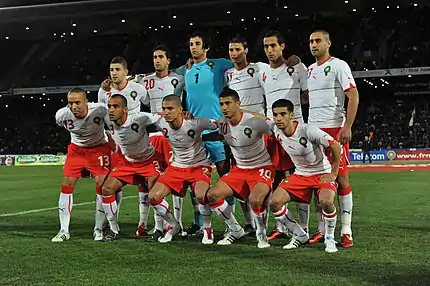
The Morocco national football team (French: Équipe du Maroc de football)(Arabic: منتخب المغرب لكرة القدم), nicknamed "the Atlas Lions", represents Morocco in men's international football competitions. It is controlled by the Royal Moroccan Football Federation, also known as FRMF. The team's colours are red and green. The team is a member of both FIFA and the Confederation of African Football (CAF).
Internationally, Morocco won the African Nations Cup in 1976 and have participated in the FIFA World Cup five times. Their best result came in 1986, when they were the first and the only African national team to finish top of a group at the FIFA World Cup. In that 1986 FIFA World Cup Group F, Morocco finished ahead of England, Portugal and Poland after holding both Poland and England to goalless draws, and beating Portugal 3–1. Thus they became the first African and first Arab national football team, and only the second national football teams from outside Europe and the Americas (after North Korea in 1966 World Cup), to reach the second round at the World Cup. In the subsequent round of 16 knockout, they narrowly lost to eventual runners-up West Germany 1–0.
The Atlas Lions were considered the best African national football team when they ranked 10th in the FIFA World Rankings in April 1998, as the first African national team in history to be ranked by FIFA in the top ten national football teams in the World. They are also the only African national team in history to have been at the top of the FIFA World Rankings for three consecutive years, by FIFA from 1997 to 1999.
History
Pre-independence period
The Moroccan national team was founded in 1928 and played its first game on 22 December of that year against the B team of France, to whom it lost 2–1. This team, formed by the best footballers of the LMFA or the Moroccan Football League (settlers or natives), was active in friendly matches against other North African teams such as those of Algeria and Tunisia. These associations of settler clubs and local footballers, in addition to having their own championship, clashed with each other in a tournament that Morocco won several times, such as in 1948–1949.
The LMFA also faced some club teams such as NK Lokomotiva Zagreb in January 1950, as well as France A and France B. Against France A the LMFA made a 1–1 draw in Casablanca in 1941.
On 9 September 1954, an earthquake struck the Algerian region of Orléansville (now Chlef) and caused the destruction of the city and the death of over 1,400 people. On 7 October 1954, the French Football Association and the Maghreb inhabitants organized a charity match to raise funds for the families of the victims of the catastrophic event. In the match, held at the Parc de Princes in Paris, a team made up of Moroccans, Algerians and Tunisians played against the national team of France. Led by star Larbi Benbarek, the Maghreb selection managed to win 3–2, a month before the Toussaint Rouge attacks by the Algerian National Liberation Front which marked the beginning of the Algerian War.
The beginnings of Morocco (1955–1963)
In 1955, the Royal Moroccan Football Federation was established, at the end of the French protectorate of Morocco, which had lasted since 1912.
On 19 October 1957, at the 2nd edition of the Pan Arab Games in Lebanon, Morocco made its debut as an independent country against Iraq, at the Camille Chamoun Sports City Stadium, and drew 3–3. At the tournament, Morocco took the first win in its history against Libya, winning 5–1, then beat Tunisia 3–1 to reach the semi-finals. After a 1–1 draw with Syria, lots were drawn to decide who would progress to the final, and Syria were selected at Morocco's expense. Morocco withdrew from the third-place play-off against Lebanon and finished fourth overall.
Between 1957 and 1958, Morocco held numerous friendly matches against the National Liberation Front team, the representative of Algeria before its independence in 1958. In 1959, the team took part for the first time in an international competition, the qualifying rounds of the 1960 Rome Olympics. Drawn into a group with Tunisia and Malta, Morocco finished second on goal difference and failed to progress. That same year, the football federation of Morocco joined FIFA.
In 1960, Morocco competed in World Cup qualification for the first time. Drawn against Tunisia in the first round, Morocco won the first leg 2–1, while Tunisia won the second leg 2–1. A play-off held in Palermo, Italy also finished in a tie, so a coin toss was used to determine who progressed. Morocco won the toss, and beat Ghana 1–0 on aggregate to reach the inter-continental play-offs. Drawn against Spain, Morocco lost 4–2 on aggregate and thus failed to qualify.
In 1961, Morocco held the Pan-Arab Games and won the football tournament, winning all five of their matches. Their third match, against Saudi Arabia, resulted in Morocco's biggest-ever victory, winning 13–1. They also claimed their first two wins against a European team, beating East Germany 2–1 and 2–0.
In 1963, the Moroccan team came close to qualifying for the African Cup of Nations. In the decisive play-off against Tunisia, they were defeated 4–1 in Tunis and won 4–2 at home, they were therefore eliminated. At the Mediterranean Games in Naples 1963, they finished fourth after a 2–1 defeat in the final for third place against Spain's reserve team.
First appearances in international competitions (1963–1976)
Morocco participated for the first time in the final phase of an international competition at the 1964 Tokyo Olympics. Having qualified under the leadership of manager Mohamed Massoun, the Moroccans were included in a group of three teams due to the renunciation of North Korea. Morocco lost both their matches, against Hungary (6–0, the team's worst-ever defeat) and Yugoslavia (3–1, despite taking the lead in the second minute via Ali Bouachra).
In 1966, the Moroccan Football Association joined the Confederation of African Football and was able to participate in the competitions organized by the CAF.
At the 1967 Mediterranean Games in Tunis, the Moroccans were eliminated in the first round, finishing fourth in a group containing Italy, France, and Algeria.
During qualifying for the 1968 Olympics, Morocco refused to play against Israel, and were eventually replaced by Ghana.
In the two-year period 1968–1969, the team was engaged in qualifying for the Mexican World Championship in 1970. Their debut was positive, they eliminated Senegal (1–0) and Tunisia after a draw, which at the time was necessary after three draws (of which last in Marseille, by 2–2). In the final round of the preliminaries, against Sudan and Nigeria, Morocco obtained five points, finishing ahead of Nigeria and qualifying for the first time for the final round of a world championship. Shortly after, Morocco lost the decisive play-off against Algeria to enter the final stage of the 1970 Africa Cup of Nations.
Morocco thus became the first African national team to qualify for a world championship after having played in an elimination tournament (at 1934 FIFA World Cup in Italy, Egypt was the first African national team to take part in the World Cup, but without having played the qualifications before). The Moroccan team, coached by the Yugoslav Blagoje Vidinić, consisted exclusively of players in the Moroccan league, including Driss Bamous and Ahmed Faras.
On 3 June 1970, against West Germany in front of 12,942 spectators, Morocco surprisingly opened the scoring with a goal in the twenty-first game of Houmane Jarir. In the second half, however, the West Germans scored with Uwe Seeler and Gerd Müller and won by 2–1. The Lions of the Atlas then played against Peru in front of 13,537 spectators. This time the Moroccans conceded three goals in ten minutes to lose 3–0. On 11 June 1970, the eliminated Moroccans drew with Bulgaria 1–1, with a comeback goal in the sixtieth game of Maouhoub Ghazouani. It was the first point obtained by an African national team at the World Cup.
In the 1972 Africa Cup of Nations qualification, the Lions of the Atlas ousted Algeria, then they faced Egypt, beating them 3–0 in the first leg and suffering a 3–2 defeat on the way back, yet they qualified for the first time for the final phase of the continental tournament. In the group stage, they had three 1–1 draws against Congo, Sudan and Zaire and were eliminated in the first round. All three Moroccan goals brought the signature of Ahmed Faras.
Qualifying for the 1972 Olympics with two wins and two draws, Morocco debuted in Group A with a white-neat draw 0–0 with the United States, then lost 3–0 against West Germany and defeated Malaysia 6–0 with an Ahmed Faras hat-trick, qualifying for the second round. Due to defeats against USSR (3–0), Denmark (3–1) and Poland (5–0), they were then eliminated.
In the 1974 world championship qualifiers, Morocco passed three CAF qualifying rounds, entering the final round with Zambia and Zaire. Badly beaten 4–0 at home by Zaire, who then won two consecutive matches against Zambia, the Moroccans went to Zaire for the return match and lost there 3–0, conceding three goals in the second half, after Faras leaving the field due to injury. Morocco filed an appeal, trying to get the match to play again, and did not appear at the final challenge against Zambia. Protesting against FIFA in protest, he also decided not to take part in the 1974 Africa Cup of Nations.
In 1974, Morocco played only two games, both against Algeria, achieving a 2–0 win and a 0–0 draw. After 1974, Morocco resumed its regular FIFA and CAF competitions. They managed to get the qualification for the 1976 Africa Cup of Nations by eliminating Ghana at the last round, but failed to qualify for the 1976 Olympics, as eliminated by Nigeria.
Between successes and defeats (1976–1986)
Morocco, coached by the Romanian Virgil Mărdărescu and captained by Ahmed Faras, took the continental throne, finishing in first place the final round of the 1976 African Cup of Nations, in his second participation in the final phase of the competition.
The final phase, in Ethiopia, foresaw a novelty, the first two classified of each of the two groups of four teams would have met in a final round from four teams, contending the title of Champion of Africa. The elimination rounds were cancelled, and replaced by a mini-championship. On 29 February 1976, the tournament started with the first matches of group A, but Morocco, entered in group B, started on 1 March 1976. Inserted in a group with Sudan, Zaire and Nigeria, Mărdărescu's team equalized 2–2 with Sudan (Mustapha Fetoui's Moroccan goals on the 5th and Ahmed Abouali on the 58th minute), then, thanks to Abdel Ali Zahraoui's goal on the eightieth minute of play, they beat Zaire. In the last game they won a comeback 3–1 against Nigeria (Nigerian goal on the 5th with a penalty and Moroccan trio with Ahmed Faras on the 8th, Abdallah Tazi on 19th and Larbi Chebbak on the 81st), obtaining so the first place in the group and qualifying for the final round (a group stage of four teams) together with the Nigerians, second in the standings in the group B. The final round put Morocco against Egypt. The Moroccans, had an advantage with a goal by Faras, suffered a draw, but took the lead two minutes before the end of the match again with Zahraoui and won 2–1. The next match against the Nigerians ended with a success, thanks to two goals from Ahmed Faras and Redouane Guezzar scored in the last eight minutes of play to overturn the provisional opponent advantage (2–1). The final match, against Guinea, would have decided the African Champion team. On 14 March 1976, in Addis Ababa, the Guineans, aimed to victory, took the lead in the first half, but four minutes to the end of the match Ahmed Makrouh scored the goal of the final draw (1–1), which gave to Morocco the first cup of its history.
Morocco then failed to qualify for the 1974 FIFA World Cup, the 1978 FIFA World Cup and the 1982 FIFA World Cup. At the 1978 Africa Cup of Nations, they were eliminated in the first round, while at the 1980 Africa Cup of Nations they won the third place, beating in the consolation final Egypt 2–0. They then won the 1983 Mediterranean Games, played at home, thanks to a 3–0 success in the final against Turkey B.
Morocco did not qualify for either the 1982 Africa Cup of Nations or that of 1984 Africa Cup of Nations. At the 1986 Africa Cup of Nations, they finished fourth, beaten 3–2 in the consolation final by the Ivory Coast (Moroccan goals by Abdelfettah Rhiati and Mohammed Sahil).
Golden Generation (1986–2000)
The subsequent participation in the 1986 FIFA World Cup which took place in Mexico. Morocco, coached by the Brazilian José Faria, had a valid team at their disposal, with Aziz Bouderbala, Salahdine Hmied, Merry Krimau and Mohamed Timoumi.
In Mexico, Morocco surprisingly won a group with Portugal, England and Poland, thanks to two draws against the English and Polish teams and a 3–1 win against the Portuguese (Abderrazak Khairi scored twice and goals from Abdelkrim Merry Krimau). However, they were narrowly eliminated by West Germany in the first knockout round, thanks to a goal from Lothar Matthäus one minute from the end of regulation time. Morocco became the first African and Arab national team to have passed the first round of a world championship.
Two years later, the Moroccan team presented itself at the 1988 African Cup of Nations as a host country with high expectations. After winning the first round, they were eliminated in the semifinals by Cameroon and finished in fourth place after losing the consolation final against Algeria (1–1 after extra time and 4–3 after the penalty shots).
Failure to qualify for the 1990 FIFA World Cup opened a period of crisis. In the 1992 African Cup of Nations, the team was eliminated in the first round. They did not participate, then, either in the 1994 Africa Cup or in the 1996 African Cup.
At the end of the millennium, the North African team took part in two consecutive world championships: in the United States in 1994 and in France in 1998. On both occasions they were eliminated in the first round, although in the second case it came close to qualifying.
In 1994, Morocco were knocked out after three defeats against Belgium (1–0), Saudi Arabia (2–1, Moroccan goal of Mohammed Chaouch) and Netherlands (2–1, Moroccan goal of Hassan Nader), while in 1998 they left in a controversial way. Having drawn in the first match with Norway 2–2 (goals from star Mustapha Hadji and Abdeljalil Hadda) and lost 3–0 against Brazil, Morocco coached by the French Henri Michel clearly beat (3–0) the Scotland (goal by Abdeljalil Hadda and two goals by Salaheddine Bassir) in Saint-Étienne, but by the time the qualifying seemed to have been achieved, they were overtaken in the standings by Norway, who was incredibly strong on Brazil (2–1) scoring the decisive goal in the last minutes of the game, thanks to a much discussed penalty.
At the 1998 Africa Cup of Nations, after winning their group, Morocco were defeated and eliminated from South Africa (2–1). They failed to qualify for the 2002 FIFA World Cup.
Difficult years (2006–2016)
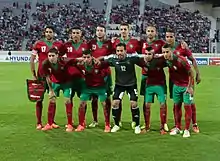
In 2012, the national team won the 2012 Arab Cup, a tournament reserved for Arab national teams with a team made up only of players playing in the Moroccan championship.
Ascent (2016–Present)
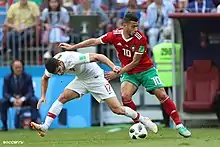
The national team won the championship of African nations in 2018, a tournament reserved for African national teams with a team formed only by players playing in the Moroccan championship. Back to participate in the final phase of a World Cup after 20 years, in 2018 FIFA World Cup, Morocco went out in the first round, after two 0–1 defeats against Iran and Portugal. In the last match against Spain they took the lead 2–1 but was unable to keep it, and drew 2–2, ultimately managed to eliminate Iran as well. Morocco entered the 2019 AFCON with high confidence, having played the previous World Cup. However, in spite of three straight group stage wins, Morocco was shockingly knocked out by less known Benin in the round of sixteen.
Home stadium
Morocco traditionally play their home games at Prince Moulay Abdellah Stadium in Rabat and the Stade Mohamed V in Casablanca as the main stadiums during their World Cup qualifiers, but they have recently used the new stadiums Stade de Marrakech in Marrakech, also the Stade Adrar in Agadir, Stade Ibn Batouta in Tangier and Fez Stadium in Fez.
Results and fixtures
The following is a list of match results in the last 12 months, as well as any future matches that have been scheduled.
2021
| 26 March 2021 AFCON Q | Mauritania  | 0–0 | Morocco | Nouakchott, Mauritania |
| 20:00 | Report | Stadium: Stade Cheikha Ould Boïdiya Referee: Joshua Bondo (Botswana) |
| 30 March 2021 AFCON Q | Morocco | 1–0 |  Burundi Burundi | Rabat, Morocco |
| 20:00 |
|
Report | Stadium: Prince Moulay Abdellah Stadium Referee: Blaise Yuven Ngwa (Cameroon) |

| 8 June Friendly | Morocco | 1–0 |  Ghana Ghana | Rabat, Morocco |
| 20:00 (UTC+1) |
|
Report | Stadium: Prince Moulay Abdellah Stadium Referee: Adalbert Diouf (Senegal) |
| 12 June Friendly | Morocco | 1–0 |  Burkina Faso Burkina Faso | Rabat, Morocco |
| 20:00 (UTC+1) |
|
Report | Stadium: Prince Moulay Abdellah Stadium Referee: Abdel Aziz Mohamed Bouh (Mauritania) |
| 2 September 2021 2022 WCQ | Morocco | 2–0 |  Sudan Sudan | Rabat, Morocco |
| 20:00 (UTC+1) | Report | Stadium: Prince Moulay Abdellah Stadium Attendance: 0 Referee: Maguette N'Diaye (Senegal) |
| 6 October 2021 2022 WCQ | Morocco | 5–0 |  Guinea-Bissau Guinea-Bissau | Rabat, Morocco |
| 21:00 (UTC+1) | Report | Stadium: Prince Moulay Abdellah Stadium Referee: Boubou Traoré (Mali) |
| 9 October 2021 2022 WCQ | Guinea-Bissau | 0–3 | Morocco | Casablanca, Morocco |
| 20:00 (UTC+1) | Report | Stadium: Stade Mohamed V Referee: Jean Jacques Ndala Ngambo (Democratic Republic of the Congo) |
| 12 October 2021 2022 WCQ | Guinea  | 1–4 | Morocco | Agadir, Morocco |
| 20:00 (UTC+1) |
|
Report | Stadium: Stade Adrar Referee: Sidi Alioum (Cameroon) | |
| Note: The match was originally scheduled on 6 September 2021, 16:00 UTC+0, but was postponed due to security concerns following the 2021 Guinean coup d'état. | ||||
| 12 November 2021 2022 WCQ | Sudan | 0–3 | Morocco | Rabat, Morocco |
| Report | Stadium: Prince Moulay Abdellah Stadium Referee: Peter Waweru (Kenya) |
| 16 November 2021 2022 WCQ | Morocco | 3–0 | Guinea | Rabat, Morocco |
| Report | Stadium: Stade Mohamed V Referee: Joshua Bondo (Botswana) |
| 1 December 2021 2021 FAC GS | Morocco | 4–0 |  Palestine Palestine | Al Wakrah, Qatar |
| 19:00 | Report | Stadium: Al Janoub Stadium Referee: Matthew Conger (New Zealand) |
| 4 December 2021 2021 FAC GS | Jordan  | 0–4 | Morocco | Al Rayyan, Qatar |
| 13:00 | Report | Stadium: Ahmed bin Ali Stadium Referee: Facundo Tello (Argentina) |
| 7 December 2021 2021 FAC GS | Morocco | 1–0 |  Saudi Arabia Saudi Arabia | Doha, Qatar |
| 18:00 |
|
Report | Stadium: Al Thumama Stadium Referee: Andrés Matonte (Uruguay) |


2022
| 10 January 2022 2021 AFCON | Morocco | v | Ghana | Yaoundé, Cameroon |
| Stadium: Stade Ahmadou Ahidjo |
| 14 January 2022 2021 AFCON | Morocco | v |  Comoros Comoros | Yaoundé, Cameroon |
| Stadium: Stade Ahmadou Ahidjo |
| 18 January 2022 2021 AFCON | Gabon  | v | Morocco | Yaoundé, Cameroon |
| Stadium: Stade Ahmadou Ahidjo |
| March 2022 World Cup qualification 1st Leg | TBD | v | Morocco | TBD |
| March 2022 World Cup qualification 2nd Leg | Morocco | v | TBD | TBD, Morocco |
Players
Current squad
The following players were called up for the 2022 FIFA World Cup qualification matches against Sudan and Guinea on 12 and 16 November 2021.[4]
Caps and goals are correct as of 16 November 2021, after the match against Guinea.
| No. | Pos. | Player | Date of birth (age) | Caps | Goals | Club |
|---|---|---|---|---|---|---|
| 1 | GK | Yassine Bounou | 5 April 1991 | 35 | 0 |  Sevilla Sevilla |
| 22 | GK | Anas Zniti | 28 October 1988 | 3 | 0 | Raja Casablanca |
| GK | Ahmed Reda Tagnaouti | 5 April 1996 | 3 | 0 | Wydad Casablanca | |
| 2 | DF | Achraf Hakimi | 4 November 1998 | 41 | 5 |  Paris Saint-Germain Paris Saint-Germain |
| 3 | DF | Adam Masina | 2 January 1994 | 7 | 0 |  Watford Watford |
| 5 | DF | Nayef Aguerd | 30 March 1996 | 12 | 1 | Rennes |
| 6 | DF | Romain Saïss (captain) | 26 March 1990 | 54 | 1 | Wolverhampton Wanderers |
| 18 | DF | Sofian Chakla | 2 September 1993 | 3 | 0 | .svg.png.webp) OH Leuven OH Leuven |
| 21 | DF | Souffian El Karouani | 19 October 2000 | 3 | 0 |  NEC NEC |
| DF | Jawad El Yamiq | 29 February 1992 | 10 | 2 | Valladolid | |
| DF | Sofiane Alakouch | 29 July 1998 | 2 | 0 | Metz | |
| 7 | MF | Imran Louza | 1 May 1999 | 5 | 2 | Watford |
| 11 | MF | Fayçal Fajr | 1 August 1988 | 44 | 3 |  Sivasspor Sivasspor |
| 13 | MF | Ilias Chair | 30 October 1997 | 7 | 1 | Queens Park Rangers |
| 16 | MF | Aymen Barkok | 21 May 1998 | 14 | 1 |  Eintracht Frankfurt Eintracht Frankfurt |
| 20 | MF | Sofyan Amrabat | 21 August 1996 | 27 | 0 |  Fiorentina Fiorentina |
| MF | Youssef Maleh | 28 August 1998 | 0 | 0 | Fiorentina | |
| 8 | FW | Ayoub El Kaabi | 25 June 1993 | 15 | 7 | Hatayspor |
| 9 | FW | Sofiane Boufal | 17 September 1993 | 22 | 1 | Angers |
| 10 | FW | Munir El Haddadi | 1 September 1995 | 8 | 2 | Sevilla |
| 17 | FW | Achraf Bencharki | 24 September 1994 | 11 | 0 |  Zamalek Zamalek |
| 19 | FW | Youssef En-Nesyri | 1 June 1997 | 40 | 11 | Sevilla |
| 23 | FW | Ryan Mmaee | 1 November 1997 | 7 | 4 | Ferencvárosi |
Recent call-ups
The following players have been called up for the team in the last 12 months.
| Pos. | Player | Date of birth (age) | Caps | Goals | Club | Latest call-up |
|---|---|---|---|---|---|---|
| GK | Munir Mohamedi | 10 May 1989 | 41 | 0 | Hatayspor |
v. Guinea, 12 October 2021 |
| GK | Sami Tlemcani | 21 February 2004 | 0 | 0 | Chelsea |
v. Guinea, 12 October 2021 |
| DF | Samy Mmaee | 8 September 1996 | 5 | 0 | Ferencváros |
v. Guinea, 12 October 2021 |
| DF | Ayoub El Amloud | 8 April 1994 | 1 | 0 | Wydad Casablanca |
v. Guinea, 12 October 2021 |
| DF | Achraf Lazaar | 22 January 1992 | 12 | 0 |  Portimonense Portimonense |
v. Burkina Faso, 12 June 2021 |
| DF | Zouhair Feddal | 23 December 1989 | 21 | 1 | Sporting CP |
v. Burundi, 30 March 2021 |
| DF | Issam Chebake | 12 October 1989 | 7 | 0 |  APOEL APOEL |
v. Burundi, 30 March 2021 |
| DF | Nabil Dirar | 25 February 1986 | 42 | 3 | Fenerbahçe |
v. Mauritania, 26 March 2021 WD |
| MF | Selim Amallah | 15 November 1996 | 12 | 3 | Standard Liège |
v. Guinea, 12 October 2021 |
| MF | Abdou Harroui | 13 January 1998 | 0 | 0 | Sassuolo |
v. Guinea, 12 October 2021 |
| MF | Adel Taarabt | 24 May 1989 | 29 | 4 | Benfica |
v. Sudan, 2 September 2021 |
| MF | Yahya Jabrane | 18 June 1991 | 3 | 0 | Wydad Casablanca |
v. Burkina Faso, 12 June 2021 |
| MF | Oussama Tannane | 23 March 1994 | 11 | 2 | Vitesse |
v. Burundi, 30 March 2021 |
| FW | Zakaria Aboukhlal | 18 February 2000 | 5 | 1 | AZ |
v. Guinea, 12 October 2021 |
| FW | Soufiane Rahimi | 23 March 1996 | 2 | 0 |  Al-Ain Al-Ain |
v. Guinea, 12 October 2021 |
| FW | Hakim Ziyech | 19 March 1993 | 41 | 17 | Chelsea |
v. Burkina Faso, 12 June 2021 |
| FW | Youssef El-Arabi | 3 February 1987 | 47 | 16 |  Olympiacos Olympiacos |
v. Burundi, 30 March 2021 |
DEC Player declined the call-up to the squad | ||||||
Previous squads
|
|
|
Player records
- As of 30 March 2021[5]
- Players in bold are still active with Morocco.
Most capped players
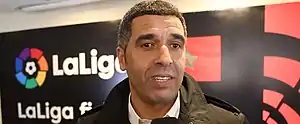
| Rank | Player | Caps | Goals | Career |
|---|---|---|---|---|
| 1 | Noureddine Naybet | 115 | 4 | 1990–2006 |
| 2 | Ahmed Faras | 94 | 36 | 1966–1979 |
| 3 | Youssef Safri | 79 | 8 | 1999–2009 |
| 4 | Houssine Kharja | 78 | 12 | 2004–2015 |
| Ezzaki Badou | 78 | 0 | 1979–1992 | |
| 6 | Abdelmajid Dolmy | 76 | 2 | 1973–1988 |
| 7 | Youssef Chippo | 73 | 9 | 1996–2006 |
| Mohamed Hazzaz | 73 | 0 | 1969–1979 | |
| 9 | Abdelkrim El Hadrioui | 72 | 4 | 1992–2001 |
| 10 | Mbark Boussoufa | 70 | 8 | 2006–2019 |
Top goalscorers
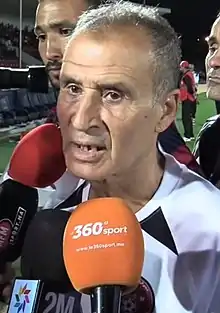
| Rank | Player | Goals | Caps | Average | Career |
|---|---|---|---|---|---|
| 1 | Ahmed Faras | 36 | 94 | 0.38 | 1966–1979 |
| 2 | Salaheddine Bassir | 27 | 59 | 0.46 | 1994–2002 |
| 3 | Abdeljalil Hadda | 19 | 48 | 0.4 | 1995–2002 |
| 4 | Hassan Amcharrat | 18 | 39 | 0.46 | 1971–1979 |
| Marouane Chamakh | 18 | 65 | 0.28 | 2003–2014 | |
| 6 | Abdeslam Laghrissi | 17 | 35 | 0.49 | 1984–1995 |
| Hakim Ziyech | 17 | 41 | 0.41 | 2015–present | |
| 8 | Youssef El-Arabi | 16 | 47 | 0.36 | 2010–present |
| Youssouf Hadji | 16 | 64 | 0.25 | 2003–2012 | |
| 10 | Aziz Bouderbala | 14 | 57 | 0.25 | 1979–1992 |
Coaching staff
| Position | Name |
|---|---|
| Head coach |  Vahid Halilhodžić[6] Vahid Halilhodžić[6] |
| Assistant coach | Mustapha Hadji |
| Stéphane Gilli | |
| Goalkeeping coach | Mustapha Chadili |
| Laurent Weber | |
| Fitness coach | Salaheddine Lahlou |
| Christophe Manouvrier | |
| Video Analyst | Moussa El Habchi |
| Technical director | Badou Ezzaki |
Coaches
Source:[7]
| Managers | |||||
|---|---|---|---|---|---|
| Name | Nationality | Years as manager | Trophy won | World Cup | Africa Cup |
| Larbi Ben Barek | |
1957 | - | - | - |
| Mohammed Khamirib & Abdelkader Lokhmiri | |
1959 | - | - | - |
| Larbi Ben Barek | |
1960 | - | - | - |
| Kader Firoud |  |
1961 | - | - | - |
| Mohammed Massoun & Abderrahmane Mahjoub | |
1961–1967 | - | - | - |
| Guy Cluzeau & Abdellah Settati | & |
1968–1969 | - | - | - |
| Blagoja Vidinić | .svg.png.webp) |
1970 | - | 1970 (GS) | - |
| José Barinaga | |
1971–1972 | - | - | 1972 (GS) |
| Abderrahmane Mahjoub | |
1972–1973 | - | - | - |
| Virgil Mărdărescu |  |
1974–1978 | 1976 African Cup of Nations | - | 1976 (W) - 1978 (GS) |
| Guy Cluzeau | |
1979 | - | - | - |
| Just Fontaine | |
1979–1980 | - | - | - |
| Jebrane & Yabram Hamidouch | |
1980–1981 | - | - | 1980 (3RD) |
| Abdellah El-Ammari | |
1982 | - | - | - |
| Jaime Valente |  |
1983 | - | - | - |
| Mehdi Faria | |
1983–1988 | - | 1986 (R16) | 1986 (4TH) - 1988 (4TH) |
| Jaime Valente | |
1988–1989 | - | - | - |
| Antonio Valentín |  |
1989–1990 | - | - | - |
| Abdellah Ajri Blinda | |
1990 | - | - | - |
| Werner Olk | |
1990–1992 | - | - | 1992 (GS) |
| Abdellah Ajri Blinda | |
1993–1994 | - | 1994 (GN) | - |
| Mohammed Lamari | |
1994 | - | - | - |
| Gílson Nunes | |
1995 | - | - | - |
| Henri Michel | |
1995–2000 | - | 1998 (GS) | 1998 (QF) - 2000 (GS) |
| Henryk Kasperczak |  |
2000 | - | - | - |
| Humberto Coelho | |
2000–2002 | - | - | 2002 (GS) |
| Badou Ezzaki | |
2002–2005 | - | - | 2004 (F) |
| Philippe Troussier | |
2005 | - | - | - |
| Mohamed Fakhir | |
2006–2007 | - | - | 2006 (GS) |
| Henri Michel | |
2007–2008 | - | - | 2008 (GS) |
| Fathi Jamal | |
2008 | - | - | - |
| Roger Lemerre | |
2008–2009 | - | - | - |
| Hassan Moumen (caretaker) | |
2009–2010 | - | - | - |
| Eric Gerets | |
2010–2012 | - | - | 2012 (GS) |
| Rachid Taoussi | |
2012–2013 | - | - | 2013 (GS) |
| Hassan Benabicha (caretaker) | |
2013–2014 | - | - | - |
| Badou Ezzaki[8] | |
2014–2015 | - | - | - |
| Hervé Renard[9] | |
2016–2019 | - | 2018 (GS) | 2017 (QF) - 2019 (R16) |
| Vahid Halilhodžić[6] | |
2019–Present | - | - | - |
Kit suppliers
| Kit provider | Period |
|---|---|
| Adidas |
1982–1993 |
| Lotto |
1994–1995 |
| Umbro |
1995 |
| Lotto |
1995–1997 |
| Puma |
1998–2002 |
 Nike Nike |
2003–2006 |
| Puma |
2007–2011 |
| Adidas |
2012–2019 |
| Puma |
2019– |
Head-to-head performance
Correct as 04 December 2021.
| Team | Confederation | GP | W | D | L | GF | GA | GD | Win% | Loss% |
|---|---|---|---|---|---|---|---|---|---|---|
 Albania Albania | UEFA | 1 | 0 | 1 | 0 | 0 | 0 | 0 | 0% | 0% |
| Algeria | CAF | 36 | 17 | 12 | 7 | 48 | 26 | +22 | 47.22% | 19.44% |
 Angola Angola | CAF | 7 | 4 | 2 | 1 | 11 | 7 | +4 | 57.14% | 14.29% |
| Argentina | CONMEBOL | 3 | 0 | 0 | 3 | 1 | 5 | –4 | 0% | 100% |
 Armenia Armenia | UEFA | 1 | 1 | 0 | 0 | 6 | 0 | +6 | 100% | 0% |
.svg.png.webp) Australia Australia | AFC | 1 | 0 | 0 | 1 | 0 | 1 | –1 | 0% | 100% |
 Austria Austria | UEFA | 1 | 1 | 0 | 0 | 3 | 1 | +2 | 100% | 0% |
 Bahrain Bahrain | AFC | 2 | 2 | 0 | 0 | 5 | 0 | +5 | 100% | 0% |
| Belgium | UEFA | 3 | 1 | 0 | 2 | 4 | 6 | –2 | 33.33% | 66.67% |
 Benin Benin | CAF | 6 | 5 | 1 | 0 | 20 | 3 | +17 | 83.33% | 0% |
 Botswana Botswana | CAF | 2 | 2 | 0 | 0 | 2 | 0 | +2 | 100% | 0% |
| Brazil | CONMEBOL | 2 | 0 | 0 | 2 | 0 | 5 | –5 | 0% | 100% |
 Bulgaria Bulgaria | UEFA | 6 | 2 | 3 | 1 | 10 | 5 | +5 | 33.33% | 16.67% |
| Burkina Faso | CAF | 11 | 7 | 2 | 2 | 16 | 6 | +10 | 63.64% | 18.18% |
| Burundi | CAF | 2 | 2 | 0 | 0 | 4 | 0 | +4 | 100% | 0% |
 Cameroon Cameroon | CAF | 13 | 2 | 5 | 6 | 10 | 12 | –2 | 15.38% | 46.15% |
.svg.png.webp) Canada Canada | CONCACAF | 4 | 2 | 1 | 1 | 9 | 7 | +2 | 50% | 25% |
 Cape Verde Cape Verde | CAF | 3 | 2 | 1 | 0 | 4 | 1 | +3 | 66.67% | 0% |
 Central African Republic Central African Republic | CAF | 5 | 3 | 2 | 0 | 10 | 1 | +9 | 60% | 0% |
 Chile Chile | CONMEBOL | 1 | 0 | 1 | 0 | 1 | 1 | 0 | 0% | 0% |
 China PR China PR | AFC | 1 | 0 | 1 | 0 | 3 | 3 | 0 | 0% | 0% |
 Colombia Colombia | CONMEBOL | 1 | 0 | 0 | 1 | 0 | 2 | –2 | 0% | 100% |
| Comoros | CAF | 2 | 1 | 1 | 0 | 3 | 2 | +1 | 50% | 0% |
 Congo Congo | CAF | 5 | 3 | 2 | 0 | 6 | 2 | +4 | 60% | 0% |
 Croatia Croatia | UEFA | 1 | 0 | 1 | 0 | 2 | 2 | 0 | 0% | 0% |
 Czech Republic Czech Republic | UEFA | 1 | 0 | 1 | 0 | 0 | 0 | 0 | 0% | 0% |
 Denmark Denmark | UEFA | 1 | 1 | 0 | 0 | 4 | 2 | +2 | 100% | 0% |
 DR Congo DR Congo | CAF | 3 | 1 | 1 | 1 | 4 | 2 | +2 | 33.33% | 33.33% |
| Egypt | CAF | 29 | 14 | 12 | 3 | 34 | 16 | 18 | 48.28% | 10.34% |
| England | UEFA | 2 | 0 | 1 | 1 | 0 | 1 | –1 | 0% | 50% |
 Equatorial Guinea Equatorial Guinea | CAF | 5 | 4 | 0 | 1 | 10 | 2 | +2 | 80% | 20% |
 Estonia Estonia | UEFA | 1 | 1 | 0 | 0 | 3 | 1 | +2 | 100% | 0% |
 Ethiopia Ethiopia | CAF | 5 | 5 | 0 | 0 | 14 | 0 | +14 | 100% | 0% |
 Finland Finland | UEFA | 2 | 0 | 1 | 1 | 0 | 1 | –1 | 0% | 50% |
| France | UEFA | 8 | 0 | 3 | 5 | 7 | 15 | –8 | 0% | 62.5% |
| Gabon | CAF | 18 | 9 | 3 | 6 | 36 | 18 | +18 | 50% | 33.33% |
 Gambia Gambia | CAF | 8 | 6 | 1 | 1 | 14 | 2 | +12 | 75% | 12.5% |
| Germany* | UEFA | 4 | 0 | 0 | 4 | 3 | 12 | –9 | 0% | 100% |
| Ghana | CAF | 10 | 4 | 3 | 3 | 7 | 8 | –1 | 40% | 30% |
| Greece | UEFA | 1 | 0 | 1 | 0 | 0 | 0 | 0 | 0% | 0% |
| Guinea | CAF | 14 | 6 | 6 | 2 | 19 | 12 | +7 | 42.86% | 14.29% |
 Hong Kong Hong Kong | AFC | 1 | 0 | 1 | 0 | 0 | 0 | 0 | 0% | 0% |
| Hungary | UEFA | 3 | 0 | 0 | 3 | 3 | 7 | –4 | 0% | 100% |
 India India | AFC | 1 | 1 | 0 | 0 | 1 | 0 | +1 | 100% | 0% |
 Indonesia Indonesia | AFC | 1 | 1 | 0 | 0 | 2 | 0 | +2 | 100% | 0% |
 Iran Iran | AFC | 1 | 0 | 0 | 1 | 0 | 1 | –1 | 0% | 100% |
 Iraq Iraq | AFC | 10 | 3 | 4 | 3 | 6 | 10 | –4 | 30% | 30% |
| Italy | UEFA | 1 | 0 | 0 | 1 | 0 | 1 | –1 | 0% | 100% |
 Ivory Coast Ivory Coast | CAF | 21 | 7 | 7 | 7 | 27 | 25 | +2 | 33.33% | 33.33% |
 Jamaica Jamaica | CONCACAF | 1 | 1 | 0 | 0 | 1 | 0 | +1 | 100% | 0% |
| Jordan | AFC | 4 | 4 | 0 | 0 | 12 | 2 | +10 | 100% | 0% |
 Kenya Kenya | CAF | 5 | 3 | 2 | 0 | 10 | 2 | +8 | 60% | 0% |
 Kuwait Kuwait | AFC | 6 | 3 | 2 | 1 | 14 | 9 | +5 | 50% | 16.67% |
 Lebanon Lebanon | AFC | 3 | 2 | 0 | 1 | 5 | 2 | +3 | 66.67% | 33.33% |
 Liberia Liberia | CAF | 3 | 2 | 0 | 1 | 9 | 3 | +6 | 66.67% | 33.33% |
 Libya Libya | CAF | 20 | 10 | 6 | 4 | 34 | 18 | +16 | 50% | 20% |
 Luxembourg Luxembourg | UEFA | 3 | 3 | 0 | 0 | 6 | 1 | +5 | 100% | 0% |
 Malawi Malawi | CAF | 10 | 6 | 3 | 1 | 15 | 3 | +12 | 60% | 10% |
 Malaysia Malaysia | AFC | 3 | 1 | 1 | 1 | 4 | 5 | –1 | 33.33% | 33.33% |
 Mali Mali | CAF | 20 | 9 | 6 | 5 | 33 | 12 | +21 | 45% | 25% |
 Malta Malta | UEFA | 1 | 1 | 0 | 0 | 3 | 1 | +2 | 100% | 0% |
| Mauritania | CAF | 10 | 7 | 3 | 0 | 27 | 5 | +22 | 70% | 0% |
 Mexico Mexico | CONCACAF | 1 | 1 | 0 | 0 | 2 | 1 | +1 | 100% | 0% |
 Mozambique Mozambique | CAF | 4 | 3 | 0 | 1 | 11 | 2 | +9 | 75% | 25% |
 Myanmar Myanmar | AFC | 1 | 0 | 1 | 0 | 2 | 2 | 0 | 0% | 0% |
 Namibia Namibia | CAF | 7 | 6 | 1 | 0 | 15 | 2 | +13 | 85.71% | 0% |
| Netherlands | UEFA | 3 | 1 | 0 | 2 | 4 | 5 | –1 | 33.33% | 66.67% |
 New Zealand New Zealand | OFC | 2 | 2 | 0 | 0 | 6 | 0 | +6 | 100% | 0% |
 Niger Niger | CAF | 7 | 6 | 0 | 1 | 16 | 2 | +14 | 85.71% | 14.29% |
 Nigeria Nigeria | CAF | 11 | 6 | 2 | 3 | 14 | 8 | +6 | 54.55% | 27.27% |
.svg.png.webp) Northern Ireland Northern Ireland | UEFA | 2 | 0 | 1 | 1 | 2 | 3 | –1 | 0% | 50% |
 Norway Norway | UEFA | 1 | 0 | 1 | 0 | 2 | 2 | 0 | 0% | 0% |
 Oman Oman | AFC | 1 | 0 | 1 | 0 | 0 | 0 | 0 | 0% | 0% |
| Palestine | AFC | 2 | 2 | 0 | 0 | 7 | 1 | +5 | 100% | 0% |
.svg.png.webp) Peru Peru | CONMEBOL | 1 | 0 | 0 | 1 | 0 | 3 | –3 | 0% | 100% |
| Poland | UEFA | 5 | 1 | 2 | 2 | 3 | 9 | –6 | 20% | 40% |
| Portugal | UEFA | 2 | 1 | 0 | 1 | 3 | 2 | +1 | 50% | 50% |
 Qatar Qatar | AFC | 2 | 1 | 1 | 0 | 1 | 0 | +1 | 50% | 0% |
 Republic of Ireland Republic of Ireland | UEFA | 1 | 0 | 0 | 1 | 0 | 1 | –1 | 0% | 100% |
| Romania | UEFA | 2 | 1 | 0 | 1 | 3 | 5 | –2 | 50% | 50% |
 Russia** Russia** | UEFA | 4 | 0 | 1 | 3 | 3 | 7 | –4 | 0% | 75% |
 Rwanda Rwanda | CAF | 4 | 2 | 1 | 1 | 7 | 4 | +3 | 50% | 25% |
 São Tomé and Príncipe São Tomé and Príncipe | CAF | 2 | 2 | 0 | 0 | 5 | 0 | +5 | 100% | 0% |
| Saudi Arabia | AFC | 6 | 1 | 2 | 3 | 15 | 7 | +8 | 16.67% | 50% |
 Scotland Scotland | UEFA | 1 | 1 | 0 | 0 | 3 | 0 | +3 | 100% | 0% |
 Senegal Senegal | CAF | 30 | 17 | 6 | 7 | 41 | 18 | +23 | 56.67% | 23.33% |
 Serbia*** Serbia*** | UEFA | 6 | 1 | 1 | 4 | 5 | 12 | –7 | 16.67% | 66.67% |
 Sierra Leone Sierra Leone | CAF | 7 | 6 | 1 | 0 | 14 | 0 | +14 | 85.71% | 0% |
 Singapore Singapore | AFC | 1 | 1 | 0 | 0 | 1 | 0 | +1 | 100% | 0% |
 Slovakia Slovakia | UEFA | 2 | 2 | 0 | 0 | 4 | 2 | 0 | 100% | 0% |
 Somalia Somalia | CAF | 1 | 1 | 0 | 0 | 3 | 0 | +3 | 100% | 0% |
 South Africa South Africa | CAF | 7 | 1 | 3 | 3 | 6 | 9 | –3 | 14.29% | 42.86% |
 South Korea South Korea | AFC | 6 | 1 | 4 | 1 | 10 | 9 | +1 | 16.67% | 16.67% |
| Spain | UEFA | 4 | 0 | 1 | 3 | 5 | 8 | –3 | 0% | 75% |
| Sudan | CAF | 7 | 3 | 4 | 0 | 9 | 3 | 0 | 42.86% | 0% |
 Switzerland Switzerland | UEFA | 4 | 3 | 0 | 1 | 7 | 10 | –3 | 75% | 25% |
 Syria Syria | AFC | 3 | 3 | 0 | 0 | 6 | 0 | +6 | 100% | 0% |
 Tanzania Tanzania | CAF | 4 | 3 | 0 | 1 | 7 | 5 | +2 | 75% | 25% |
 Thailand Thailand | AFC | 1 | 1 | 0 | 0 | 2 | 1 | +1 | 100% | 0% |
 Togo Togo | CAF | 12 | 6 | 3 | 3 | 22 | 11 | +11 | 50% | 25% |
 Trinidad and Tobago Trinidad and Tobago | CONCACAF | 3 | 3 | 0 | 0 | 4 | 0 | +4 | 100% | 0% |
 Tunisia Tunisia | CAF | 50 | 13 | 28 | 9 | 53 | 46 | +7 | 26% | 18% |
 Uganda Uganda | CAF | 3 | 1 | 0 | 2 | 5 | 6 | –1 | 33.33% | 66.67% |
 Ukraine Ukraine | UEFA | 1 | 0 | 1 | 0 | 0 | 0 | 0 | 0% | 0% |
| United Arab Emirates | AFC | 4 | 0 | 3 | 1 | 3 | 4 | –1 | 0% | 25% |
 Uruguay Uruguay | CONMEBOL | 2 | 0 | 0 | 2 | 0 | 2 | –2 | 0% | 100% |
| United States | CONCACAF | 3 | 3 | 0 | 0 | 6 | 2 | +2 | 100% | 0% |
 Uzbekistan Uzbekistan | AFC | 1 | 1 | 0 | 0 | 2 | 0 | +2 | 100% | 0% |
 Yemen Yemen | AFC | 1 | 1 | 0 | 0 | 4 | 0 | +4 | 100% | 0% |
 Zambia Zambia | CAF | 18 | 10 | 2 | 6 | 23 | 18 | +5 | 55.56% | 33.33% |
 Zimbabwe Zimbabwe | CAF | 4 | 3 | 1 | 0 | 6 | 2 | +4 | 75% | 0% |
(*) includes West Germany
(**) includes  Soviet Union
(***) includes Yugoslavia
Competitive record
FIFA World Cup
Morocco's national football team has participated five times in the FIFA World Cup. Their best performance was the 1986 edition when they advanced to the second round, being the first African nation to do so. In 1998, the team narrowly missed repeating the same achievement.
| FIFA World Cup record | FIFA World Cup qualification record | |||||||||||||||
|---|---|---|---|---|---|---|---|---|---|---|---|---|---|---|---|---|
| Year | Round | Position | Pld | W | D | L | GF | GA | Pld | W | D | L | GF | GA | ||
| 1930 | Part of France |
Part of France | ||||||||||||||
.svg.png.webp) 1934 1934 | ||||||||||||||||
| 1938 | ||||||||||||||||
.svg.png.webp) 1950 1950 | ||||||||||||||||
| 1954 | ||||||||||||||||
 1958 1958 | Did not enter | Did not enter | ||||||||||||||
| 1962 |
Did not qualify | 7 | 2 | 2 | 3 | 7 | 8 | |||||||||
| 1966 |
Withdrew | Withdrew | ||||||||||||||
| 1970 |
Group stage | 14th | 3 | 0 | 1 | 2 | 2 | 6 | 10 | 4 | 4 | 2 | 11 | 7 | ||
| 1974 | Did not qualify | 10 | 4 | 3 | 3 | 12 | 13 | |||||||||
| 1978 |
2 | 0 | 2 | 0 | 2 | 2 | ||||||||||
| 1982 |
8 | 3 | 2 | 3 | 5 | 6 | ||||||||||
| 1986 |
Round of 16 | 11th | 4 | 1 | 2 | 1 | 3 | 2 | 8 | 5 | 2 | 1 | 12 | 1 | ||
| 1990 |
Did not qualify | 6 | 1 | 3 | 2 | 4 | 5 | |||||||||
| 1994 |
Group stage | 23rd | 3 | 0 | 0 | 3 | 2 | 5 | 10 | 7 | 2 | 1 | 19 | 4 | ||
| 1998 |
18th | 3 | 1 | 1 | 1 | 5 | 5 | 6 | 5 | 1 | 0 | 14 | 2 | |||
.svg.png.webp)  2002 2002 | Did not qualify | 10 | 6 | 3 | 1 | 11 | 3 | |||||||||
| 2006 |
10 | 5 | 5 | 0 | 17 | 7 | ||||||||||
| 2010 |
10 | 3 | 3 | 4 | 14 | 13 | ||||||||||
| 2014 |
6 | 2 | 3 | 1 | 9 | 8 | ||||||||||
| 2018 |
Group stage | 27th | 3 | 0 | 1 | 2 | 2 | 4 | 8 | 4 | 3 | 1 | 13 | 1 | ||
| 2022 | To be determined | |||||||||||||||
| 2026 |
||||||||||||||||
| Total | Round of 16 | 5/21 | 16 | 2 | 5 | 9 | 14 | 22 | 116 | 53 | 41 | 22 | 159 | 80 | ||
Africa Cup of Nations
| Africa Cup of Nations record | Africa Cup of Nations qualification record | |||||||||||||||
|---|---|---|---|---|---|---|---|---|---|---|---|---|---|---|---|---|
| Year | Round | Position | Pld | W | D | L | GF | GA | Pld | W | D | L | GF | GA | ||
.svg.png.webp) 1957 1957 | Not affiliated to CAF | Not affiliated to CAF | ||||||||||||||
.svg.png.webp) 1959 1959 | ||||||||||||||||
.svg.png.webp) 1962 1962 | Withdrew | Withdrew | ||||||||||||||
| 1963 | Did not qualify | 2 | 1 | 0 | 1 | 5 | 6 | |||||||||
| 1965 | Did not enter | Did not enter | ||||||||||||||
| 1968 | ||||||||||||||||
| 1970 | Did not qualify | 2 | 1 | 0 | 1 | 1 | 2 | |||||||||
.svg.png.webp) 1972 1972 | Group stage | 5th | 3 | 0 | 3 | 0 | 3 | 3 | 4 | 2 | 0 | 2 | 9 | 6 | ||
.svg.png.webp) 1974 1974 | Did not enter | Did not enter | ||||||||||||||
.svg.png.webp) 1976 1976 | Champions | 1st | 6 | 4 | 2 | 0 | 11 | 6 | 6 | 4 | 0 | 2 | 13 | 4 | ||
| 1978 | Group stage | 6th | 3 | 1 | 1 | 1 | 2 | 4 | Qualified as defending champions | |||||||
| 1980 | Third Place | 3rd | 5 | 2 | 1 | 2 | 4 | 3 | 4 | 2 | 1 | 1 | 14 | 5 | ||
.svg.png.webp) 1982 1982 | Did not qualify | 4 | 3 | 0 | 1 | 8 | 4 | |||||||||
| 1984 |
4 | 1 | 2 | 1 | 4 | 2 | ||||||||||
| 1986 | Fourth Place | 4th | 5 | 1 | 2 | 2 | 4 | 5 | 2 | 1 | 1 | 0 | 1 | 0 | ||
| 1988 | Fourth Place | 4th | 5 | 1 | 3 | 1 | 3 | 3 | Qualified as hosts | |||||||
| 1990 | Did not qualify | 2 | 0 | 2 | 0 | 1 | 1 | |||||||||
| 1992 | Group stage | 9th | 2 | 0 | 1 | 1 | 1 | 2 | 6 | 4 | 0 | 2 | 11 | 4 | ||
| 1994 | Did not qualify | 6 | 2 | 2 | 2 | 5 | 4 | |||||||||
| 1996 |
4 | 1 | 1 | 2 | 2 | 4 | ||||||||||
| 1998 | Quarter-finals | 6th | 4 | 2 | 1 | 1 | 6 | 3 | 6 | 4 | 2 | 0 | 10 | 1 | ||
| 2000 |
Group stage | 11th | 3 | 1 | 1 | 1 | 1 | 2 | 4 | 2 | 2 | 0 | 6 | 4 | ||
| 2002 |
9th | 3 | 1 | 1 | 1 | 3 | 4 | 6 | 3 | 1 | 2 | 5 | 4 | |||
| 2004 | Runners-up | 2nd | 6 | 4 | 1 | 1 | 14 | 4 | 6 | 5 | 1 | 0 | 10 | 0 | ||
| 2006 |
Group stage | 13th | 3 | 0 | 2 | 1 | 0 | 1 | 10 | 5 | 5 | 0 | 17 | 7 | ||
| 2008 |
11th | 3 | 1 | 0 | 2 | 7 | 6 | 4 | 3 | 1 | 0 | 6 | 1 | |||
| 2010 | Did not qualify | 10 | 3 | 3 | 4 | 14 | 13 | |||||||||
| 2012 |
Group stage | 12th | 3 | 1 | 0 | 2 | 4 | 5 | 6 | 3 | 2 | 1 | 8 | 2 | ||
| 2013 |
10th | 3 | 0 | 3 | 0 | 3 | 3 | 2 | 1 | 0 | 1 | 4 | 2 | |||
| 2015 | Disqualified | Originally qualified as hosts, then disqualified | ||||||||||||||
| 2017 | Quarter-finals | 7th | 4 | 2 | 0 | 2 | 4 | 3 | 6 | 5 | 1 | 0 | 10 | 1 | ||
| 2019 | Round of 16 | 9th | 4 | 3 | 1 | 0 | 4 | 1 | 6 | 3 | 2 | 1 | 8 | 3 | ||
| 2021 |
Qualified | 6 | 4 | 2 | 0 | 10 | 1 | |||||||||
| 2023 |
To be determined | To be determined | ||||||||||||||
| 2025 | ||||||||||||||||
| Total | 1 Title | 18/33 | 65 | 24 | 23 | 18 | 74 | 58 | 118 | 63 | 31 | 24 | 182 | 81 | ||
African Nations Championship
Mediterranean Games1951 to 1987 senior teams, from 1991 youth teams.
| ||||||||||||||||||||||||||||||||||||||||||||||||||||||||||||||||||||||||||||||||||||||||||||||||||||||||||||||||||||||||||||||||||||||||||||||||||||||||||||||||||||||||||||||||||||||||||||||||||||||||||||||||||||||||||||||||||||||||||||||||||||||||||||||||||||||||||||||||||||||||||||||||||||||||||||||||||||||||||||||||||||||||||||||||||||||||||||||||||||||||||||||||||||||||||||||||||||||||||||||||||||||||||||||||||||||||||||||||||||||||||||||||||||||||||||||||||||||||||
.svg.png.webp)
.svg.png.webp)
.svg.png.webp)
.svg.png.webp)
Pan Arab Games
|
FIFA Arab Cup
|
| |||||||||||||||||||||||||||||||||||||||||||||||||||||||||||||||||||||||||||||||||||||||||||||||||||||||||||||||||||||||||||||||||||||||||||||||||||||||||||||||||||||||||||||||||||||||||||||||||||||
.svg.png.webp)
.svg.png.webp)
Minor tournaments
Honours
International competitions
|
Friendly Tournaments
|
Friendly competitions
|


Awards
African National Team of the Year
 First place : 1985, 1986, 1997
 Second place : 1993, 1998, 2003, 2004
 Third place : 1980
- 3rd FIFA Best Mover of the Year: 1993
See also
- Cultural significance of the Atlas lion
- Morocco A' national football team
- Morocco national under-23 football team
- Morocco national under-20 football team
- Morocco national under-17 football team
- Morocco women's national football team
Other football codes
Notes
References
- "Morocco - Record International Players". rsssf.com.
- "The FIFA/Coca-Cola World Ranking". FIFA. 19 November 2021. Retrieved 19 November 2021.
- "Morocco's FIFA World Ranking April 1998". FIFA Ranking. 22 April 1998.
- "اللائحة النهائية للمنتخب الوطني لمبارتي السودان وغينيا" [The final list of the national team for the matches of Sudan and Guinea] (in Arabic). Royal Moroccan Football Federation. 4 November 2021.
- Mamrud, Roberto. "Morocco - Record International Players". RSSSF.
- "Morocco: FRMF to name former Fennec manager as new coach of Atlas Lions". The North Africa Post. 2 August 2019.
- Hassanin Mubarak. "Morocco National Team Coaches". rsssf.com. Rec.Sport.Soccer Statistics Foundation. Retrieved 15 February 2012.
- "Morocco name former player Badou Zaki as new coach". bbc.com. BBC Sport. 2 May 2014. Retrieved 2 May 2014.
- "Morocco unveil Frenchman Herve Renard as coach". bbc.com. BBC Sport. 16 February 2016. Retrieved 16 February 2016.
External links
 |
Wikimedia Commons has media related to Morocco national football team. |
| |
| |||||
| National teams |
| ||||
| League system |
| ||||
| Domestic cups |
| ||||
| Awards |
| ||||
| Lists |
| ||||
| |||||
Morocco FIFA World Cup squads | |||||||||||||||||||||||||||||||
|---|---|---|---|---|---|---|---|---|---|---|---|---|---|---|---|---|---|---|---|---|---|---|---|---|---|---|---|---|---|---|---|
| |||||||||||||||||||||||||||||||
Morocco Africa Cup of Nations squads | |||||||||||||||||||||||||||||||||||||||||||||||||||||||||||||||||||
|---|---|---|---|---|---|---|---|---|---|---|---|---|---|---|---|---|---|---|---|---|---|---|---|---|---|---|---|---|---|---|---|---|---|---|---|---|---|---|---|---|---|---|---|---|---|---|---|---|---|---|---|---|---|---|---|---|---|---|---|---|---|---|---|---|---|---|---|
| |||||||||||||||||||||||||||||||||||||||||||||||||||||||||||||||||||
Africa Cup of Nations winners | |
|---|---|
|
.svg.png.webp)
.svg.png.webp)
African Nations Championship winners | |
|---|---|
FIFA Arab Cup winners | |
|---|---|
Finalists | |||||||||||||||||||||||||||||||||||||||||||||||||||||||||||||||||||||||||||||||
|---|---|---|---|---|---|---|---|---|---|---|---|---|---|---|---|---|---|---|---|---|---|---|---|---|---|---|---|---|---|---|---|---|---|---|---|---|---|---|---|---|---|---|---|---|---|---|---|---|---|---|---|---|---|---|---|---|---|---|---|---|---|---|---|---|---|---|---|---|---|---|---|---|---|---|---|---|---|---|---|
| |||||||||||||||||||||||||||||||||||||||||||||||||||||||||||||||||||||||||||||||
.svg.png.webp)
.svg.png.webp)
.svg.png.webp)
.svg.png.webp)
.svg.png.webp)
.svg.png.webp)
.svg.png.webp)
.svg.png.webp)
.svg.png.webp)
%253B_Flag_of_Serbia_and_Montenegro_(2003%E2%80%932006).svg.png.webp)
.svg.png.webp)
.svg.png.webp)