Urban runoff
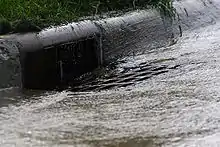
Urban runoff is surface runoff of rainwater, landscape irrigation, and car washing[1] created by urbanization. Impervious surfaces (roads, parking lots and sidewalks) are constructed during land development. During rain storms and other precipitation events, these surfaces (built from materials such as asphalt and concrete), along with rooftops, carry polluted stormwater to storm drains, instead of allowing the water to percolate through soil.[2] This causes lowering of the water table (because groundwater recharge is lessened) and flooding since the amount of water that remains on the surface is greater.[3][4] Most municipal storm sewer systems discharge stormwater, untreated, to streams, rivers and bays. This excess water can also make its way into people's properties through basement backups and seepage through building wall and floors.
| Part of a series on |
| Pollution |
|---|
 |
|
Urban runoff is a major source of flooding and water pollution in urban communities worldwide.
Pollutants
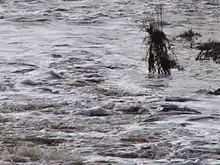
Water running off these impervious surfaces tends to pick up gasoline, motor oil, heavy metals, trash and other pollutants from roadways and parking lots, as well as fertilizers and pesticides from lawns. Roads and parking lots are major sources of polycyclic aromatic hydrocarbons (PAHs), which are created as combustion byproducts of gasoline and other fossil fuels, as well as of the heavy metals nickel, copper, zinc, cadmium, and lead. Roof runoff contributes high levels of synthetic organic compounds and zinc (from galvanized gutters). Fertilizer use on residential lawns, parks and golf courses is a measurable source of nitrates and phosphorus in urban runoff when fertilizer is improperly applied or when turf is over-fertilized.[3][5]
Eroding soils or poorly maintained construction sites can often lead to increased sedimentation in runoff. Sedimentation often settles to the bottom of water bodies and can directly affect water quality. Excessive levels of sediment in water bodies can increase the risk of infection and disease through high levels of nutrients present in the soil. These high levels of nutrients can reduce oxygen and boost algae growth while limiting native vegetation growth. Limited native vegetation and excessive algae has the potential to disrupt the entire aquatic ecosystem due to limited light penetration, lower oxygen levels, and reduced food reserves. Excessive levels of sediment and suspended solids have the potential to damage existing infrastructure as well. Sedimentation can increase runoff by plugging underground injection systems, thereby increasing the amount of runoff on the surface. Increased sedimentation levels can also reduce storage behind reservoirs. This reduction of reservoir capacities can lead to increased expenses for public land agencies while also impacting the quality of water recreational areas.[6]
Runoff can also induce heavy metal poisoning in ocean life. Small amounts of heavy metals are carried by runoff into the oceans. These metals are ingested by ocean life. These heavy metals cannot be disposed so they accumulate within the animals. Over time, these metals build up to a toxic level, and the animal dies. This heavy metal poisoning can also affect humans. Ingesting a poisoned animal increases the risk of heavy metal poisoning.[7][8]
As stormwater is channeled into storm drains and surface waters, the natural sediment load discharged to receiving waters decreases, but the water flow and velocity increases. In fact, the impervious cover in a typical city creates five times the runoff of a typical woodland of the same size.[9]
Effects
Dry weather discharges
Overwatering during landscape irrigation may produce runoff reaching receiving waters during low flow conditions.[10] Runoff carries accumulated pollutants to streams with unusually low dilution ratios causing higher pollutant concentrations than would be found during regional precipitation events.[11]
Urban flooding
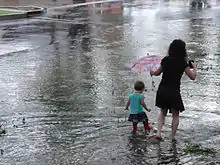
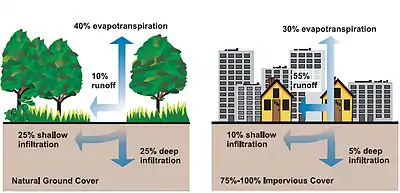
Urban runoff is a major cause of urban flooding, the inundation of land or property in a built-up environment caused by rainfall overwhelming the capacity of drainage systems, such as storm sewers.[12] Triggered by events such as flash flooding, storm surges, overbank flooding, or snow melt, urban flooding is characterized by its repetitive, costly and systemic impacts on communities, regardless of whether or not these communities are located within formally designated floodplains or near any body of water.[13]
There are several ways in which stormwater enters properties: backup through sewer pipes, toilets and sinks into buildings; seepage through building walls and floors; the accumulation of water on property and in public rights-of-way; and the overflow of water from water bodies such as rivers and lakes. Where properties are built with basements, urban flooding is the primary cause of basement flooding.
Flood flows in urban environments have been investigated relatively recently despite many centuries of flood events.[14] Some researchers mentioned the storage effect in urban areas. Several studies looked into the flow patterns and redistribution in streets during storm events and the implication in terms of flood modelling.[15] Some recent research considered the criteria for safe evacuation of individuals in flooded areas.[16] But some recent field measurements during the 2010–2011 Queensland floods showed that any criterion solely based upon the flow velocity, water depth or specific momentum cannot account for the hazards caused by the velocity and water depth fluctuations.[14] These considerations ignore further the risks associated with large debris entrained by the flow motion.[16]
Urban flooding has significant economic implications. In the US, industry experts estimate that wet basements can lower property values by 10%-25% and are cited among the top reasons for not purchasing a home.[17] According to the U.S Federal Emergency Management Agency (FEMA), almost 40% of small businesses never reopen their doors following a flooding disaster.[18] In the UK, urban flooding is estimated to cost £270 million a year in England and Wales; 80,000 homes are at risk.[19]
A study of Cook County, Illinois, identified 177,000 property damage insurance claims made across 96% of the county's ZIP codes over a five-year period from 2007-2011. This is the equivalent of one in six properties in the County making a claim. Average payouts per claim were $3,733 across all types of claims, with total claims amounting to $660 million over the five years examined.[17]
Despite concerted efforts, many communities lack the funds to fully address these issues, and often seek funds elsewhere. Numerous watersheds within Los Angeles County, California do not meet state water quality standards, despite spending $100 million a year on clean water programs to combat issues such as urban runoff. To combat this problem, officials have introduced a measure that would assess a fee to homeowners and local businesses in attempt to raise $290 million for effective urban runoff management.[20]
Water pollution
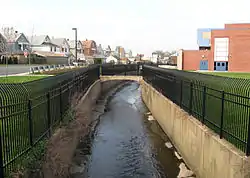
Urban runoff contributes to water quality problems.[21]
The runoff also increases temperatures in streams, harming fish and other organisms. (A sudden burst of runoff from a rainstorm can cause a fish-killing shock of hot water.) Also, road salt used to melt snow on sidewalks and roadways can contaminate streams and groundwater aquifers.[22]
One of the most pronounced effects of urban runoff is on watercourses that historically contained little or no water during dry weather periods (often called ephemeral streams). When an area around such a stream is urbanized, the resultant runoff creates an unnatural year-round streamflow that hurts the vegetation, wildlife and stream bed of the waterway. Containing little or no sediment relative to the historic ratio of sediment to water, urban runoff rushes down the stream channel, ruining natural features such as meanders and sandbars, and creates severe erosion—increasing sediment loads at the mouth while severely incising the stream bed upstream. As an example, on many Southern California beaches at the mouth of a waterway, urban runoff carries trash, pollutants, excessive silt, and other wastes, and can pose moderate to severe health hazards.
.JPG.webp)
Because of fertilizer and organic waste that urban runoff often carries, eutrophication often occurs in waterways affected by this type of runoff. After heavy rains, organic matter in the waterway is relatively high compared with natural levels, spurring growth of algae blooms that soon consume most of the oxygen. Once the naturally occurring oxygen in the water is depleted, the algae blooms die, and their decomposition causes further eutrophication. Algae blooms mostly occur in areas with still water, such as stream pools and the pools behind dams, weirs, and some drop structures. Eutrophication usually comes with deadly consequences for fish and other aquatic organisms.
Excessive stream bank erosion may cause flooding and property damage. For many years governments have often responded to urban stream erosion problems by modifying the streams through construction of hardened embankments and similar control structures using concrete and masonry materials. Use of these hard materials destroys habitat for fish and other animals.[23] Such a project may stabilize the immediate area where flood damage occurred, but often it simply shifts the problem to an upstream or downstream segment of the stream.[24] See River engineering.
There are many different ways that the polluted urban runoff can come to harm humans: through contaminating drinking water, disrupting food sources and even causing parts of beaches to be closed off due to risk of illness, it has a high harm-causing potential. It is often the case that post heavy rainfall there are warnings given for people to avoid beaches or water based activities. This is because the runoff has likely caused a spike in harmful bacterial growth or inorganic chemical pollution in the water. The contaminants that we often think of as the most damaging are gasoline and oil spillage but we often overlook the impact that fertilizers and insecticides have. When plants are watered and fields irrigated then all the chemicals that the crops have been treated with are at least partially washed away and introduced into the water table. The new environments that these chemicals are introduced to suffer due to their presence as they kill native vegetation and bugs.
Swales

Stormwater management is hard to contain due to the lack of drainage systems facilitated to take in runoff that tends to overflow. There are possible changes that could be made that would mitigate the effect that urban and stormwater runoff has on salmon and the ecosystem at large.(18) This comes in many forms; from not dumping pollutants down the storm drain; to taking your car to the car wash and not washing it in the street. one of the most impactful ways is swales. Swales also known as Rain Gardens are relatively shallow patches of vegetation that lay on the side of many roads and busy streets. These gardens act as a form of filtration for the polluted water before it joins the water table, or seeps back out in the streams.These rain gardens are only necessary due to the fact that urbanization has disrupted the ecosystems natural filtration systems. The plants that are kept in these rain gardens are durable and referred to as ‘hyperaccumulators’ essentially meaning that they can absorb mass amounts of toxins and pollutants without being poisoned themselves. This means that there are ways to protect the ecosystem on a greater scale (oceans, beaches, and streams) but it does not mean that it will be widely implemented due to the fact that it would take mass amounts of funding and infrastructure changes in cities where swales became a norm. Some advantages of maintaining swales are: low capital costs, easy to incorporate into landscaping, and pollution blockage is easily dealt with. The positives of swales is that they are compatible with most environments they are in, utilizing native plants in an often aesthetically pleasing way to remove the pollutants. They have a low cost to implement and are beneficial in more ways than simply removing pollutants, they can help improve air quality. The positives of swales is that they are compatible with most environments they are in, utilizing native plants in an often aesthetically pleasing way to remove the pollutants.(5) They have a low cost to implement and are beneficial in more ways than simply removing pollutants, they can help improve air quality.
Salmon
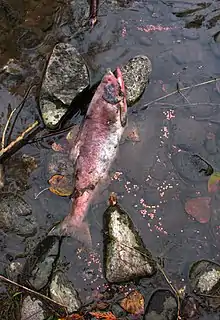
As water moves across the cement, it picks up all the particulates and oils that have been left on the surface from cars and urban living. The toxins that this water gathers include: heavy metals such as copper and nickel, and many different products of oil based origins, the microscopic bits of rubber that have shed off the tires of cars and the gasoline that leaked from the gas tank, these are both derived directly from oil, and are both detrimentally impacting our ecosystem. This water then runs down a storm drain, into the vegetation, or directly into a watershed. These places then lead into the oceans, streams, rivers, or lakes, in the area. In areas where rivers are home to the breeding grounds of Salmon the effect is quite shocking and visible. The impact that the runoff has on our water table is disproportionate, affecting everything in the water, the soils around it, and the plants on the banks. What scientists have been focusing most on recently is why all the salmon are dying before breeding. The answer to that can be largely attributed to the effects that water runoff has on their brains. In some extreme cases the road runoff results in ‘acute mortality’ or the rapid death of the fish. It deteriorates the protection of the brain and the blood that surrounds it, corrupting the cerebrovascular system of the fish and rendering them either dead or severely sick and dying. The fish that do not die immediately; the ones that are left very sick are also left with neurological damage due to the lack of protection of the brain. In the period of development from being fry to being sea ready fish, most salmon feed on the small microorganisms that inhabit the streams: the plankton and the midge larva.(1)The issue here being that the little creatures that the Salmon feed on are also being impacted greatly by the runoff of from the roadways. This means that not only are these Salmon facing the detriment that is the poisonous pollution tainting their waterways, but they are also facing depleted food sources. The increasing numbers of dying salmon is not an isolated negative impact, the lack of salmon then goes on to remove the food sources of Orca whales in the pacific northwest and other predators that rely on their existence to stay alive. On a less environmental scale the desolation of salmon would cause a drop in jobs and work opportunities for people working in the fishing industry, it would cause hatcheries that grow and release fish to become moot because the environment that the fish would be released into would not be sustainable or healthy.(3,4,)
Prevention and mitigation
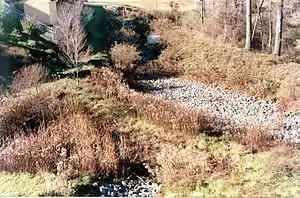
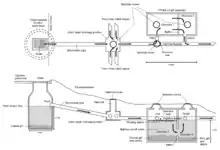
Effective control of urban runoff involves reducing the velocity and flow of storm water, as well as reducing pollutant discharges. Local governments use a variety of storm water management techniques to reduce the effects of urban runoff. These techniques, called best management practices for water pollution (BMPs) in some countries, may focus on water quantity control, while others focus on improving water quality, and some perform both functions.[25]
Pollution prevention practices include low impact development (LID) or green infrastructure techniques - known as Sustainable Drainage Systems (SuDS) in the UK, and Water-Sensitive Urban Design (WSUD) in Australia and the Middle East - such as the installation of green roofs and improved chemical handling (e.g. management of motor fuels & oil, fertilizers and pesticides).[9][26] Runoff mitigation systems include infiltration basins, bioretention systems, constructed wetlands, retention basins and similar devices.[27][28]
Providing effective urban runoff solutions often requires proper city programs that take into account the needs and differences of the community. Factors such as a city's mean temperature, precipitation levels, geographical location, and airborne pollutant levels can all effect rates of pollution in urban runoff and present unique challenges for management. Human factors such as urbanization rates, land use trends, and chosen building materials for impervious surfaces often exacerbate these issues.
The implementation of citywide maintenance strategies such as street sweeping programs can also be an effective method in improving the quality of urban runoff. Street sweeping vacuums collect particles of dust and suspended solids often found in public parking lots and roads that often end up in runoff.[29]
Educational programs can also be an effective tool for managing urban runoff. Local businesses and individuals can have an integral role in reducing pollution in urban runoff simply through their practices, but often are unaware of regulations. Creating a productive discussion on urban runoff and the importance of effective disposal of household items can help to encourage environmentally friendly practices at a reduced cost to the city and local economy.[30]
Thermal pollution from runoff can be controlled by storm water management facilities that absorb the runoff or direct it into groundwater, such as bioretention systems and infiltration basins. Retention basins tend to be less effective at reducing temperature, as the water may be heated by the sun before being discharged to a receiving stream.[25]: p. 5–58
Stormwater harvesting deals with collection of runoff from creeks, gullies, ephemeral streams, and other ground conveyances. Stormwater harvesting projects often have multiple objectives, such as reducing contaminated runoff to sensitive waters, promoting groundwater recharge, and non-potable applications such as toilet flushing and irrigation.[31]
Trees
The canopy of trees has a significant impact on the amount of stormwater or rain that actually reaches the ground during a storm. The water lands on the higher levels of trees or the foliage and when it lands at that level it has a higher likelihood of being evaporated back into the atmosphere without it ever entering the water table on the ground, it doesn’t get the opportunity to get become polluted by the chemicals because it never comes into contact with them. There is a way to calculate the total loss of water in the water table to the previously described process of evapotranspiration and it is the process of subtracting the amount of water that flows down the trunk or center of the tree, also called stemflow, along with throughflow, which is the water that makes its way through the canopy of the tree from the gross amount of water falling on the tree. The implementation of planting trees throughout cities that have issues with polluted runoff would largely reduce the amount of runoff created.(1,18)
See also
- Agricultural wastewater treatment - Nutrient runoff
- First flush (initial runoff of a rainstorm)
- List of environmental issues
- Nationwide Urban Runoff Program, a research project conducted by the US Environmental Protection Agency
- Nonpoint source pollution
- Rainwater harvesting
- Surface runoff - Agricultural issues
References
- "Impact of Water Runoff from Streets and Yards". Highlands Ranch Metro District. Retrieved 30 August 2021.
- "Runoff (surface water runoff)". USGS Water Science School. Reston, VA: U.S. Geological Survey (USGS). 2016-12-02.
- Water Environment Federation, Alexandria, VA; and American Society of Civil Engineers, Reston, VA. "Urban Runoff Quality Management." WEF Manual of Practice No. 23; ASCE Manual and Report on Engineering Practice No. 87. 1998. ISBN 1-57278-039-8. Chapter 1.
- Schueler, Thomas R. (2000) [initial publ. 1995]. "The Importance of Imperviousness" (pdf). In Schueler; Holland, Heather K. (eds.). The Practice of Watershed Protection. Ellicott City, MD: Center for Watershed Protection. pp. 1–12. Retrieved 2014-12-24.
- Burton Jr., G. Allen; Pitt, Robert (2001). "Ch. 2: Receiving Water Uses, Impairments, and Sources of Stormwater Pollutants". Stormwater Effects Handbook: A Toolbox for Watershed Managers, Scientists, and Engineers. New York: CRC/Lewis Publishers. ISBN 0-87371-924-7.
- "Ch. 1. Impacts of Urban Stormwater Runoff". Stormwater Solutions: Turning Oregon's Rain Back into a Resource (PDF) (Report). Portland, OR: Oregon Environmental Council. December 2007.
- Bortman, Marci (2011). "Marine Pollution". Environmental Encyclopedia. 3: 21–34.
- Weiss, Kenneth R. (2009). Endangered Oceans. Farmington Hills, MI: Glenhaven Press. pp. 39–45.
- Protecting Water Quality from Urban Runoff (Report). EPA. February 2003. EPA 841-F-03-003.
- Stein, Robert; Ash, Tom. "Using Smart Controllers to Reduce Urban Runoff in the City of Newport Beach". Newport Beach, California. Retrieved 30 August 2021.
- "Over-Irrigation Can Cause Storm Water Pollution". El Cajon, California. Retrieved 30 August 2021.
- "Surface Runoff - The Water Cycle". USGS Water Science School. USGS. 2016-12-15.
- Center for Neighborhood Technology, Chicago IL "The Prevalence and Cost of Urban Flooding." May 2013
- Brown, Richard; Chanson, Hubert; McIntosh, Dave; Madhani, Jay (2011). Turbulent Velocity and Suspended Sediment Concentration Measurements in an Urban Environment of the Brisbane River Flood Plain at Gardens Point on 12–13 January 2011. Hydraulic Model Report No. CH83/11. Brisbane, Australia: The University of Queensland, School of Civil Engineering. ISBN 978-1-74272-027-2.
- Werner, M.G.F.; Hunter, N.M.; Bates, P.D. (November 2005). "Identifiability of distributed floodplain roughness values in flood extent estimation". Journal of Hydrology. 314 (1–4): 139–157. Bibcode:2005JHyd..314..139W. doi:10.1016/j.jhydrol.2005.03.012.
- Chanson, Hubert; Brown, R.; McIntosh, D. (2014). "Human body stability in floodwaters: The 2011 flood in Brisbane CBD" (PDF). Hydraulic structures and society - Engineering challenges and extremes. pp. 1–9. doi:10.14264/uql.2014.48. ISBN 978-1-74272-115-6.
- "The Prevalence and Cost of Urban Flooding." May 2013, Center for Neighborhood Technology, Chicago IL.
- Federal Emergency Management Agency (U.S.). "Protecting Your Businesses," last updated March, 2013, http://www.fema.gov/protecting-yourbusinesses Archived 2013-09-17 at archive.today
- Parliamentary Office of Science and Technology, London, UK. "Urban Flooding." Postnote 289, July 2007
- Sewell, Abby (2013-01-03). "County seeks parcel fee to pay for projects to combat urban runoff". Los Angeles Times.
- National Research Council (United States) (2009). Urban Stormwater Management in the United States (Report). Washington, D.C.: National Academies Press. p. 24. doi:10.17226/12465. ISBN 978-0-309-12539-0.
- United States Geological Survey. Atlanta, GA. "The effects of urbanization on water quality: Urban runoff." Accessed 2009-12-30.
- Laws, Edward A.; Roth, Lauren (2004). "Impact of Stream Hardening on Water Quality and Metabolic Characteristics of Waimanalo and Kane'ohe Streams, O'ahu, Hawaiian Islands". Pacific Science. University of Hawai'i Press. 58 (2): 261–280. doi:10.1353/psc.2004.0019. hdl:10125/2725. ISSN 0030-8870. S2CID 19417682.
- "Ch. 3. Channelization and Channel Modification". National Management Measures to Control Nonpoint Source Pollution from Hydromodification (Report). EPA. 2007. EPA 841-B-07-002.
- "Ch. 5: Description and Performance of Storm Water Best Management Practices". Preliminary Data Summary of Urban Storm Water Best Management Practices (Report). Washington, DC: United States Environmental Protection Agency (EPA). August 1999. EPA-821-R-99-012.
- "Low Impact Development and Other Green Design Strategies". National Pollutant Discharge Elimination System. EPA. 2014. Archived from the original on 2015-02-19.
- California Stormwater Quality Association. Menlo Park, CA. "Stormwater Best Management Practice (BMP) Handbooks." 2003.
- New Jersey Department of Environmental Protection. Trenton, NJ. "New Jersey Stormwater Best Management Practices Manual." April 2004.
- "Parking Lot and Street Cleaning". National Menu of Stormwater Best Management Practices. EPA. 6 August 2014. Archived from the original on 2015-08-28. Retrieved 2014-12-24.
- Ballo, Siaka; Liu, Min; Hou, Lijun; Chang, Jing (2009-07-10). "Pollutants in stormwater runoff in Shanghai (China): Implications for management of urban runoff pollution". Progress in Natural Science. 19 (7): 873–880. doi:10.1016/j.pnsc.2008.07.021.
- "Monterey-Pacific Grove ASBS Stormwater Management Project" (PDF). 2014. Retrieved November 8, 2020.
Further reading
- McGinn, Anne Platt (2004). Human Activities That Threaten the Worlds Oceans. Farmington Hills, MI: Glennhaven Press. pp. 144–157.
- Berland, Adam; Shiflett, Sheri A.; Shuster, William D.; Garmestani, Ahjond S.; Goddard, Haynes C.; Herrmann, Dustin L.; Hopton, Matthew E. (1 June 2017). "The role of trees in urban stormwater management". Landscape and Urban Planning. 162: 167–177. doi:10.1016/j.landurbplan.2017.02.017. PMC 6134866. PMID 30220756.
- Anstett, Catherine. “SALMON AND PIPER'S CREEK WATERSHED.” Carkeek Watershed Community Action Project, 2015, http://www.carkeekwatershed.org/wp-content/uploads/Salmon-Guide-Fall-2015.pdf. Accessed 9 December 2021.
- Blair, Stephanie I.; Barlow, Clyde H.; McIntyre, Jenifer K. (February 2021). "Acute cerebrovascular effects in juvenile coho salmon exposed to roadway runoff". Canadian Journal of Fisheries and Aquatic Sciences. 78 (2): 103–109. doi:10.1139/cjfas-2020-0240. S2CID 230581357.
- “Component: Swales.” Susdrain, https://www.susdrain.org/delivering-suds/using-suds/suds-components/swales-and-conveyance-channels/swales.html. Accessed 9 December 2021.
- Fassman, Elizabeth A.; Blackbourn, Samuel D. (1 November 2011). "Road Runoff Water-Quality Mitigation by Permeable Modular Concrete Pavers". Journal of Irrigation and Drainage Engineering. 137 (11): 720–729. doi:10.1061/(ASCE)IR.1943-4774.0000339.
- “Get Rid of Motor Oil Stains.” Parkside Motors, https://parksidemotors.ca/remove-oil-stains-from-surfaces/. Accessed 9 December 2021.
- Tromp, Karin; Lima, Ana T.; Barendregt, Arjan; Verhoeven, Jos T. A. (15 February 2012). "Retention of heavy metals and poly-aromatic hydrocarbons from road water in a constructed wetland and the effect of de-icing". Journal of Hazardous Materials. 203–204: 290–298. doi:10.1016/j.jhazmat.2011.12.024. PMID 22226719.
- National Ocean Service. “MBNMS: What You Can Do To Reduce Urban Runoff Pollution.” Monterey Bay National Marine Sanctuary, National Ocean Service, 9 December 2019, https://montereybay.noaa.gov/resourcepro/urbancando.html. Accessed 9 December 2021.
- Peer, Wendy Ann; Baxter, Ivan R.; Richards, Elizabeth L.; Freeman, John L.; Murphy, Angus S. (2005). "Phytoremediation and hyperaccumulator plants". Molecular Biology of Metal Homeostasis and Detoxification. Topics in Current Genetics. 14. pp. 299–340. doi:10.1007/4735_100. ISBN 978-3-540-22175-3.
- Rosen, Julia. “Road Runoff a No-No for Coho.” Scientific American, 26 October 2015, https://www.scientificamerican.com/podcast/episode/road-runoff-a-no-no-for-coho/. Accessed 9 December 2021.
- “Runoff: Surface and Overland Water Runoff.” Water Science School, USGS, 6 June 2018, https://www.usgs.gov/special-topics/water-science-school/science/runoff-surface-and-overland-water-runoff .
- Fletcher, T. D.; Andrieu, H.; Hamel, P. (1 January 2013). "Understanding, management and modelling of urban hydrology and its consequences for receiving waters: A state of the art". Advances in Water Resources. 51: 261–279. Bibcode:2013AdWR...51..261F. doi:10.1016/j.advwatres.2012.09.001.
- Selbig, William R.; Loheide, Steven P.; Shuster, William; Scharenbroch, Bryant C.; Coville, Robert C.; Kruegler, James; Avery, William; Haefner, Ralph; Nowak, David (1 February 2022). "Quantifying the stormwater runoff volume reduction benefits of urban street tree canopy". Science of the Total Environment. 806 (Pt 3): 151296. Bibcode:2022ScTEn.806o1296S. doi:10.1016/j.scitotenv.2021.151296. PMID 34736755. S2CID 240180212.
- Harry C. Torno; Jiri Marsalek; Michel Desbordes, eds. (1986). Urban Runoff Pollution. Berlin: Springer-Verlag. ISBN 3-540-16090-6.
 |
Wikimedia Commons has media related to |
| Air | |
|---|---|
| Biological | |
| Electromagnetic | |
| Natural | |
| Noise |
|
| Radiation | |
| Soil | |
| Soild waste | |
| Space | |
| Thermal | |
| Visual | |
| War | |
| Water |
|
| Topics | |
| Responses | |
| Lists | |
 Categories (By country) Commons Categories (By country) Commons  WikiProject Environment WikiProject Ecology WikiProject Environment WikiProject Ecology  Environment portal Environment portal  Ecology portal Ecology portal | |
Authority control  | |
|---|---|
| National libraries | |
| Other | |