V1794 Cygni
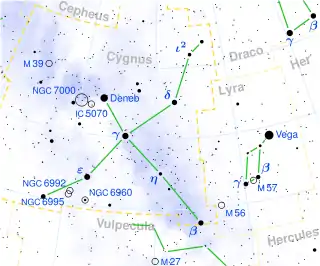
V1794 Cygni, also known as HD 199178, is a single star in the constellation Cygnus. With an apparent magnitude of 7.24, it's impossible to see with the naked eye, but can be seen with binoculars. V1794 is currently 366 light-years (112 pc) away, based on parallax, but is drifting closer to the Solar System, with a radial velocity of -30.76 km/s.
  | |
| Observation data Epoch J2000.0 Equinox J2000.0 | |
|---|---|
| Constellation | Cygnus |
| Right ascension | 20h 53m 53.65s[1] |
| Declination | +44° 23′ 11.08″[1] |
| Apparent magnitude (V) | 7.24 (7.23-7.4) |
| Characteristics | |
| Spectral type | G5III-IV |
| Variable type | FK Com[2] |
| Astrometry | |
| Radial velocity (Rv) | −30.76±0.33[3] km/s |
| Proper motion (μ) | RA: 26.323±0.061[1] mas/yr Dec.: −0.742±0.066[1] mas/yr |
| Parallax (π) | 8.9015 ± 0.0400[1] mas |
| Distance | 366 ± 2 ly (112.3 ± 0.5 pc) |
| Details | |
| Mass | 1.678[4] M☉ |
| Radius | 6.11 R☉ |
| Luminosity | 15.54[5] L☉ |
| Surface gravity (log g) | 3.5[6] cgs |
| Temperature | 5164[6] K |
| Rotational velocity (v sin i) | 83.15±4.65 km/s |
| Age | 2.014[4] Gyr |
| Other designations | |
| Database references | |
| SIMBAD | data |
Properties
This is a variable star with 167.8% the mass of the Sun, but, with an age of around 2 billion years is younger than the latter. At this age, it has 6 times the radius of the Sun, and radiates 15.54 times the latter's luminosity, and has an effective temperature of 5,164 K, which gives it a yellow hue.
Variability
V1794 Cygni was first classified as a Herbig Ae/Be star in 1999[7] in a catalog of UX Orionis stars. Other stars light curves have been observed in the paper. However, it was reclassified as a FK Comae Berenices variable due to its fast rotation compared to other giants.
References
- Gaia Collaboration (2018-04-01). "VizieR Online Data Catalog: Gaia DR2 (Gaia Collaboration, 2018)". VizieR Online Data Catalog. 1345. Bibcode:2018yCat.1345....0G.
- Samus, N. N.; Durlevich, O. V.; et al. (2009). "VizieR Online Data Catalog: General Catalogue of Variable Stars (Samus+ 2007-2013)". VizieR On-line Data Catalog: B/GCVS. Originally Published in: 2009yCat....102025S. 1: B/gcvs. Bibcode:2009yCat....102025S.
- Frasca, A.; Guillout, P.; Klutsch, A.; Ferrero, R. Freire; Marilli, E.; Biazzo, K.; Gandolfi, D.; Montes, D. (2018-05-01). "A spectroscopic survey of the youngest field stars in the solar neighborhood . II. The optically faint sample". Astronomy and Astrophysics. 612: A96. arXiv:1801.00671. Bibcode:2018A&A...612A..96F. doi:10.1051/0004-6361/201732028. ISSN 0004-6361. S2CID 119537437.
- Feltzing, S.; Holmberg, J.; Hurley, J. R. (2001-10-01). "The solar neighbourhood age-metallicity relation - Does it exist?". Astronomy and Astrophysics. 377 (3): 911–924. Bibcode:2001A&A...377..911F. doi:10.1051/0004-6361:20011119. ISSN 0004-6361. S2CID 4811000.
- Gaia Collaboration; Brown, A. G. A.; Vallenari, A.; Prusti, T.; de Bruijne, J. H. J.; Babusiaux, C.; Bailer-Jones, C. A. L.; Biermann, M.; Evans, D. W.; Eyer, L.; Jansen, F. (2018-08-01). "Gaia Data Release 2. Summary of the contents and survey properties". Astronomy and Astrophysics. 616: A1. arXiv:1804.09365. Bibcode:2018A&A...616A...1G. doi:10.1051/0004-6361/201833051. ISSN 0004-6361. S2CID 49211658.
- Massarotti, Alessandro; Latham, David W.; Stefanik, Robert P.; Fogel, Jeffrey (2008-01-01). "Rotational and Radial Velocities for a Sample of 761 HIPPARCOS Giants and the Role of Binarity". The Astronomical Journal. 135 (1): 209–231. Bibcode:2008AJ....135..209M. doi:10.1088/0004-6256/135/1/209. ISSN 0004-6256.
- Herbst, W.; Shevchenko, V. S. (1999-08-01). "A Photometric Catalog of Herbig AE/BE Stars and Discussion of the Nature and Cause of the Variations of UX Orionis Stars". The Astronomical Journal. 118 (2): 1043–1060. Bibcode:1999AJ....118.1043H. doi:10.1086/300966. ISSN 0004-6256.