Vale Tudo
Vale Tudo (Portuguese pronunciation: [ˈvali ˈtudu]; English: Everything Goes/Everything Allowed), also known No Holds Barred (NHB) in the United States, is an unarmed, full-contact combat sport with relatively few rules. It became popular in Brazil during the 20th century and would eventually evolve into modern Mixed martial arts (MMA).[1] It uses techniques from many martial arts.
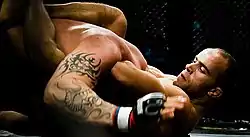 Rafael Silva locks Mika Ilmén in a guillotine choke during a Vale Tudo match in 2005 | |
| Also known as | No Holds Barred (NHB) |
|---|---|
| Focus | Hybrid |
| Hardness | Full contact |
| Country of origin |  Brazil Brazil |
| Creator | Mitsuyo Maeda Gracie family |
| Famous practitioners | Hélio Gracie Carlos Gracie Valdemar Santana Euclydes Hatem Euclides Perreria João Alberto Barreto Carlson Gracie Rei Zulu Rickson Gracie Marco Ruas Rafael Cordeiro Carlos Barreto Wanderlei Silva Johil de Oliveira |
| Parenthood | Luta Livre, Brazilian Jiu-Jitsu, Boxing, Muay Thai, Karate, Judo, Sambo, Sanda, Capoeira, Wrestling |
| Descendant arts | Mixed Martial Arts |
| Olympic sport | No |
History
1920s–1980s
Fighting sideshows called vale tudo became popular in Brazilian circuses during the 1920s.[2] Examples of such bouts were described in the Japanese-American Courier on October 4, 1928:[3]
One report from Brasil declares that Jiu Jitsu is truly an art and that in an interesting exhibition in the side tent to the big circus a Bahian of monstrous dimensions met his waterloo at the hands of a diminutive Japanese wrestler. The man was an expert at Capoeira, an old South American style of fighting, but after putting the Japanese on his back and trying to kick his head ... the little oriental by the use of a Jiu Jitsu hold threw the Bahian and after a short struggle he was found sitting on the silent frame of the massive opponent.
However, this circus term did not enter popular use until 1959–1960, when it was used to describe the style-versus-style bouts featured in a Rio television show called Heróis do Ringue ("Heroes of the Ring"). The matchmakers and hosts of the show included members of the Gracie family, including Carlson Gracie and Carley Gracie. The participants were all legitimate practitioners of their styles.
One night during the show, João Alberto Barreto (later a referee for UFC 1) was competing against a man trained in Luta Livre. Barreto caught his opponent in an armbar and the man refused to submit. Barreto broke the man's arm. Consequently, the show was canceled and soon replaced by a professional wrestling show called Telecatch.
From 1960 onwards, Vale Tudo remained mostly an underground subculture, with most fights taking place in martial arts dojos or small gymnasiums. The Vale Tudo subculture was based in Rio de Janeiro, but many fights took place in the northern region, the southern region and the Bahia state, where Capoeira is prevalent. The scene in Rio de Janeiro focused mainly on the intense rivalry between Brazilian Jiu-Jitsu and Luta Livre. Fights in the other regions featured more diverse martial arts competing in the events.
The Gracie family devised the "Gracie Challenge", where they would invite or be challenged by opponents from other martial arts to a Vale Tudo match prove the effectiveness of their Gracie Jiu-Jitsu. The Gracies would held their challenges behind closed doors at their gyms, but in some cases they realised public events too. In 1980 and 1984 Rickson Gracie fought two events against Casimiro de Nascimento Martins ("Rei Zulu"), father of Zuluzinho.[4] In 1984 at the Maracanãzinho it was held the Noite das Artes Marciais ("Night of the Martial Arts") also known as Jiu-jitsu vs Artes Marciais ("Jiu-Jitsu vs Martial Arts"), fought by representatives of BJJ against representatives of Muay Thai, Kung Fu, Kickboxing and Luta Livre. Future UFC 7 champion Marco Ruas participated, with a draw against BJJ representative Fernando Pinduka. There was also a match between Rei Zulu versus Kickboxing world champion and future promoter of the International Vale Tudo Championship and World Vale Tudo Championship Sérgio Batarelli.[5][6] And in 1991 the most famous event happened: Desafio - Jiu Jitsu vs Luta Livre between representatives of both martial arts. The event was organized after BJJ practitioners almost got into a brawl with Luta Livre fighters, after they invaded a BJJ tournament in order to fight Wallid Ismail, as he had issued an insult and a challenge at a local newspaper against Luta Livre. The Luta Livre fighters were conviced to stand down and instead fight in a public challenge. Rickson Gracie, organizer of the event, convinced TV Globo, Brazil's largest network, to broadcast the event live under the assumption it was a pure grappling event, the rules were later changed to Vale Tudo but Globo kept the program. The actual event would see 3 matches, all with victories by Jiu-Jitsu representatives. [7][8]
1990s–present
In the 1970s, Rorion Gracie of the famous Gracie family emigrated to the United States and introduced Vale Tudo to a new market when he helped found the Ultimate Fighting Championship (UFC) in 1993. Inspired by the format of the UFC, many new promotions of Vale Tudo were created.[9] Some of the noteworthy promotions of this time in Brazil include Universal Vale Tudo Fighting and Brazilian Vale Tudo Fighting. Besides the UFC, the United States also saw the introduction of Vale Tudo promotions with similar to the UFC, such as the Battlecade Extreme Fighting in 1995. Vale Tudo would receive the name No Holds Barred (NHB) in the United States.[10] In Japan, former professional wrestler Satoru Sayama had created in 1985 a hybrid martial arts organizaton named Shooto, which featured striking with all limbs, takedowns, groundfighting and submissions. In 1994 he introduced Vale Tudo to Japan by organizing the Vale Tudo Japan tournament, which was more rules-free compared to previous Shooto rules.[11]
As the UFC and similar promotions started to receive more rules (eventually evolving into the Unified Rules of Mixed Martial Arts). The premier organizations of the late 1990s became the World Vale Tudo Championship (WVC) and the International Vale Tudo Championship (IVC), which featured prominently throughout the 1990s as they were also televised on Brazilian TV and pay-per-view. The WVC and IVC were based in the Brazilian financial capital of São Paulo and launched the careers of many of today's MMA stars. However, after the state of São Paulo prohibited Vale Tudo from being a sanctioned sport, both promotions went into decline and have not staged an event since 2002.
Beginning in the early 2000s, newer promotions such as Jungle Fight and Bitetti Combat abandoned traditional Vale Tudo rules in favor of the safer mixed martial arts "Unified" rules. However, some promotions continued the use of traditional rules for a time, most notably Meca World Vale Tudo and Rio Heroes.
Today, all major events use MMA rules, according to former IVC and WVC promoter Sérgio Batarelli in an interview to Brazilian online news G1 he affirmed: "But fighting with the rules from before is impossible. It's over. [...] It's the beginnings. There's no way back. Even because there are very few fighters who would venture into something like this."[12]
Vale Tudo events are still taking place in small numbers around Brazil. Due to the violent and bloody nature of the sport, these underground[13] events sometimes cause controversy in the media.[14] Critics of the sport argue that Vale Tudo shows should all adopt the MMA "Unified" ruleset created in the United States by Athletic Commissions, and used by various other countries such as Canada and England. On the other hand, supporters of Vale Tudo criticize the Unified Rules, pointing out that there is no medical proof that the Unified Rules are safer, no contestant has ever been killed or permanently disabled while fighting under traditional rules, the Unified Rules were created not for safety, but to ban techniques that commissioners saw as "uncivilised" (such as the soccer kick and headbutt), that the Unified Rules set is not used in Japanese, Russian, Singaporean and Thai promotions, and so on. Proponents also counter that the style of mixed martial arts fighting created by the Unified Rules is now so different from traditional Vale Tudo that it should be treated as an entirely different sport, just as kickboxing is considered different from Muay Thai.
References
- About European Vale Tudo Archived 2006-04-28 at the Wayback Machine. www.europeanvaletudo.com. URL last accessed on April 28, 2006.
- Boxing booth – Boxrec Boxing Encyclopaedia. Boxrec.com. Retrieved on 2012-01-08.
- The original reference was probably "Jiu Jitsu", Time, September 24, 1928. Archived from the original on October 15, 2007 on the Wayback Machine.
- Sherdog.com. "Casemiro". Sherdog. Retrieved 2021-12-16.
- Sherdog.com. "JJ vs. MA - Jiu-Jitsu vs. Martial Arts". Sherdog. Retrieved 2021-12-16.
- Awi, Fellipe (2012-03-13). Filho teu não foge à luta (in Portuguese). Editora Intrinseca. ISBN 978-85-8057-175-2.
- "The Biggest Rivalry in Martial Arts History: BJJ vs Luta Livre | BJJ Heroes". Retrieved 2021-12-16.
- Sherdog.com. "Desafio - Jiu-Jitsu vs. Luta Livre". Sherdog. Retrieved 2021-12-16.
- T.P. Grant, April 12, 2011 History of Jiu-Jitsu: Coming to America and the Birth of the UFC. Bleacher Report. Retrieved on 2012-01-08.
- Bateman, Oliver Lee (2018-07-06). "The Early Years of MMA Were a 'No-Holds-Barred Freakshow' That Couldn't Be More Different From…". MEL Magazine. Retrieved 2021-12-15.
- Sherdog.com. "The Resurrection of Vale Tudo Japan". Sherdog. Retrieved 2021-12-14.
- Alex, Por; Fern, re; Janeiro, es Rio de. "Sergio Batarelli: 'O MMA de hoje é brincadeira perto do que era o IVC'". sportv.globo.com/site/combate. Retrieved 2021-12-16.
- "Campeonato clandestino dá origem à Rio Heroes, nova série da Fox" (in Portuguese). Retrieved 2021-12-15.
- "Retorno do Rio Heroes é adiado por causa de patrocínio". Nocaute na Rede (in Portuguese). 2018-10-25. Retrieved 2021-12-15.
External links
- The influence of Jiu Jitsu in Vale Tudo
- Vale Tudo Statistics
- Vale Tudo Project (2009) at IMDb
| Regional origin | |
|---|---|
| Unarmed techniques | |
| Weapons | |
| Training | |
| Grappling | |
| Striking | |
| Internal | |
| Full contact / combat sports | |
| Self-defense / combatives | |
| Eclectic / hybrids | |
| Martial arts at the Summer Olympics | |
| Martial arts at the World Games | |
| Martial arts at the Pan American | |
| Martial arts at the Asian | |
| Martial arts at the African | |
| |

